



Atlantis Rising (Second Edition) Deep Dive
What the Community Thinks About Atlantis Rising (Second Edition)
Reviewers broadly agree that Atlantis Rising (Second Edition) is a strong cooperative worker placement game with a clear, urgent premise. The gods are flooding the island of Atlantis, and the players must gather ore, crystal, gold, and atlantium to build nine blueprints and a Power Core that opens a dimensional portal before the city sinks. Tyler Williams, Meeple Mountain is the most enthusiastic about its design. Williams says the review started out hesitant about cooperative games, which are usually not a first pick, and that the game won Williams over with its components, replayability, and asymmetric leader abilities. Williams places it among the few co-op games enjoyed regularly, alongside Spirit Island and Pandemic Legacy.
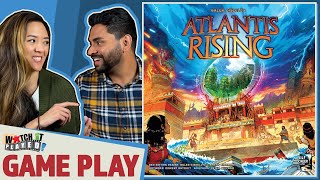
The Watch It Played playthrough, hosted by Monique and Naveen, offers a more hands-on view. Their two-player game is tense from start to finish, with early dice rolls failing to produce crystals and the island steadily flooding. The hosts end up calling the experience nerve-wracking, but they also describe a satisfying final push once the resources finally came together.
A third perspective comes from Sam and JT, The Flip Side, who included the game on a top-100 list. Their appeal is mostly the artwork and the sense of escape, and they single out the Stargate-like wormhole imagery and the way the art balances futuristic and indigenous influences. Their praise centers on the game's presentation rather than its mechanics.
Core Mechanics That Define Atlantis Rising (Second Edition)
Worker Placement on a Sinking Island
The game's central system is worker placement across six peninsulas and the city at the center of the island. Each peninsula has spaces with different capacities, with the wild peninsulas offering the main resource gathering. As Tyler Williams explains, a worker placed on a wild space rolls a die against a target number, and a successful roll yields the resource shown. The peninsulas closest to the tip offer the best actions but are the first to flood, so the most valuable spaces become the riskiest as the game progresses. Misfortune cards resolve after the workers are placed, and any worker on a flooded tile is lost before it can act. Watch It Played noted that this pressure forces players to decide early whether to spend workers on immediate resources or on components that will matter later. The game was designed by Galen Cezelle and Brent Dickman and is published by Elf Creek Games, as introduced in the Watch It Played video.
Cooperative Actions and Pooled Resources
Resources are kept separate, and players cannot hand items directly to one another. Teams work around this by placing workers on the same blueprint space, where they can pool their resources to complete a component. Tyler Williams notes that this allows two players to build a blueprint that neither could afford alone. The Power Core is the clearest example of the cooperative demand, because it requires every player's leader to be on the same space and each player to contribute resources. Watch It Played's players also used the hologram leader ability to protect a worker on a tile at risk of flooding, which shows how the leader powers interact with cooperative planning.
The Atlantis Rising (Second Edition) Experience
Collaborative Problem Solving
Reviewers describe the game as one where the team succeeds or fails together. Tyler Williams highlights how easy the game is to teach, noting that the iconography is simple enough for less experienced players to join in. Watch It Played's two players spent much of their turns discussing which tiles to protect, which library cards to draw, and whether to gamble on a dice roll. That shared decision-making is the core of the experience, and the game rewards groups that talk through each round rather than playing in parallel.
Frantic Pressure as the Island Sinks
The Wrath of the Gods track is the engine of the sense of urgency. Each round, the team floods a growing number of tiles, and the Watch It Played hosts repeatedly described the moment when a flood threatened a critical resource. Their playthrough shows how quickly the board can become unrecognizable: the mountains and forges flooded, a Controlled Flood card hit the library, and a Crisis of Faith prevented mystic energy collection at a critical moment. The result is a game where the players feel the water rising, and where each mistake has a visible cost.
What Makes Atlantis Rising (Second Edition) Stand Out
Variable Setup That Keeps Replays Fresh
Tyler Williams emphasizes that the game's replayability comes from its modular setup. Players build nine blueprints from a much larger pool, and the library deck is shuffled with four artifacts chosen from a larger set. The misfortune deck also lets groups adjust difficulty by choosing how many Controlled Flood cards to include. Williams argues that these choices mean no two games feel identical, and that the variety in blueprints and artifacts keeps players reconsidering their priorities from game to game.
Scaling From Solo to a Full Table
Meeple Mountain praises the game's support for one to seven players without a large increase in playing time. As the player count grows, the misfortune deck grows as well, which reduces the number of rounds. Williams says this rare balance lets groups of six or seven enjoy a meaningful game without the sluggish pacing common to larger tables, where players often either lose time or lose depth.
Potential Drawbacks
The Risk of Quarterbacking
Tyler Williams raises a caution that applies to many cooperative games. Williams warns that one well-intentioned player can start directing every other player's turn, turning the game into a solo effort with the rest of the table watching. Williams stresses that this is not a flaw in the design itself, but a dynamic groups should consider before buying the game, and also notes that the peninsula pieces, which look similar apart from their iconography, took longer to assemble than expected.
Luck, Dice, and the Crystal Bottleneck
Because every resource on a wild peninsula depends on a die roll, the Watch It Played playthrough shows how a poor start can compound. The hosts repeatedly failed to roll the crystals they needed, and the lack of crystals delayed the components that would have sped up the game. They acknowledge that building components earlier would have helped, but the dice made that difficult. Players who dislike significant randomness in a cooperative setting may find this frustrating, though the Watch It Played team ultimately described the victory as satisfying.
If You Enjoy Atlantis Rising (Second Edition)
Players who enjoy Atlantis Rising's cooperative pressure will find a similar tension in Spirit Island, which Tyler Williams places alongside it among the favorite co-op experiences mentioned in the review. Both games ask the team to balance immediate threats against long-term progress, and both reward groups that plan together. Pandemic Legacy is the other comparison Williams draws, and it suits players who like a shared campaign where the table's choices carry forward. Twilight Imperium serves as a reference point for the opposite experience: Williams contrasts Atlantis Rising's ability to scale to seven players with the much longer, deeper competitive games that big tables often require.
What Reviewers Are Saying
"The great thing about Atlantis Rising is you don't really have to give up much of either, because as the number of players grow, so does the amount of misfortune cards, so the amount of rounds that you're playing usually diminishes. So you're not getting a ton more time commitment regardless of how many people are at the table."
— Tyler Williams, Meeple Mountain
"It did work out, it would have been faster, I think, had we gotten at least some crystals in the beginning, then we could have at least built a couple of these components and not have to draw out the rounds."
— Monique and Naveen, Watch It Played
"Atlantis Rising is a really fun cooperative game where you're trying to get as many people away from the island of Atlantis as it's sinking into the ocean as you possibly can through these really neat kind of Stargate-esque wormholes. The further out of these different spires of Atlantis that you go, the greater your reward but the higher the risk that you're going to fall into the ocean."
— Sam and JT, The Flip Side