/pic4549423.jpg)
Inspired by the 1950's sci-fi movie genre, players take on the role of one of 4 alien races, to dish out vengeance on their captors, the humans. Be it through conquest, abduction, or plain 'ole vaporizing! All of these can garner you Points, but you'll have to move fast as the humans are developing The Doomsday Device, or might drop you the A-Bomb!
On your turn you'll use cards to move, mitigate action dice, and plan your action that round. Will you conquer a location to use its benefits? (Area Control), Abduct humans for the end game points(Set Collection), or plain ole' vaporize them for points? Don't forget your initial mission on Earth as these secret Objectives can put you over the edge and win! The game ends when either all players have orbited, or the humans devellop the Doomsday Device or dropped the A-Bomb! Do you want to risk getting extra points, or will this be the round the humans will capture you once again?(Press Your Luck).
—description from the designer
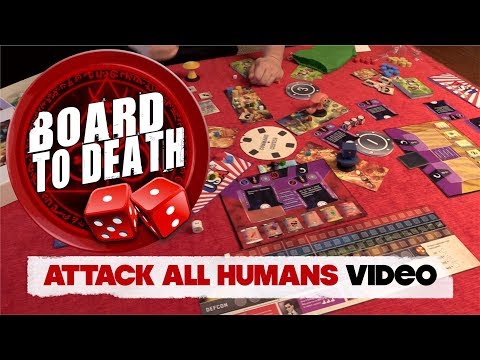
Attack All Humans Board Game Preview
- Strong, cohesive theme with distinct alien factions and a sense of escalating threat
- Large emphasis on mission-based scoring and endgame decision points
- Rich doomsday/threat mechanics that heighten tension and replayability
- Tight, teachable core loop once players grasp the power-card turn order and hand-management
- Scales from lower to higher player counts with predictable adjustments to setup and tokens
- Rule complexity may challenge newcomers; a careful read or a scenarios-first playthrough is helpful
- Some players may experience downtime due to planning and card interactions in heavier setups
- Component quality and artwork are dependent on production run; initial prototypes can vary
- Certain high-variance elements (e.g., mission draw and Doomsday device outcomes) can create uneven pacing
- alien conquest, clandestine operations, and escalating threat via a Doomsday-style countdown
- Earth under alien invasion with factions Path Orion, Martians, Zorgs; humans in threat track and special locations
- asymmetric, confrontational strategy with hidden objectives, location-based power, and variable endgames
- Clank
- Star Wars (brother's project referenced by speaker)
Mechanics (from transcript analysis)
- combat and damage resolution — humans and aliens deal damage in a sequence; certain humans can serve as scoring pieces or contribute to endgame scoring when captured or defeated
- Combat: Damage Based — humans and aliens deal damage in a sequence; certain humans can serve as scoring pieces or contribute to endgame scoring when captured or defeated
- conquest tokens and bunker mechanics — conquest tokens provide points and influence threat removal; engineers can bunker locations resulting in blocked areas and altered movement
- dice-based action system with mitigation — roll dice to perform actions; you may set aside dice, reroll, or mitigate using scientist cards to convert dice toward preferred icons
- doomsday device and threat track — DEF CON threat track governs endgame pressure; elite humans enter play and can alter outcomes; doomsday device can end the game if completed
- five-phase round structure — rounds consist of reinforcement, movement, actions, recharge, and resolution of effects; five phases structure guides tempo
- Hand Management — no basic draw phase; drawing only occurs via recharge; having too few cards crashes the ship and costs tokens
- hand management and no draw phase — no basic draw phase; drawing only occurs via recharge; having too few cards crashes the ship and costs tokens
- Hidden Victory Points — each player receives secret mission(s); completing missions yields victory points and adds strategic goals beyond raw aggression
- location tiles with situational effects — each location grants a unique ability (e.g., Statue of Liberty example) that affects humans and combat outcomes based on majority control
- mission cards and hidden objectives — each player receives secret mission(s); completing missions yields victory points and adds strategic goals beyond raw aggression
- movement resolution from card values — movement distance is the highest card value minus the lowest card value; direction is dictated by the revealed values
- setup variation by player count and randomized locations — determine player count (2-4, with a different command center side per count) and randomly choose a number of location tiles equal to the players; each location provides a unique effect
- turn order determined by power cards — players play power cards; the lowest value acts first, second lowest is second, etc., which can reorder who moves when
- vaporize vs abduct actions — dice icons allow vaporizing or abducting humans; abducting places figures into holding cells and advances mission/score potential
- Variable Phase Order — rounds consist of reinforcement, movement, actions, recharge, and resolution of effects; five phases structure guides tempo
- Variable Set-Up: Player — determine player count (2-4, with a different command center side per count) and randomly choose a number of location tiles equal to the players; each location provides a unique effect
Video topics + discussion points
Quotes (from this video)
- the power cards are very important in the game
- the game is played over five phases every round
- this is the five phases, reinforcement phase and then turnover
- hand management is a big part of the risk-reward
- the Doomsday device is a central tension point in the game