






BattleLore: Second Edition Deep Dive
What the Community Thinks About BattleLore: Second Edition
Reviewers treat BattleLore: Second Edition as the fantasy member of the Command & Colors family, and most of them come away impressed. Anton Torres, filming at the Fantasy Flight Games booth during Gen Con 2013, introduced it as a spectacular new design built on the Battle system created by Richard Borg, and they highlighted the new 28 millimeter miniatures and the refined play. Later reviewers returned to the same themes: the fantasy setting, the figures, and the card-driven battles.
The consensus is that this is one of the strongest entries in the family. The Discriminating Gamer ranked it fifth among their favorite Command & Colors games and called it a good fantasy adventure war game, while Box of Delights went further and called it their favorite game of the system. Board Games UnLocked included it on a personal top 100 list, citing the command color system and hand management as the reasons it stands out. Reviewers do not agree on everything. Some point out that the game is strictly two-player, which narrows the table, and others point to the luck built into card draw. Those concerns are real, but they rarely change the overall verdict.
Core Mechanics That Define BattleLore: Second Edition
Command Card Hand Management
The heart of the game is the command deck. Box of Delights walks through the setup: each player draws six command cards, keeps four, and discards two, while a separate deck of law cards supplies special abilities. On a turn, a player plays one command card to order units in a section of the battlefield, which is the left, center, or right flank in the Command & Colors tradition. Some cards let a unit in a middle section be ordered through two flanks at once, which gives the player more options than the simple flank structure suggests.
Reviewers focus on the decisions this creates. Drive Thru Games describes the need to be conservative with a hand that holds only one card able to activate the last flank, because a player who can only act in one area leaves other units exposed. The same reviewer notes that players must read each other, since a card held back can leave enemy units open later. Box of Delights also explains that a law card can be played on an opponent's turn, so the hand is always a source of threat and counterplay. Richard Borg's underlying Command & Colors design is clearly visible here, but reviewers consistently describe the card layer as what makes this version distinct.
Hidden Deployment and Decoys
Before the first turn, each player assembles an army from a deck of unit cards and fills the remaining slots with decoy cards, then places the stack face down on the board. Box of Delights describes both players revealing their deployments simultaneously, with decoys simply returned to the box. The result converts a game of open information into a game of inference, because an opponent has to guess which face-down stack hides real units. The same reviewer noted that scenario cards offer a random setup from which players choose among a few options, so the terrain, victory point banners, and deployment zones shift from game to game. Together, hidden deployment and scenario variation give the setup phase real strategic weight.
The BattleLore: Second Edition Experience
Bluffing and Reading the Other Player
Reviewers repeatedly describe the feeling of bluffing across the table. Drive Thru Games says that a player has to bluff about what they are capable of, and that long-time partners develop a kind of sympatico rhythm, learning how the other person commits their cards. The reviewer also describes the choice of when to spring a trap with lore, since spending all of your lore too early leaves you with nothing when the decisive moment arrives. This is not the open, calculating feel of a pure area control game. It is closer to a tense conversation where each choice reveals something about your intentions.
Sit-Down Fun Without the Brain Drain
The most common praise for the game's pace is that it is easy to sit down to and easy to step away from. Drive Thru Games describes playing it with a son on the app across several devices and on Steam, and calls it a Hollywood blockbuster style experience: enough strategy to stay engaged, but not so demanding that the player is completely absorbed. That reviewer contrasts it with heavier Euro games and heavy war games that can drain the energy out of the room. It is the kind of game a group can pick up after a long day and still enjoy.
What Makes BattleLore: Second Edition Stand Out
Miniatures and Battlefield Presence
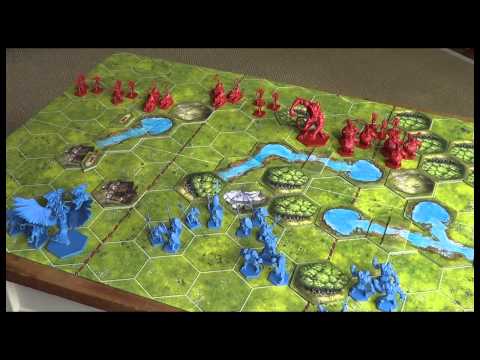
The figures are one of the most consistently praised features. Anton Torres highlighted the brand new 28 millimeter miniatures as spectacular looking when the game was first revealed, and The Discriminating Gamer recalled that they loved the minis, from the human soldiers to creatures such as a giant spider. Drive Thru Games made a similar point, saying the miniatures are awesome and the pieces are great, which makes the game fun to set up. For a fantasy war game, seeing an army set out across the board and face the opposition is a real part of the appeal, and reviewers treat it as a strong reason to choose this edition.
Scenario Variety and Replayability
Anton Torres described a unique scenario system in which players play different games each time with different armies, and Box of Delights said the random setup varies enough that each game feels distinct. Reviewers link this to the game's staying power. Because the maps, scenarios, and armies are assembled anew for each game, a player can tailor an army to a preferred style of play. Drive Thru Games also mentions the app and the Steam version, which extend the play and give players another way to explore the scenarios.
Potential Drawbacks
A Two-Player Game With a Narrow Table
Board Games UnLocked is candid about the practical limits of the design. The reviewer says the game is strictly two-player, which narrows the audience, and that the fantasy theme does not appeal to everyone at home. The same reviewer jokes that nobody will ever play with them, a reflection of how hard it can be to find an opponent for a head-to-head game. Players with a regular partner may not feel this constraint, but anyone hoping to bring the game to a larger group will need to look at other options.
Card Draw Luck and Limited Availability
Some reviewers acknowledge that the command system can feel unfair in the moment. Drive Thru Games notes that a player can get screwed by the card draw, for example when most of the army sits on a flank that the hand cannot activate, and admits that many players dislike a system where cards decide what can move. Availability is another practical concern. Watch Review notes that the game is out of print, though it can still be found at reasonable prices, and that some expansions may be more expensive to track down. Players should expect to hunt for a copy rather than buy it from a current catalog.
If You Enjoy BattleLore: Second Edition
Players who enjoy BattleLore: Second Edition's command card rhythm will find a natural next step in Memoir '44 from Days of Wonder. The Discriminating Gamer ranks the Overlord expansion as their favorite Command & Colors game, and Watch Review notes that Memoir 44 is always in print and easy to teach, with a deck that can be tailored to ease new players in. Its range-based combat delivers the same tactical satisfaction in a different form.
For a fantasy experience with a similar feel, Samurai Battles from GMT Games is the closest match. Watch Review describes its honor mechanic as similar to BattleLore's lore system, and The Discriminating Gamer enjoyed the extra deck of cards that can disrupt an opponent's plans, a layer that also appears in BattleLore.
Players who want the block-based version of the same system should look at Command & Colors: Ancients from GMT Games, which The Discriminating Gamer ranked highly for its historical battles and Punic War scenarios. Those who want a science fiction twist can try Red Alert from PSC Games, which the same reviewer described as the Command & Colors system with large spaceship battles.
What Reviewers Are Saying
"And I loved the minis here. You had some of these uh minis, you know, of course you had humans, but then you had all sorts of creatures. You had that one like giant spider. I mean, the game I thought was just a heck of a lot of fun."
— The Discriminating Gamer
"It's my favorite command and color of game just because of all the different card combinations and the use of lore and the different units and lots of stuff going on."
— Box of Delights
"There's fog of war. There's a unique scenario system that uh that has you playing different games every single time with uh different different armies."
— Anton Torres, Board to Death TV