








Biome Deep Dive
What the Community Thinks About Biome
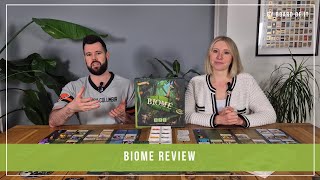
Reviewers describe Biome as a nature-themed tableau builder that openly shares DNA with Wingspan and Earth, while adding its own rhythm. Board Of It presents it as a card driven game with terrific components that broadens the strategies on offer by letting players activate different wildlife in different habitats. The Broken Meeple's first review, recorded after a partial session, came away more impressed than expected. That reviewer described the game as a surprisingly pleasant Wingspan-style experience with clear iconography, interactive card abilities, and a charming nest mechanism, and gave it seven out of ten.
The critical perspective comes mainly from The Broken Meeple's second video. That review is far less generous about luck and catch-up mechanisms. It finds the game's achievements and predation rolls frustrating, and it places Biome below Earth and Wingspan. The reviewer still acknowledges the game's appeal and rates it around six out of ten, so the critique is about specific design choices rather than a dismissal.
Two of the reviewed videos come from the Stonemaier Games channel, where designer-side commentary is informative about intent. Those videos naturally present the game favorably, so their praise for the simultaneous structure and the nest tokens should be weighed alongside the independent reviews.
Core Mechanics That Define Biome
Tableau Building
Each player builds a personal biome divided into three habitats. Plants, trees, birds, rabbits, and other animals are played into those habitats, and each card has a preferred habitat that restricts where it can go. Cards also belong to one of seven types, which feed the achievements. The Broken Meeple's first review describes the card action economy as the most interesting feature: each card's ability can be activated only once in the game, marked by a cube. That gives players a reason to hold a card for its ability later, use it purely for its card type on an objective, or never activate it at all. Board Of It highlights the same flexibility, noting that players choose one card on their mat to activate each round and can always play a card without activating it.
Simultaneous Actions
Most of each season runs simultaneously. Players draw cards, collect resources, and play one card into their habitats at the same time. Only the activation phase proceeds in turn order. Board Of It describes the result as a game with minimal downtime, saying that the first part of each season keeps everyone focused on their own board and the activation phase stays brief. Stonemaier Games makes the same point from the design side, explaining that the activation of a card is the only non-simultaneous step, and that this is where interaction happens. Board Of It also notes a cost: the many micro actions can make it hard to remember where you are in a step, particularly when discarding down to the hand limit of eight.
The Biome Experience
Nature and Wildlife
The theme is communicated through the structure of play rather than decoration alone. Birds need trees, rabbits need plants, and the seasons move the table from breeding in spring to predation in summer. Stonemaier Games captures the feel of this well, saying that the animal cards that generate tokens make the habitat feel alive and growing. Board Of It frames it for nature game fans, recommending the game to anyone who enjoys nature themes regardless of how many nature games they already own.
Cozy
The tone is warm, largely because of the breeding mechanic. Chicks and bunnies are placed into nests printed on the cards, and reviewers respond to them personally. The Broken Meeple's first review calls the nests one of the cutest gimmicks it has seen in a game, and even the more critical second review concedes that the nests are cute as buttons. The softness of the theme is deliberately contrasted with the harshness of the game: predators from other players can eat unprotected young, and the young that survive still need to be fed.
What Makes Biome Stand Out
Component Quality and Nest Tokens
Reviewers consistently single out the components, especially in the deluxe edition. Board Of It notes the terrific components and the egg carton style component trays. Stonemaier Games describes the wooden tokens and the small, detailed nests as an impact on the game's most loved mechanism. The Broken Meeple's first review points to the printed chicks and rabbits and to the tokens' strong tactile appeal, saying that the physical nests make the breeding phase feel special. Because the animals become tangible tokens rather than cubes, reviewers say the losses in the predation phase feel more personal.
Simultaneous Play That Keeps Everyone Engaged
Board Of It argues that Biome is surprisingly engaging because of its rhythm. Players are busy with their own boards for most of each season, and the turn order phase remains interesting because of predation and the points and food that other players' actions can provide. Board Of It describes the game as very good at two players, because predation can come from any opponent and the interaction stays consistent. The same reviewers say the game works at any player count thanks to the short activation phase.
Potential Drawbacks
Luck in Achievements and Card Draws
The most consistent criticism concerns achievements. The Broken Meeple's second review argues that achievements such as "four birds," where each bird must sit in a different habitat, become improbable when a player is drawing randomly from a deck where a specific card type appears roughly one in seven draws. Combining that with a specific habitat requirement compounds the difficulty, and the reviewer notes that the game has no wild symbols to smooth this out. Board Of It agrees that achievements are the weakest element and that they vary in difficulty, although that reviewer is less bothered by randomness in general. The consensus is that the draw is the weak point of the achievement system specifically.
Predation Dice Rolls and the Lack of Catch-Up
Predation resolves with a die roll against the number of plants in the target habitat, and some reviewers object to how much that roll can swing the outcome. The Broken Meeple's second review argues that a single failed roll can mean the difference between drawing two or three cards and eating two of an opponent's young, a swing of around eight points. It also criticizes the victory point track, which gives bonuses to whoever reaches each stop first, with only a one-resource-per-turn bonus for the player at the back. The first Broken Meeple review wished for a more deterministic predation system, while Board Of It enjoys the spice that randomness adds and points out that planting plants in a habitat is a way to mitigate predation. The difference reflects how much random variance each player is willing to accept.
If You Enjoy Biome
Reviewers most often reach for Wingspan and Earth when describing Biome, and those comparisons are a reliable guide. Players who enjoy Wingspan's bird themed tableau and habitat placement will recognize the core loop, although Board Of It notes that Biome plays differently enough that it does not feel like Wingspan once you read the rules. Players who like Earth's large card pool and the decision of which cards to play, discard, or hold for later will find the same kind of hand management, with Biome offering a lighter pace. Century: Spice Road is a useful next step for players who enjoy card-driven engine building, since its compact card economy rewards planning ahead in a similar way to Biome's choice of when to activate each card. For nature lovers who want a more relaxed experience, Biome's nests and seasonal rhythm make it a good fit.
What Reviewers Are Saying
"Biome is surprisingly engaging because of the rhythm of the game. It's pretty much all action all the time because the first part of each season sees players doing actions simultaneously."
— Board Of It
"It's luck without enough mitigation. And that is the problem with this Biome game is that I think it relies too much on some of those luck aspects to really set it apart."
— The Broken Meeple
"Every ability is a when activated ability and the only part of the game that isn't simultaneous is activating one of your cards because that is where the interaction happens."
— Stonemaier Games