














Black Rose Wars: Rebirth Deep Dive
What the Community Thinks About Black Rose Wars: Rebirth
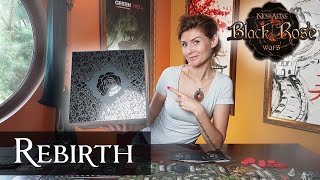
Reviewers present Black Rose Wars: Rebirth as a cleaner, more streamlined take on the original Black Rose Wars rather than a reinvention. On Board Games UnLocked, the hosts single out the room design as the key difference: rooms of the same color share an ability from the start, and each room gains a unique ability only once it is restored. One host found that easier to learn than the original, and said that if a player can choose between the two, Rebirth is the better buy. ON TABLE Board Games, hosted by Janna, approaches the box as a comparison piece and treats the Rebirth scoring system as a valuable change that later editions adopted.
The main point of agreement is that the game is at its best with three or four mages. The Board Games UnLocked hosts argue that the chaos of overlapping spells, traps, and protections is what makes the game work, and that a two-player match loses much of that tension even with the built-in AI opponent. The hosts' scores land between a seven and a nine, and both see the game as a strong recommendation for groups who enjoy dueling mage games, with the caveat that the rules and the playtime demand commitment.
Core Mechanics That Define Black Rose Wars: Rebirth
Deck Building
Players in Black Rose Wars: Rebirth draft spell cards from the schools of magic to build a personal deck that drives the match. The Board Games UnLocked hosts describe this as a choice made at the table: whenever a player drafts, they pick cards from a deck and can either specialize in one school to become very strong in it, or mix elements from several schools to create different combinations. In the Board Games UnLocked discussion, one host picked a school at random, then found that the deck had evolved into a hex and technomancy build by the end of the game. That evolving deck is what separates Black Rose Wars: Rebirth from games where the deck is fixed before play begins.
Area Control
Rooms are the contested ground of the board. Janna of ON TABLE Board Games explains that each room displays victory point banners, and the mage with the most instability cubes in a room takes first place and earns the points shown on the banner. The Rebirth twist is that a room is not permanently removed once it is overturned. It is rebuilt, and a token carrying its ability is placed on it. The Board Games UnLocked hosts describe a similar ranking for damage, where the mage who deals the most damage receives a trophy and points, and the runner-up scores as well.
The Black Rose Wars: Rebirth Experience
Interactive/Dynamic
Reviewers remember the table talk most. Each mage programs spells that can disable others, set traps, arm defenses, deal damage, or summon beasts, and the hosts of Board Games UnLocked describe the result as a constant clash in which spells, traps, and protections collide with every turn. Players compete for damage and for quests and events that affect several players at once, and the hosts felt this made the three-player game far more engaging than the two-player game. The Black Rose itself also gains points as a timer, as the Board Games UnLocked hosts note, which pushes players to act rather than wait for an opening.
Rewarding Mastery
The learning curve is steep, but reviewers say it pays off. The Board Games UnLocked hosts report that the first session was spent figuring out the systems, and that the game only clicked after a few turns. The hosts also note that the dark side of many spell cards is harder to read than the light side, so players who learn both sides gain a clear edge. Once a player knows how each school works and what each card does, the choices become sharper, and the hosts believe the game rewards repeated plays more than most games in its genre.
What Makes Black Rose Wars: Rebirth Stand Out
A Deep Roster of Magic Schools
Reviewers praise the variety of magic schools more than any other feature. The Board Games UnLocked hosts say the six schools in the core box are good to have on their own, and that expansions add many more. The same channel's list of anticipated games describes each school as one that feels like the school you would expect, with a distinct identity and playstyle. For players who enjoy building unusual combinations, the breadth of the roster is the main reason to keep returning to the game.
A Cleaner Rebirth of the Original
Reviewers consistently treat Rebirth as the better version of the original. The Board Games UnLocked hosts praise the quest cards for requiring players to work toward them over several turns by placing cubes, which they call a smart change. Janna of ON TABLE Board Games highlights the replacement of tiny rose markers with player-colored faces on the avatar miniatures as a very important improvement. Together, these changes make the game feel more streamlined, even though the core interaction is unchanged.
Potential Drawbacks
Two-Player Play and the AI Opponent
Reviewers are most critical of the game at two players. The Board Games UnLocked hosts argue that the game does not truly work as a two-player experience, and they point to the Black Rose Wars Duel as proof that a dedicated two-player design is necessary. The included AI is serviceable, which the hosts place in roughly the top third of AI opponents they have tried, but it has a drawback: it replaces the event deck with its own, and that deck contains only five cards in each moon phase. The hosts also worry that the game will not reach the table often enough in households where one player is not enthusiastic about heavy games.
Rules Clarity and Writing Polish
Several reviewers say the rules are less clear than they should be. The Board Games UnLocked hosts describe the game as not intuitive, and recall needing printed player aids to track room activation in the original. Even in Rebirth, the sequence of programmed spells and other turn-order details must be learned through play. The hosts argue that Ludus Magnus Studios would benefit from an outside proofreader, since the rulebook wording still needs cleanup. Janna of ON TABLE Board Games also finds the overgrown Rebirth room tiles visually busy and describes them as bushy, a complaint Janna says was resolved in the later revised edition.
If You Enjoy Black Rose Wars: Rebirth
Players who enjoy Black Rose Wars: Rebirth's programmed spell system will find similar satisfaction in Ion, which the Board Games UnLocked hosts describe as the closest comparison for a mage dueling game, although they felt its rules were less clean. Whiz War offers a lighter, more chaotic take on mage combat, and Epic Spell Wars goes further in that direction. Players who value cards that serve two purposes will recognize the approach in Fireteam Zero and Gloomhaven, both of which the Board Games UnLocked hosts linked to the dual card play in Black Rose Wars: Rebirth. Adrenaline shares the damage markers that the Board Games UnLocked hosts found similar, so players who like area-based combat will recognize familiar ideas. Black Rose Wars Duel is a two-player spin-off that the hosts considered far inferior, so it is best approached only for solo or two-player play.
What Reviewers Are Saying
"With Black Rose Wars it's the chaos of everyone's spells going off and traps and protections and dividing and conquering on who you're trying to attack."
— Board Games UnLocked
"But what's cool about this is that the Black Rose is also gaining points which is kind of a timer so if you're not doing anything to get you points then everyone can kind of lose."
— Board Games UnLocked
"And for having the most instability cubes in this room the magician wins first place and earns the most victory points specified on the banner but when the title is turned over this room is not destroyed in this game it's rebuilt."
— Janna, ON TABLE Board Games