/pic5301335.jpg)


















Bonfire Deep Dive
What the Community Thinks About Bonfire
Bonfire has captured the attention of strategy game enthusiasts as one of Stefan Feld's most intricate and rewarding designs. Channels like The Dice Tower and Board Game Sanctuary consistently praise its tightly interlocking systems, challenging decision-making, and the satisfying payoff of careful planning. The game has earned respect as a heavyweight euro that demands both planning and flexibility, rewarding players who can navigate its economic constraints while competing for shared objectives.
Core Mechanics That Define Bonfire
Tile Placement and Action Selection
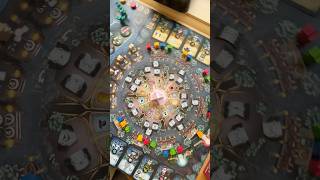
The heart of Bonfire is its domino-style tile action selection system. Each player has a grid where they place hex tiles drawn from a queue. When you place a tile, you immediately gain its actions. More powerfully, when adjacent tiles share matching icons, you trigger those actions multiple times based on the size of the group you form. This creates cascading opportunities as you build clusters of identical actions, rewarding players who think ahead about which tiles to claim and where to position them. Published by Queen Games, it is a Stefan Feld design through and through.
Engine Building Through Careful Chain Planning
Success in Bonfire requires viewing the game as a series of interlocking chains. You pursue missions by gathering resources, moving your boat around the board to collect new objectives, and carefully building your action engine to complete those missions. The challenge lies in recognizing which short-term moves support long-term goals, forcing you to work backwards from your desired outcome to determine what actions you need today. Completing one mission helps you progress toward another, and your gnome helpers provide special powers that unlock more efficient pathways through your puzzle.
The Bonfire Experience
A Game of Expansion and Acceleration
Bonfire unfolds in two distinct phases. Early on, your decisions feel slow and deliberate as you construct your engine piece by piece, gradually understanding which combinations work together. But as your tableau develops and your clusters grow, the game accelerates dramatically. Actions trigger in greater abundance, your helpers activate, and what once felt constrained suddenly blooms into possibility. This pacing creates a satisfying tempo where patience in the early game pays dividends as you reach the final rounds with increasingly powerful turns.
Managing Resources Under Scarcity
Bonfire enforces a tight economy where no single player can accomplish everything. Resources are limited, missions are contested, and the order in which you draw tiles sometimes forces compromises. You might pursue only the objectives you are confident you can complete, accepting that perfection is impossible. Yet the game rewards careful navigation of these constraints; finding the one additional resource you needed, or combining actions in an unexpected way to achieve a mission, creates moments of genuine satisfaction.
What Makes Bonfire Stand Out
Thematic Integration Through Mechanical Design
Rather than bolting theme onto mechanics, Bonfire's systems breathe life into its mystical setting. The ritual of moving your boat to islands, taking tasks from the guardians, and building pathways for prayer people feels thematic because the mechanics enforce that structure. The tiles with their symbols, the deliberate placement of portals, and the progression of advisors to the high council all reinforce the sense that you are gradually rekindling the sacred bonfires through organized, methodical action. The mechanics give the theme texture rather than the other way around.
Complexity That Opens Up With Play
Bonfire initially overwhelms new players with its interconnected systems and symbolic density. The board can feel like a puzzle box with too many pieces. But as you internalize how actions cluster, how missions chain together, and how your helpers modify your engine, the game transforms. What felt bewildering on a first play becomes an exciting landscape of possibilities. The game rewards your growing understanding, revealing deeper strategic paths as you learn which combos matter most and how to sequence turns for maximum efficiency.
Potential Drawbacks
The Risk of Over-Extension
Bonfire punishes ambition. It is entirely possible to take a mission you cannot complete, spending valuable resources and time pursuing a path that leads nowhere. The game offers no safety net. You must learn to be selective about which objectives you pursue, or accept the consequences of reaching the midgame and realizing you cannot achieve your chosen tasks. This creates tension and learning moments, but it also means newer players may struggle with decision paralysis as they weigh the risk of overcommitting.
Symbolic Density and Rules Overhead
Bonfire uses many symbols and interlocking subsystems that must be tracked at once. Between portals, prayer people, missions, resources, and gnome powers, the game demands that players remember the current state of multiple parallel tracks. The symbols are logical once learned, but the initial rules explanation requires clear communication, and players must stay organized to track their own economy.
If You Enjoy Bonfire
Players drawn to Bonfire should explore Bora Bora, another Stefan Feld design with a tight economy and objective-driven gameplay where efficiency and planning are paramount. For those who love the tile placement and engine building, AquaSphere offers a different mechanical approach to similar depth through its programming and worker-placement hybrid. Istanbul provides a lighter but still satisfying blend of route planning and engine building as an accessible entry point to this style of euro.
What Reviewers Are Saying
"What really stands out to me is the main mechanism. Each player has a grid with a random tile in the middle. You take the top or bottom tile from the queue and place it into your grid, but if you place a tile so its actions are adjacent to one already on the board, you can do that action as many times as the size of that new group of identical actions. It's a game of chains."
— The Dice Tower
"Everything requires advanced planning. You sail your boat around the islands and collect different objective tiles, and when you fulfill the objectives you also collect these little prayer people who move around the grid of your player board. The game is driven by this domino tile-action selection mechanism, where if you connect multiple icons together you gain more of that action."
— Board Game Sanctuary
"There are lots of interconnecting mechanisms that will challenge you, and with all the extra tasks there is definitely high replayability. The mechanics give life and flavor to the theme, and every little piece needs to be in the right place; the order in which things are done transmits a certain sense of ritual."
— cardboardrhino