






























Ca$h 'n Gun$ Deep Dive
What the Community Thinks About Ca$h 'n Gun$
Reviewers treat Ca$h 'n Gun$ as a party game first and a tactical game second. The shared view is that its appeal lives at the table: players point foam guns at each other, bluff about whether the card they played face down is a Bang or a Click, and then divide the loot. Corey of Travel the Board is one of the more enthusiastic voices, praising the bluffing and the silly foam-gun energy. Corey also argues that the second edition is the version to seek out, describing the first edition as a strange take on Telephone. Adam in Wales places the game among the modern party games that rely on physical play, describing it as a more straightforward game of pointing polystyrene guns at each other while trying to decide who gets the most of the shared loot. Chairman of the Board is more measured, praising the novelty and physicality while admitting to not having played it in some time. Jamie, of Stonemaier Games, had not thought of Ca$h 'n Gun$ as a heist game when viewers suggested it, but agreed that it made sense. The main point of disagreement concerns structure. Shelfside walks through the core rules step by step, which suggests the base game teaches quickly, while the optional power cards draw criticism.
Core Mechanics That Define Ca$h 'n Gun$
Simultaneous Actions
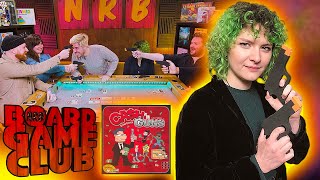
Every round of Ca$h 'n Gun$ depends on the whole table acting at once. Shelfside's tutorial shows the Godfather counting to three, after which everyone must simultaneously point a gun at another player and hold that aim. Before this happens, each player secretly chooses a bullet card, either a Bang or a Click, and places it face down. The table therefore commits to hidden information before any pointing begins. A second countdown then asks each player to decide whether to stay in the standoff or back down, and the surviving shots resolve together. No Rolls Barred describes the effect on the room: people keep talking across the table while everyone is locked in, asking whether they are allowed to speak to the player pointing a gun at them. The Godfather can also use a privilege to ask another player to redirect a gun, which adds table politics to a process that otherwise runs on simultaneous decisions.
Take That
The aggression in Ca$h 'n Gun$ is direct. A Bang that lands on a player who stayed in the standoff inflicts a wound, and a player who takes three wounds is removed from the game and does not tally a score. No Rolls Barred says that a player can take only one wound per round regardless of how many shots land. Shelfside's explanation, however, describes bangs stacking so that two shots in a single round mean two points of damage. The two readings differ, and tables should settle the rule before the first standoff. Players can also dive out of the way to avoid damage, but doing so forfeits their shot and any share of the loot for that round. Reviewers locate the central tension in that trade-off between surviving and staying in the take.
The Ca$h 'n Gun$ Experience
Tension at the Standoff
The strongest feeling reviewers describe is dread at the moment the guns come up. No Rolls Barred opens its session with the line "God, why is this game so tense?" and the rest of the episode bears that out. Players check who is pointing at whom, ask one another whether they are about to be shot, and read faces for signs of a bluff. Corey of Travel the Board describes the bluffing side of the same pressure, having tried to game the table by firing three times in a row, expecting opponents to assume the bullets were being saved, but the table simply concluded the ammunition was gone and the bluff power disappeared for the rest of the game. The face-down bullet means that a gun aimed at you might carry a Bang or a Click, and that uncertainty keeps each standoff charged.
Silly, Physical Party Energy
The other half of the experience is pure table comedy. Players point plastic guns at friends, shout, dive to the floor, and keep talking across the table. The hosts of Travel the Board explain that the foam guns need little introduction, since everyone understands the assignment as soon as they hold one, and they recommend explaining the rules before handing out the guns because players stop listening once they have a weapon in hand. Chairman of the Board describes the game as something like Reservoir Dogs as a board game, valuing the physical play that makes a party game memorable. No Rolls Barred's playthrough shows the cast laughing, riffing on each other's standoffs, and trading accusations of unfair shots, which is the kind of noisy, shared experience reviewers tend to recall.
What Makes Ca$h 'n Gun$ Stand Out
Foam Guns as the Centerpiece
Reviewers consistently point to the foam guns as the feature that makes the game work. The hosts of Travel the Board go as far as calling the silly foam guns the best component in all gaming, arguing that a small piece of plastic turns an abstract bluffing system into a physical act everyone can see. Chairman of the Board says the novelty and physicality are what make players remember the game after the session ends. That physical stake is the difference between Ca$h 'n Gun$ and a purely hidden-information card game: a player can see exactly who is aiming at them, even though they cannot see what the bullet card says.
Loot That Rewards Being First
No Rolls Barred highlights how the loot is divided. The split is not a fair cut, and its host summarizes the rule as "a whoever gets there first gets the most." The Godfather picks first and, because the card supply runs out part way through the round, the next round starts with the new Godfather, so position in the line matters a great deal. Shelfside's walkthrough adds the scoring structure. Paintings are worth more the more of them a player collects, so a set becomes more valuable as it grows, and the player with the most diamond cards, not the most valuable diamonds, receives a bonus of $60,000. That combination of escalating sets and a single large bonus keeps each take tense, because a player who has picked up paintings can still lose the diamond bonus to a rival who collected one more card.
Potential Drawbacks
The Optional Power Cards
Shelfside presents power cards as an optional variant that gives each player a unique ability, but it is candid about the result. The host says, "I personally found this to be pretty unbalanced and kind of convoluted," while still acknowledging that the cards are good for spicing things up. No Rolls Barred shows the frustration from the table. Its host calls the wizard card the most frustrating card in the deck, because players tend to hoard their power cards for a late-game play and then find that the timing does not work out. Reviewers who enjoy the base game may therefore want to play without the variant or treat it as a separate, lighter experience.
Getting Shot Out of the Loot
Being shot or diving costs a player their share of the loot for that round, and enough damage removes them from the game entirely. In the No Rolls Barred episode, one host finds the late-game targeting especially hard to take. After being singled out in the final round without firing a shot, the host sums up the feeling this way: "When you do that and you still lose, you just feel like you've lost twice." The mechanic is fair in design, since every shot is a choice, but it does mean that a player who gets targeted early or often can spend much of the session watching rather than taking part in the splitting of the loot.
If You Enjoy Ca$h 'n Gun$
Players who enjoy the bluffing in Ca$h 'n Gun$ will find a related satisfaction in Spyfall. Adam in Wales describes Spyfall as a game about bluffing and lying, keeping your identity secret and getting one past the other players, which is the same social pressure that drives the face-down bullet choice. Dixit is the other comparison Adam in Wales draws. It is a clue-giving party game where players read each other's intentions, so anyone who enjoys the talking and guessing around the table will find that energy familiar. Players who want the film-style theme of a crew turning on itself will recognize the Reservoir Dogs comparison that Chairman of the Board draws directly. For players who want another session of table-wide contention, No Rolls Barred followed its Ca$h 'n Gun$ episode with Citadel, a natural companion for a group that enjoys sharp, interactive play.
What Reviewers Are Saying
"It's got that real novelty factor and that physicality to a party game that does make people remember it, so I think it's a good one. I haven't played it for some time, but it's still pretty solid for a party game."
— Chairman of the Board
"I love bluffing games. So, not just the silly funness of like the guns and stuff, whatever. I love the bluffing in it."
— Corey, Travel the Board
"It's not one of those you cut you choose kind of vibes. It's a whoever gets there first gets the most."
— No Rolls Barred