/pic3119514.jpg)
/pic3239104.jpg)
/pic1421173.jpg)
In Citadels, players take on new roles each round to represent characters they hire in order to help them acquire gold and erect buildings. The game ends at the close of a round in which a player erects their seventh building. Players then tally their points, and the player with the highest score wins.
Players start the game with a number of building cards in their hand; buildings come in five colors, with the purple buildings typically having a special ability and the other colored buildings providing a benefit when you play particular characters. At the start of each round, the player who was king the previous round discards one of the eight character cards at random, chooses one, then passes the cards to the next player, etc. until each player has secretly chosen a character. Each character has a special ability, and the usefulness of any character depends upon your situation, and that of your opponents. The characters then carry out their actions in numerical order: the assassin eliminating another character for the round, the thief stealing all gold from another character, the wizard swapping building cards with another player, the warlord optionally destroys a building in play, and so on.
On a turn, a player earns two or more gold (or draws two building cards then discards one), then optionally constructs one building (or up to three if playing the architect this round). Buildings cost gold equal to the number of symbols on them, and each building is worth a certain number of points. In addition to points from buildings, at the end of the game a player scores bonus points for having eight buildings or buildings of all five colors.
The 2016 edition of Citadels includes twenty-seven characters — eight from the original Citadels, ten from the Dark City expansion, and nine new ones — along with thirty unique building districts, and the rulebook includes six preset lists of characters and districts beyond the starter list, each crafted to encourage a different style and intensity of gameplay.
Part of the Citadels family — see Citadels for the combined view.
/pic3119514.jpg)

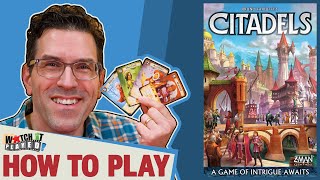
Citadels - How To Play

Let's Play CITADELS | Board Game Club
- Stood the test of time, still in print
- Fun game
- Not recommended for 7 players
- Not recommended for 2 players
- Euro game hobby
Mechanics (from transcript analysis)
- Area Control — Control of council seats and buildings seems to be a factor.
- Hand Management — Players draft cards, keeping some and passing others.
- Role selection — Players pick a role, and then build buildings.
- Set Collection — Buildings score points based on their color and adjacent buildings of the same color.
Video topics + discussion points
Quotes (from this video)
- And it's a game that hasn't it's stood the test of time in some ways because it's still in print consistently, which is rare for games that came out back then.
- But at the same time, I think that they have effectively captured the spirit of the original game in many ways.
- There's a nice push and pull in this that gives you that feeling of, 'Hmm, what are you doing? Maybe I'll do this over here. Maybe I'll I'll distract you over there while I steal this thing from under you.'
- Funny enough, I think it feels less mean in this game because anything I do is effectively pushing you down and vice versa.
- The game looks and feels great. I love the dual-layer board in here, and hilariously, they sell a playmat version of the board.
- It is, by its very nature, limited in some ways. Uh but it's a really nice spin-off, and that's all you can really hope for with a game like this, that they nail that spin-off in the feel and in not excluding the original game, right?
- No one will play this and go, 'I'll never play Citadels again.' That's not going to happen, and I love that.
- Um I'm going to come down at an eight on this one, but it's a really strong eight.
- It's punchy, man. It's a real punchy game. I think it's one that's going to It's going to have some legs, uh which is great, you know.
References (from this video)

- Too skillful for a party game
- Need to blend roles
Mechanics (from transcript analysis)
- Engine Building — Players build up their city to gain points and income.
- Role selection — Players select roles each round.
- Set Collection — Players collect districts to build their city.
Video topics + discussion points
Quotes (from this video)
- if it can't accommodate at least five it's not a party game
- your definition of party game is a game that place sadness fine please have to be at least 5 yep
- and then what has to be simple enough in componentry to be played easily at a party hmm and it has to be simple enough that you can explain it I'm inside probably 10 minutes yep and have it be understood by gamers and non-gamers I think those are the hallmarks of a genuine party game
- if the game isn't generating laughter naturally through playing it then it's not really a party game
- there's a lot of chaos element often that's what causes the the humor
- it really depends on the people that we're playing with as well
- it can read like party on paper but then it people aren't quick enough to like make it fun party or they're not happy enough to just throw a caution to the wind and wind and lose and have it be funny and it becomes really understand
References (from this video)

- So much game packed in a tiny box
- Awesome role selection phase with social maneuvering and bluffing
- Adaptable to players and drawn cards
- High setup ease and immense variety
- Fantastic and an easy entry
- City Building
- Medieval
- Cordelia
Mechanics (from transcript analysis)
- bluffing — Then bluff and deduce who took what to build the most valuable medieval city.
- Card Drafting — secretly drafting from the shared deck of role cards for special powers
- role drafting — role drafting city building game where each round players secretly pick a character with unique power.
- Set Collection — You get gold from them. No, instead you'll pick the king because you want to be the first player.
- Tableau Building — The city you lay down card by card is slowly getting stronger and accumulating more abilities and gold bonuses.
Video topics + discussion points
Quotes (from this video)
- Citadels is an absolute classic and has been in my collection now for I think almost 25 years.
- There's just so much game packed in such a tiny little box.
- Citadels ask you to adapt not just to the players around the table and what their behaviors are and what their needs are, but also to the small hand of cards you draw from a large pool of building cards.
- Castle Combo is a nine-card tableau builder where you spend coins to buy villagers and nobles from a shared market and slot them into a 3x3 grid.
- This game is constantly through the simplest rule set and limited decision space forcing you to make immense trade-offs and decisions.
- it makes every turn feel meaningful despite the fact that you're only drafting from like six cards.
- I'm incentivized to pay close attention to what my opponent is doing which is something you rarely get in these sort of like much larger and more complicated tableau builders.
- If you want to join my Patreon, then I could have got the money to hire Rick Moranis.
- I have been on a tear now going through small box board games and just replaying a bunch of them because I want to make the biggest tier list video I have ever made.
References (from this video)

- One of the most replayable games ever made specifically because of its meanness.
- The assassin eliminates a chosen character for the entire round.
- The thief takes all of another character's accumulated gold the moment that character's turn begins.
- Race to build buildings
Mechanics (from transcript analysis)
- Race game — Players race to be first to complete eight buildings.
- Role selection — Each round players secretly select one character role.
- Take That — The assassin eliminates a chosen character; the thief takes gold.
Video topics + discussion points
Quotes (from this video)
- There is a specific kind of silence that falls over a game table when somebody realizes they have just been completely, deliberately, and systematically destroyed by somebody they trusted.
- Mean games are a genre unto themselves.
- The person sitting across from them smiled, played their cards just right, and had been planning it for three rounds.
- The sea serpent player maintained eye contact and smiled the whole time.
- You were never trying to save us.
- I was always trying to save myself.
- That is a different thing. It is, in fact, exactly what Nemesis is designed to produce.
- Everything is negotiable.
- The elected pope controlled by a player can excommunicate opponents.
- The traitor system is the knife at the game's heart.
- I held that card for two hours.
- That is why you committed everything.
- It is the meanest game ever designed because it is the only major board game where the primary mechanic is human trust and the primary strategy is its violation.
- Attack the east on this move and I will allow you three supply centers.
- That is diplomacy.
- This is showing me things about markets I did not want to understand.
- Since round one.
- The worst part was understanding that it had never been a competition. It had been a lesson on a schedule the teacher set before the first card was played.
References (from this video)
- building a city via district cards and character abilities
- medieval kingdom city-building competition under a king
- instructional explanation format
Mechanics (from transcript analysis)
- character abilities — Each character has a special ability that can be used at most once per turn, typically triggered at various times during a turn.
- character draft/selection with passing — At the start of each round, players privately select a character from a face-down deck; players pass the remaining options around the table until everyone has chosen.
- district building — Players may build one district per turn by paying its gold cost; districts have types and cannot duplicate the same name in a city.
- End condition and scoring — The game ends when a player builds seven districts; final scoring includes bonuses for first to seven, having at least one of each district type, gold spent on buildings, and unique buildings.
- Once-Per-Game Abilities — Each character has a special ability that can be used at most once per turn, typically triggered at various times during a turn.
- rank-based turn order — Turns proceed in ascending order of the character's rank, called out by the crowned player.
- resource gathering choices — On a turn, a player may either gain two gold or draw two district cards and keep one.
- round end and crown reassignment — At round end the crowned player collects discarded/used cards and a new selection phase begins for the next round.
- specific character abilities (examples) — Thief robs a character; Assassin kills a character; Magician swaps hands or discards to draw anew; King rules and can be killed; Bishop/Merchant/Architect/Warlord provide other bonuses or effects as described.
- Turn Order: Progressive — At round end the crowned player collects discarded/used cards and a new selection phase begins for the next round.
Video topics + discussion points
Quotes (from this video)
- citadels designed by bruno fiduti and published by z-man games
- let's learn how to play
- the game is played over a series of rounds and each round is broken into two phases
- if you are the first player to complete your city by building seven districts you earn four points
- the game concludes at the end of that round
References (from this video)
- brutal but fun competitive play
- dynamic role powers
- brutal, competitive bidding for district control
- medieval/fantasy city-building
- tainted by misdirection and bluffing
- El Grande
Mechanics (from transcript analysis)
- Area Majority — players compete to build districts and score points.
- area majority / city-building — players compete to build districts and score points.
- Hidden Roles — players draft roles with distinct powers and use them to influence rounds.
- hidden roles / drafting — players draft roles with distinct powers and use them to influence rounds.
Video topics + discussion points
Quotes (from this video)
- They are what I would call omniamers.
- El Grande seems to be the forgotten game because to me that is still the most perfect board game ever made.
- I absolutely love all of the work that Tom does.
- Cosmic Encounter is just so so much fun.
- The complete lack of El Grande.
- The minis are way too big. Just ridiculous.
References (from this video)

- accessible gateway for heavier euros
- good variety and player interaction
- older game; some players may find it dated
- mechanics are simple but require proper teaching to maximize depth
- building districts and characters with special powers
- Medieval city-building with character roles
- clever, role-based strategy
- Gallerist
- Citadels (the game itself)
Mechanics (from transcript analysis)
- Direct interaction / denial — choose roles that block or influence other players
- Role selection — on your turn you pick a role with a unique power; strategic denial is possible
- Set Collection — collect money to build districts for points
- set collection / building — collect money to build districts for points
Video topics + discussion points
Quotes (from this video)
- it's just so buttery smooth.
- easy rules, smooth mechanics, and a good price point.
- the flame track is the one weakness of the game
- Here's a very easy house rule for it. If you're at the top of the flame track... discard a grunt token.
- It looks absolutely beautiful on the table.
- Life with the Amazonia is basically advanced Cascadia.
- The Gallerist is the smoothest Lassers in existence.
References (from this video)

- classic, well-established design with broad appeal
- asymmetrical roles can be very tense and thematic
- two-player version discussed (Velvara) felt lacking balance
- balance and player interaction can be uneven for two players
- Asymmetric character powers with land/draft mechanics
- Medieval-like city-building arena
- classic, clean design with familiar role selection
- Velvara
- Kelp
- Fugitive
- Mr. Jack Pockets
Mechanics (from transcript analysis)
- draft/land card interaction — draft land cards to gain bonuses and scoring opportunities
- Set Collection — collect sets to maximize scoring and bonuses
- Simultaneous action selection — players secretly choose actions and reveal them in order
- Simultaneous Actions — players secretly choose actions and reveal them in order
Video topics + discussion points
Quotes (from this video)
- This channel's been doing a series on games that didn't fulfill a specific expectation.
- I would rather play Istanbul.
- it's all based on your dice. And it just felt so lucky.
- Velvara is one of the games that I gave one of my highest recommendations to.
- If there were ever a party game that I could give my highest recommendation, even looking at my shelf right now, I'm like, there's nothing that even comes close.
References (from this video)

- Accessible gateway strategy game
- Varied character/role options increase replayability
- Balance can shift with expansions
- Role selection and district construction
- Medieval city-building
- Clever, tactical
Mechanics (from transcript analysis)
- building and scoring — Construct buildings to gain points and block opponents
- card/priority management — Cards and effects help shape the round order and actions
- Compound Scoring — Construct buildings to gain points and block opponents
- Role selection — Players choose roles each round to activate actions
Video topics + discussion points
Quotes (from this video)
- The objective is to score points by forming colored areas of at least five adjacent cards while adhering to specific grouping rules for each value.
- Butterflies on certain cards earn points if adjacent to a card of their color.
- Evolution has over 4,000 ways to evolve their species.
- Presents players with tactical choices to outmaneuver opponents and secure Victory.
- Prelude cards that accelerate the terraforming process or enhance players' corporations at the game's outset.
References (from this video)

- Deluxe edition has all expansions
- Variety of mechanics
- Good family game
- 2-8 players
- Treacherous cards can be harsh
- Building districts while avoiding treachery
- Medieval city building
- Role selection intrigue
Mechanics (from transcript analysis)
- Betting and Bluffing — Trying to avoid being targeted
- bluffing — Trying to avoid being targeted
- Set Collection — Building up city districts
- Unique Player Powers — Different role abilities each round
- Variable player powers — Different role abilities each round
Video topics + discussion points
Quotes (from this video)
- It's so hard for us to come together to be cooperative
- If you don't have dessert you get hurt
- We wore out the cards we played it so much
- Multi-use card to the fifth degree
- Some games are nice to me some are not
- You can have both of them in your collection
References (from this video)

- Easy to teach
- Strong bluffing interactions
- Works well with a variety of player groups
- Can be stressful with larger player counts
- Reliant on players' reading of others' intentions
- Bluffing, deduction, and drafting of district characters
- Medieval city with character roles
- Competitive bluffing with social deduction elements
- Mini Diversity
- Love Letter
Mechanics (from transcript analysis)
- Betting and Bluffing — Players try to mislead opponents about their intent and chosen character
- bluffing — Players try to mislead opponents about their intent and chosen character
- Drafting — Players select characters for their turn from a draft pool
Video topics + discussion points
Quotes (from this video)
- Mini Diversity is a one to seven player game
- it's extremely hard even on its easiest setting
- it's a card bluffing game and it's drafting
- three seems to for me is the perfect number
- Tiny Epic Galaxy is there is a lot of strategy in this tiny little box
- Doxy - it's the perfect size
References (from this video)

- Strong player interaction and social bluffing
- Dynamic and chaotic, which many players find highly entertaining
- Rich variety of character abilities and potential strategies
- Can be complex to teach and learn, especially for new players
- Downtime and chaotic play can undermine strategy for some groups
- Political intrigue, bluffing, and take-that style interaction through character powers.
- A stylized past kingdom with kings, nobles and urban districts.
- Character-driven vignettes and social manipulation driving the flow of play.
Mechanics (from transcript analysis)
- Assassination/stealing/magic interaction — Characters such as Assassin, Thief, and Magician enable direct interaction and disruption.
- Character roles (role selection) — Players secretly choose a character each round; order and powers shift with each choice.
- City district building — Spend coins to acquire district cards to build a personal city; seven districts ends the game.
- End-game scoring with special bonuses — Points come from district costs and special scoring rewards from certain districts or combinations.
- Hand Management — Players draw and discard district and token cards, managing resources to build.
Video topics + discussion points
Quotes (from this video)
- Citadels designed by Bruno Fiduti.
- The aim of the game is to build the most impressive City.
- these characters mostly exist for players to dick each other over
- oldest player is the one who starts with the king's crown
- Crown a new king
References (from this video)
- Short play time around 30 minutes
- Simple rules that are easy to learn
- Strong social deduction and bluffing mechanics
- Re-released with new art and additional characters
- Ideal for players who enjoy backstabbing and confrontational gameplay
- Classic game that has aged well after 23 years
- Can be too confrontational for family game nights
- Plays somewhat poorly at 2 or 8 players, best at 4-6 players
- Assassin and Thief roles can be harsh and create revenge cycles
- Can trigger visceral and angry reactions from players
- Picking the Assassin every turn does not guarantee a win
- Urban development and social deduction
- Medieval city building
- Competitive play with role selection
- Small World
- Mission Red Planet
Mechanics (from transcript analysis)
- card management — Players manage building cards and character cards throughout the game
- Drafting — Each turn players draft character cards in secret before revealing and acting
- Role selection — Eight different character roles with unique powers: Assassin, Thief, Magician, King, Bishop, Merchant, Architect, Warlord
- Set Collection — Collecting all five colors or multiple cards of one color provides benefits
- Social Deduction — Players must deduce roles and figure out which role to take to avoid being robbed or assassinated
Video topics + discussion points
Quotes (from this video)
- Citadels is 23 years old at the time of this review and my copy of the game is almost 20 years old and pretty worn out
- Citadel's strength is its social deduction and figuring out what role to take that doesn't end with you being robbed or murdered
- The best thing about this game is when the Assassin has a 50/50 chance of getting you and they still miss
- this is also the game I've played where I have most frequently seen visceral and angry reactions from players, be warned
- Citadels the 'C' word of board gaming
References (from this video)
- scales well from 2 to 8 players
- tight, tense decisions with binary risk/reward choices
- expansion-ready with bonus characters and buildings
- easy to teach core mechanics and quick to play
- high replayability due to multiple characters and strategies
- rules can be tricky with many exceptions and interaction nuances
- game can drag on in some player counts or with certain card effects
- keeping track of all character abilities may require reference to the rulebook
- political power and city development through role-based powers
- Medieval city-building with noble houses vying for control
- competitive role selection and district drafting with hidden information
- Puerto Rico
- Masquerade
- Mission Planner
Mechanics (from transcript analysis)
- character selection / drafting — Players select a character each round, each with unique abilities and activation order.
- district building — Players acquire and build district cards to score points.
- end-game scoring and bonuses — Scoring involves district points plus end-game bonuses; first to eight districts is not a guaranteed winner.
- gold economy / auction — Gold is earned and spent to acquire districts and trigger effects.
- Hidden Information — Character choices are kept facedown and revealed in turn.
- player interaction / disruption — Some characters can remove or impede opponents (e.g., assassin, warlord).
- round-based activation order — Characters have a defined activation order from 1 to 8 each round.
- special abilities by district color — Different colored districts grant different bonuses and effects.
Video topics + discussion points
Quotes (from this video)
- it's not the first player that gets to eight districts it's gonna win the game it's the player who has the most points
- we're gonna give it a 4/5
- it's a lovely sort of binary opposition in choices
- you really wanna take control of every character in the game