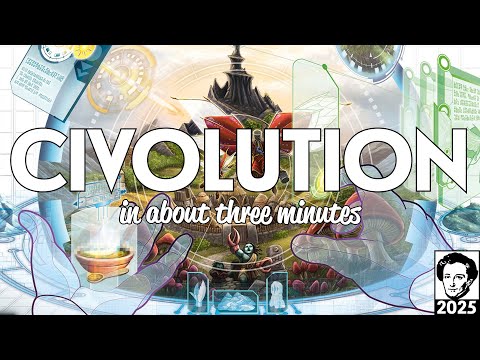














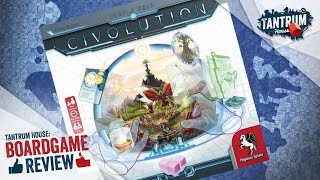













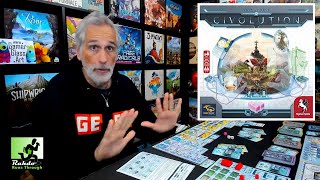
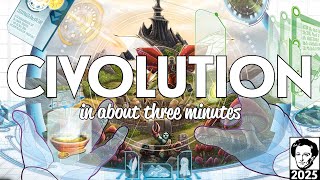
Civolution box art

Civolution

Game ID: GID0069273
Collection Status
Description

Hello, student beings! The cosmic faculty of the Technical Academy of Creation is delighted to welcome you to your Civolution, the final exam in Civilization Design!

For this occasion, we prepared a humanoid scenario on an isolated continent. Here, each of you holds the rank of a local deity which is closely linked to its very own civilization and must lead it to success over the other civilizations. Your developmental possibilities are endless and reach from cultural and technical progress to evolutional adaptations. For example, what would you consider more beneficial to your tribes: inventing the wheel or growing wings? Demonstrate your ability to operate your civilization console and show us how well you can adjust to changeable environmental conditions and mild creational chaos.

When the exam ceases after four eras, whoever managed to gather the most success points will not only pass the exam but will become a full member of the Technical Academy of Creation and garner the opportunity to be promoted to the next instance.

Civolution is a medium heavy to heavy euro-style game that utilizes a dice selection mechanism to trigger actions on a tech tree-like structure. As you figure out how to best use your dice and put your unique cards into play, tons of strategies and paths to victory emerge, though each time you play, you will only explore a fraction of the possibilities that the game’s system and many cards provide.

—description from the publisher

A webapp implementation of the V.I.C.I solo automa is available (requires a physical copy of the game).

Year Published
2024
Transcript Analysis
Browse transcript mentions, sentiments, pros/cons, mechanics, topics, quotes, and references.
Total mentions: 17
This page: 17
Sentiment: pos 14 · mix 2 · neu 0 · neg 1
Mentions per page
Top
Showing 1–17 of 17
Video ldLfzRof980 Totally Tabled top_10_list at 14:05 sentiment: positive
video_pk 42295 · mention_pk 128335
Totally Tabled - Civolution video thumbnail
Click to watch at 14:05 · YouTube ↗
Overall sentiment (raw)
positive
Pros
  • Very streamlined AI for a game of this complexity.
  • No need for a dedicated automa board; decisions are quick and clear.
Cons
  • The decision process may rely on a die, introducing randomness to planning.
Thematic elements
  • Resource-free automation that emphasizes decision-making and card play.
  • Automa-facilitated empire-building with streamlined AI.
  • AI uses cards with blue/red sides to adjust difficulty; decisions are intuitive.
Comparison games
none
Mechanics (from transcript analysis)
  • Card-driven automa — Automa flips a card and picks actions, with a die determining between options.
  • Variable difficulty via card sides — Blue side = weaker actions; Red side = stronger actions; adjust by eras.
Video topics + discussion points
No key topics recorded for this video.
Quotes (from this video)
  • One of my favorite games of all time.
  • The joy of obsession is puzzling out your servants and your guests and trying to put on the best social activities and get the money to get the improvements for your estate to restore your family's reputation.
  • The AI system is brilliantly done, and it's so quick and simple to manage.
  • This is about as simple as a solo opponent can get.
References (from this video)
No references stored for this video.
Video -G8Sq6iDSf0 Toy Table playthrough at 0:00 sentiment: positive
video_pk 39622 · mention_pk 119685
Toy Table - Civolution video thumbnail
Click to watch at 0:00 · YouTube ↗
Overall sentiment (raw)
positive
Pros
  • Strong exploration emphasis with high player agency
  • High replayability due to random setup across many components
  • Clear sense of progression through eras with meaningful decisions
  • Competitive solo AI adds challenge and structure
Cons
  • Complex setup and rule overhead for newcomers
  • Dice-driven randomness can affect early game balance
  • Terrain interactions (e.g., volcano effects) create occasional tough constraints
Thematic elements
  • civilization design exam; civilization-themed Euro game
  • A mythic civilization-building world where players are deities evaluating civilization design
  • solo commentary with instructional narration
Comparison games
none
Mechanics (from transcript analysis)
  • Compound Scoring — End-of-era scoring along multiple tracks (culture, technology, etc.) with bonuses and market/house rules.
  • dice-based action selection — Players spend two specific dice numbers to perform actions from a grid of actions; early and later levels upgrade actions.
  • Era-based scoring with tracks — End-of-era scoring along multiple tracks (culture, technology, etc.) with bonuses and market/house rules.
  • Event/income conversion to features — Event/income tiles allow converting goods into permanent features or capabilities based on majority goods.
  • Modular, randomized setup — Map tiles, sites, resources, and goals are randomized to create varied setups each game.
  • Tiered action cards/console — Actions can be upgraded by placing cards into a multi-level console, granting bonuses and triggering ongoing abilities.
  • Tribe/encampment placement and feeding — Tribes are placed on terrains; feeding phase requires food or provisioning to keep tribes alive.
Video topics + discussion points
No key topics recorded for this video.
Quotes (from this video)
  • it's more like a civilization themed Euro game
  • the action phase this is the meat of the game where we're going to go back and forth taking turns doing actions
  • we're in the lead right out of the gate
  • we can flip one of our action tiles to the next level
  • the exploration action has an alternative action that you could take
References (from this video)
No references stored for this video.
Video eMGtMGPVx5g Unknown playthrough at 0:00 sentiment: positive
video_pk 39128 · mention_pk 117936
Unknown - Civolution video thumbnail
Click to watch at 0:00 · YouTube ↗
Overall sentiment (raw)
positive
Pros
  • Engaging engine-building with multiple viable scoring paths
  • Rich thematic flavor reinforced by tangible resources (gold, papyrus, jade, oil)
  • Dynamic scoring both per era and in the final tally adds strategic depth
  • Terrain considerations (forests, glaciers) create interesting placement decisions
  • Energetic, entertaining live commentary enhances viewer engagement
Cons
  • Time pressure can force resets or rushed decisions
  • End-game scoring depth may be complex for new players or casual viewers
  • Visuals in video might make some terrain interactions hard to interpret on screen
  • Dice-driven exploration/forest outcomes introduce randomness that can affect pacing
Thematic elements
  • Civilization development, resource management, era progression, and spatial/territorial growth through tiered scoring and infrastructure building.
  • Modular board with eras and tribes, set in an ancient civilization environment featuring geographic features (forests, grasslands, glaciers).
  • Live, commentary-driven decision making with explicit scoring narration and real-time strategic choices.
Comparison games
none
Mechanics (from transcript analysis)
  • Achievements and knowledge track — Achievements can be installed to advance on a knowledge track, sometimes flipping scoring tiles and altering end-game scoring.
  • Action selection and placement — Players choose actions (production, exploration, movement, and construction) that affect board state, tracks, and resource flow.
  • Building statues and board enhancement — Spending resources to construct statues provides movement on tracks and potential end-game bonuses when flipped.
  • end game bonuses — Final scoring tallies various columns, tracks and tokens; certain columns grant bonus points per item, influencing late-game strategy.
  • End-game decoding and bonuses — Final scoring tallies various columns, tracks and tokens; certain columns grant bonus points per item, influencing late-game strategy.
  • era progression and scoring — Game progresses through four eras with escalating scoring opportunities; end-of-era and end-of-game scoring influence final totals.
  • Hunting and feeding — Inhabitants must be fed; hunting yields food that sustains the tribe and contributes to scoring opportunities.
  • income — Income phase grants resources and can trigger events or modifiers that affect subsequent turns.
  • Income and event timing — Income phase grants resources and can trigger events or modifiers that affect subsequent turns.
  • Resource management — Players generate and store resources (gold, papyrus, jade, oil) based on settlements, storage capacity, and production actions each era.
  • Resource production and storage — Players generate and store resources (gold, papyrus, jade, oil) based on settlements, storage capacity, and production actions each era.
  • Terrain-driven placement — Terrain such as forests and glaciers influence placement and scoring decisions, with specific rules for where pieces can go.
  • Track advancement — Achievements can be installed to advance on a knowledge track, sometimes flipping scoring tiles and altering end-game scoring.
Video topics + discussion points
No key topics recorded for this video.
Quotes (from this video)
  • This is coming together nicely
  • Complete solo game of Civolution
  • We have a little bit of a secret weapon here because they're done scoring
References (from this video)
No references stored for this video.
Video MzQvLwsin4s board gaming doctor top_10_list at 11:02 sentiment: positive
video_pk 38858 · mention_pk 117112
board gaming doctor - Civolution video thumbnail
Click to watch at 11:02 · YouTube ↗
Overall sentiment (raw)
positive
Pros
  • deep, puzzle-forward experience
  • high potential to evolve with solo playthrough upcoming
Cons
  • heavy and potentially intimidating for new players
Thematic elements
  • heavy civilization-building with integrated mechanics
  • civilization-themed world
  • modern heavy euro puzzle with evolving systems
Comparison games
  • Castles of Burgundy
Mechanics (from transcript analysis)
  • complex puzzle solving — high complexity and planning required
  • dig deeper into mechanics from Burgundy — blends Burgundy-like mechanisms with newer modern euro ideas
Video topics + discussion points
No key topics recorded for this video.
Quotes (from this video)
  • "This is a Rosenberg in which you are drafting tiles and building your own tableau of them."
  • "Plus the uh the message that it it's trying to send is really nice too for environmentalism in Africa."
  • "So that is my number 10, Click Tree."
  • "My number two is Clans of Caledonia. This game is a kind of similar approach in the style of game as Terrammystica, Gaia Project, etc."
References (from this video)
No references stored for this video.
Video bLPWZ-MPvA8 Board Game Garden general_discussion at 21:43 sentiment: positive
video_pk 37861 · mention_pk 113770
Board Game Garden - Civolution video thumbnail
Click to watch at 21:43 · YouTube ↗
Overall sentiment (raw)
positive
Pros
none
Cons
none
Thematic elements
Comparison games
none
Mechanics (from transcript analysis)
Mechanics unknown.
Video topics + discussion points
No key topics recorded for this video.
Quotes (from this video)
  • you are somebody's reason to smile
  • we are so close to 30,000 Garden members
  • thank you all so much for watching and for your support
  • I am leaving for Japan and I cannot wait to document it
References (from this video)
No references stored for this video.
Video iQ-8hs4SeVI Board Gaming Doctor game_review at 0:07 sentiment: positive
video_pk 31863 · mention_pk 93948
Board Gaming Doctor - Civolution video thumbnail
Click to watch at 0:07 · YouTube ↗
Overall sentiment (raw)
positive
Pros
  • Immense replayability with multiple victory paths and varied eras/events
  • Excellent iconography and well-written rules that support complex decisions
  • Strong thematic integration between theme and mechanics, making the civ progression feel coherent
  • Depth of strategy with meaningful decisions and long-term planning
  • Solid solo mode and potential for competitive play in more players
Cons
  • Heavy learning curve and long rulebook; learning can take substantial time
  • Long playtimes, representing a substantial time investment for multi-hour sessions
  • Dice-driven randomness can frustrate players seeking deterministic outcomes
  • Limited interaction in two-player games, which may reduce tension for some groups
Thematic elements
  • Civilization development through Eurogame mechanics in a sci-fi setting
  • Futuristic civilization simulation framed around a class-based societal structure and a final exam-style civilization arc
  • Abstracted, theme-driven progression rather than a narrative storytelling approach
Comparison games
  • Castles of Burgundy
  • A Feast for Odin
  • Tapestry
Mechanics (from transcript analysis)
  • card drafting — Draft cards or build from your hand to influence routes to victory and scoring opportunities
  • Card drafting and building along tracks — Draft cards or build from your hand to influence routes to victory and scoring opportunities
  • Compound Scoring — End-of-era scoring is driven by randomly selected eras/events that shape scoring priorities each game
  • Dice placement and dice-driven action selection — Roll dice and assign them to actions on the board, with mitigation options like focus markers and planning resources to tweak outcomes
  • Dice tableau-building with cards — Use drafted or drawn cards to construct a tableau that unlocks or modifies actions, tying card costs to resource management
  • Era-based variability and event-driven scoring — End-of-era scoring is driven by randomly selected eras/events that shape scoring priorities each game
  • Hunting/feeding mechanism — Acquire food through terrain-based logic to sustain populations, linking to thematic survival and growth
  • Resource management — Gather and allocate resources, manage population needs, and explore regions to locate resources and scoring opportunities
  • Resource management and exploration — Gather and allocate resources, manage population needs, and explore regions to locate resources and scoring opportunities
  • Tile-based scoring and prosperity — Place tiles to fill in income or scoring opportunities on your tableau, multiplying points through tiered fills
  • Track advancement — Advance on thematic tracks and score based on progress at the end of rounds and in final scoring phases
  • Track advancement and end-round scoring — Advance on thematic tracks and score based on progress at the end of rounds and in final scoring phases
Video topics + discussion points
No key topics recorded for this video.
Quotes (from this video)
  • this game is very complex and long but deeply rewarding
  • I think this is the most thematically integrated Euro game I've ever played
  • there's immense replayability with this game with different paths to Victory
  • the iconography is very well done
  • the solo mode is quite surprisingly simple to do
  • this organization is happening thematically as well as logistically
References (from this video)
No references stored for this video.
Video Yf8iuFgLe-E Onetop Co-op Shop game_review at 0:00 sentiment: mixed
video_pk 28782 · mention_pk 84462
Onetop Co-op Shop - Civolution video thumbnail
Click to watch at 0:00 · YouTube ↗
Overall sentiment (raw)
mixed
Pros
  • Solo bot is easy to resolve and interacts with core game goals
  • Endgame and era scoring provide strong variety and strategic direction
  • Board play and territory expansion deliver a solid civilization feel
  • Cards and chits offer a wide range of powers and victory point opportunities
  • High replay value due to event variety, tiles, goals, and card draws
  • Not a combat-focused civ game, which can be appealing for players seeking non-combat civ experiences
  • Action system is highly engaging and offers deep strategic choices
Cons
  • Significant luck component due to dice rolls and random draws
  • Some card/ability combinations swingy depending on acquisition and fit with era goals
  • Complexity can be intimidating and may digest slowly for some players
  • Heavy emphasis on luck may deter players who dislike luck in Euro games
Thematic elements
  • Empire-building, exploration, and territorial control
  • Civilization-building with a modular, tile-based map across four eras
  • Array
  • Strategic, with historical/civilizational progression and evolving goals across eras.
Comparison games
  • Castles of Burgundy
Mechanics (from transcript analysis)
Mechanics unknown.
Video topics + discussion points
No key topics recorded for this video.
Quotes (from this video)
  • the bot is super easy to resolve.
  • the endgame scoring and the era scoring, which gives the game a ton of variety.
  • There's just so much to bring you back to this game time after time.
  • the cards and chits that you get to install on your playerboard for bonuses and points.
  • It is immensely interesting and really challenges you to figure out how to work the best you can with imperfect resources.
  • But I think it is also by far the most frustrating aspect of the game and the one that'll push people who are randomness averse away.
  • If you like civilization games, although again, it doesn't have combat...
  • Overall, you might want to check out Colution if you like complex years.
  • If you like failed games like Castles of Burgundy, it's not quite identical, but the dice activation here is similar.
  • If you don't like luck in your Euros, this is one that has a pretty heavy dose of luck, especially for a longer Euro game.
References (from this video)
No references stored for this video.
Video _pXKWgDJNbg The Brothers Murf top_10_list at 18:00 sentiment: positive
video_pk 13812 · mention_pk 40331
The Brothers Murf - Civolution video thumbnail
Click to watch at 18:00 · YouTube ↗
Overall sentiment (raw)
positive
Pros
  • Interesting deity-centric twist on civilization-building
  • Crunchy but thematic for players who like engine-building
Cons
  • Abstract mechanics may be confusing at first
  • Dice-centric play can introduce luck elements
Thematic elements
  • deity-run civilization-building through dice-driven actions
  • Deities shaping civilizations; gods govern tribes and mutations.
  • dice-driven with mutation cards and tribal movement
Comparison games
none
Mechanics (from transcript analysis)
  • card-driven tech/mutations — Cards grant technologies, mutations, and track bumps.
  • Dice-driven actions — Dice determine actions and resources for tribes and mutations.
  • tableau/tech progression — Play and activate cards to progress on technology tracks.
Video topics + discussion points
No key topics recorded for this video.
Quotes (from this video)
  • We absolutely adore this game. It's super super fun.
  • the big Mayan calendar in the middle
  • you can place a worker on the symbol that matches the god card.
  • This is a big deck building game where you are going to have a different nation.
  • Every game I feel like is a little bit different because the board map will change.
  • Civolution is very good.
References (from this video)
No references stored for this video.
Video b7oAU0Q6TZI The Grumperon top_10_list at 5:15 sentiment: positive
video_pk 11729 · mention_pk 34392
The Grumperon - Civolution video thumbnail
Click to watch at 5:15 · YouTube ↗
Overall sentiment (raw)
positive
Pros
  • Epic scale and deep decision space
  • Very satisfying engine-building feel
Cons
  • Heavy and long; may overwhelm casual players
  • Complex-to-learn rules and many actions
Thematic elements
  • Civilization-building with dice-based actions
  • Civilizational development across regions
  • Epic, long-form strategy with multiple action choices
Comparison games
  • Castles of Burgundy (inspiration and dice-based action economy)
Mechanics (from transcript analysis)
  • Dice placement for actions — Dice are used to perform a wide range of actions such as building and exploring
  • Region-based development — Advancing a civilization through technological and resource choices
Video topics + discussion points
No key topics recorded for this video.
Quotes (from this video)
  • The visually most pleasing board game, Euro game of all time.
  • I can't stop thinking about this game and want to play it again and again.
  • The box is actually part of the game.
  • It's the best character building in board games, period.
  • The historic flavor, the politics, the negotiation, the backstabbing makes this an amazing game experience.
References (from this video)
No references stored for this video.
Video D8M5ZOC-o98 Chairman of the Board top_10_list at 16:04 sentiment: positive
video_pk 10795 · mention_pk 31867
Chairman of the Board - Civolution video thumbnail
Click to watch at 16:04 · YouTube ↗
Overall sentiment (raw)
positive
Pros
  • Grand, epic feel with tightly interwoven mechanics
  • Smooth blend of euro strategy and aggressive tension
  • Flexible paths to victory and a strong sense of forward planning
Cons
  • High complexity can be intimidating to new players
  • Richness can lead to lengthy play sessions
Thematic elements
  • epic scale with multiple paths to victory
  • Grand strategic civilization-building
  • grand strategy with euro-influenced depth
Comparison games
none
Mechanics (from transcript analysis)
  • Auction / Bidding — Players bid with reusable tokens to shape board state and endgame timing.
  • auction/bidding with tokens — Players bid with reusable tokens to shape board state and endgame timing.
  • Compound Scoring — Points come from diverse sources, rewarding flexible planning.
  • multi-path scoring — Points come from diverse sources, rewarding flexible planning.
  • Resource management — Resource flows and tile placement shape future options and tension.
  • tile/resource management — Resource flows and tile placement shape future options and tension.
Video topics + discussion points
No key topics recorded for this video.
Quotes (from this video)
  • I love the sense of urgency when it comes to rushing to these islands and getting them populated as quickly as you can.
  • This game is the absolute best of the best. You know, the top 1% of the top 1% of the games that I've played.
  • I could not speak more highly of this design.
  • The dice-driven twist, the engine-building, the tension—this is why I play board games.
References (from this video)
No references stored for this video.
Video XTwzc9OSEgA The Dice Tower top_5_list at 30:19 sentiment: positive
video_pk 9617 · mention_pk 28415
The Dice Tower - Civolution video thumbnail
Click to watch at 30:19 · YouTube ↗
Overall sentiment (raw)
positive
Pros
none
Cons
none
Thematic elements
  • civilization development
  • Civilization-building era
  • historical/strategic progression
Comparison games
none
Mechanics (from transcript analysis)
  • Resource management / city-building — Core euro-style mechanics with civilization advancement
  • Scoring / progression — Track progress across epochs
Video topics + discussion points
No key topics recorded for this video.
Quotes (from this video)
  • Most expansions are a net negative.
  • I'm almost completely over miniatures. I think that any game is perfectly fine with standies and that miniatures are wasting space.
  • I love apps and board games. And I think it brings more people in the hobby and it's good.
  • Not every game needs a distinct two-player version of that game.
  • The more expansions that you've released for your game, the less likely I am to want to play the base game.
  • Campaigns bigger, better. I mean, AON Trespass Odyssey is a box this big.
  • You should never teach people how to play a game by sitting down and reading the rules to them.
  • Give me table space. How much area on the back of the box does the game require to be played at full player count?
  • If you read the rulebook carefully, you can understand it. It is not meant to be browsed like a novel.
  • Legacy party games could work.
  • There should be table space information on the box—how much table space you need for the full player count.
References (from this video)
No references stored for this video.
Video 73gQ0ydNTsM Chairman of the Board top_10_list at 12:45 sentiment: positive
video_pk 9377 · mention_pk 91827
Chairman of the Board - Civolution video thumbnail
Click to watch at 12:45 · YouTube ↗
Overall sentiment (raw)
positive
Pros
  • heaviest and most ambitious Feld-like title on the list
  • deep mechanics with multiple strategic pathways
  • replayable with varied pacing per session
Cons
  • very broad in scope; may be intimidating for new players
Thematic elements
  • engine development with adaptable player boards
  • Civilization-style climbing on tracks and maps
Comparison games
  • Castles of Burgundy
  • Chinatown
Mechanics (from transcript analysis)
  • Dice-action allocation reminiscent of Castles of Burgundy — Allocate dice to actions; mitigations exist but aren't mandatory.
  • End-game/objective pacing — Multiple end-game objectives and engine upgrades drive long-term strategy.
Video topics + discussion points
No key topics recorded for this video.
Quotes (from this video)
  • a lovely mediumweight Euro by board and dice
  • the dice has dual use
  • I love the way that everything is driven here through dice
  • spatial puzzle
  • an instant classic
  • a great example of its genre
  • I instantly fell in love with it
  • Kitzia at his best
  • Punchy, colorful and very engaging
  • top tier kitzia for me
References (from this video)
No references stored for this video.
Video gWu9gVOHlWA Paul Groen top_10_list at 36:58 sentiment: positive
video_pk 8287 · mention_pk 24308
Paul Groen - Civolution video thumbnail
Click to watch at 36:58 · YouTube ↗
Overall sentiment (raw)
positive
Pros
  • tight, fast civilization gameplay with approachable pace
  • strong core mechanics and approachable dice system
  • high-quality production from Deep Print Games
Cons
  • dice randomness can be polarizing for some players
  • some players may desire deeper chaining or automation
Thematic elements
  • civ-game design with micro-turn execution
  • civilization-building with a compact, fast-turn format
  • mechanical civ flavor with light narrative cues
Comparison games
  • Civilization (classic civ games)
Mechanics (from transcript analysis)
  • civilization progression — typical civ-act sequence condensed into fast rounds
  • dice-driven core — dice mechanics drive action and progress with some house-rule potential
  • micro turns — turns are short and usually non-chainable; minimal downtime
Video topics + discussion points
No key topics recorded for this video.
Quotes (from this video)
  • If you enjoy the Ingenious game, I would definitely have a look at Ingenious 3D.
  • Tower Up is the game that I would play with non-gamers.
  • This is SETI, and it's cool from a mechanical perspective.
  • The narrative is exceptional. The writing style is superb.
  • Civolution has micro turns... your turn is generally fairly short and doesn't contain any chaining of actions.
References (from this video)
No references stored for this video.
Video tgcNkLDWDJ4 OneTop Co-op Shop playthrough at 0:00 sentiment: positive
video_pk 5695 · mention_pk 16933
OneTop Co-op Shop - Civolution video thumbnail
Click to watch at 0:00 · YouTube ↗
Overall sentiment (raw)
positive
Pros
  • Huge variety in scoring and strategic paths across eras.
  • Solid solo/automa implementation with meaningful interaction between the human and bot.
  • Tight coupling of dice, actions, and upgrades creates interesting optimization decisions.
  • Deep engine-building with layered incentives and multiple upgrade tracks.
  • Modular board and terrain variety yield high replayability and emergent strategies.
Cons
  • Considerable rule complexity and setup; learning curve is steep.
  • Long play sessions and heavy component management may deter lighter gamers.
  • Balancing and pacing can be challenging, especially for new players learning the mechanics.
Thematic elements
  • Empire-building, resource management, exploration, and adaptation across eras.
  • Modular board-based empire-building with tribal factions and territorial exploration.
  • Engine-building/Euro-style with modular setup, evolving tech, and variable end-game scoring.
Comparison games
  • Castles of Burgundy
Mechanics (from transcript analysis)
  • Automa (solo mode) — A scripted bot opponent that uses its own deck of cards, tracks, and goals to compete against the human player.
  • Building and installation columns — Place buildings and chips into stage/row columns; placement locks future tiles of the same type to that column.
  • dice-driven action system — Players select two dice and their values determine which actions they can take; modifiers and fate dice add flexibility.
  • End-of-era and era-scoring variety — Each era scores certain tracks and randomizes which scoring types will be worth more later; players can upgrade modules to influence scoring.
  • Event/weather deck — Era events alter weather and scoring; weather can enable certain income tiles or impose penalties.
  • Exploration and activation of adjacent tiles — Exploration actions reveal and flip adjacent tiles, potentially uncovering valuable building grounds or resources.
  • Hunting and feeding phase — Territories provide hunting options; players must feed their tribes, with wilderness costing double to feed.
  • Modular board construction — The board is built from territory tiles, creating a unique map each game with different terrain types.
  • Procreation and migration — Tribes can procreate into adjacent territories if strong, with migration rules and territorial control affecting scoring.
  • Research/tech decks — Starting tech cards from multiple decks; players draw and slot them for ongoing or immediate bonuses.
  • Resource conversion and income tiles — Income tiles provide ongoing income, which can be activated via upgrades or specific actions.
  • Resource management — Players manage money, food, and terrain-specific resources (wood, gold, etc.) to build and upgrade.
  • Statues and Aggera track — Statues provide ongoing end-of-era bonuses; Aggera favor checks unlock powerful actions and bonuses.
  • Upgrade pathways and row effects — Upgrading actions unlocks more powerful card plays and provides benefits when expanding rows and tracks.
Video topics + discussion points
No key topics recorded for this video.
Quotes (from this video)
  • the game has a ton of variety in what is valuable each play.
  • the ocean is the best place to hunt.
  • the level three version is actually printed inside of the board.
  • this event was insane in its implications for building progress.
References (from this video)
No references stored for this video.
Video WUs-9dr_N9k R runs through playthrough at 0:00 sentiment: mixed
video_pk 5735 · mention_pk 17012
R runs through - Civolution video thumbnail
Click to watch at 0:00 · YouTube ↗
Overall sentiment (raw)
mixed
Pros
  • deep strategic depth and high replay potential
  • clever integration of dice, cards, and tracks
  • beautiful production design and component quality
  • strong thematic cohesion despite abstract mechanics
  • rich scope for pivoting strategies mid-game
Cons
  • very long play sessions; pace can be draining for two players
  • high complexity and learning curve
  • rulebook and setup are dense; casual players may feel overwhelmed
  • endgame can be hard to accelerate without Prelude-style shortcuts
Thematic elements
  • evolution of civilizations, resource management, and strategic planning under pressure
  • alien civilization academy on a newly discovered planet; finals week with an exam in civilization design
  • playthrough diary-style commentary with setup, decisions, and endgame reflection
Comparison games
  • Castle of Burgundy
  • Terraforming Mars Prelude
Mechanics (from transcript analysis)
  • card drafting and deck synergy — starting markers and cards (Insight, Mutation, Invention, etc.) are drafted and later combined with other cards to shape strategy.
  • dice-based action engine with modification — players roll a set of dice and modify their values using focus, ideas, and mutations to perform actions like migration, production, or card play.
  • event-driven era progression and end-of-era scoring — each era introduces events; end-of-era scoring and threshold tracking determine ongoing bonuses and final points.
  • exploration and regional resource management — the map is region-based with forests, grasslands, deserts, swamps, and mountains; exploration reveals sites and resources.
  • track-based scoring and upgrades — technology, culture, and prestige tracks drive scoring; upgrades to mutations and activities change future options.
Video topics + discussion points
No key topics recorded for this video.
Quotes (from this video)
  • this designer stefen feld's masterpiece pie
  • this is burgundy in a nutshell
  • not a keeper for me
  • this is a tactical game and I think it's great
  • this is such a huge combinations of things you could try to do
  • Pivot and do something else
References (from this video)
No references stored for this video.
Video hEA_boZSN7I Board Games Hitting My Table general_discussion at 0:30 sentiment: positive
video_pk 5189 · mention_pk 15391
Board Games Hitting My Table - Civolution video thumbnail
Click to watch at 0:30 · YouTube ↗
Overall sentiment (raw)
positive
Pros
  • Deep engine-building with multiple viable routes
  • Card interactions are meaningful without overwhelming players
  • Balanced endgame scoring that rewards planning
Cons
  • Long play time
  • Limited direct interaction at 2 players; three players recommended for more engagement
Thematic elements
  • Euro-engineering on a map with route diversification
  • A sprawling map-based engine-building euro where players travel, collect resources, and optimize routes
  • Strategic optimization with multiple viable pathways
Comparison games
  • Concordia
  • The Gallerist
Mechanics (from transcript analysis)
  • Card-driven yet balanced — Cards provide options but are generally expensive to play, preventing card overload
  • Dice-driven actions — Dice activation triggers options on player boards, creating a dice-based action economy
  • engine-building — Players develop a scoring engine through card-chains and tracks
  • Resource management — Resource gathering and conversion to fuel endgame scoring and engine growth
Video topics + discussion points
No key topics recorded for this video.
Quotes (from this video)
  • "I am learning to love this game more and more as I become more familiar with it."
  • "this game struck a really nice balance of making the cards important but not making it entirely card driven."
  • "this is a pretty wild bidding game"
  • "some really cool swings, some good kind of guer manipulation"
  • "not a tug-of-war game... it's more of a traditional euro"
  • "it's a really good one. very mass appeal and I'd highly recommend Push."
References (from this video)
No references stored for this video.
Video aSfcAI2EXfI Three Minute Board Game game_review sentiment: negative
video_pk 866 · mention_pk 2480
Overall sentiment (raw)
negative
Pros
  • Variety of actions
  • Interesting dice system
  • Modular board
Cons
  • Overly complex
  • Lacks memorable moments
  • Feels like busy work
  • Thematically weak
Thematic elements
  • Civilization building
  • Far future studying historical civilization
  • Academic simulation
Comparison games
  • Castles of Burgundy
  • Mosaic
Mechanics (from transcript analysis)
  • Dice Action Selection — Players use matching dice sets to take actions
  • Resource management — Collect and manage resources through various actions
  • Tech Tree — Players advance on technology tracks and upgrade skills
Video topics + discussion points
No key topics recorded for this video.
Quotes (from this video)
  • Civolution: The Castles of Microsoft Excel
  • More is almost always better in Civolution
References (from this video)
No references stored for this video.
Transcript Navigation
Top
Showing 1–17 of 17
View on BoardGameGeek