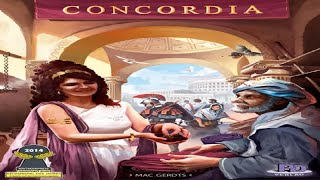
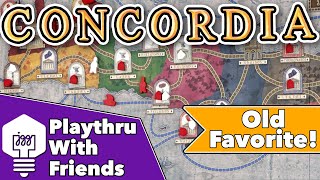
Two thousand years ago, the Roman Empire ruled the lands around the Mediterranean Sea. With peace at the borders, harmony inside the provinces, uniform law, and a common currency, the economy thrived and gave rise to mighty Roman dynasties as they expanded throughout the numerous cities. Guide one of these dynasties and send colonists to the remote realms of the Empire; develop your trade network; and appease the ancient gods for their favor — all to gain the chance to emerge victorious!
Concordia is a peaceful, strategy game of economic development in Roman times for 2-5 players aged 13 and up. Instead of looking to the luck of dice or cards, players must rely on their strategic abilities. Be sure to watch your rivals to determine which goals they are pursuing and where you can outpace them! In the game, colonists are sent out from Rome to settle down in cities that produce bricks, food, tools, wine, and cloth. Each player starts with an identical set of playing cards and acquires more cards during the game. These cards serve two purposes:
They allow a player to choose actions during the game.
They are worth victory points (VPs) at the end of the game.
Concordia is a strategy game that requires advanced planning and consideration of your opponent's moves. Every game is different, not only because of the sequence of new cards on sale but also due to the modular layout of cities. (One side of the game board shows the entire Roman Empire with 30 cities for 3-5 players, while the other shows Roman Italy with 25 cities for 2-4 players.) When all cards have been sold or after the first player builds their 15th house, the game ends. The player with the most VPs from the gods (Jupiter, Saturnus, Mercurius, Minerva, Vesta, etc.) wins the game.
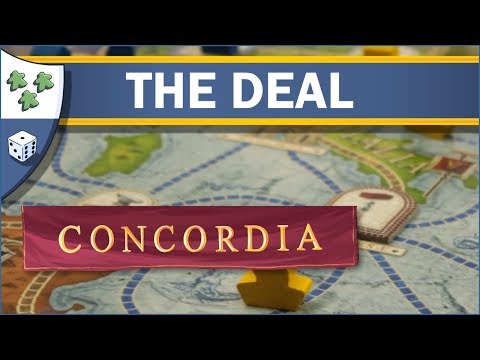
Concordia in about 3 minutes
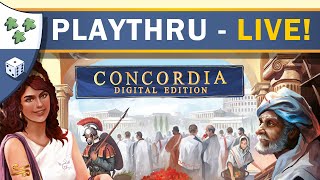
Concordia - 5 Player Live Playthrough
Mechanics (from transcript analysis)
- deck-building with actions — Decks influence actions and scoring; many paths to optimize points.
Video topics + discussion points
Quotes (from this video)
- this is really interconnected worker placementish game.
- it's surprisingly smooth for how many moving parts there are.
- it's a game of inches where every space matters.
- there's way too many moving parts to explain here, but it is very very satisfying.
- you can definitely not just follow one thing and focus on one thing.
References (from this video)
- Elegant card-interaction with scoring multipliers
- Accessible yet deep
- Can be dry if misplayed
- Requires optimization over time
- Economic development/network-building
- Roman trade empire with route-building and card interactions
- Elegant, modular strategy
- Gaia Project
- Brass Birmingham
- Power Grid
Mechanics (from transcript analysis)
- deck-building with scoring multipliers — Cards influence both actions and scoring multipliers
- Network/route building — Connect routes to maximize efficiency and scoring
- network/route expansion — Connect routes to maximize efficiency and scoring
Video topics + discussion points
Quotes (from this video)
- it's a wonderful starter game for nearly anyone.
- how have I not played dominion
- when I played Dominion I just felt like an absolute idiot
- the quintessential racing game out there
- it's an absolutely brilliant game
- the best network builder of all time
References (from this video)
- economic development, exploration, and settlement
- Mediterranean basin in ancient/romanesque setting focusing on trade
- historical-economic narrative
- Gaia Project
- Brass: Birmingham
- Food Chain Magnate
Mechanics (from transcript analysis)
- deck-building/hand management — players manage a deck to perform actions and optimize income
- set collection/auction-ish gearing — collecting resources and fulfilling contracts for points
Video topics + discussion points
Quotes (from this video)
- I'm definitely into Dragon Eclipse right now
- I just have to bribe my youngest son to play 12 games with me on that
- Primal The Awakening I actually have here on my desk I'm playing it right this second
- I've never taken money for a preview
- if you're not consistent you're never going to get seen
References (from this video)
- Elegant design
- Strong strategy and replayability
- Complex for beginners
- Long playtime
- Economic empire-building through networks and card-driven actions
- Ancient Roman trade networks
- historical, systems-driven
Mechanics (from transcript analysis)
- Card-driven action selection — Cards are used to perform a variety of actions including settlement placement and resource gathering
- Multi-use cards — Cards are used to perform a variety of actions including settlement placement and resource gathering
- worker placement — Place workers to develop networks and collect resources
Video topics + discussion points
Quotes (from this video)
- There's tons of board games in the world, but only some are so freaking hot.
- This is one of the most thematic Lord Rings experiences you can get
- Welcome to the best racing board game. Ruin the freaking world.
- The cockpit of your car. You're going to put it in gear and then play as many cards as the gear says, three, for example, and hope you don't crash.
- This is a good game.
- In this game, you will be your own faction where you will collect these set resources or little workers that you will then use to place on the map.
References (from this video)
- deep and elegant engine/hand-management
- low look-impact but strong gameplay
- solo and two-player expansions available
- visually understated; not always immediately appealing
- trade, city-building, resource management
- Roman-era economic simulation and trade
- non-linear, strategic depth with hidden scoring
Mechanics (from transcript analysis)
- hand management — play cards from your hand to perform actions; discarded cards go to discard pile.
- hand_management — play cards from your hand to perform actions; discarded cards go to discard pile.
- resource_handling — collect resources to build and score across the map.
- tribune_mechanic — Tribune card lets you reclaim the discard pile for repeated actions.
Video topics + discussion points
Quotes (from this video)
- Earth is a fantastic bang for your buck.
- Tableau building with simultaneous play is great.
- I love this game so so much.
- I could talk about this for hours on end because I love this game so so much.
- I hate the way the game looks but I absolutely love the game play.
- Please ignore the look of it, try Concordia, I promise you you will enjoy it.
- Stardew Valley is a cooperative game, a great one to bring to the table if you have people in your life who aren't into board games.
- Cartographers is one of my favorite role and write games and will always have a special place in my heart.
- Near and Far is a campaign game; Francis and I have played through quite a few maps and we love this game.
- Tapestry is probably one of my favorite games right now; it's just so satisfying to me.
References (from this video)
- elegant, accessible mid-weight Euro
- hidden scoring increases tension and strategy
- scales well with player count
- table presence can be large
- some players find zoning choices repetitive
- economic optimization and resource planning
- Roman-era trade and empire-building
- abstract economic simulation with historical flavor
Mechanics (from transcript analysis)
- Card-driven action selection — Actions are triggered by cards and produce resource flows
- Modal economic engine — Efficient networked production and trade across regions
Video topics + discussion points
Quotes (from this video)
- Raiders of the North Sea
- it's a work placement game which does clever very very clever things with workers you have one worker and that is it you place a worker do an action you pick up another one and you do that action
- Cascadia cuz he's I think it's simple as a banger and MH but delivers a lot I like it it's very simple to to put on the table
- Root is a world that I I it's the closest to a board game world I just want to live in
- Pizza Pizza you can't beat Pizza Pizza is always you can't argue with your genetics
References (from this video)
- deep engine with minimal luck
- strong solo variant (Solitaria)
- economic route-building and logistics
- Roman trade empire
- euroscale optimization
- Paladins of the West Kingdom
Mechanics (from transcript analysis)
- economic engine — trade goods and build cities for points
- hand management — play cards to take actions and manage resources
- Hand management and card-driven actions — play cards to take actions and manage resources
- set collection and scoring multipliers — cards provide scoring opportunities that multiply with counts
Video topics + discussion points
Quotes (from this video)
- Cascadia is my number 10, it is a fantastic puzzly tiling game
- the veil of Eternity this game is so good
- Twist on Hadrian's Wall in Paladins feels similar but fresh
- Wayfarers of the South Tigress, carvan mechanic is one of my favorite things in a game
- Castles of Burgundy is my number one game of all time
References (from this video)
- strong solo implementation that preserves Concordia feel
- expansion adds meaningful solo options
- requires base Concordia or ownership of expansion to play
- economic strategy and empire building
- ancient trade empire, solo AI dynamics
- AI-driven card play with solo mechanics
- Concordia (base game)
Mechanics (from transcript analysis)
- Card play sequencing — play cards to influence AI and your own scoring
- solo card-driven AI — cards determine AI behavior and pacing; you optimize your card plays.
Video topics + discussion points
Quotes (from this video)
- this is a wonderful little puzzle game
- it's easy to get to the table
- I absolutely love this game
- Legacy of You has captured my heart
References (from this video)
- Elegant engine with tight optimization
- High replayability
- Strong scoring tension
- Can feel heavy for casual players
- Scaling requires careful player count consideration
- Trade, empire building, and migration
- Ancient Roman Empire
- Eurogame precision, economic engine
Mechanics (from transcript analysis)
- hand management — cards representing actions are played strategically
- Network/route building — players connect cities to optimize routes and scoring
- route-building / network building — players connect cities to optimize routes and scoring
- set collection — collect resources and fulfill objectives for points
- set collection / resource management — collect resources and fulfill objectives for points
- tile placement — tiles placed to form networks and gain points
- Tile placement / area development — tiles placed to form networks and gain points
Video topics + discussion points
Quotes (from this video)
- My heart is set on Miyabi it's happening
- Paint the Roses is gonna win
- Seize the Bean that's the winner
- I think I'm going with Katan y'all
- I think Cascadia is still going to be my choice
References (from this video)
- classic, well-regarded mid-weight Euro
- strong expansion potential and app integration
- steep learning curve for newcomers
- trade, resource management, exploration
- Roman Empire trading network
- card-driven actions with spatial expansion
- Gaia Project
- Terramystica
Mechanics (from transcript analysis)
- Area Control — expand into regions and claim advantages
- area control via expansion — expand into regions and claim advantages
- deck-building / hand management — cards provide actions and scoring options
- Resource management — move across a map to gain resources and score
Video topics + discussion points
Quotes (from this video)
- "This is a Rosenberg in which you are drafting tiles and building your own tableau of them."
- "Plus the uh the message that it it's trying to send is really nice too for environmentalism in Africa."
- "So that is my number 10, Click Tree."
- "My number two is Clans of Caledonia. This game is a kind of similar approach in the style of game as Terrammystica, Gaia Project, etc."
References (from this video)
- one of the author's favorite games
- fun to play with new-to-them players and different strategic viewpoints
- solving the puzzle requires experimentation with unfamiliar players
- economic engine building and route optimization
- Roman Empire trade and colonial expansion
- economic strategy in classical setting
Mechanics (from transcript analysis)
- engine building — developing routes and actions to optimize scores.
- set collection — collecting goods and commodities for points.
Video topics + discussion points
Quotes (from this video)
- "Cascadia is a fantastic game"
- "Time's Up is such a fantastic game"
- "Lacrimosa is a great game Francis and I really enjoyed it"
- "Architects of the West Kingdom... I love this game"
- "Kid-friendly, cozy and cute, Creature Comforts is the cutest thing"
- "Thank you so much for including me in this Charity Auction"
References (from this video)
- Elegant endgame scoring
- Deep strategic map interaction and planning
- No direct confrontation between players
- Trade and city-building across provinces
- Mediterranean trade empire
- Strategic, economic
- Lost Ruins of Arnack
Mechanics (from transcript analysis)
- deck-scheduling / card play — Play cards to perform actions (ship movement, building, etc.) and use prefect to boost regions.
- endgame scoring via card types — End-of-game scoring uses card-type multipliers based on how many of each type you have.
Video topics + discussion points
Quotes (from this video)
- Concordia is fantastic.
- Endgame scoring is so cool and unique.
- Obsession is such a fun game.
References (from this video)
- Aesthetic and tactile quality: the large, sturdy box and classic look evoke a timeless, enduring Eurogame feel.
- Historical Italian setting provides a familiar thematic backbone for players who enjoy economic strategy and network-building.
- Card-driven action economy offers elegant tension between short-term needs and long-term planning.
- Replayability is enhanced by card interactions and province-focused economics, allowing a range of strategies to emerge across plays.
- Component quality includes wooden pieces and a clean, legible map that remains legible as it ages.
- Rulebook density can be intimidating: early players may struggle with the depth of rules conveyed in dense, compact typography.
- The retro, old-map aesthetic may feel dated to newer players seeking a sleeker production style.
- Setup and teaching time can be non-trivial for groups new to card-driven Euro designs.
- Component aging can affect readability or perceived clarity of older editions, potentially impacting onboarding.
- Economic engine-building through trade, colonization, and resource management; players grow influence by establishing a trade network, managing income, and leveraging card-driven actions to expand into provinces and capitalize on markets.
- Concordia sits in the heart of an expansive Roman world, circa the expansion of trade and settlement across the Italian peninsula and adjacent regions. The game abstracts the movement of goods and people through a network of provinces, with cities and trade routes forming the backbone of a growing economy. The setting is deliberately broad and historical in flavor, offering players a sandbox of economic activity rather than a narrative-driven story.
- Historical abstraction rendered through a card-driven action economy. The theme is present but not overbearing; the game emphasizes systems and optimization over cinematic storytelling, presenting a clean, streamlined interpretation of trading in a classical Italian milieu.
Mechanics (from transcript analysis)
- Card-driven action selection — Each turn, a player selects a card from their hand, using the two action symbols printed on the card to determine the available actions. The card-based system creates a blend of predictability and tension, as players must balance immediate needs with future options showcased by the card's icons. The mechanism rewards planning and memory of which cards remain in hand for critical turns that can unlock powerful combinations.
- worker placement — Concordia uses a form of worker placement that hinges on card activation rather than raw positional advantage alone. Colonists (workers) are placed to gain income, settle new provinces, or activate trading routes, but the card-driven unlocks add a dynamic layer where choices are constrained by what cards you hold and how you sequence plays across the round. This results in a tight, strategic rhythm rather than a free-form drafting of actions.
- worker placement with a twist — Concordia uses a form of worker placement that hinges on card activation rather than raw positional advantage alone. Colonists (workers) are placed to gain income, settle new provinces, or activate trading routes, but the card-driven unlocks add a dynamic layer where choices are constrained by what cards you hold and how you sequence plays across the round. This results in a tight, strategic rhythm rather than a free-form drafting of actions.
Video topics + discussion points
Quotes (from this video)
- Look at this nice big box.
- This is an old game. This is an old classic game, but it's new to me that I'm doing a little research for a new video.
- what stood out right away is I know it's scary. Look at all that tiny text.
- From what I gathered, that's your turn.
- plain wooden meeples.
- Have you played Concordia? Have you opened the box recently? And if you haven't, open it again. Tell me what you think about it.
References (from this video)
- Deep, satisfying hand-management/collection feel
- Strong solo variant with expansions
- Not a pure deck-builder; some players want more deck-building focus
- Can be heavy to teach
- Roman trade empire and market-driven exploration
- Dune Imperium
- Lost Ruins of Arnak
Mechanics (from transcript analysis)
- Card-based resource acquisition and city building — Acquire cards to generate income and construct on the map; Tribune returns cards for coins.
- Hand / deck-building variant — Not a traditional deck-builder; emphasis is on hand configuration and card purchasing to gain resources and build on the map.
Video topics + discussion points
Quotes (from this video)
- Clank in space is fantastic
- this is quite a popular deck building worker placement game
- Concordia is not really a deck building game but it is a deck building/hand configuration game
- Lost Ruins of Arnak... the act of getting the most done on a turn as you possibly can
References (from this video)
- tight strategic depth
- clear euro-design with meaningful choices
- balanced interaction without luck-driven swings
- steeper learning curve for newcomers
- trade, expansion, colonization
- Roman Empire trading network across the Mediterranean
- historical Euro-style
- SWOT
Mechanics (from transcript analysis)
- Card-driven actions — Players select actions via cards that provide multiple options, shaping strategy.
- Trading and goods economy — Goods produced and traded for victory points; resources flow through the map.
- worker placement — Placement of tokens/buildings to access benefits and points.
- Worker/settlement placement — Placement of tokens/buildings to access benefits and points.
Video topics + discussion points
Quotes (from this video)
- Concordia is a benchmark, it is the SWOT in its class.
- this game is tight, strategic and surprising and is a great example of what a Euro can be.
- Escape room games are the ultimate form of escapism.
- Elementary, my dear Watson.
- you will feel like one of the greatest detectives that never lived.
- Star Wars and Twilight Imperium are nothing alike.
- Twilight Imperium is so close to real world politics the more I think about it the more it unsettles me.
- this is excellent with the right group of people.
- the box is about as big as some London apartments.
References (from this video)
- Deep strategic options once the rules click
- Elegant integration of mechanics into a coherent theme
- High replayability and meaningful decisions each session
- Clear sense of progression and long-term engine development
- Beautiful production quality and thematic coherence
- Steep learning curve for new players
- Early games can feel opaque without proper onboarding
- Rule explanations can be lengthy and intimidating
- Trade, exploration, and colonization across provinces
- Ancient Rome trading empire spanning the Mediterranean
- Eurogame mechanics-driven with historical veneer
- Spirit Island
Mechanics (from transcript analysis)
- card-driven action system — Players play action cards to select and resolve actions on the map, guiding their empire-building.
- Map exploration and route development (economic expansion) — Expansion across provinces and strategic placement of influence to access tiles and bonuses.
- Resource management and engine-building — Careful acquisition and conversion of goods into points and city growth to build momentum.
- Trading and set-collection — Acquiring different goods and exploiting markets to maximize VP potential.
Video topics + discussion points
Quotes (from this video)
- Concordia, after actually learning how to playing the game, we had a completely different experience.
- We absolutely love Concordia. We played it the other night and it was just such a fantastic experience.
- Knowing the rules and not knowing the rules, the different type of experience you can have.
- Laminate my board game to make sure that I didn't get hurt—ok, that bit was a joke, but the spirit is real: learn the rules.
- It's one of my top 15 board games of all time, and I want to play it as much as possible.
- Don't be the mobile phone user; put your phone down and be part of the group experience.
- Don't be a rules lawyer or an alpha gamer; let people make their own decisions and keep the game moving.
References (from this video)
- strong, clean engine-building with elegant card play
- variability via modular map and map tiles
- some players find it dry or less interactive compared to Puerto Rico
- map and scoring economy can feel repetitive over many plays
- trade routes and commercial expansion
- Mediterranean trade network; ancient commerce
- evolution of empire via card-based mechanics and market building
- Puerto Rico, Caverna (engine-building through card play), Terraforming Mars (strategy depth via cards)
Mechanics (from transcript analysis)
- Blocking and competition without heavy direct confrontation — interaction happens via space control and card timing
- Market/resource management with cards as engines — cards drive actions and scoring while markets shift
- Route optimization and hand management — players select cards to extend their trade network and actions
- Set-collection with modular map tiles — tiles create varied strategic layouts each game
Video topics + discussion points
Quotes (from this video)
- This is a top 10 list that we're roasting here, and yes, it's tongue-in-cheek but we actually like a lot of these games.
- Viticulture without Tuscany is basically nothing for me.
- This is a multiplayer solitaire in many sessions, but with blocking and interaction that can still feel brutal.
- The theme rocks it for me; mechanics are the engine, but a strong theme makes me want to replay.
- Pursuit of Happiness is one of those games where the life narrative matters as much as the mechanics.
References (from this video)
- considered one of the best euros by the presenter
- works extremely well on two players with tight maps
- can be heavy for new players
- economic engine-building with card-driven actions
- Roman-era trade and empire-building euro
- strategic, multi-path
Mechanics (from transcript analysis)
- hand-management / engine-building — cards drive actions and allow engine-building across map regions
Video topics + discussion points
Quotes (from this video)
- I think Concordia is one of the best games ever made, full stop
- two players it works extremely well because the downtime is gone
- it's a brain burner game
- the tension in the two-player game is great
- loads of content to explore, tons of replayability
References (from this video)
- Fun euro game experience
- Allows multiple strategies
- Strategic depth
- Real brain stressor
- Trading and territorial expansion
- Ancient Rome
- Mechanically-driven
- Agricola
Mechanics (from transcript analysis)
- Euro-style gameplay — Strategic trading and building mechanics
- Resource management — Swap and manage different resources
Video topics + discussion points
Quotes (from this video)
- Agricola is one of those games that you just got to have in your collection if you like euro style games
- Porta is one of my favorite underrated games
- Broom service I absolutely love food service one of the coolest mechanics in board games 100 percent recommend this game it is a hoot
- Barron Park is my favorite polyomino Tetris in a board game game
- Orleans is a top 5 game for me period just one of my favorite games to play ever
- Power grid this was the game that got me into board gaming y'all
- Seven wonders this is a modern-day classic
- Betrayal at house on the hill every game is different
- King of Tokyo one of those games that you have to have in your collection
- If you like board games one or percent recommend this game
References (from this video)
- Hand as engine analogy highlights tableau-building aspect
- Lacks gas-forging activation cadence in some views
- Disagreement about whether it is a pure engine builder
- Dominion
- Lorenzo Magnifico
Mechanics (from transcript analysis)
Video topics + discussion points
Quotes (from this video)
- furnace hits the my definition of an engine builder.
- it's a feeling not a mechanism.
- Terraforming Mars as being like a quintessential engine building game to me.
- Concordia... your hand in and of itself is an engine that you are building towards.
- Steampunk Rally matches your definition and it also matches mine in that it is you're making this frankenstein's monster of a racing machine.
- Golem is where you stack the cards and then you keep reactivating them.
- Darwin's Journey comes to mind.
- Dominion is deck builders but can build engines; it sits in a spectrum.
- Villages, vineyards, and aging workers can feel engine-like but not always.
- income is not an engine.
References (from this video)
- Deep strategic depth and multi-path victory potential
- Rich card interactions and combo potential
- Modular design with expansions and forum cards
- Steep learning curve and heavy rule set
- End-game scoring is intricate and can be confusing
- economic development through trade, colonization, and city-building
- Mediterranean trade network in the Roman era
- historical eurogame flavor with mythic gods as scoring themes
Mechanics (from transcript analysis)
- Card-driven action selection — Players choose actions by playing cards from hand to perform specific in-game actions.
- End-game scoring via gods and forum cards — Final scoring uses god-themed and forum cards with layered scoring conditions.
- hand management and deck-building — Cards add to hand and can be traded/copied; top card effects persist.
- Market and province production — Regions produce goods activated by province tiles; players trade goods at market values.
- Storehouse capacity management — Goods stored in a storehouse with limited spaces; overflow requires strategic handling.
- Worker/colonist movement and placement — Two types of colonists move on land or sea; placement to build cities.
Video topics + discussion points
Quotes (from this video)
- essentially this game you will play a card from your hand and then you'll do what it says on the card
- the end of game scoring is probably the most confusing thing about this game
- the final scoring this is probably the most convoluted
- it's a brain burner
References (from this video)
- elegant simplicity and sprawling depth
- masterful precision and flowing actions
- asymmetric scoring and multi-use cards
- digital adaptation is the treatment the game deserves
- two base game maps with more to come
- cross-play, AI, and local pass-and-play
- autoscoring option provides clarity for new players
- visually stunning with antique map aesthetics and smooth UI
- tutorial design focuses on actions rather than big-picture concepts, which can hinder first-time players
- tutorial could be improved for onboarding new players on the app
- online sign-up for the publisher's service can be a barrier
- expansion content like Salsa not included in Concordia Prime app yet
- economic engine-building, route optimization
- Roman Empire trade network across the map
- historical euro flavor with minimal narration
Mechanics (from transcript analysis)
- asymmetric scoring — Scoring conditions vary by cards and board state leading to asymmetry.
- Compound Scoring — Scoring conditions vary by cards and board state leading to asymmetry.
- economic production / resource management — Players manage resources and trade for points as the map develops.
- hand management — Players hold and play cards to take actions; cards have multiple uses.
- hand-management — Players hold and play cards to take actions; cards have multiple uses.
- map-based engine / route optimization — Players expand economic network across a map via routes and settlements.
- Multi-use action cards — Actions are chosen by playing cards that can have multiple effects depending on usage.
- Multi-use cards — Actions are chosen by playing cards that can have multiple effects depending on usage.
- Network/route building — Players expand economic network across a map via routes and settlements.
- Resource management — Players manage resources and trade for points as the map develops.
Video topics + discussion points
Quotes (from this video)
- elegant simplicity and sprawling depth
- the digital adaptation is absolutely the treatment the game deserves to start out with
- every action you take beautifully flows into the next
- two base game maps with the promise of more to come down the road
- cross-play compatible with ai or a local pass and play
- ability to toggle active scoring throughout the game as opposed to the classic end game scoring only
- that the tutorial is designed to walk a player through individual actions
- think the tutorial could have had a better design for people playing the game for the first time with the app
- concordia prime has some excellent expansion material
- faithfully reproducing one of the greatest games ever is nice
- the app is a great adaptation
References (from this video)
- clean design
- fluid engine-building feel
- economic trading and route optimization
- Mediterranean trade
- engine-building with historical flavor
Mechanics (from transcript analysis)
- hand management — players manage cards to activate actions
- Network/route building — establish trade routes and influence markets
- route/network building — establish trade routes and influence markets
Video topics + discussion points
Quotes (from this video)
- this is the sort of game that should be in just about every starting collection and that's sushi go
- a well-designed simple game is a thing of beauty and I think we should appreciate
- designing a good gateway game anyone can pick up and play is an art form in some ways
References (from this video)
- clean, elegant design
- tight engine with opportunities for clever play
- perceived as dry or boring by some players
- subject to strict optimization that can feel dry
- economic engine, route-building, player interaction through trade
- Roman-era trading empire across the Mediterranean
- abstract economics rather than story-driven campaign
Mechanics (from transcript analysis)
- Card-driven action selection — players use hand-manipulated cards to activate actions and expand their network
- route-building and expansion — placement of traders/ware routes to optimize trade and scoring
- Set collection / resource optimization — collecting resources to fulfill objectives and maximize points
Video topics + discussion points
Quotes (from this video)
- I jumped straight into Kingdom Death Monster those were like in my first 10 games.
- i'd rather just play kingdom death for me, time and again
- my second biggest regret is failing to introduce so many games
- i have not yet effectively learned how to read and learn a game not only efficiently but accurately
- the core of it it's about facilitating and building relationships
- we have a responsibility to be careful the way we present something and try our best to let the audiences understand what they will and won't like
- get out there and stare in somebody's eyes subscribe to table dots
References (from this video)
- easy to learn at a glance
- great depth and excellent box-seal of approval vibe
- some players underestimate its depth due to two-page rule feel
- economic engine-building and route optimization
- Roman trade routes expanding across provinces
Mechanics (from transcript analysis)
- set-collection / resource management — Card-driven actions produce resources and opportunities to score.
- worker placement / card-driven actions — Players use cards to place workers and trigger actions; depth emerges from card choices.
Video topics + discussion points
Quotes (from this video)
- we are giving away over 50 games across those 24 episodes
- the description is where we will post the winners, never in the comments
- Concordia is a must-have, it's easy to learn but has amazing depth
- this is a gorgeous prototype, they did a great job
- it's easy to get into and has depth—Deserved of our boarding coffee seal of approval
References (from this video)
- Eliminates luck of the draw through the card-holding mechanic, enabling deliberate planning.
- Encourages deep strategic thinking with long-term sequences of valuable actions.
- Card-driven scoring provides varied, tangible incentives and different paths to victory.
- Engaging and elegant mechanic integration that rewards careful execution and timing.
- The design voice of Mac Gerdts comes through in crisp, purposeful action-cycles.
- Trade, colonization, and economic development within a structured Roman world; the focus is on strategic expansion rather than narrative drama.
- Ancient Rome spanning across Europe, with settlement-building as Roman influence expands into Gaul, Iberia, Italia, and beyond.
- Eurogame abstraction: emphasis on mechanisms and scoring progression over explicit storytelling.
Mechanics (from transcript analysis)
- Card-driven action selection — Actions on cards drive player choices; sequencing and timing matter, and the cards themselves inform possible scoring objectives.
- economic/resource-informed decision making — Resource management and card economy influence strategic options, influencing both immediate actions and long-term planning.
- hand management — Players hold all of their cards and may play any one card on their turn; unplayed cards sit on the table and are only used when chosen.
- map-based expansion / settlement placement — Players expand influence by establishing settlements across a continental map, tying growth to strategic placement and pathing.
- Resource management — Resource management and card economy influence strategic options, influencing both immediate actions and long-term planning.
- set collection — Cards contribute to scoring; players acquire more cards during play, with each card offering distinct scoring criteria.
- set collection / scoring via cards — Cards contribute to scoring; players acquire more cards during play, with each card offering distinct scoring criteria.
Video topics + discussion points
Quotes (from this video)
- i call concordia my favorite game to lose
- gameplay is card driven but in a way that eliminates the luck of the draw
- the best player will often be the one who can string together a long sequence of valuable actions
References (from this video)
- extremely balanced, elegant design
- varied strategic paths with robust engine
- meaningful blocking and interaction without heavy conflict
- some players may find it too deterministic
- teaching can be a bit dense for new players
- economic engine building with hand management
- Roman trade empire expansion
- clean, elegant, pure euro design
Mechanics (from transcript analysis)
- area_control — Economic interplay and possible blocking influence create meaningful interaction.
- economic_engine — Efficiently generate resources and convert them into points through diverse routes.
- hand_management — Carefully manage cards that trigger actions and block opponents.
Video topics + discussion points
Quotes (from this video)
- this game does a great job of mashing together the hybrid systems of like euro games and american games
- the engine building is so satisfying
- turns in this game are extremely fast
- you can be extremely creative and clever with the way you link these clues together
- the familiarity of a game like charades is gonna instantly help other people understand the rules
- an underrated and under-appreciated family-friendly puzzle-style game
- a wonderfully put together game
- the dice being used in weird and wonderful ways
- this is a dry euro, one of the most mechanical and most mathematical games out there
- weathering the storm and overcoming all the obstacles
References (from this video)
- Card-driven actions provide clear linkage between actions and scoring, promoting strategic planning
- Market and hand-management elements add depth and variability
- Province-based production creates dynamic interactions and competition over resources
- Multiple specialized cards (Mercator, Senator, Tribune, etc.) encourage varied strategies
- High cognitive load due to many card types and their scoring links
- Dependence on card draw can create uneven experiences if players cycle favorable cards
- Competition is indirect; players may feel stalled if others optimize the card market
- Economic expansion through merchant activity and strategic card-driven actions in a Roman-flavored setting
- Ancient Rome, with a focus on trade and colonization across provinces
- Procedural economic simulation with clear goals tied to card-specified scoring categories
Mechanics (from transcript analysis)
- Card-driven action selection — Players choose actions by playing personality cards, granting access to specific actions and enabling strategic sequencing.
- Currency and scoring alignment — Each card links to a distinct scoring category; success depends on aligning actions with those categories.
- Market for cards and hand management — A card Market lets players acquire new cards; when running low, Tribune cards can reclaim discarded cards to the hand.
- Province activation and shared production — Activating a Province influences all players with trade houses there, creating competitive production opportunities.
- Trade and production network — Provinces, trade houses, and special cards affect production of goods and generate coins; production is linked to location and card effects.
Video topics + discussion points
Quotes (from this video)
- Concordia
- Tribune card to take all of their discarded cards back to their hand
- all cards are connected to a specific scoring category like having a lot of money establishing a lot of trade houses
- having a lot of colonists on the board
- producing large quantities of specific goods
- scoring categories will win in a game of
References (from this video)
- First game to use card pickup mechanism effectively
- Positive player interaction through income triggers
- Build deck for both actions and endgame scoring
- Beautiful map and resource management
- Trade and empire building
- Ancient Rome and Mediterranean trade
- Euro game with positive player interaction
Mechanics (from transcript analysis)
- Card Selection and Pickup — Place cards, then pick them all up as an action
- Deck building — Build hand of cards for actions and endgame scoring
- Income generation — Positive interaction where players trigger incomes for each other
- Map-based Trading — Trade goods on Mediterranean map
- Market Goods Flipping — Goods board where players flip goods for resources then back to money
Video topics + discussion points
Quotes (from this video)
- It's like a gumbo. You want to have a little bit of worker placement? Cool. You want to have a little bit of interesting card play? Cool.
- You're trying to colonize the moon, baby.
- I love that there's just positive interaction that is people trigger the incomes.
- When do I kill my people? Like when do I use them for such a strong action and then reset them down to one?
- This game is stupid good.
- Don't be an alpha player. Done. This game is fantastic.
- Look what we all made.
- I'm so sorry I'm over here. (Said repeatedly in Project Elite)
References (from this video)
- Favorite engine with strong fan support; Venus expansion enhances team play.
- Setup complexity with multiple expansions can be cumbersome.
Mechanics (from transcript analysis)
- Worker placement / team play — Base game with a Venus expansion enabling team play; two-box setup for ease.
Video topics + discussion points
Quotes (from this video)
- I love the card game I designed and she made the game.
- Spring cleaning is officially up for pre-order.
- Not a whole lot of views on these things obviously because they are exclusives but that doesn't matter.
- Ten years later, I designed a game and you could go out and buy it right now.
- Is this going to be a thing I continue to do for another ten years? Time will tell.
- I could have a whole lot more views if I changed things around to target getting a lot more views, but I would have stopped this channel years ago.
References (from this video)
- Deep strategic planning with nuanced timing
- Rich interaction through shared board and card timing
- Can be long and somewhat intimidating for casual players
- Steeper learning curve due to card timing and geography
- trade, exploration, economy
- Roman Empire Mediterranean trade networks
- engine-building with timing and hand management
- Everdell
- Suburbia
- Photosynthesis
Mechanics (from transcript analysis)
- card drafting — players hold a hand of cards; use them to perform actions; timing matters, and you cycle by collecting your entire hand
- card drafting / hand management — players hold a hand of cards; use them to perform actions; timing matters, and you cycle by collecting your entire hand
- engine building — careful sequencing to maximize card utility and scoring potential
- Shared board interaction — board is shared; timing and card play affect other players' plans
- timing-driven engine development — careful sequencing to maximize card utility and scoring potential
Video topics + discussion points
Quotes (from this video)
- Suburbia really solid game however not as new not as flashy as everdell
- everything about suburbia makes a lot of sense
- it's a stunning game
- it's stunning i would even say prettier than everdell
- no dice rolling there's no cards involved it's a game of pure strategy
- timing matters a lot
- you have a hand of cards you're holding; your entire deck; you play your cards and for each turn you can't play your cards again until you play the card that lets you pick up all your cards
- this is my favorite game to lose by the way and it's also the highest rated game on board game geek
- five games that solve some of the gripes about everdel
- check out any of those five
References (from this video)
- deep card management and multipliers make scoring dynamic
- one of the best in the genre according to the speaker
- can be heavy and strategic for casual players
- economic engine-building with card-driven actions
- Roman-era trading empire
- economic simulation with god cards for scoring
Mechanics (from transcript analysis)
- deck-building (shared card pool) — cards provide actions; players buy from a common row
- multi-use debt-like cards — cards contribute to multiple scoring or action paths
- set and god card scoring — god cards influence scoring multipliers for different regions
Video topics + discussion points
Quotes (from this video)
- this is a game that really impressed me
- the strategy in this one is a lot deeper than your standard deck building game
- this is an amazing fun game probably one of the big hits of last year for me
- you can really strategize and focus on what you want all through the use of building your different decks
- the engine building in this game is fantastic
- Concordia is one of the best games out there in my opinion
- Legends is legendary, Marvel deck-building game
References (from this video)
- tight tension and elegant pacing
- high replayability across maps and strategies
- requires careful planning and timing; difficult for first-timers
- some may find it less thematic
- commerce, distribution, and city-building
- Mediterranean trade empire
- system-driven, historically flavored
Mechanics (from transcript analysis)
- card-driven movement and actions — Timing on when to play a card matters for sequence and resource access.
- no-round structure; continuous play — No fixed rounds or phases; the game ends when resources exhaust.
Video topics + discussion points
Quotes (from this video)
- one of the biggest things you know as being a good game designer you want to give players interesting choices
- Gamers or people in general they want to feel rich they want to feel powerful they want to feel smart
- there's value in playing terrible games
- you can create a system that can be re-themed to different things to make more money
- it's like watching film... you break it down to see how they do it
- this is a monumental feat of game design
References (from this video)
- Smooth, balanced design
- Accessible yet deep endgame bonuses
- Initial opacity can make it seem complex
- trade, building, and exploration
- Ancient Rome trade
- card-driven actions with private hand management
- Puerto Rico
- Caverna
- Viticulture
Mechanics (from transcript analysis)
- Card-driven actions — play cards to perform actions; some powers interact with other players
- diplomat/reuse — diplomat card can reuse another player's action
- hand management — cards go to private discard until they reappear
- set collection & economy — trade goods for money, build buildings
Video topics + discussion points
Quotes (from this video)
- they're easily the most dominant form of proper board games in the hobby
- we've covered some fantastic heavier euros and past lists like Alchemists Wingspan and Robertson Crusoe so just for the sake of an all-new list we're putting those as honorable mentions
- this is a collection starter and here are the 10 best euro games for experienced gamers
References (from this video)
- highly polished design
- replayable with solid engine
- could feel repetitive to some players
- economic engine-building with route optimization
- Roman Empire trade and settlement
- classic Euro with elegant systems
- Babylonia
- Babylonia
Mechanics (from transcript analysis)
- hand_management — Use a hand of cards to trigger actions and optimize routes.
- route_building — Plan routes between cities to maximize efficiency and points.
- set_collection — Collect sets for scoring and bonuses.
Video topics + discussion points
Quotes (from this video)
- I would say I prefer Praga Caput Regni.
- Praga Caput Regni is my number one game of 2020.
- I absolutely love everything about the hobby to be honest.
- I love the social aspect of the hobby.
- I'm a semi-omnigamer in some ways yes in some ways no.
- Quacks of Quedlinburg lived up to the hype for me.
- Concordia is one of my favorite games; timeless and elegant.
References (from this video)
- Simple to learn elegant mechanics
- Hidden victory points create uncertain outcomes
- Multiple simultaneous scoring conditions
- No player elimination
- Clean elegant design
- Does not judge by box cover - gameplay is exceptional
- Uninspiring artwork and box design
- Ancient merchant trading networks
- Roman empire trade and settlement
- Abstract economic simulation
Mechanics (from transcript analysis)
- Card play system — Each player has ten cards; play a card, execute its action, pass turn
- End-game scoring — Multiple hidden scoring mechanics revealed at game end
- Resource Production — Generate wheat, clay, iron, silk, wine and other commodities
- Town Settlement — Players establish shops in various towns to generate resources
Video topics + discussion points
Quotes (from this video)
- if you enjoy deck combat games like like Magic the Gathering or anything like that but you don't want the effort of building your own custom deck each time and you just want to kind of level the playing field try out key Forge
- tapestry is one of the newer games on the list and honestly it made it on the list as soon as I played it
- I love the theme I loved having these giant robots going through this 3d city the table presence is amazing
- it's like reverse settlers of catan because basically you're the spirits of these of the island
- we have yet to lose but it always feels like you're gonna lose it's always one of those like it starts off well we're doing great then all things are going really bad
- the story in this game is just amazing
- anything these two do you tell Ian is just gold
- we're getting into the part of the list where like every game is my favorite
- do not judge a game by its box cover
- I'll play mysterium any time of the day
References (from this video)
- efficient resource management and timing
- end-game scoring via Roman gods multipliers
- deck randomness and card draw ordering can affect variance
- learning curve around regional production and scoring rules
- colonization and trade empire
- Roman Empire
- economic strategy
Mechanics (from transcript analysis)
- card play for actions — start with identical cards; play and reuse actions by cycling cards
- deck-building-lite — acquire stronger cards over time; random distribution per game
- resource collection with regional production — produce region-specific resources or coins; strategic timing matters
Video topics + discussion points
Quotes (from this video)
- Balancing what actions you get on either side of the action space is kind of the whole fun of this.
- This is one of those weekend night games where this low overhead is quick to play, but it still has an interesting hook that keeps me coming back.
- There is no randomness in the game. Once the board is set up, all outcomes are on you and your decision.
References (from this video)
- Deep yet elegant hand-management
- Good table presence and scalability
- Some players find it repetitive over long sessions
- Requires table presence for best experience
- Economy, route-building, and hand management
- Roman trade empire across the classical world
- Elegant, strategic negotiation of supply and demand
- Istanbul
- Agricola
Mechanics (from transcript analysis)
- hand management — Play cards to take actions; cards provide long-term benefits.
- Market / resource optimization — Manage resources to expand trade routes and scoring.
- Resource management — Manage resources to expand trade routes and scoring.
Video topics + discussion points
Quotes (from this video)
- This is Mind Management, the best hidden movement game I’ve played in a long time.
- The central mechanism of ruby on that around that mala… it’s simple but deliciously clever.
- This is Aridia. I love this game from the first playthrough.
- This is a game system that’s incredibly versatile and has staying power—Marvel United.
References (from this video)
- Solid mid-weight euro with approachable mechanics
- Well-regarded in larger collection
- Puerto Rico
- St. Petersburg
Mechanics (from transcript analysis)
- Deck building — Connection of card play with expansion into territories and commerce.
- Deck-building / area control — Connection of card play with expansion into territories and commerce.
Video topics + discussion points
Quotes (from this video)
- these are all like nines or 10 out of ten for me
- I'm going to stand up now because I'm in a very uncomfortable position but um yeah you can see that I have cut down on the heavier style games
- museum is fine I think it's a gorgeous looking game probably one of the most attractive games I have actually
- you can lie about what's in your bag the last one there which is where I keep all of my sleeves
- I have a nice library that I can always pick and choose from
References (from this video)
- versatile and scalable design
- maps and expansions add replayability
- well-regarded for accessibility and depth
- some players may want more direct interaction
- the base game can feel lean without map packs
- trade, movement, and colonization
- Roman trade empire with a modular map and map packs
- card-driven rondell-like operations in a modular world
Mechanics (from transcript analysis)
- card_driven_actions — Cards dictate where you can move, build, and establish trading posts.
- Deck building — Use cards in hand to trigger actions and influence movement and development; integrates with map control.
- modular_map_and_expansions — Maps scale with player counts; expansions provide varied scenarios and play experiences.
- rondell_deck_building — Use cards in hand to trigger actions and influence movement and development; integrates with map control.
Video topics + discussion points
Quotes (from this video)
- Don't sit in the bath with your toaster
- If you're new here, consider subscribing to this channel
- pigs in blankets look like the wolf cogs
- this is a frantic time
References (from this video)
- Excellent teachability and accessibility for a deep euro
- Elegant scoring system tied to cards
- Some players feel it lacks thematic flavor
- Box/supply and production quality varies by edition
- Trade and route optimization with card-driven actions
- Ancient Mediterranean trading world
- Abstracted economic engine with light theme
- Castles of Burgundy
Mechanics (from transcript analysis)
- Card-driven action selection — Play cards to perform actions and gain resources, with card combos driving strategy.
- Route/networking and area control-lite — Develop networks and placement to optimize scoring.
Video topics + discussion points
Quotes (from this video)
- This is a gun to our head situation.
- The fate of board games hinges on our decisions.
- Gloomhaven gets lives to fight another day.
- Unlock is evolving; Exit is gone for now, but Unlock lives on.
- Terraforming Mars is the quintessential modern classic.
References (from this video)
- Clear turn efficiency through card play
- Elegant engine-building with European scope
- Requires careful planning and memory of card timing
- Some players may find setup heavy
- economic engine-building and trade
- European trade network
- hand-management/engine-building with card support
- Imperial Settlers
Mechanics (from transcript analysis)
- Card-driven engine-building — Recruit cards to enable more efficient actions across Europe.
- deck-building / hand management — Cards are played for actions; more cards recalled later yield greater benefits.
- Route-based logistics / shipment — Move goods and resources across a mapped Europe for points.
Video topics + discussion points
Quotes (from this video)
- there are stories in a giant book and it randomizes when you go down in the caves
- it's always a new adventure
- the one thing I like is the way that people can take people on missions
- it's got aspects of why I love Battlestar Galactica and the hidden Trader
- the stock market of this game
- it's still there, it's still a great game to play
- the Rondell is so neat
- you can lock out tiles if you take one of the scoring spaces
- the more cards you pull back to your hand when you recall them the better the benefit is
- the minis are really cute, this like cute chibi style
- the artwork and graphic design of this game it is just gorgeous
- it's fascinating to watch people and their logic for figuring out who is The Insider
References (from this video)
- Simple core rules with deep, nuanced scoring
- Elegant Prefect system that rewards cross-region production
- Plan-driven gameplay that rewards long-term strategy and careful positioning
- Clear emphasis on building a coherent trade network across the empire
- Endgame scoring is not immediately intuitive, making tallies feel abrupt
- New players may trip over how card management and score events interact
- No solo mode is referenced in the discussion
- trade networks, empire-building, economic planning, religious devotion to the gods
- Roman Empire, Mediterranean trade network from Egypt to Britannia
- Eurogame-style economic simulation with historical flavor
- Power Grid
- Brass Birmingham
Mechanics (from transcript analysis)
- Architect movement — Move colonists along paths using the Architect card; limited to one colonist per path on a given route.
- Card-driven actions — Players play one card per turn to trigger actions; card text and type influence scoring and opportunities.
- City-building and adjacency — Build houses in cities adjacent to your colonists; costs increase if a house already exists.
- Compound Scoring — Six scoring events exist, each scaled by how many corresponding cards you hold, shaping long-term planning.
- Endgame scoring via multi-criteria events — Six scoring events exist, each scaled by how many corresponding cards you hold, shaping long-term planning.
- hand management — Start with 7 cards; Tribune can reclaim cards; top board cards affect purchase opportunities.
- Hand management and card economy — Start with 7 cards; Tribune can reclaim cards; top board cards affect purchase opportunities.
- Network/route building — Expand a continental trade network by placing colonists and building houses in connected cities.
- Region production via Prefect — Prefect selects a region to produce resources; region tiles grant bonuses and influence resource flow.
- Trading and goods economy — Mercator action yields money; goods are bought and sold with storehouse values guiding prices.
Video topics + discussion points
Quotes (from this video)
- Concordia is a game with simple rules and engaging gameplay, with a complex and detailed scoring system that requires a lot of planning and thinking.
- The best thing about this game is the Prefect system. I just love how it rewards you for producing in regions other people are in as well. Simple and elegant.
- However, The scoring system in Concordia is not immediately intuitive and it takes a while to score the game once it ends.
- Definitely a game for people who like to start a game with a plan and see how well they can execute it.
- One would assume a game about trading would focus on the accumulation of money, in Concordia, that it simply not the case and it trips up new players.
- Concordia - the best trading in the med game, Gold Medal
References (from this video)
- deep engine-building
- strategic flexibility
- economic engine-building
- Roman-era trade and empire
- Ticket to Ride
- Hero Realms
- Sagrada
Mechanics (from transcript analysis)
- hand management / card-driven engine building — play cards to enable actions and move across the map to gain resources; manage cards for future use
Video topics + discussion points
Quotes (from this video)
- Our world needs more good humans.
- Be kind to one another.
- Imagine that everyone I'm dealing with is having the worst day of their lives.
- This is July — Bipoc mental health awareness month.
References (from this video)
- Elegant card/system interactions
- Well-balanced, highly replayable
- Economic engine-building
- Roman trade routes
Mechanics (from transcript analysis)
- dice drafting — Use dice values and colors to activate regions and build trades
Video topics + discussion points
Quotes (from this video)
- card drafting to the forefront of gaming mechanisms
- it's very difficult but again if you especially love the Lord of the Rings this is one to definitely sink your teeth into
- this really is a family weight game you can play this one with just about anybody
References (from this video)
- Iconic euro with classic mechanisms
- Strong player interaction through market dynamics
- trade and resource management
- Roman economic expansion
Mechanics (from transcript analysis)
- engine building — players optimize routes and actions to maximize income.
- engine-building / hand-management — players optimize routes and actions to maximize income.
Video topics + discussion points
Quotes (from this video)
- I'm trying to only keep the games that I really love because of course I have so many games coming through on the channel.
- Theme isn't really important to me. It's all about the mechanisms.
- I do share a collection with my brother.
- Beige euros.