






















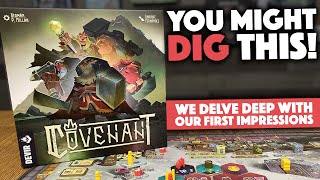







Covenant Deep Dive
What the Community Thinks About Covenant
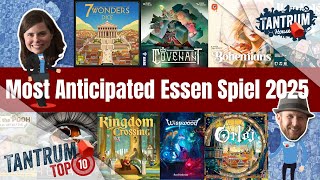
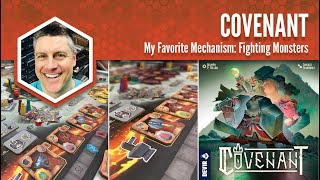
Covenant arrived at Essen Spiel 2025 as one of the most buzzed-about releases of the year, and reviewers who got their hands on it have responded with genuine enthusiasm. The consensus is that Covenant is a satisfying, combo-driven Euro that packs more depth into its limited action count than most games of its type. Board Gaming Ramblings named it their number one game of October 2025, with both hosts independently declaring it their top pick of the month. The Dice Tower's Graeme awarded it an 8.5 out of 10, the Dice Tower Seal of Excellence, saying it "didn't disappoint" despite high expectations. Rahdo Runs Through placed Covenant at number 18 on his top 25 most-anticipated Essen Spiel games of 2025 (among games he had already played), calling it "comboastic crazy" and praising its satisfying solo mode. Tantrum House's Sarah included it in her top five games of the year, while Going Analog's Christina described it as "a really satisfying, fun, pretty comboy, dwarfy game" after playing it at BGG.CON.
The one area where opinions converge on a caveat is the rulebook. Both Tantrum House and The Dice Tower flagged the rulebook as difficult to navigate, though both followed that criticism with the same conclusion: the gameplay rewards the effort to learn it. Our Family Plays Games positioned Covenant as an excellent gift for the gamer in your life who enjoys "puzzly Euro style games with a strong theme," while being clear it is not a gateway title. Overall, reviewers treat Covenant as a welcome addition to the heavier Euro space, a game that feels cohesive despite its many interlocking systems.
Core Mechanics That Define Covenant
Worker Placement with Escalating Power
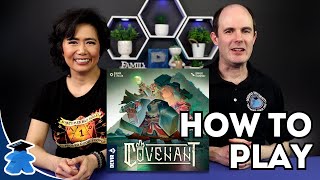
The engine that drives Covenant is a compact worker placement system built around your four dwarves and their varying levels of strength. Each player assigns dwarves to action spots on their personal board, and the power of the action taken depends entirely on how experienced that dwarf is. As The Dice Tower's Graeme explains, "when you take an action, it will depend on the strength of the worker you just placed and if there is a beer token spent with it." Beer provides a temporary boost, letting you punch above your dwarf's current level when timing demands it. Over the course of the game's three eras and twelve main actions, you train your dwarves up through levels, so the same dig or build action that produced modest results in era one becomes dramatically more powerful by era three. Rahdo Runs Through describes how players can also forge new tools that add additional worker placement spots to their own board: "one of the most common side bonus actions you get to do is forge new tools that give you additional worker placement spots on your own board." The designer credited for this system is Herman Milaan, working here with publisher Dvere in what Rahdo describes as their first collaboration on something "quite a bit heavier than your Red Cathedrals or your White Castle."
Engine Building Through Track Advancement and Combos
Covenant's defining quality, the one reviewers return to again and again, is how its overlapping tracks and bonuses chain together into cascading combos. The Dice Tower's Graeme describes the loop clearly: "going up tracks unlock some upgrades, which can unlock other upgrades or bonuses. Having inlays gives you more actions or kind of bonuses on your turn. And getting those king's coins is fun to get the income every round. Just so many combos to be looking for." Board Gaming Ramblings captures the mental experience of navigating this system, noting that when taking an action, "you get up on the track and then you unlock this bonus and that gives you this thing. But you also... I don't want to do that thing yet because I don't have the resources to actually buy that upgrade yet." The combo system rewards patience and sequencing: the player who can read three or four steps ahead, timing their track advances to unlock the right bonuses at the right moment, will score far more efficiently than one who takes actions in isolation. Rahdo summarizes the snowball effect succinctly: "this game as it goes on, it just gets more and more and more comboastic."
The Covenant Experience
Crunchy and Rewarding Mastery
Covenant sits firmly in the brain-burner category, and reviewers embrace that identity. The Dice Tower's Graeme notes that "there's not a lot of actions you'll be taking during the game, so making sure you're maximizing each one is really important." With only twelve main actions across three eras, every decision carries genuine weight. Tantrum House's Sarah captures the pressure in a phrase: "you have to really optimize everything that you do." Board Gaming Ramblings describes the experience of feeling perpetually behind on ambition: "I still feel like I want to achieve so much more when I'm playing Covenant than I actually do." That gap between aspiration and execution is not frustrating so much as it is the engine of replayability. Players who return learn to read the board state faster, sequence their track advances more cleanly, and time their beer tokens for maximum effect. The Dice Tower's Graeme observes that "the game turns into a lot more tactical than strategic after the initial round," with early decisions about objectives and tools locking in a loose path that you then optimize turn by turn based on what the board offers.
Triumphant and Satisfying Engine
Despite the crunch, Covenant delivers moments of genuine joy that reviewers describe in almost physical terms. Board Gaming Ramblings captures this best: "it gives me that feeling of joy... the diddiness of just like I'm feeling everything in myself. I'm excited for my turn. I want to do something cool. I'm very excited for something cool to happen. And that is what this game gives me from the beginning to the end." Going Analog's Christina echoes the sentiment after her first play at BGG.CON, calling the combos "really, really satisfying" and noting that "even though there's a lot that you can do, I think it's like pretty intuitive." The Our Family Plays Games hosts describe it as "kind of heavy, kind of medium heavy," a puzzly Euro game with a strong dwarven theme that lands somewhere between the familiar Hobbit-inspired fantasy and a serious optimization challenge. When a chain fires the way you planned, the payoff is tangible enough that reviewers struggle to stop thinking about their next play.
What Makes Covenant Stand Out
Thematic Coherence Across All Actions
One of the qualities The Dice Tower's Graeme praises most explicitly is how naturally the theme and mechanics reinforce each other in Covenant. "The actions you're taking make perfect sense in the theme and they do exactly what you expect them to do. You dig for more resources. You skirmish to capture monsters. Build to well, build, and transport to make deliveries. It makes the teach and play a little easier because you know what you need and it's obvious which actions you need to take to get to it." The dwarves returning to their ancestral mountain home, clearing out monsters, opening new halls, forging tools, building gates and pillars, and making deliveries to the throne room: all of it connects to the fantasy of rebuilding a fallen dwarven civilization. Rahdo describes the setting as "very Lord of the Rings inspired," with players trying to "rekindle the fires of industry in a cavern that they had to abandon long ago because it was overrun by monsters." This thematic clarity is what separates Covenant from heavier euros that feel like spreadsheets wearing costumes.
Tool Scoring System Creates Strategic Depth
The forge tool system is where Covenant's long-term strategic layer lives. As The Dice Tower's Graeme explains, the tools you forge during play not only add new worker placement spots to your board and unlock immediate bonuses, but each column of tools corresponds to a different endgame scoring category: relics, monsters, monument construction, and district presence. "The number of tools you have forged in that column is a multiplier." This means every tool placement decision carries both a short-term consideration (what bonus do I get right now?) and a long-term one (which scoring column do I want to lean into?). Graeme describes the tension explicitly: "what's more important? The immediate bonus you get or the long-term points from the column you place it in? And is it better to spread your tools out and get some points everywhere and make sure you have two tools in the scoring column that you're really going to focus on?" This layered decision-making is what makes the twelve-action game feel much bigger than its action count suggests.
Potential Drawbacks
Rulebook Clarity
The rulebook is a consistent point of criticism across reviews. The Dice Tower's Graeme calls it "a little difficult to find things you need to know" and notes uncertainty about specific rules for getting relics even after playing. Tantrum House's Sarah simply flags it directly: "not the greatest rulebook." Both reviewers agree that the gameplay itself is worth pushing through the learning curve, and Graeme notes that player aids are included and genuinely necessary in early games. Rahdo Runs Through mentions a specific ongoing thread on Board Game Geek about relic rules, suggesting that even experienced players are working through ambiguities post-publication. For groups willing to lean on video tutorials and community resources for their first session, this ceases to be an obstacle; for groups who rely exclusively on the rulebook, the first game may require some patience.
The Action Scarcity Can Feel Punishing
Twelve main actions over the entire game is a deliberately tight constraint, and not everyone lands comfortably within it. Tantrum House's Sarah puts it plainly: "it is too short. It's a long game, but I need more turns." The Dice Tower's Graeme echoes this from a different angle: "you'll end up doing a little bit of everything during the game," because the track system requires you to spread actions across multiple categories to unlock your objectives. This can leave players feeling like every path they ignored was equally important, and that the game ended just as things were getting interesting. Board Gaming Ramblings describes a persistent sense of wanting to do more than the turn structure allows. Players who enjoy games where efficiency is its own reward will relish this constraint; players who prefer a more expansive sandbox may find Covenant's brevity frustrating rather than elegant.
If You Enjoy Covenant
Players drawn to Covenant's combo-driven efficiency puzzle and dwarven fantasy setting will find natural connections in several other games. Voidfall shares thematic DNA through its connection to the Dvere universe and similarly rewards players who can plan chains of actions across tight turn structures. Dune Imperium offers comparable track advancement and influence-building within a competitive worker placement framework, though with a lighter touch on the combo depth. Ark Nova satisfies the same audience: a Euro where efficient sequencing of a limited action count determines the winner, with end-game scoring multipliers that reward long-term planning from turn one. Traron, also from Dvere, shares the publisher's commitment to elegant action structures that open into strategic depth. For players intrigued by the fantasy setting and dungeon-clearing elements but wanting something more narrative, the genre comparison to games like Ana Gr may also prove useful as a starting point for further exploration.
What Reviewers Are Saying
"It gives me that feeling of joy. I speak a lot about feeling because feeling is important to me when I play games. And that feeling is like the diddiness of just like I'm feeling everything in myself. I'm excited for my turn. I want to do something cool. I'm very excited for something cool to happen. And that is what this game gives me from the beginning to the end. I'm just loving it."
— Board Gaming Ramblings
"I really like the combo aspect of the game. Going up tracks unlock some upgrades, which can unlock other upgrades or bonuses. Having inlays gives you more actions or kind of bonuses on your turn. And getting those king's coins is fun to get the income every round. Just so many combos to be looking for. The game does feel like it's several pieces put together, but I feel that overall it really comes together as a cohesive whole."
— The Dice Tower
"This game as it goes on, it just gets more and more and more comboastic. Fans of this designer are going to be very satisfied indeed. If you're looking for a game with big crunch and huge combo chains, Covenant is one you need to check out."
— Rahdo Runs Through