


























Daybreak Deep Dive
What the Community Thinks About Daybreak
Reviewers across several channels agree that Daybreak succeeds at tying its cooperative systems tightly to its climate change theme. No Pun Included argues that the game's fiction, where major world powers cooperate to draw down emissions, is what makes the design work, even while acknowledging that the premise simplifies real economics and governance. Board Game Sanctuary's Danny compares Daybreak directly against Pandemic, the earlier cooperative game from the same designer, and judges the newer game the stronger of the two. The Board Gaming Doctor and Tabletop Tolson both encountered Daybreak as a nominee for the 2024 Kennerspiel des Jahres and independently rated it above the other finalists on the list, pointing to how closely its theme and mechanics reinforce each other. Might I Suggest A Game's Alex named Daybreak his top overall game from the first half of 2024, crediting both its systems and its optimistic take on climate change.
Where the channels diverge is on how the game's weight will play with a wider audience. Tabletop Tolson personally ranks Daybreak above the other Kennerspiel nominees but expects the jury to favor a lighter game instead, since recent winners in that category have trended toward simpler designs. The Board Gaming Doctor takes the opposite view, expecting Daybreak to win on the strength of its theme and its connection to Matt Leacock's earlier cooperative games. Beyond Solitaire's interview with co-designer Matteo Menapace adds another angle: he describes watching a group of enthusiastic players, including television weather presenters, struggle to apply their own expert knowledge because the game's card combinations and turnless structure were unfamiliar to them, a tension between depth and accessibility that several reviewers touch on from different sides.
Core Mechanics That Define Daybreak
Building an Engine Across Five Card Columns
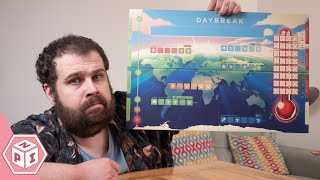
Each player represents a world power, such as the United States, China, Europe, or the majority world, and manages a personal tableau of five card columns. No Pun Included walks through how a card discarded from hand activates a column's action, and how tucking an extra card underneath that column, so it carries a regulation tag, multiplies the effect: removing one dirty energy plant per tag rather than one at a time. Cards can also be layered on top of an existing column to redirect it entirely, so a player who has built up several tags might overlay a new card and suddenly remove several dirty energy tokens in a single action. Board Game Sanctuary describes the same system from the outside, noting that each of the five columns rewards a different kind of investment and that the tags a player stacks into a column determine how powerful that column's main action becomes once triggered.
A Shared Climate System of Carbon, Temperature, and Crises
Underneath the tableau sits a shared planetary system. No Pun Included details how dirty energy tokens generate carbon cubes each round, how forests and oceans absorb a portion of that carbon, and how the remainder pushes a shared temperature track upward until the game ends in a loss. Board Game Sanctuary adds that every round also brings a die roll into one of six major climate change effects, from changing weather patterns to deforestation to glacial melt, and that unmet energy demand or unprotected communities pile pressure onto individual player boards in the form of crisis tokens. Both reviewers describe the tension of watching carbon accumulate faster than it can be pulled back down, with Board Game Sanctuary calling the resulting swings from disaster rolls an element that can be very punishing or can roll in a group's favor.
The Daybreak Experience
Constant Negotiation Without a Turn Order
No Pun Included highlights that Daybreak has no turn order at all: everyone plans and plays at once, and cooperation happens through conversation rather than tracking who goes next. That means players are constantly asking each other what resources they have spare, what combinations they are building, and whether those plans line up with the rest of the table. The Board Gaming Doctor frames this the same way, describing the game's simultaneous action selection alongside a ramping difficulty in the style of Pandemic, and noting that on a platform built for turn-based play the game loses some of that live, overlapping coordination.
From Dread to Cautious Hope
Several reviewers describe an emotional arc rather than a purely tactical one. No Pun Included recounts losing a first game on the final flip of a crisis card, then finding later sessions felt like a cool breeze once the table learned which global projects to prioritize. Board Game Sanctuary describes an almost addictive feel to narrowly missing a win and immediately wanting to try again. Neon Gorilla, reaching for a cooperative game that shows people working together to fix a real problem, calls Daybreak probably one of the most optimistic board games and one of the best cooperative games played that year.
What Makes Daybreak Stand Out
Real-World Research Behind Every Card
No Pun Included and Board Game Sanctuary both single out the QR code printed on every card, which links to an article on Daybreak's website explaining the real climate science, policy, or technology that card represents, alongside rules clarifications. Tabletop Tolson echoes this, describing eco-friendly design and real-world data on the cards as a defining feature. No Pun Included also notes the physical production itself uses zero plastic and includes accessibility aids, a detail that reviewers connect directly back to the game's subject matter.
Individual Agency That Cuts Down Quarterbacking
Alex argues that because each player is busy managing combinations on their own tableau, it is difficult for anyone to track exactly what everyone else is capable of, which keeps table talk at a higher level of asking for favors and help rather than one player dictating every move. That reviewer connects this directly to why Spirit Island works so well as a cooperative design, and credits Daybreak with capturing that same spirit of cooperation on its own terms.
Potential Drawbacks
A Steep, Unfamiliar Structure
Co-designer Matteo Menapace, speaking on Beyond Solitaire, places Daybreak at close to three out of five in complexity and points to its lack of a conventional turn order as something that puts off a few players even when they are otherwise engaged with the theme. He describes the game unlocking real strategic depth through how its cards combine, but says that combination of a turnless structure and an engine-building learning curve is unfamiliar enough that it can be a real barrier for some tables, which is part of why he later designed a shorter, simplified companion game.
Disasters That Can Feel Punishing
Board Game Sanctuary calls out the randomness introduced by Daybreak's six major disaster effects as a real downside alongside its strengths, noting that this element can swing a session sharply against the table or, just as easily, roll in its favor. That same reviewer contrasts it with Pandemic's more even, if repetitive, sense of tension, suggesting Daybreak trades some of that predictability for higher highs and lower lows.
If You Enjoy Daybreak
Board Game Sanctuary builds an entire video around comparing Daybreak to Pandemic, the earlier cooperative game from designer Matt Leacock, and The Board Gaming Doctor and Alex both invoke the same title when describing Daybreak's ramping difficulty and shared cooperative pedigree. Alex also reaches for Spirit Island when explaining what makes Daybreak's brand of player agency work, arguing that the personal-tableau structure gives Daybreak the same kind of individual ownership within a cooperative frame that makes Spirit Island stand out.
What Reviewers Are Saying
"I cannot find a single thing to criticize in Daybreak. It will not save the world, a board game cannot do that, but it'll show you a thousand ways it could work. It'll let you have fun exploring it, it'll give you hope."
— No Pun Included
"The card play here, in the combination of different cards and abilities and effects that you can use here, just creates that same level of tension, but there's a huge new tableau building effect in the game that I absolutely adore."
— Board Game Sanctuary
"I love this type of agency in a cooperative game. I mean, it's one of the reasons why Spirit Island is so good, and I think Daybreak really captures the spirit of cooperation perfectly."
— Might I Suggest A Game