/pic3304124.png)






















Ethnos Deep Dive
What the Community Thinks About Ethnos
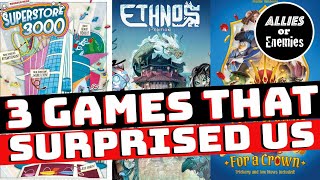
Ethnos occupies a peculiar and beloved niche in the board gaming world: reviewers who know it tend to adore it, while those who haven't tried it often walk right past it. The reason is no mystery. Ethnos is, in the words of No Pun Included, "an ugly ugly baby" in its original editions, and its modest box does little to signal the surprisingly tense and interactive experience waiting inside. Yet every reviewer who has spent meaningful time with it comes away impressed, and several place it firmly in their personal all-time lists.
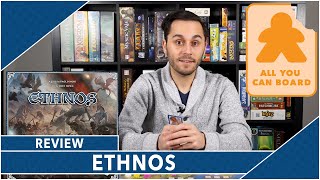
The consensus from across the community is that Ethnos punches well above its weight class. All You Can Board's Carlo describes it as a "solid experience" he does not hear talked about nearly enough, and notes that playing it again would likely see it climb even higher on his rankings. His co-host Dylan, having played through a friend's copy rather than owning it himself, was struck by "how smooth of a design it is." Chairman of the Board called it "a really smooth game" that almost felt like a Knizia design in how elegantly its systems interlock. The enthusiasm is consistent: once you sit down and play Ethnos, it tends to win you over fast.
Board Game Coffee's Mark echoed this, saying Ethnos "was fantastic" after being taught the game by designer Daryl Andrews, and noting that "this little box, the game when you see it, it's not very pretty but it's so fun." The gap between first impression and table experience is a recurring theme across the community, and most reviewers treat it as a feature rather than a flaw: Ethnos is proof that a small, unassuming package can hide a genuinely great game.
Core Mechanics That Define Ethnos
Set Collection With Painful Sacrifice
The engine driving every turn of Ethnos is deceptively simple: collect cards, then play them in sets. Cards either share the same fantasy faction (matching the symbol on their face) or the same color (matching the banner along their side). You place the set face-up in front of you, choose one card as your leader, and potentially add a control marker to the region matching your leader's color. Simple enough on the surface, but the mechanic has a sting in its tail.
When you play a set, every card remaining in your hand that you did not include in the set is discarded face-up into the shared market. No hoarding, no saving for later. As No Pun Included put it, "each time you play cards, you lose all of the cards you don't play." Those discarded cards become instantly available for your opponents to draft on their next turn. This single rule transforms hand management from a private puzzle into a tense public negotiation. Every time you play a set, you are simultaneously scoring and feeding your rivals.
All You Can Board described this as "one of the most brilliant things about the game," noting that "you can keep pushing your luck and trying to get a better set of cards by drawing, but the more you draw, if you then have a huge hand and only play a few of them, you discard those cards, and not only do people pick them up, but you think back how many turns did you waste just drawing a card that you did nothing with." The push-and-pull between building the biggest possible set and not overfilling your hand is where most of the game's tension lives.
Area Majority Across Three Ages
Beneath the card play sits an area majority system that escalates beautifully over three distinct scoring ages. Each of the six regions on the board has prestige tokens assigned to it, with higher values unlocking in later ages. At the end of Age One, only the player with the most control markers in a region scores. In Age Two, first and second place both score. By Age Three, the top three positions all receive points.
No Pun Included captured why this structure works so well: a low-value region in Age One might be worth twelve points by Age Three, making long-term investment strategically interesting without forcing you to commit early. There is also a natural escalation in the cost of placing markers: you can add your first marker to a region with a single card, but placing your second requires a set of at least two, your third requires three, and so on. This means the competition for dominant regions becomes progressively fiercer as the game advances, and spreading your presence wisely matters as much as dominating any single area.
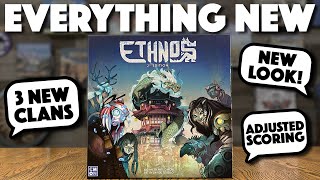
The twelve available factions (six chosen randomly each game) each bring a unique leader ability that adds another layer of decision. A raven leader lets you draw cards from the deck equal to your set size. An owl lets you immediately play a second set. A fox manipulates tie-breaking. Each ability interacts differently with the area majority system and with which factions your opponents are pursuing, so the strategic texture of the game shifts meaningfully from session to session.
The Ethnos Experience
Breezy, Snappy, and Constantly Tense
Despite having genuine strategic depth, Ethnos moves fast. Turns are almost always quick because your choices are bounded: take one card from the market or the deck, or play a set from your hand. There is rarely analysis paralysis, and the shared card market ensures that interesting decisions are happening even on other players' turns. You are always watching, always calculating whether a card that just entered the pool serves your plans better than it serves someone else's.
Chairman of the Board described the game as playing so smoothly it evoked the feel of a Knizia design, and All You Can Board repeatedly highlighted how quickly turns cycle and how the competition for regions "ever evolves as you go." No Pun Included was even more effusive in contrasting Ethnos against Ticket to Ride, noting that "every one of its beats is rimmed to the top of the lid with tension, agonising decisions, and meanness." The game's lean ruleset does not produce a thin experience; it produces one where every card draw and every discard carries genuine weight.
High Replayability Through Variable Setup
One of Ethnos's most praised qualities is what happens before the game even starts. From a pool of twelve distinct factions, only six are chosen for any given session, and those six are drawn randomly. The combination of abilities in play completely changes the texture of the game. All You Can Board's Carlo described this as his favorite part of Ethnos, saying he "still loves how every single game is different depending on which factions are in the game." Whether the skeletons (wild cards that vanish at age-end) appear alongside the trolls (who break ties through accumulated tokens) or the orcs (who build a secondary scoring board) produces a meaningfully different experience each time.
The prestige tokens placed randomly on the board's regions also vary the point landscape, so even familiar faction combinations play out differently depending on which regions are most valuable in which ages. Players who have logged many sessions with Ethnos consistently cite this variability as what keeps them coming back, particularly given how short and accessible the overall experience is.
What Makes Ethnos Stand Out
An Accessible Entry Point Into Area Control
Reviewers frequently position Ethnos as a bridge game, particularly for groups interested in exploring the area control genre without committing to heavy productions like Blood Rage or Rising Sun. All You Can Board described it as "an awesome starting point" for players who eventually want to reach bigger area control experiences, while acknowledging it sits slightly above pure gateway games like Ticket to Ride in complexity. Chairman of the Board placed it in a similar slot, praising its "area control game in such a small accessible package."
The game scales well across its two-to-six player range (with some rule adjustments at lower counts), and the physical footprint is modest. No Pun Included highlighted the value proposition explicitly, noting that the current edition is "cheap and available" despite some production missteps. For groups wanting contested territory and meaningful player interaction without a four-hour commitment, Ethnos delivers reliably.
The Discard Economy Creates Real Interaction
What separates Ethnos from more passive set collection games is that the discard mechanism makes every play a social event. No Pun Included described other players watching the shared market "like my dogs watch me eat a boiled egg: with great intensity." When you play your set and reveal the cards you could not include, the table collectively evaluates what just became available. Someone might delay their own play specifically to grab a card that just appeared. Someone else might rush out a set earlier than planned to deny an opponent a card that just entered the pool.
All You Can Board articulated the push-and-pull beautifully: you are constantly weighing whether drawing more cards to build a stronger set is worth the risk of handing your opponents better options. This shared market pressure is a design element that Chairman of the Board also called out directly, noting the "give and take" where "sometimes you'd leave opportunities for your opponents to take." The interactivity in Ethnos is not confrontational in the aggressive sense, but it is constant and consequential.
Potential Drawbacks
Presentation and Production Concerns
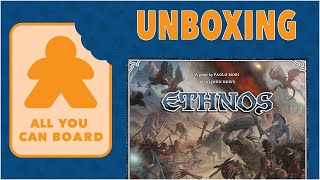
Almost every reviewer who praises Ethnos also acknowledges its visual shortcomings. All You Can Board's Carlo put it plainly: "the very generic art obviously hurts the game and makes a lot of people not really give it a chance." Board Game Coffee's Mark said the same, noting that "this little box, the game when you see it, it's not very pretty," while still enthusiastically recommending it. No Pun Included dedicated a notable portion of their coverage to cataloguing the second edition's specific production problems: some card sets sharing colors that create confusion, color stripes on card sides that are mismatched with the board, and a card tray that, in their words, "doesn't function."
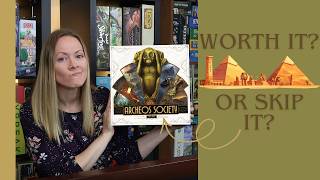
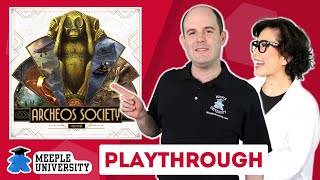
The art and production situation is genuinely complicated by the game's publishing history. The original 2017 CMON edition went out of print. A rethemed republication called Archeos Society changed the rules significantly and, according to No Pun Included, "made it much less toothy." The second edition from CMON is the most accessible version but carries its own production baggage. For players who care deeply about visual presentation, Ethnos requires a degree of patience or willingness to create custom organizational solutions.
Player Count Considerations
While Ethnos supports two to six players, reviewers consistently note that the experience is not uniform across that range. All You Can Board expressed a clear preference for the higher end of the count, noting "it plays better in my opinion at four to six." The two-player version introduces different rules, including counting all control markers in a region (not just your own) when determining whether you can add a new one, which changes the feel of the game considerably.
At lower player counts, the shared card market is thinner and less dynamic, and the competition for regions can feel less organic. At four or more players, the market fills and depletes with satisfying frequency, factions feel genuinely contested, and the region scoring produces more dramatic swings. The game is not unplayable at two or three, but most of the praise in the community implicitly assumes a table of four or more, so players who primarily game in smaller groups should adjust expectations accordingly.
If You Enjoy Ethnos
If Ethnos has you hooked on the tension of shared card markets and contested territory, a few natural next steps present themselves. Small World covers similar area majority ground with more thematic depth and a broader range of fantasy faction combinations, though it adds more rules and runs longer. Ticket to Ride sits at a lighter weight and removes most of the direct interaction, making it an excellent introduction for players who find Ethnos slightly too sharp for their group. For those who fall in love with the idea of an area control game that plays in under an hour, Blood Rage and Rising Sun offer the same publisher's take on the genre with far more production spectacle and considerably higher complexity. All You Can Board repeatedly name-dropped these titles as the natural escalation path from Ethnos for players ready to commit more table time and mental energy to the genre.
What Reviewers Are Saying
"Where Ticket to Ride survives, Ethnos thrives, because every one of its beats is rimmed to the top of the lid with tension, agonising decisions, and meanness. Each time you play cards, you lose all of the cards you don't play. The cards you lost go to the shared market where the other players can pick on them like nasty little vultures feasting on the carcass of your mistakes."
— No Pun Included
"It is so interesting to have an area control game in such a small accessible package. I still love how every single game is different depending on which factions are in the game. That is something that in every game I'm always going to love when there's different combinations that now make for a different experience compared to the last one you played."
— All You Can Board
"I was actually quite impressed with how smooth this game worked. It almost felt like a Knizia game to me. There's some good variability here as you play with a different range of these fantasy characters each time you play the game, and they're all quite vastly different and work in different ways. I was left quite impressed with Ethnos."
— Chairman of the Board