3 Games the Surprised Us: Ethnos, Superstore 3000, For A Crown:
Games in This Video
3 games are featured in this video — they unlock as you watch.


Transcript
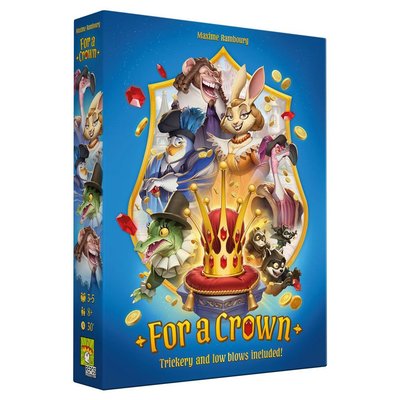
Welcome to Allies or Enemies. I'm Jess. And I am Sean. And today we're going to be doing three reviews of three different games. And these games have a few things in common. First of all, these are all really quick, light, very easy to learn games. But also, these are three games that we were not sure about at first. We even went into them like a little trepidacious, but all of them we ended up liking. And the first two games were provided for review, but the thoughts are all our own. And let's get right to it. The first game we're going to talk about is For a Crown. And this is a three to five player game designed by Maxim Ramorg. And it is a very, very mean card drafting game where you're drafting mercenaries. So, this is a little bit of a different game. I'm not even sure what category to put it in.
So, you are kind of drafting cards, but you're kind of buying cards. So, each round, what's going to happen is all the players have this chest. This chest starts with 10 rubies in it, as well as a few coins. The end of the game, whoever's the most rubies wins the game. Each turn, you're going to buy one of these cards. The first turn, you're actually going to buy two cards, but generally, you're going to buy one of these cards. Then, you're going to slide it into your color card sleeve, and you're going to put it on a pile of cards. After everyone's bought a card, you shuffle up those cards. Then you flip those over one by one and you resolve them. And the stuff that they do is pretty simple. They get your ruby. They'll uh get rid of a ruby from someone else. And you don't take that ruby. You just get rid of it. It's just pure mean. They move you up and down this in this influence track. They give people raccoons. They get coins. And but that influence track and raccoon are also tied to these effects that will happen. They're shuffled into that pile of cards. and those are going to impact everyone around the table. So, where you are in that influence track, it's going to be how many gems you lose. Whoever has the most raccoons is going to lose two gems, which is a lot, and their raccoons. And then, like I said, end of the game, whoever has the most gems or rubies left hidden in their little treasure chest, cuz everything's always hidden, is going to be the winner. Yeah.
And it's an interesting type of game that definitely has a change of pace throughout because the first round you only have two cards in that deck. So you'll only have like two choices to make, but each round you're adding another card. So what card you purchase is really important and the cost for the better value cards is higher. So, it could be worth it to pay more to get a better card, but you're going to be losing coins or if you run out of coins, you just pay in rubies. And that can be tough to do because you're like, I don't really want to lose my rubies. Yeah. But it it can really work out to buy those more expensive cards. And it's cool, too, because that market changes. So, in the first round, you can only buy from the first three sections, and they're like 0, one, and three, but you're only going to have between three and five coins. So, you're probably going to end up spending some rubies as coins. But then each round those all slide over.
Another column becomes available and then that column is worth five. The next one's three, then one, then zero. So then the new whatever was the first column becomes free. By the last round, the first three columns are free and the last two cost money. So that that last round, the cards get really mean cuz as you move up those columns, they just get meaner and meaner and meaner. The meanness, I think, is the most fun part of this game. Yeah, definitely. And the fact that you keep your rubies secret is a really important part of that because you're obviously going to try and target the leader, but you don't necessarily know who's in the lead. So, what's really interesting is everybody has like a family heirloom. And once you've spent all of your like loose rubies, you can sell your family heirloom for 10 rubies, but you bring that out of your chest so everybody knows you've sold it. So once that happens, whoever's the first person to do that no longer really has a target on their back. Yeah, that is really neat that that kind of shifts. It's it's a really neat kind of catch-up mechanic cuz you can keep targeting them if you're mean and that'll just end the game early. So if someone's eliminated, they're not eliminated. Well, they are.
They'll lose, but the game ends. They don't have to watch everyone play. But I I do like that that they flip it over and everyone's like, "Okay, cool. Jess isn't a threat now. Now we're going to move on. Now we're all attacking Shawn until I flip mine over. Then it's like, "Okay, who else hasn't had it flipped over?" And so you really do get a target on your back, but you also get a target on your back um because you've targeted other people because all you're doing is mean things. You're just like you can choose, especially with that influence, too, because you can choose to move all the way up to the front of the line or you can move anyone else all well not all the way back, but back to the next empty space. But sometimes that can be a long way back and you can kind of strand them back there. And I've definitely seen people prioritize meanness over prioritizing their own gains. And that is like the heart of it because it's not like meanness and something else.
Really, the core thing is about being mean, but it is interesting because the cards get randomly revealed because each round they get shuffled together. And so what that means is you're usually going to be likely to target the person who just targeted you and that's going to be in a random order. So if Shawn targets me, he knows that the next time my card gets revealed, I'm going after him. Yeah. And people do kind of split up their targets sometimes. So I do find in a higher This is a better game, but higher numbers at three, you kind of even it out. A lot of the cards seem to be like, "Oh, two raccoons go out or two rubies go out so that you do one each." But it's nice at four or five that you kind of more specifically attack two people. You don't attack the other two people. And I also like how much of this game is simultaneous because you've got that buying cards part of the game, but that's pretty quick and you're just buying one card. Probably you got an eye on it because they're all out from the last round anyway. But most of it is just flipping over that card and then making a lot of really small decisions as it kind of automatically flips over.
And so it's just a lot of tiny decisions. So it moves very very fast. Yeah. And each decision is tiny. But I think there is the right amount of choices that you're making for when you're buying your cards because if it was just getting rid of rubies, that wouldn't be nearly as interesting. But I like that there is the raccoons because whoever like loses all of their raccoons and loses two rubies, that means that everybody else who didn't lose raccoons still has some. And what can often happen is there's often another card in there that will then again target whoever has the most raccoons. So that's interesting. And it's nice that there's the influence track because that's another thing to consider. But going into this game, I definitely thought like, "Oh, I'm only going to buy five cards and then we're just going to flip them." Like, how interesting is that going to be? Way more interesting than I expected. Yeah, it really surprised me.
Especially, I think by the time we got to the second half of our first game because the first half, I really didn't feel like I had a lot of power over those decisions. But by the time you have more of your cards in the deck, it definitely is a lot more interesting. And I think it's really clever how they use those card sleeves. Yeah. And the components in this are really nice. So the card sleeves are great and it's what a smart way to do that to show that it's your card while you put it in the deck and mix up the deck and then be able to just flip over a single deck and know whose card is whose. I haven't seen any other game do that. Really, really clever solution. Also, the treasure chests. While a lot of games have like player screens and stuff, I like that that it's in an actual treasure chest. You can just close it all the way down, which is great, too, because sometimes you have people like go behind you for drinks and stuff in games and you're like, "Don't look. Don't look." This is great. You can just shut that down. No one's taking a peek at that unless you let them. And and it looks really nice, too. And I like the art style. And I like that the different mercenaries are these different animals that I think do have a bit of character. Yeah, there is definitely like a specific kind of art style. Some folks we played with didn't love it. I actually really like it as well. I think it's it's a really cute art style, but I think overall this is a game that is going to be definitely for people who like mean games cuz it's very very mean, but it also is pretty quick to pick up and it does have fairly pretty components. So, it's always, you know, that always makes a little bit of an easier cell. The next game we're
going to talk about is Supertore 3000. And this is a two to four player game designed by Rodrigo Rego. And it is a tile placement game about building the mall of the future. And I'm very familiar with the malls of the future because I'm from Alberta, home of West Edmonton Mall. But in this game, like you say, it's a tile placement game. And you're drafting tiles. So you've got two rows of tiles in this big store dispenser. You can either take a store and add it to your mall, which is going to build straight up as they do in the future, or you can flip over a store and turn that into money. When you take a store, you're adding it to your mall and you want to think about both putting it into groups of the same sort of store as well as fulfilling what customers want.
So, you're going to have these really cool looking chunky customers standing on these entrances. And you want to put the stores they want to go to, then they'll go and hang out in those stores. The whole point of this is to fulfill a bunch of different goals. So, first of all, like I said, make color groups, get customers to where they want to go. Also, you've got a secret goal card that's going to put a really special attraction from your own mall. And you've got these shared goal cards everyone's racing to. And those are going to put these giant attractions into your mall. The game is over once either all of the stores have been taken or all of those attractions have been taken, which is almost always how it ends. And that's basically the game. I like that on your turn, you're choosing to either get money or get a tile. and that it's the same thing that it's a tile on one side and money on the other side. And you don't necessarily need money cuz how you're spending that money is to draft a tile that's higher up. So, you know, if the very first row is free, it costs one for the next row and so on.
But you will spend money because there will be tiles that come out that you definitely want. Yeah, there's a lot of racing for tiles in this. There's definitely there's not a lot of interaction like in the game. There's nothing that you're doing that specifically impacts my mall. There's no way to mess with each other's mall. But within the drafting, there's a lot of I can see that you've got like three people who want green dresses. I don't want you to get I know you want that green dress. I don't want you to get that green dress. I'm just turning it into money. That definitely happens a lot. Or like I need more customers. And because we're running towards those same goals, we know how close each of us is because we can see everything that everyone is doing. And so that race really becomes a big factor in what we're drafting. Yeah. And the race for the goals is the most important thing because that is how you're getting your points. You aren't necessarily really scoring for getting customers in the right shops. only whoever has the most of those gets to take like the higher scoring tile for that. So, I think that's really interesting and is something that we had to get used to that really you have to be looking at all of the goals and trying to fulfill those as quickly as possible. Yeah. At the end of the game, all of the points are just coming from these few little scoring balloons, one for each color shop, one for who has the most customers, and then from the stuff from the big attractions that you've made. So you're you'll score maybe 30ish points
off of like four maybe five different things. So that is interesting that in some games maybe everyone really just wants to put blue customers into something cuz that's going to be that big tile. But you do also have that personal goal that does mean there's at least something you want to do that other people maybe don't want to do. Yeah. Your personal goal can shift things. And the goals are different cuz you sometimes get some that specifically have to do with what color shop satisfied customers should be in. You also get others that have to do with how high certain stores are. And so if those are in play, then we tend to build like quite high quite quickly. And it is important to note this is a very light game. So if you're listening to this and thinking, "Oh, that sounds really light." You're right. It 100%. This is super super light. You are just adding tiles, moving customers to matching things, trying to fill goals. Very very light game. But we did find it interesting. We did find it fun. And I think part of that too is just those customers. That's such an interesting component I haven't seen elsewhere where each one of the customers is individual.
First of all, they all have different pictures and they all have these kind of seethrough. They're like these little mini Yeah. with like the thing on the inside. And I like that there's so much Jetsons. This is just oodles of Jetson's references. And I'm a huge fan of the Jetsons. Yeah, tons of Jetsons as well as like other sci-fi characters, too. So, those characters look awesome. And the big attractions, they all look really cool, too, because they're all individual and they're all double-sided. So, you get things like a haunted house, a giant aquarium, a really large roller coaster. And I just generally like like that theme of building this fun mall with a bunch of attractions. Yeah. No, this is one I I won't quite say e up orc uh I love you, but e up orc uh I at least like you a lot more than I expected to. The last game we'll be talking about is Ethnos. And this is a one to six player game designed by Palomorei. And it is an area control game involving different animal factions. And it's a pretty simple game.
On your turn, you're either drafting a card or you're playing cards. When you're playing cards, you either have to play a bunch of cards that all have the same color or a bunch of cards that all have the same animal. But then you have to discard any other cards that are in your hand. What you're trying to do with those cards is put these little like temply things down on the board in the different areas. And you just need to play more cards than however many temples the leader has in that area. The end of a round, you're going to score points based on how large the groups of cards are that you played, as well as what different areas you control. But throwing a bunch of spanners into those works are there are 12 different animal factions and every one of them plays a little bit differently. They can do all sorts of different stuff, but the point of it is you're drafting cards, you're playing cards. You're going to do this for three different rounds. You're going to score at the end of each one of those rounds. At the end of the third round, whoever has the most points wins the game. Yeah, those animal factions make the biggest difference. and they all seem really strong. And it's interesting when you're choosing to draft your card, it can be really difficult to choose what card you want to draft because you might be trying to get into a specific region and wanting to take that color or you might be really hoping to use an animal power. Or the other thing to bear in mind as well is when you are playing your party, any cards you're not using
get made available again in the market. So you might be considering that as well. Yeah, that is a big part of it is that you want to take more cards, but you don't want to have too many cards. You can only have a max of 10 cards as well, but that's you're doing things wrong if you end up always at that max. So, you kind of want to play stuff like as quick as you can, but you also want to make a big group because you're going to score more for a big group. And so, there really is a bit of a push pull. And often is almost a push or luck game because you've got like a small group of cards out at first that you're drafting from, but pretty quickly those all get taken and you often find yourself just drawing blind from the top of the deck. So, you don't know what you're going to get and you might get something that you're then going to make available to everyone else. And you really want to make everyone be drafting blind as much as you can. And you might find yourself in a situation of being able to play a party, but realizing that another player is at 10 cards. So, they will definitely be playing a party and making cards available in the market. So, it could be worthwhile to hold off to be able to hopefully take something that they're making available because that might give you the edge you need to take over an area. And we should maybe quickly run through what each of those different animal factions do. So the tigers count as having one extra card. The koi lets you move on the koi board and will give you points if you're further ahead. The monkeys let you put a token on your individual monkey boards and you can
choose at the end of each round to remove them for points. The rabbits will count as one extra in the set stern scoring. The dogs are a wild card, so they can be any animal or any color, but they run away before scoring. And the deer lets you play in any region. And then there's also the owls, which are really interesting one because they let you play two. So they they let you play your cards and then play another set of cards. So with the owls, you're always building up two sets in your hand. Then there's also the red pandas. Those allow you to hold cards in your hand. the ravens which allow you to draft new cards to your hand. The raccoons that make the different areas a little bit more valuable. The bears that have kind of a hot potato thing. Not really a hot potato, but you get a thing that is worth points at the end of the round if you still got it. You also get it when you take that. And then finally, the foxes, which break ties in areas, and that is worth a lot because there are a lot of ties in different areas. Yeah.
And depending on which factions you're including, the game is going to feel incredibly different. Like if you have cards that let you hold on to cards or play multiple parties, you're going to be keeping a lot more cards and drafting a lot more than if you don't have either of those factions. Yeah. And there's also the ones that kind of make you race for stuff where those foxes, you really want to get the higher point fox shurikens so that you win ties because that's big. And also those bears that's kind of bouncing around the table as people are stealing the bear. The koi becomes a race up. The monkey makes you really go into different regions because you can even lose a region and still have that count for the monkey. So that's a really like strong secondary scoring. So there is a lot of replayability in this game. And another thing that makes the game feel different is player count. And we've played this for one to five players and it has felt very different. At two players, there's quite a few changes. And one of those is that you're only playing two rounds. And the other change is in order to add a temple, you have to play a party size that's bigger than all of the temples in that region, not just bigger than the leading temple. Yeah. And that is a pretty big change. And that definitely makes you play you almost play larger parties in a two-player game. Maybe not, but you do a little bit. The other thing with two players is only one person is going to score each one of those lands.
So, it really is like a zero someum game. Whereas at higher player counts, more people you're going to score for first and second, and I think even first, second, and third for the higher higher player counts. But the other things as well that at the higher player counts are obviously the market's going to change a bit more and it's a little bit more variable because you got more people who might play like a lot of stuff fast who could push the game in different ways. So you can sometimes end up ending the game a little bit quicker because how the rounds end is you've got these dragon cards shuffled in to the bottom half of the deck. Once you get through all three dragon cards, the round immediately ends. you just stop right then. So, a little bit like four shuffle's got a similar thing. A few games have a similar thing and so that makes it just really you really don't know when that's going to end. And in more players, I feel like I don't know even more. Yeah, definitely. When the two dragons have come out, every time a card gets taken off of the top of the deck, it is a risk cuz it could end immediately. And you've said you've played the solo mode. What was that like? So, the solo mode, I think the nice way to say it is maybe just don't buy this specifically for the solo mode.
I think in theory it can work well, but the rule book is a bit of a mess. If you want to know how much of a mess, go on BG, look at how many questions there are about the solo mode. I still don't totally think that I have a full grasp on it, but I do think it could work. But with this sort of game, I don't know if a lot of people are really going to focus on that anyway. I think this is really a game that is going to shine a lot more at that three to like the top limit of players, but I was surprised with how well it worked at two. Yeah, I thought it worked really well at two and I really like how it looks. It is very bright and colorful. The different factions all look really cool. The art style is really neat, I think. And I also really like that there are a bunch of different animals for each animal faction. I think the art looks really cool. I will say, however, that the icons in this second edition leave a little bit to be desired. There are maybe two that make it easier for me to understand. All the rest I really have to look at those playids. You do, however, have those playerids, and I do think those do a really good job, but you're either going to have to refer to those a lot or just remember what everything else does. Also, the second edition, I think there might be some new factions, but I'm not sure about this.
One thing that annoys me a bit is there's a bunch of factions you can only get at conventions, which is just a pain in the butt to know that they're out there. You don't need them. You can totally live without them. I just wish I could get them. I was really surprised by this game. It was friends of ours who suggested we play it and I was being kind of a good sport because I didn't know much about it and I was just told it was an area control game. So I thought, "All right, fine. I'll play a game." And we like immediately purchased it right after we played it. Yeah, I was on my phone buying this right away. But I think the thing that surprised me even more is how well this game works at two. And I think that's because at its heart, this is really a card game that also has a board and has that area control part, but that's really just how you're scoring as you're playing down your cards. And so, I guess that shouldn't surprise me that much. I do still think there are going to be a lot of players who say, "No, I really only like this at those highest player counts." But if you're someone who plays a lot of games that more people play at higher counts and still likes them at the lower player counts, I think this is going to work for you. And that is it. That is three games that have surprised us. And we've been surprised by a few games this year.
And I don't know if that's cuz we're getting more negative going in or if we're getting more positive coming out. I'd like to think that it's more glass half positive, but what are some games that surprised you? And have you played these games that we just spoke about? Thank you so much for watching. As usual, please like, subscribe, and hopefully we'll see you next time for another game.