





Superstore 3000 Deep Dive
What the Community Thinks About Superstore 3000
Reviewers were pleasantly surprised by Superstore 3000. While its colorful, retro aesthetic might suggest a children's game at first glance, the strategic depth won them over. Players consistently described discovering a surprisingly engaging, lighthearted strategy experience that blends puzzle-solving with accessible rules. The game proved enjoyable for both casual players and those who enjoy spatial reasoning and tactical planning. Reviewers noted going in with cautious expectations and leaving impressed by how well the core mechanics, tile drafting, customer placement, and mall construction, worked together to create a cohesive, rewarding experience. The charm and replayability of building unique malls game after game emerged as genuine highlights across multiple channels.
Core Mechanics That Define Superstore 3000
Tile Placement and Drafting
Superstore 3000 centers on drafting and placing themed store tiles to build your mall vertically across two columns. On each turn, players choose to either take a store tile from a central dispenser or flip one over for money. The dispenser organizes tiles in tiers: the first row is free, while higher rows cost increasing amounts to acquire. Once taken, players stack stores atop their entrance, and the tile they place pushes the previous one down, creating a shifting puzzle of placement decisions. Reviewers highlighted the satisfying spatial reasoning involved in positioning stores for both immediate income and longer-term strategic goals, such as grouping stores by color to maximize end-game scoring. The drafting element adds competition, as players must race to secure specific tiles before opponents claim them, especially when targeting shared goal cards that unlock high-value attraction pieces.
Resource Management and the Money Mechanic
The money system in Superstore 3000 creates a clever push-and-pull dynamic that reviewers found genuinely elegant. Each tile has money printed on its back, and players can choose to flip tiles facedown to collect those funds rather than adding them to their mall. However, money only accumulates in the central pool when other players purchase tiles from higher rows, incentivizing careful spending and budgeting of actions. Reviewers noted this creates interesting moments where players must decide whether to spend accumulated cash on expensive tiles they covet or hold it back to avoid enriching the next player. The money mechanic forces constant tactical reconsideration: do you buy the critical store you need, knowing it will enable a competitor's purchase next turn, or do you wait and hope it reappears? This interplay of scarcity and opportunity emerged as one of the game's most satisfying strategic layers.
The Superstore 3000 Experience
Retro-Futuristic Charm and Jetsons Aesthetic
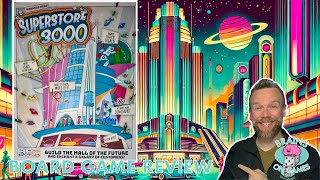
The art direction of Superstore 3000 draws heavily from retro-futurism and 1960s science fiction, creating a cohesive, playful setting. Reviewers repeatedly mentioned the Jetsons influence, not just thematically, but reflected in the acrylic customer pieces that evoke that era's space-age optimism. The transparent, chunky customer meeples feature individual artwork depicting space aliens and sci-fi characters, each with personality and charm. The double-sided attraction tiles showcase imaginative attractions including roller coasters, aquariums, and haunted houses, all rendered in bright, inviting colors. Reviewers found this aesthetic consistently delightful, creating a warm welcome to the game's world. The retro-futuristic setting leaned into fun rather than dark sci-fi, making Superstore 3000 feel like building a whimsical, optimistic shopping destination in an imagined future.
Satisfying Individual Puzzle Construction
Each player builds their own mall puzzle largely independently, focusing on optimizing tile placement, customer satisfaction, and goal completion on their personal board. Reviewers described this as relaxing yet engaging spatial reasoning: you juggle multiple overlapping priorities (color clustering for end-game points, placing stores within three tiles of customers who want them, meeting attraction requirements) while watching your unique mall take shape game after game. The solitaire-like feel of this individual puzzle means that outcomes depend on your own decisions and available tiles rather than direct confrontation, creating a cerebral, thoughtful experience. One reviewer noted the appeal of visual-spatial skills and executive functioning: planning ahead to ensure certain tiles arrive when needed, budgeting your money wisely, and adapting when the tile stream doesn't cooperate. Each player's final mall looks distinctly different, reflecting their priorities and the luck of the draw, making every game feel fresh and rewarding to construct.
What Makes Superstore 3000 Stand Out
Innovative Acrylic Customer Components and Satisfying Customer Mechanics
The transparent acrylic customer pieces stand as one of Superstore 3000's most distinctive components. Unlike typical cardboard or wooden meeples, these thick acrylic tokens stand upright when unsatisfied and lie flat once placed at a store they want to visit, creating immediate visual feedback of your progress. Reviewers highlighted the elegance of this design: customer satisfaction feels tactile and real, and the standing-to-flat transition is genuinely satisfying. The customer mechanic itself creates additional scoring options and placement constraints; to maximize happy customers, you must build wide enough to have multiple entry points and ensure stores they want are reachable (within three tiles of movement). This gives players a secondary goal beyond color clustering, encouraging diverse mall layouts rather than vertical monoliths. The art on each customer, individual alien and sci-fi faces, adds personality and makes the component feel less like a generic utility piece and more like thematic inhabitants of your future mall.
Replayability Through Variable Attractions and Light Strategic Depth
Not every game uses the same set of attractions; each attraction card is double-sided, and players flip them at the start to randomize which requirements appear. This means the scoring incentives and strategic targets shift from game to game, preventing stale repeat patterns. Combined with the semi-random tile draw from the dispenser, each playthrough presents different pressures and opportunities. Reviewers appreciated that despite its light rules, Superstore 3000 offered real strategic meat: you must balance immediate needs against long-term attraction requirements, manage your money to afford critical tiles, and stay flexible when the market doesn't cooperate. The game rewards forward planning and spatial foresight without punishing players who adapt on the fly. This blend of accessibility and light-to-medium strategic depth made Superstore 3000 appealing to both casual players and those who enjoy puzzle-optimization games.
Potential Drawbacks
Small Components and Visibility Challenges
Reviewers noted a consistent frustration: the game's components are quite small. The acrylic customer pieces, while charming, carry detailed artwork that is hard to read from across the table, and older players or those without perfect vision may struggle to make out the details on attraction tiles or customer faces without leaning in closely. One reviewer mentioned having to remove their glasses to squint at the finer details of the pieces. This is not a fatal flaw, as the component quality is high and the aesthetic appealing, but it may create accessibility challenges in certain play groups, particularly for players with vision impairments or those sitting farther from the central play area.
Limited Direct Player Interaction and Solitaire Feel
Because each player builds their own mall independently on their own board, direct player interaction is minimal. There is no way to directly interfere with an opponent's mall or negate their placements. Reviewers noted that the only meaningful interaction occurs during drafting: deciding whether to take a tile an opponent clearly wants, or flipping it to money to deny them resources while enriching future purchases. This was not necessarily a negative for players who enjoy individual puzzle-building games, but it could feel isolating for those seeking head-to-head competition or direct negotiation. Reviewers recommended the game works better with 3-4 players, where drafting dynamics create more meaningful tension and the game moves faster (keeping turns quick). At two players, the interaction thins further, though the game is still playable and functional at that count. Players who value games where you can directly sabotage or manipulate opponents may find Superstore 3000 too solitary for their taste.
If You Enjoy Superstore 3000
If Superstore 3000 resonated with you, consider exploring Fleet: The Dice Game, a dice-rolling engine-building game praised by reviewers for elegant resource management and puzzle-like tile acquisition. Like Superstore 3000, it involves careful planning and visual arrangement, though through a different mechanism. Ark Nova offers similarly satisfying individual tableau construction with spatial elements and compound scoring from multiple categories. For a closer thematic match, Mycelia provides puzzle-based tile placement in a different setting, rewarding thoughtful adjacency and pattern-building decisions. All three share Superstore 3000's emphasis on personal board development, replayability through variable setup, and light-to-medium weight strategic play.
What Reviewers Are Saying
"I looked at these pieces and the artwork and I thought oh well this is going to be a kids game but I didn't play it with any kids it was grown-ups who were playing it and we were all like there's a little bit of analysis that was happening as we were playing. I quite liked the money mechanic where there's nothing for you to claim until another player has bought something from higher up on the board and you might be trying to be careful so that you don't put too much money in the pot that the next player can take."
— Dr. Brian McDonald, Brains on Games
"I like that on your turn, you're choosing to either get money or get a tile and that it's the same thing that it's a tile on one side and money on the other side. There's a lot of racing for tiles in this. The race for the goals is the most important thing because that is how you're getting your points. I think that's really interesting and is something that we had to get used to that really you have to be looking at all of the goals and trying to fulfill those as quickly as possible."
— Jess and Sean, Allies or Enemies
"This game is by Space Cowboys and it's a game from 2024 and you are essentially creating this mega mall and you do so by having goals of particular customers or consumers who want to buy certain things, and so you're taking these people and then you are moving them around inside of your mall as you build it store by store, floor by floor, and if you qualify for your personal objective or global objectives you get to add these wild pieces to your Superstore and then you're going to score up all your points earned, and it's just fun, it's charming, everyone's store is going to look different, a nice light strategy game that just has a lot of charm honestly."
— Kimberly, Tabletop Tolson