/pic3918905.png)
/pic8646704.png)
/pic3918905.png)









































Everdell Deep Dive
What the Community Thinks About Everdell
Reviewers across the board celebrate Everdell as one of the most charming and visually striking worker placement games available. The consensus is overwhelmingly positive: this is a game that attracts newcomers with its beauty and keeps them engaged with clever mechanics. Designed by James A. Wilson and illustrated by Andrew Bosley, Everdell created something that resonates with players of all experience levels. Multiple reviewers report that the game consistently impresses first-time players, with many having purchased copies based solely on seeing the iconic board in online videos. The game ranks highly on BoardGameGeek and has spawned numerous expansions and standalone variants, testament to its staying power. While some players note quirks in the original design, most agree that the core experience remains compelling and rewards both newcomers and experienced gamers.
Core Mechanics That Define Everdell
Worker Placement
Everdell implements worker placement as its primary action system. Players position their critter workers on board locations to gather resources like berries, twigs, resin, and pebbles. The constraint of limited workers creates meaningful competition: you must decide not only what action to take, but what you deny your opponents. Workers return at the end of each season and get placed anew, giving players multiple opportunities to pivot strategies. The elegance lies in how simple this core loop is to teach yet how much strategic depth emerges from the finite placement spaces and the resources they provide. Some spaces accept unlimited workers if you pay the cost, while others are exclusive, forcing players to race for premium locations.
Tableau Building
The heart of Everdell is building a personal city of cards that work together. Players spend gathered resources to play critter and construction cards into their tableau, forming an increasingly powerful engine. Cards trigger various effects: some activate when played, others provide ongoing benefits when specific conditions are met, and still others score points at game end. The original tableau is capped at 15 cards, creating a puzzle about what to build and what to leave out. This constraint forces meaningful decisions about efficiency and synergy, as leaving room for the right combo piece becomes as important as playing efficient cards. Special critter cards can be played for free if you have the matching construction, encouraging players to hunt for these valuable pairings.
The Everdell Experience
Gorgeous, Whimsical Presentation
Everdell is one of the few games whose visual presentation is inseparable from its appeal. The giant cardboard Evertree dominates the table with anthropomorphic woodland creatures and lush forest scenery. Andrew Bosley's artwork invokes the feel of classic children's literature like Redwall and Watership Down. Every card is beautifully illustrated with clean layout that serves both aesthetics and mechanical clarity. The components feel premium: wooden resources that satisfy to handle, distinctive meeples in multiple shapes and colors, and a rulebook that prioritizes clarity and charm. For many players, the visual experience alone is worth the price of admission, making Everdell a joy to set up and display on any game shelf.
Satisfying Engine Building and Cascading Plays
Beyond the pretty exterior lies genuine satisfaction in watching your city develop into a smoothly functioning engine. When you play a card that triggers existing cards, which in turn produce resources for another card, that cascade of effects feels deeply rewarding. Reviewers describe the joy of discovering card combinations and building synergies across their tableau. One reviewer highlighted what they called the procrastination mechanic: the smart player tries to extend their season as long as possible by chaining card plays together, creating turns where your single action triggers multiple cascading effects. The feeling of a well-oiled engine that generates resources and points with minimal effort is one of Everdell's greatest pleasures, making each game feel like a personal puzzle you are solving.
What Makes Everdell Stand Out
Accessibility Without Sacrificing Depth
Everdell teaches quickly but rewards mastery. The three available actions are simple to explain. The color-coded card types signal their effects at a glance. Yet within this accessibility lies surprising strategic depth. Multiple viable approaches exist: chase free critter plays, focus on point-generating events, or prioritize specific card combinations. Luck plays a role through random card draws, but skilled players consistently outperform by identifying opportunities others miss and adapting when their preferred cards do not appear. New players can enjoy a pleasant afternoon without understanding all nuances, while experienced players find plenty to optimize. The game scales beautifully from casual play to deeper strategic consideration depending on who sits at the table.
Component Innovation and Iconic Table Presence
The Evertree is more than aesthetic decoration. It organizes the card marketplace at its base, holds special event cards in its crown, and sits perfectly at the center of the table during play. Its presence transforms the game into a spectacle that draws people to want to play. This commitment to physical presentation extends throughout the box: squishy berry tokens, real wooden resources, and distinctive worker shapes. Reviewers consistently note that newcomers immediately respond to the tree and components with enthusiasm. The large footprint and multiple player tableaus do demand significant table space, but the memorable experience and visual impact justify the spatial commitment for most players.
Potential Drawbacks
Significant Table Space Requirements
Everdell is a table hog. The Evertree blocks sightlines from certain seats, making it difficult for some players to see the central marketplace or other players' actions clearly. Each player's tableau can extend to 15 cards, and combining these with the central board and card display creates a footprint that strains a standard dining table at four players. Players may struggle to reach their pieces or view what opponents are doing without shifting positions or standing up. In four-player games, someone inevitably finds themselves blocked by the tree or unable to fully display their city without encroaching on shared space. This is a real logistical problem that affects play experience, and no simple solution exists without removing the iconic tree itself.
Component Stability and Early Design Issues
Some components misbehave on the table. Early versions featured twig and berry tokens that rolled freely due to their cylindrical and spherical shapes, creating frustration especially on unstable surfaces or with careless handling. Later printings addressed this by flattening twig bottoms, but original copies still suffer from pieces migrating across the board. Cards placed atop the tree can be hard to read from a distance, particularly the special event cards. The central marketplace can become cluttered with repeated cards stacking on each other, reducing visual clarity. While these are minor quibbles that disappear with familiarity and careful setup, they create friction in early plays and demand conscious table awareness to manage effectively.
If You Enjoy Everdell
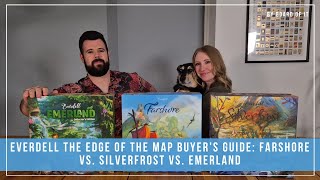
Players drawn to Everdell's blend of mechanics should explore related titles that capture different aspects of what makes it special. Those who love the worker placement core will find similar satisfaction in Viticulture and Agricola, though these lack Everdell's aesthetic charm and whimsical theme. Fans of tableau building should try Race for the Galaxy, which delivers similar card engine satisfaction in a faster, more portable package. For those enchanted by Everdell's woodland theme and beautiful artwork, the standalone games Farshore and Silverfrost offer reimagined experiences in different settings while preserving the core systems. Players seeking deeper worker placement with more interaction should explore Dwellings of Eldervale or Argent the Consortium, which use the mechanic in more complex ways. Finally, the Everdell expansions Newleaf and Mistwood deepen the original experience for those ready to invest further in the world of Everdell and want to refine their copy of the base game.
What Reviewers Are Saying
"It's a gigantic cardboard tree! It looks absolutely incredible. In fact, this entire game looks absolutely incredible. It makes Everdell beautiful to photograph, it shows up really nicely on Instagram."
— Nights Around a Table
"I don't think there's ever been a single newcomer that didn't think this was the coolest thing ever when I showed them Everdell. Like this is the type of thing that could've easily been a dysfunctional mess, but it isn't."
— Shelfside
"I really like Everdell. I enjoyed Farshore just fine. I actually like Everdell with the Mistwood expansion over base Everdell."
— Where There's A Wilz, There's a Play