/pic6177962.jpg)














































Fantasy Realms Deep Dive
What the Community Thinks About Fantasy Realms
Fantasy Realms earns a rare consensus among board game reviewers: it is a small, deceptively clever design that consistently surprises players who overlook it. Adam from Adam in Wales - Board Game Design placed it at number four in his all-time top ten filler games, calling it "such a clever game" and crediting its resurgence in popularity to the release of Red Rising, which "lifted Fantasy Realms up with it." The team at Foster the Meeple went further, ranking it their number one card game overall, describing it as a title that "just keeps sticking around" and something they "always go back to." Meanwhile, Rolls in the Family awarded it an 8 out of 10, praising it as "one of the best quick fillers you can add to your collection" for players who love card combos. The hosts of All You Can Board also placed it in their top 30 games of all time, with one host saying it is "such a satisfying game for me to play."
Reviewers consistently emphasize that Fantasy Realms earns its reputation not through complexity but through the quality of its decision space. The game is described across multiple channels as looking generic on the surface but revealing genuine depth once you start playing. Going Analog guest Peter C. Hayward highlighted the game's setup as one of the best in any game he owns: shuffle the deck and you are done. That simplicity of entry sits alongside a scoring phase that can feel as long and satisfying as the game itself. The Meeple University hosts compared it directly to Red Rising and concluded that Fantasy Realms is a kind of "gamer's rummy," a modernized version of gin rummy where you draw, swap, and refine until you have the highest-value hand possible. That framing captures why the game resonates so broadly: it takes a familiar human instinct, building the best hand you can, and wraps it in satisfying card interactions.
Core Mechanics That Define Fantasy Realms
Hand Optimization Through Constant Swapping
The mechanical heart of Fantasy Realms is elegantly minimal. On your turn, you either draw from the deck or take a face-up card from the communal discard area, then discard one card from your hand. You always hold exactly seven cards. The game ends the moment ten cards accumulate in that communal area. That is the entire ruleset.
What makes this tick is the hand optimization puzzle underneath that simplicity. As the Foster the Meeple team described it, the game is "a hand optimization card game," where you are constantly asking whether the card in front of you fits the strategy you are building or whether it is time to pivot entirely. The Rolls in the Family review captured the tension well: "With each new card that you see you will question whether it has a place in your strategy or even consider abandoning your strategy to go in a completely new direction." That moment of strategic recalibration, repeated over and over in a twenty-minute window, is what keeps the game feeling alive from turn to turn.
There is also a meaningful risk-management layer around the end-game timer. Since drawing from the deck pushes the game closer to ending, every draw carries a small cost. Players who need more specific cards can try to stall by taking from the discard pile instead, but at higher player counts, someone drawing from the deck at the wrong moment can catch everyone off guard. Rolls in the Family flagged this explicitly: "As the game gets closer to the end you face this tension of whether you should draw from the deck and push the end of the game or stall just a little bit longer."
Combos, Bonuses, and the Blanking System
Each card in Fantasy Realms carries a base point value plus a conditional scoring rule. The Rolls in the Family review described how cards score differently depending on what surrounds them: one card might be worth a modest amount on its own but triple in value if a specific other card is in your hand. The Foster the Meeple team illustrated this with a royal family example: a king card might score ten points alone, but if you also hold the queen and princess, the value can balloon to fifty. Landing those combinations produces a satisfaction that reviewers reach for superlatives to describe.
The other side of this coin is the blanking mechanic, which is Fantasy Realms' most distinctive and occasionally tricky feature. Certain cards, when paired together, blank one another: they score no points and trigger no bonuses. The Meeple University hosts identified this as the key puzzle new players need to internalize: "You need to have a combination of cards in your hand that hasn't blanked the other ones out." With the Curse Horde expansion, this system gets layered further, adding cards that can prevent other cards from being blanked, introducing a kind of meta-puzzle where you track not just which cards help each other but which cards protect which relationships. As one Meeple University host put it, the one tricky bit is "you've got to kind of pass it all together" to understand what is and is not blanked in a given hand.
The Fantasy Realms Experience
A Satisfying Engine of Escalating Combos
Reviewers across multiple channels describe Fantasy Realms as producing a specific kind of pleasure: the feeling of a hand clicking into place. The Rolls in the Family team recalled a game where one player "pulled off just the most incredible combination of cards" and turned it into a lasting memory, a score that became a benchmark in their group. That story is not unusual. The game creates these highlight moments regularly because some combinations are genuinely hard to assemble, and landing them delivers a reward proportional to the effort.
The Foster the Meeple hosts described the experience of chasing that perfect hand: "The whole game you could be like I gotta get that book of whatever, I gotta get that artifact, and you're just sifting through cards." That ongoing hunt gives the game a breezy momentum. Turns are short. The decision each turn is contained. But the underlying goal, assembling the best possible seven-card hand, generates a sustained engagement that belies the twenty-minute runtime. Rolls in the Family put it plainly: "It's a really satisfying experience with great variety that makes you want to play it again and again."
Accessible Gateway with Strategic Depth
Fantasy Realms occupies an unusual position as a gateway game that also satisfies experienced players. The Rolls in the Family team called it "a great gamer's filler," noting that "the type of card combinations in Fantasy Realms are more commonly found in longer and more strategic games, but for Fantasy Realms it's able to scratch that same itch in just 20 minutes." Daniel from Rolls in the Family included it in his five-game starter collection precisely because it "brings a wide range of people together": someone new to board games can grasp draw-and-discard immediately, while experienced gamers can dive into the combo-hunting.
Going Analog's Peter C. Hayward highlighted that Fantasy Realms' setup is essentially nonexistent, which lowers the barrier to actually getting the game to the table. The All You Can Board hosts agreed, noting that it is "such a simple thing to learn." That combination of fast setup, simple rules, and genuine strategic texture is what earns the game repeated plays across different groups. The Foster the Meeple team noted they play it at two, three, and four players, and bring it "everywhere we go." At the same time, reviewers are honest that players who struggle with reading card text or dislike ongoing mental calculation may find it less comfortable than it looks.
What Makes Fantasy Realms Stand Out
One Person's Trash Is Another's Treasure
A feature reviewers highlight with particular enthusiasm is the communal discard pile and the way it creates a shared economy. Because all discarded cards remain visible and available, every card you put down becomes an opportunity for another player. Rolls in the Family described this as one of the game's best positive qualities: "One player's trash is another's treasure. Every card in the game can be good in the right situation and very often what one player discards as the worst card in their hand is the perfect card for another player's strategy."
This creates a delightful secondary layer of indirect interaction. Players watch what their opponents take and discard, trying to infer what strategies are being assembled. At two players this becomes especially transparent: you can closely track what the other person is building and decide whether to race them to a key card or withhold a discard they clearly want. Rolls in the Family noted this effect: in a two-player game "it's a lot easier to really pay attention to what the other person is taking." At higher player counts this monitoring becomes looser and more chaotic, which some players prefer and others find less engaging.
Incredible Variety in a Tiny Package
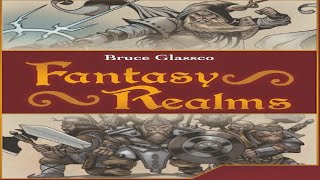
Fantasy Realms fits in a small box containing a single deck of cards, and reviewers return repeatedly to how much variety that deck generates. Because your starting hand of seven cards is randomized, no two games begin from the same position. Because the cards are interconnected in dozens of ways, the optimal strategy in one game may be completely different from the next. Foster the Meeple described this as offering "infinite strategies that you can try," with the gameplay experience shifting based on which key cards appear and in what order. The All You Can Board host put it simply: it is "one I'll always just kind of default to" because of how reliable and replayable the experience is.
The game has also generated multiple rethemed editions, including a Star Wars version and a Marvel Remix version with minor rules variations, as well as the Curse Horde expansion that adds new suits including outsiders and undead. The All You Can Board hosts played both the original and Marvel Remix, ultimately preferring the original but acknowledging that both "do really really great stuff." The core design has proven adaptable enough to carry multiple treatments without losing what makes it work.
Potential Drawbacks
Scoring Can Be Slow and Tedious
The most consistent criticism across every channel that reviewed Fantasy Realms is the end-game scoring. Because each of the seven cards in your hand has its own base value plus conditional bonuses and potential blanking interactions, tallying a final score requires working through all of those layers simultaneously. Rolls in the Family flagged that "scoring can also be rather tedious since you need to manually tally the points generated by all the cards while keeping in mind all of the various interactions." At two players this is manageable. With five or six players it can feel like a math quiz after what was a breezy game.
A scoring web application exists that lets players input their cards and receive a calculated total, which multiple reviewers mentioned as a practical solution. However, Rolls in the Family noted a trade-off: when an app spits out a final number, "you do lose some of the fun of seeing how players earn their points." Adam from Adam in Wales pushed back against the tedium framing, arguing that even the scoring is enjoyable once you appreciate the combo structures, calling it "frankly even that's fun." But for groups who are not already invested in understanding the card interactions, the scoring phase can feel like homework at the end of a short game.
Randomness and Limited Interaction
Fantasy Realms is honest about its relationship with luck. Your starting hand is random, the cards that appear in the discard pile are random, and the game can end before you have had enough turns to pursue a strategy. Rolls in the Family acknowledged that "randomness has a huge role" and that "some players are simply going to have more luck in the cards they acquire." This is not necessarily a problem given the short runtime, but it means the playing field is not level and experienced players cannot consistently outperform lucky draws.
Direct player interaction is also minimal. You can watch what others take and calibrate your discards accordingly, but there are no mechanics for directly disrupting opponents. The Meeple University comparison to Red Rising noted that Red Rising includes some take-that cards while Fantasy Realms largely avoids them, which makes the game feel cleaner but also more solitary. Players who want meaningful head-to-head tension may find the indirect competition via the shared discard pile satisfying enough; those who want direct conflict may prefer something else. At higher player counts specifically, Rolls in the Family observed that the game produces more downtime and fewer turns per player, which amplifies the luck factor and reduces the ability to respond strategically to what others are doing.
If You Enjoy Fantasy Realms
Reviewers consistently point toward Red Rising as the closest relative, sharing the hand-management core with added card actions and area-control elements that make it longer and more complex. The Meeple University hosts and the All You Can Board team both drew this comparison directly. If you want more game around the same fundamental idea, Red Rising is the natural next step. Marvel Remix is a rethemed version with minor rules differences that fans of the original often enjoy as a companion.
For the gateway and filler side of Fantasy Realms, reviewers mention Sushi Go as a similarly quick, friendly set-collection card game with drafting mechanics and broad appeal. Splendor appeared on the Rolls in the Family list as a comparable medium-weight accessible game with engine-building elements. Gizmos scratches a similar itch around building combos and watching an engine assemble itself. If the card-interaction complexity of Fantasy Realms is what excites you, Dominion and Magic: The Gathering were both cited by Rolls in the Family as games that share that DNA at greater depth and investment. For the quick, elegant, two-player angle that Fantasy Realms handles well, the broader canon of compact card games is your territory.
What Reviewers Are Saying
"It's just such a satisfying game for me to play. I'm glad that you picked it up and introduced it because I would have skipped over it just based on like it just seems so generic. The artwork is generic and everything. I overlooked it for a long time too. But it's just this really solid game I really really like it."
All You Can Board (— Watch on MindForge)
"If you're someone who enjoys games with lots of card abilities and the thrill of searching for high scoring combos then Fantasy Realms is one of the best quick fillers you can add to your collection. Getting that in kind of the gamers filler short package leads to it being a solid 8 out of 10 for me."
Rolls in the Family (— Watch on MindForge)
"Fantasy Realms is our number one. It is literally just a deck of cards. It comes with us everywhere we go. We play it with everyone. It plays fantastic at two, three, four. There's like infinite strategies that you can try and it all depends on what card you get."
Foster the Meeple (— Watch on MindForge)