/pic1091049.jpg)
360 animals on big cards are waiting for the players of Fauna. Every round a single animal presents itself by name and picture. The 2-6 players try to guess the animal's weight, length, height, tail length and - most important - the areas in which the animal lives on the Earth. The early bird gets the worm: an area on the big map or a sector on the scales already occupied by a player token cannot be chosen a second time. When no player wants to set another token the round ends and the scoring is performed. Tokens on correct spaces get points for the corresponding player, also tokens in the direct neighborhood of correct spaces score points. Tokens not earning points are temporarily out of the game - so risk should be carefully considered. Next round - next animal - starting player changes. The first player who reaches a certain total score wins (normally after 8-12 animals).

FAZA Tutorial Playthrough - JonGetsGames
- portrait drafting around relatives
- aphrenda/day of the dead tableau-building
- tableau-building with familial portraits
Mechanics (from transcript analysis)
- Card Drafting — draft and orient portraits of relatives
- Tableau Building — arrange portraits to form a tableau
Video topics + discussion points
Quotes (from this video)
- I am not a fan of it at all.
- This artwork is so beautiful. Like look at it's so vibrant and so pretty.
- The Lord of the Rings Fate of the Fellowship though this I am very excited about.
- Cali Mala is a reprint.
- I pre-ordered Cube Express from them because I wanted to take a look at that one.
References (from this video)

- Puzzly
- Crunchy puzzle
- Feels different from similar games
- Making an altar to light up portraits of loved ones lost.
- Calico
Mechanics (from transcript analysis)
- Card Drafting — Players will be 'drafting cards'.
- Pattern Building — Players are 'placing them in different spots in your pyramid' and scoring depends on 'certain things... next to them'.
- Set Collection — Scoring is based on 'different attributes' and adjacency requirements like 'doesn't want green cards... near them' or 'wants needs a pink card next to them'.
Video topics + discussion points
Quotes (from this video)
- This one is the top 10 games that I've already played cuz I'm fortunate enough to get some early copies of things that are releasing at Gen Con.
- Jungo is the reason why I'm never going to play Scout again.
- This is one of the most unique experience games ever.
- Breaking down barriers, growing relationship board games by helping you find the next one you love.
References (from this video)

- gorgeous components
- puzzly and engaging
- not always perfect; some players may end unhappy with placements
- grudges across generations and familial placement
- family tomb or ancestral setting with a focus on placement
- puzzly, drafting-driven with a somber tone
Mechanics (from transcript analysis)
- draft system — Initial drafting that determines play order or available actions
- Placement puzzle — Place pieces (ofrena) so that family members are satisfied with positioning
Video topics + discussion points
Quotes (from this video)
- The artwork on these cards is adorable and you're trying to capture rooms because essentially you want to be the head honcho of this manor. It's really fun. It's really cute.
- The components are amazing in this game, and I can usually find it for really cheap on sale.
- it's a ridiculous theme, but it's not scary or gross. It's more meant to be funny and campy.
- This is a fantastic solo only game. And I love the game, but I definitely lose more than I win.
References (from this video)

- Celebrates Spanish culture and a lesser-known architect.
- Devir's unpredictability in their releases is a positive.
- Retails for $49.99, considered not bad.
- Catalan architect
- 19th century Catalonia
- Euro game exploring the architect's life and work
- Barcelona
Mechanics (from transcript analysis)
- tile laying — Players will create trencadís art patterns, suggesting tile laying.
- Victory Points — Players earn victory points in categories like nature, Catalonia, and religion.
Video topics + discussion points
Quotes (from this video)
- Yeah, my man [laughter] loves paths.
- You're going to be going across crumbling bridges, but beware each bridge crossed will collapse behind you, changing the landscape.
- They're going smaller. We're going to be able to fit all these on your shelf, yeah.
- Now, this one before you get to what it's about, I had it myself a shame for a while only because the components were so nice, right?
- Beautiful editions of those games, right? Now, this looks very nice to me.
- Our focus has been in ensuring that it's the definitive version, including a visual over overhaul.
- When you compare against any of those three Super Meeple games, those are stellar productions.
- It's more portable. It's a little easier to bring to the table cuz you need less footprint, you know, things like that.
- Now, that I'm I'm intrigued by making this game a little bit shorter.
- It could be very mean like uh all of these games kind of could be.
- I do worry that they're kickstarting or crowdfunding, I don't know how uh all of these at once in the same project.
- Roll and write, flip and write.
- Smack and write.
References (from this video)
- crunchy, deep puzzle with multiple scoring layers
- strong thematic cohesion around family and memory
- good replay potential due to many flipping decisions
- high cognitive load and learning curve
- some players may find the rules dense or opaque
- memorialization, family lineage, rituals surrounding the departed
- an altar-like tableau where family members are drafted and arranged with candles and backgrounds to score
- puzzle-driven drafting and placement with candle-based endgame goals
- Calico
Mechanics (from transcript analysis)
- Drafting — you select and pay to draft family members for your tableau
- Flip scoring — points are awarded when characters are flipped according to evolving objectives
- pattern and endgame objectives — candles and icons around the board create endgame scoring opportunities
- Tableau Building — you place drafted figures on an altar-like board to create scoring configurations
Video topics + discussion points
Quotes (from this video)
- One of the most unique games I've played in a while
- crunchy sort of puzzy style
- If you liked Revive... you like that weight of game
References (from this video)

- Cooperative, team-focused play with asymmetric roles and unique abilities per planet faction
- Rich thematic flavor with clear, board-state-driven drama (drones, terraforming, motherships)
- Layered combat resolution that rewards tactical planning, card synergy, and positioning
- Varied game events (short vs long cards) add unpredictability and replay potential
- Clear teaching through a narrated playthrough, including practical demonstrations of core rules
- Prototype components and artwork noted in the video; final production may differ
- High complexity and several interacting rules can create a steep learning curve
- Three-player focus; scalability to more players is not shown, which may affect balance
- cooperative resistance against an insectoid/alien incursion with rebels and terraforming tokens
- Earth under alien invasion by Fahza, with motherships terraforming and drones darkening the map
- tutorial-playthrough narrative that blends teaching mechanics with in-game events
Mechanics (from transcript analysis)
- Airfield movement, Run/Plane actions, and teleport — Units move using Run (single tile) and Plane (up to two tiles with a restrictor) or teleport via a card; rebels may teleport to join battles.
- Brain Worm long event (ongoing effect with recover/kill constraints) — A long event that imposes ongoing effects and requires resource commitment to cure (sacrificing drones) at the end of team phases.
- Combat resolution with dice and color matching — Dice are rolled with color-matching regions providing +1 to rolls; certain cards add modifiers and abilities that affect hit likelihood.
- Drones, drones on tiles, and max 3 per tile — Carrier drones are dropped onto tiles by the Fahza; tiles can hold up to three drones, influencing combat outcomes and reinforcements.
- Event cards with short/long duration effects — Top-deck events apply local or lasting effects; some are short-lived, others persist until a new card is drawn.
- Fossa phase sequence and doom-cycle through three ships — Three ship types (Destroyer, Carrier, Former) each have a phase-based movement and attack sequence; drones increase or decrease as ships move.
- Mothership combat via board-and-rebel boarding — Humans pilot rebels to board motherships to deal damage; must clear drones on the tile first; damage tracked on a die.
- Outpost management and terraforming — Motherships and outposts are terraformed by Fahza actions, changing tile status and enabling or restricting actions later.
- Re-rolls and special skills — Certain units or cards provide one-time re-rolls or special abilities that modify combat outcomes or maneuverability.
- Rebel recruitment and absorption — Spending drones to recruit rebels onto face-up outposts; rebels absorb damage instead of or in place of humans depending on tile color.
- Team phase / Fahza phase round structure — Players take actions in a team phase, then the Fahza (alien) phase drives threats (drones, motherships, terraforming) and ongoing effects.
Video topics + discussion points
Quotes (from this video)
- the motherships are wandering around damaging our military terraforming the planet
- the only way we can actually do damage to and destroy those motherships is by recruiting rebel fahza to come over and fight for our side
- rebels are fahza aliens who have decided to defect and help out the humans
- you are never allowed to leave a tile if it has drones on it
References (from this video)

- engaging and accessible
- high production value
- depends on group knowledge diversity
- knowledge-driven party/euro hybrid
- animal-themed general knowledge
- approachable, social deduction-like
- Terror
- Trivial Pursuit
Mechanics (from transcript analysis)
- general knowledge with leeching — players leverage others' knowledge and guessing to score
Video topics + discussion points
Quotes (from this video)
- The Spiellers Yares Award is the most prestigious award in board gaming in the world.
- Bucket King 3D uses plastic cups that stack on top of each other to give it a real three-dimensional view.
- It's a lot of fun.
- This is not a great game, but it is a funny one.
- Splendor is everywhere. The artwork is so boring. It’s a lovely game, don’t get me wrong.
- Rise of Augustus demonstrates that bingo is the one thing that makes it so accessible.
- This is an accessible, simple game. It's got a beautiful look to it.
- Concept would have been a worthy winner.
- Arcadia looks amazing when you play it and lay it out on the table.
References (from this video)
- Accessible still engaging trivia
- Copying others' guesses adds social interaction
- Fits a party vibe while remaining board-gameish
- Relies on general knowledge; some topics may feel narrow
- animals and global trivia themes
- animal trivia
- casual, party-leaning but still board-game flavored
- Terra (TerrA) series
Mechanics (from transcript analysis)
- trivia with inference — Players answer animal-based trivia; clever copying of others' guesses can maximize scoring.
Video topics + discussion points
Quotes (from this video)
- the brave action is bigger but you might not get it if someone else also takes it
- the witch's theme delivering potions works very well
- rules are really simple, uh the game is attractive and it's a game that you can really sort of you feel like you could master
- it's the best trivia game that i know
- the production is fantastic, the pieces are really high quality
- you are not allowed to speak to each other
- the cubes are the most magnificent component
- i created doodle rush
References (from this video)

- Isle of Cats
- Dwellings of Elder Vale
Mechanics (from transcript analysis)
- cooperative play — team-based puzzle-solving against aliens
Video topics + discussion points
Quotes (from this video)
- this is experimentation month
- I want to be less stubborn
- the sticker shock issue really rears its head
- please give me feedback about this specific log
- it's a big box if it was a smaller box I think you'd be much more likely to have a state in the collection
- I think it's really important to be introspective and be honest with myself
References (from this video)
- Encourages educated guessing and discussion
- Social and accessible
- Timeline
- Wits and Wages
Mechanics (from transcript analysis)
- Trivia/Estimation — Players guess approximate values (e.g., animal tail length, geography).
Video topics + discussion points
Quotes (from this video)
- This list is all about hopefully it'll give you some ideas of games that you might want to pick up yourself.
- Auctions are challenging; the more you play, the more you start to feel how much those power stations are worth.
- Not everybody is going to have totally accurate general knowledge and it welcomes players in to just have a go.
- I split you choose is a mechanism that could be used more broadly; it creates delicious tension and stress at the table.
References (from this video)
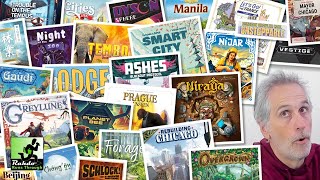
- artistry / architecture
- Barcelona / Gaudi's legacy
Mechanics (from transcript analysis)
Video topics + discussion points
Quotes (from this video)
- I am just a huge fan of this kind of time loop sort of thing
- The more people respond, the better this system is going to be
- Spoiler alert for a game that's I'll be covering soon on the channel