










Fertility Deep Dive
What the Community Thinks About Fertility
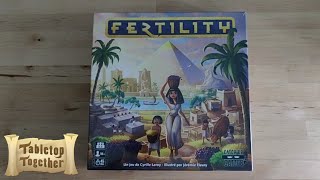
Reviewers describe Fertility as a compact domino placement game played on a shared grid, where each tile laid out generates resources based on the matching terrain beside it. Opinions agree on the core loop and split on how much lasting depth it offers. Tabletop Together approached it as a first-time unboxing and came away with the sense that it sounded simple on paper but rewarded careful timing. Getting Games was more enthusiastic, praising the time pressure and the way placements shape what opponents can do on their next turn.
Board Game Dad is the most favorable voice across the videos that cover it. The channel describes the game as a family favorite that held up through repeated plays, with the mood of the table shifting as players found different ways to score. A separate Board Game Dad review, which rates games by theme, mechanics, components, strategy and complexity, is more critical, calling Fertility a game with little theme and little strategy. The same channel's Amazon deals video, however, says the owner enjoys the game a great deal and finds its flow satisfying.
Core Mechanics That Define Fertility
Resource Management
The most discussed system is the rule that resources must be used quickly. Getting Games explained that resources produced by placing a domino must be spent before the turn ends, and any that do not go into a shop tile are discarded. Board Game Dad described the same pressure as "use it or lose it," adding that the two main outlets are buying a tile to expand the player board or placing resources on spaces already on that board to score points. That constraint means every placement carries an opportunity cost, because a domino that produces the wrong resource at the wrong time simply wastes its output. Tabletop Together noted the same trap, warning that resources cannot be carried from round to round and will be wasted without a space to put them.
Set Collection
Shop tiles function as one-shot set collection. Getting Games described conditions such as placing a papyrus and a stone to produce a grape, which can then be spent on another shop that awards victory points. Some shops reward a player for holding a certain number of a resource at the end of the game, which pushes players to build a small victory point engine. Tabletop Together also highlighted the monument element, where a player who places a monument on the shared board can score if they hold the most or second most monuments by game end. Reviewers saw these conditions as the heart of the game, because the best choices come from chaining shop purchases together.
The Fertility Experience
Brisk Time Pressure
Reviewers repeatedly describe the feeling of racing the clock. Getting Games said the game carries a great deal of time pressure, because the reviewer kept counting remaining turns and realized there was still a long list of shops to fill. Board Game Dad said the game ends at just the right point, leaving players wanting another turn rather than feeling worn out. The result is a game that feels tight and deliberate, where each domino needs a purpose and the closing rounds demand efficient conversion of resources into points.
Tense, Self-Balancing Interaction
Placement is also a social act. Getting Games observed that players often try to take the most valuable open spots so an opponent cannot use them, while also considering whether a placement will set up the next player for a strong turn. Reviewers described a table where players lean on each other to keep the game balanced. A placement that helps an opponent needs a significant payoff to justify it, and the reviewer noted that the game rewards players who stay alert to what the rest of the table is building.
What Makes Fertility Stand Out
A Satisfying Domino Flow
Reviewers praise the feel of placing tiles. Board Game Dad said the domino placing mechanic is very satisfying, and that the game has a flow that is enjoyable even for a reviewer who does not usually care for abstract games. The reviewer added that they would rather play Fertility than a standard domino game because the resources give each placement a reason to matter. Getting Games made a similar point, calling the core loop easy going and quick to learn, with each turn offering something to consider without a long analysis phase.
A Length That Fits the Table
Many reviewers singled out how well the game fits into a standard game night slot. Getting Games found the game surprisingly quick and easy to teach, with a game length that felt comfortable for a mid-evening session. Board Game Dad's family list described the game as one that many households play repeatedly, because it provides enough strategic variety to change the feel of each session without requiring a long commitment. The result is a game that reviewers return to often, even when they have other options on the shelf.
Potential Drawbacks
Limited Variation Between Plays
The most common criticism is that the game plays similarly from session to session. Board Game Dad said that every game feels like the previous game, because the setup does not change in a way that alters the experience. The reviewer compared this unfavorably with games that look different each time they are set up, and noted that Fertility is not a game where variation in how it is played adds much to the experience. Players who need constant novelty may find the repeated structure tiring over many plays.
A Thin Theme and Abstract Feel
Several reviewers said the game's Egyptian presentation does little to shape how it plays. Board Game Dad's rating-based review described the game as having hardly any theme or strategy at its core, and called the design a domino placing game painted with an Egyptian look but abstract in its gameplay. The same channel's Amazon deals video described the game as thematically dry, even while praising its flow. Players who want a story to carry the session may find the abstraction a poor fit, even if the mechanics themselves work well.
If You Enjoy Fertility
- Calico: Board Game Dad said they would rather play Calico than Fertility because Calico makes more sense to them. Players who enjoy grid-based tile placement and want a clearer connection between their decisions and the theme may find Calico a natural next step.
- Dominion: Board Game Dad used Dominion as the reference point for a card-ability engine, where each card's effect either buys more cards or produces victory points. Fertility shares that chain from action to resource to points, so players drawn to turning small actions into a growing engine may appreciate the comparison.
What Reviewers Are Saying
"It sounds way too simple, right? But the trick is there are resources you get for, for resources, keep on saying that, resources you get for placing these tiles will, you will not be able to keep them from round to round, so unless you have somewhere to put them, as in some of these spots, then they will basically be wasted."
— Tabletop Together
"I think this is the kind of game where you really are kind of leaning on each other to be self balancing. If you put down this tile on a spot that really helps out one of your opponent's, you better be getting a lot of stuff for that, so you have to be very cognizant of what's going on."
— Getting Games
"One of the things it does so well is the game ends at just the right point every time I play it. It's enough to get a lot done, but it stops right before you wish it could stop. It always leaves you going, like, I could play one more domino if I could just play one more domino."
— Board Game Dad