/pic3482521.jpg)
































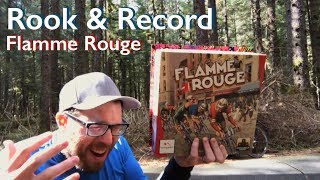

Flamme Rouge Deep Dive
What the Community Thinks About Flamme Rouge
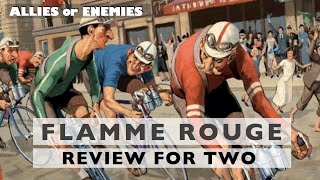
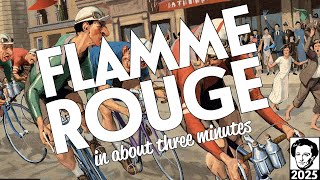
Reviewers across formats, from short-form breakdowns to long-form conversations, land on the same conclusion: Flamme Rouge earns its reputation as one of the tightest racing designs in the hobby. 3 Minute Board Games, reviewing from a publisher-provided copy, called it "an exceptional game" and was "slightly surprised it didn't conquer the world," while still noting the ideas here would echo later in Heat Pedal to the Metal. Allies or Enemies described the base experience as "exceedingly simple" and pointed to the free Tour app as the thing that keeps players coming back for entire championships. On Beyond Solitaire, guest Pete singled out Flamme Rouge among the games that bring personal joy, praising how it keeps everyone in contention for the win. Ilia and Tyler placed it in their top five games discussed that month, and The Cardboard Herald returned to it repeatedly as a model example when discussing catch-up design.
The disagreement is less about whether the game works and more about how exciting it feels sitting at the table. 3 Minute Board Games was blunt that the game "is just not flashy at all," describing it as feeling "exceedingly European in a slightly sensible yet boring kind of way." BoardGameBollocks took the most mixed stance of the group, enjoying their plays enough to land on a seven out of ten, yet questioning whether the design brings anything new to the racing genre once its influences are accounted for.
Core Mechanics That Define Flamme Rouge
Deck Depletion and Card Management
Each team runs on two separate decks, one for the Rouleur and one for the Sprinteur, and every turn asks for a hard choice. 3 Minute Board Games explained that players draw four cards from one rider's deck, decide which one to play face down, and place the other three face up under the draw pile, with the crucial catch that "once a card is used it's gone for the rest of the game." BoardGameBollocks walked through the same structure, noting that players take four cards off the deck, choose one to play face down, then do the same for the other rider before everyone reveals together. Allies or Enemies framed the tension this creates plainly: the deck "is built to just barely get you over the finish line," so every one-space gain or loss from a hill or a bad draw compounds over the course of a race.
Slipstreaming and Exhaustion
The game's catch-up engine runs through slipstreaming and exhaustion cards. Allies or Enemies summarized it as riders one space behind getting to "slipstream up to the pack" while riders at the front "add one exhaustion card to their decks." The Cardboard Herald used Flamme Rouge as its go-to example when unpacking why catch-up mechanics work when they make thematic sense, explaining that a rider at the head of a pack takes an exhaustion card while a rider further back avoids it and instead gets "the opportunity to slipstream and get free movement," which the host tied directly to drafting behind another vehicle to escape wind resistance in real racing. BoardGameBollocks likewise called out the slipstream rule as the game's built-in catch-up mechanism, letting a trailing rider "time it" to jump forward in bulk without burning a high-value card.
The Flamme Rouge Experience
Fast, Tight, and Tense
Multiple channels described the same rhythm at the table: quick to teach, quick to play, and close every time. BoardGameBollocks called the rulebook "a full sheet" and said the game is "easy to teach" and "a really fast moving, fast-paced game," adding that finishes are always tight, sometimes coming down to the last card played. Ilia and Tyler echoed the pacing, saying every turn produces a moment of "no, why did you do that" even though the underlying system "feels so simple." That combination of light rules and constant tactical pressure is what The Cardboard Herald pointed to when discussing why the exhaustion mechanic keeps every position in the pack meaningful.
Team Racing and Theme
3 Minute Board Games highlighted the two-rider team structure as the design's strongest idea, saying the "team game element here is exceptional" and that using the Rouleur's and Sprinteur's different strengths well is "key to winning," including the strategy of loading fatigue onto the Rouleur so the Sprinteur can pull away later. The theme carries through the presentation as well. BoardGameBollocks described art that "really does bring to life" a French countryside Tour de France setting, and on Beyond Solitaire, Pete said the game does "a wonderful uh emulation of a bike race" and that players end up discussing the session in the same language they would use for a real race.
What Makes Flamme Rouge Stand Out
The Peloton Expansion at Low Player Counts
Several reviewers pointed to how well the game scales down. Allies or Enemies explained that the base game is "really a game for three or four players" because the track feels empty otherwise, but that the Peloton expansion adds bot riders that are "exceedingly easy to use and work surprisingly well," making Flamme Rouge "one of the better two player race games going." 3 Minute Board Games separately mentioned playing with six players using the Peloton expansion and finding that it "works remarkably well at high player counts," showing the same add-on stretches the design in both directions.
The Tour App and Expansion Depth
Beyond the base box, reviewers called out the amount of extra structure available. Allies or Enemies credited the free Tour app as "probably the biggest thing that's been bringing us back," letting players run "a championship tour of various lengths" complete with individual and team stats and yellow jerseys. 3 Minute Board Games pointed to the Grand Tour expansion for a different kind of depth, describing "a campaign, new tiles, tons of stage layouts and different skill sets for riders to try out."
Potential Drawbacks
Understated Presentation and Pacing
Not every reviewer wanted more excitement from the theme itself. 3 Minute Board Games was the most direct about this, saying the game "is just not flashy at all" and can feel "exceedingly European" in tone, and warning that the game "moves at the pace of the slowest player," so one person who agonizes over their cards can slow the whole table.
Randomness and Familiar Ideas
BoardGameBollocks raised the biggest structural concerns, pointing out that players "don't know when the cards that you really want to come out are gonna come out," leaving no real control over how a deck plays out and occasionally leaving someone stuck behind a better random draw. The same review found the ascent and descent rules for hills unclear at first, called searching through the tile bag "a pain," and ultimately felt the design borrows enough from other games that it "lacks originality." Allies or Enemies added a smaller complaint that the base game "can feel light" without an expansion, and that the two-player balance depends heavily on adding the Peloton bots.
If You Enjoy Flamme Rouge
3 Minute Board Games directed fans toward Heat Pedal to the Metal for a similar game about motorsport, and toward Steampunk Rally for "a far more wacky racing game." Ilia and Tyler weighed the two head to head and said they lean toward Flamme Rouge over Heat despite the two games being mechanically similar. The Cardboard Herald used Mario Kart alongside Heat as the clearest example of a design that rewards trailing players and punishes the leader, the same rubber-banding tension found in Flamme Rouge's exhaustion cards.
What Reviewers Are Saying
"Flamme Rouge is an exceptional game and I'm slightly surprised it didn't conquer the world. A lot of the ideas here and the overall feel of the game would end up in Heat Pedal to the Metal, but Flamme Rouge is a strong game in its own right."
— 3 Minute Board Games
"Probably the biggest thing that's been bringing us back is the tour app, which makes it possible to run a championship tour of various lengths with individual and team stats and yellow jerseys and a running tally of trophies. I'm 90 percent sure that it's official as well, but either way it's free and it's pretty awesome."
— Allies or Enemies
"I had heard the whole debate of heat versus flam, and I think I lean on the Flam Rouge side of things. I enjoyed that a lot more than Heat. I don't know why because mechanically they are very very similar."
— Ilia and Tyler