










































Fog of Love Deep Dive
What the Community Thinks About Fog of Love
Fog of Love stands out as a genuinely unique experience in board gaming, with reviewers consistently praising its innovative approach to two-player gameplay. The game captures something rarely seen at the table: an intimate, narrative-driven relationship simulator that challenges players to balance personal goals against shared happiness. Reviewers emphasize that this is not a traditional competitive game but rather a social experience where the arc of your fictional romance genuinely unfolds through the choices you make together.
Core Mechanics That Define Fog of Love
Simultaneous Revelation and Hidden Traits
At the heart of Fog of Love lies a deceptively simple mechanic: players secretly commit to choices and simultaneously reveal them. Each player begins by selecting three hidden trait cards representing secret personality goals their character wants to embody. These traits remain unknown to the opponent throughout the game, creating a fascinating dynamic where players gradually learn about each other through gameplay. As choices are revealed, both players must infer what traits might be driving their partner's decisions. The relationship succeeds not just through matching choices but through developing intuition about who your fictional partner actually is.
Destiny Cards and Variable Endings
Rather than a binary win or loss, Fog of Love offers multiple paths to relationship fulfillment through destiny cards. Each player begins with four possible relationship outcomes, ranging from a destined love to a dominant relationship or even a breakup. As the game progresses, players discard destiny options, narrowing their possible futures. At the finale, both players must select a remaining destiny and achieve its specific requirements for victory. This structure means the game is as much about discovering compatible relationship styles as it is about mechanical victory, creating moments where one player might break up with their partner to win while the other loses by wanting to stay together.
The Fog of Love Experience
Intimate and Interactive Dynamics
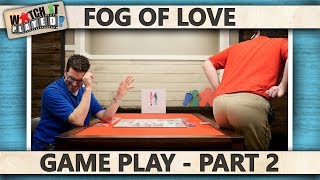
What makes Fog of Love resonate with players is its ability to create genuine emotional moments between two people at the table. The game is intensely interactive, forcing constant negotiation of needs and expectations through the narrative of your relationship. Reviewers note the game excels at creating memorable, sometimes hilarious, sometimes surprisingly poignant moments. One reviewer described watching their partner smile while actively choosing selfish behavior in-game and feeling actual hurt, blurring the lines between roleplay and reality. The simultaneous reveal mechanic ensures players are constantly discovering new things about how their companion approaches problems.
Narrative-Driven and Unique in Scope
The game feels less like a traditional board game and more like participating in a romantic comedy together. Scenarios come from simple cards that present relational challenges: a party you don't want to attend, concerns about commitment, questions about attraction. The decisions you make stack upon each other, creating a sense that you're actually in a relationship with arc and development. Some reviewers noted the component quality is excellent and adds to the thematic experience. The game comes with multiple scenarios that function like different story starts, allowing each playthrough to feel fresh while maintaining the core emotional trajectory.
What Makes Fog of Love Stand Out
A Role-Playing Experience Without Traditional Role-Playing
Remarkably, Fog of Love achieves immersive character development without traditional role-playing. Players who normally avoid RPGs report enjoying the game because the mechanics guide their character choices rather than requiring improvisation. Your traits and decisions create a consistent personality that emerges naturally through play. The game teaches what your character wants, and then you play toward those goals. It's a unique synthesis where character roleplay emerges from mechanical incentives rather than creative performance, making it accessible to players who find traditional RPGs intimidating or tiring.
Emotional Stakes and Relationship Testing
The game excels at generating genuine emotional engagement with the fictional relationship. Because mechanics reward selfishness, ambition, or other goals that might conflict with partnership success, players must actively choose to prioritize the relationship over their hidden objectives. This creates tension that goes beyond typical board game strategy. Reviewers consistently mentioned moments of silence or actual concern when one player's goal required actions that hurt the fictional relationship. The designer even includes a warning that players in rocky real-life relationships might want to avoid the game, acknowledging its capacity to surface actual relationship dynamics and tensions.
Potential Drawbacks
Requires Emotional Investment and Vulnerability
Fog of Love can be uncomfortable for players who prefer their gaming detached from personal dynamics. The game's power comes from genuine engagement with the relationship narrative, which means detached or ironic play diminishes the experience. Players who are uncomfortable being vulnerable with their gaming partner, or who play in a group where teasing crosses into cruelty, might find the game exposes uncomfortable dynamics. Additionally, because the game involves role-playing relationship scenarios, some players may find the constant character engagement exhausting over multiple playthroughs.
Variable Replay and Expansion Requirements
While the game offers good setup variation through trait cards and scenario selection, reviewers noted that after playing through scenarios multiple times, the situational cards eventually lose their element of surprise. The core scenarios are finite, and discovering what choices you face removes some of the discovery factor that makes early playthroughs engaging. Extending the game's life requires purchasing expansions, which some found frustrating given the game's relatively modest initial component cost. The experience also heavily depends on player commitment to take the game seriously; cynical or distracted play undermines what makes it special.
If You Enjoy Fog of Love
Players who love Fog of Love often gravitate toward games with strong narrative experiences and emotional stakes. Mysterium offers similar thematic depth through its ghost-and-investigator dynamic, creating intimate collaborative moments. For those drawn to the decision-making and hidden information elements, Watergate provides tense two-player gameplay with asymmetric information and hidden agendas. Gloomhavens campaign structure creates the kind of character development and emotional investment, though at a much larger scale. Players might also appreciate The Crew: Mission Deep Sea for its cooperative puzzle-solving between two players with hidden goals, or Patchwork as another excellent two-player experience that rewards understanding your opponent's approach and psychology.
What Reviewers Are Saying
"Sitting across from my actual partner, watching them actively choose to be a jerk to our fictional relationship, it bled through. It started to feel like a commentary on us."
— Board Game Critique
"The game forces you to operationalize selfishness. It gamifies betrayal. And the designer even suggests maybe you shouldn't play with your real life partner if your relationship is rocky."
— Board Game Critique
"This game does an amazing job of pulling you into acting like a person that you're not while still not making you feel like you are role-playing in the traditional sense."
— Getting Games