



























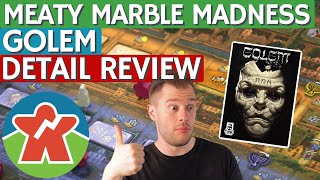





Golem box art

Golem

Game ID: GID0145197
Collection Status
Description

Golem is an engine-building game by Simone Luciani, Virginio Gigli and Flaminia Brasini, the same team that brought you Grand Austria Hotel and Lorenzo il Magnifico.

The game is based on the 16th-century legend of the Golem of Prague, an anthropomorphic creature that Rabbi Loew animated from a clay statue to protect his people. In the game, players take on the role of rabbis who create and grow these powerful creatures that will be moved around the neighborhoods of Prague under the control of students. Be careful, because if a golem becomes too powerful, it will destroy everything it encounters on its way. Players can also kill their Golems in order to get bonuses.

Players also create powerful artifacts and acquire knowledge by collecting ancient books.

The game is divided into four rounds, and each round is composed of 7 phases:

Refresh
Golem Movement
Actions (2 marble actions and 1 rabbi action)
Turn Order
Influence Character
Income and Development
Golem Control

At the beginning of each round, the players will shuffle the colored marbles into the 3D synagogue that will split them into five lines corresponding to the five main actions available in the game:

Work: By paying Knowledge, you can activate the Golem placed in the city of Prague and get bonuses.
Golem: Obtain clay to create new golems and upgrade the developments on your personal board.
Artifact: Obtain coins and buy gold to build artifacts that offer permanent bonuses in the game and upgrade developments on your personal board.
Spells: Obtain Knowledge and perform spells (with a scoring for book collection) and upgrade developments on your personal board.
Mirror: Perform one action of your choice by paying 1 coin.

The number of marbles available in the corresponding action line determines how much the player gets from the action. When you choose an action, you collect one marble of your choice in the corresponding line and depending on the color of the marble you chose, you also move your student forward on one of the districts of Prague.

It's important to advance your students on those tracks to be able to keep your golems under control. At the end of the round, knowledge can also be used to control a golem that surpassed its students, but if one of these creatures is uncontrolled, it may become dangerous and destroy the neighborhood, after which you will have to destroy and bury it!

The marble color also matters, because at the end of the round, if you get the correct combination of two colors, you receive the favor of one of the powerful Prague characters, which will differ each round.

At the end of the fourth round, players score points for active or buried golems, artifacts, books, development on their personal board, and collected goal cards.

Year Published
2021
Transcript Analysis
Browse transcript mentions, sentiments, pros/cons, mechanics, topics, quotes, and references.
Total mentions: 12
This page: 12
Sentiment: pos 8 · mix 2 · neu 1 · neg 0
Mentions per page
Top
Showing 1–12 of 12
Video 5PL7DMVET68 Golem Tutorial Channel rules teach at 0:00 sentiment: neutral
video_pk 30377 · mention_pk 89427
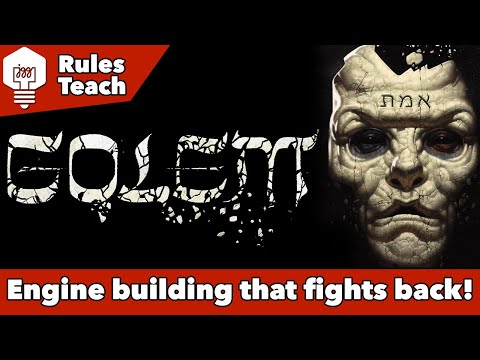
Golem Tutorial Channel - Golem video thumbnail
Click to watch at 0:00 · YouTube ↗
Overall sentiment (raw)
neutral
Pros
  • Clear delineation of setup steps for new players, including the starting components and their orientations.
  • Comprehensive walkthrough of core actions (marble actions, Golem activation, and Rabbi actions) that helps build a mental model of engine management.
  • Explicit guidance on interaction between different board elements (markets, development tiles, artifacts, and tracks).
  • Examples of strategic decisions (e.g., when to move Golems, when to buy tiles, and how to maximize menorah bonuses).
  • Highlights potential pitfalls and pacing considerations (e.g., the cost of unplayed or overextended tracks, graveyard strategies).
Cons
  • The tutorial is dense and long; beginners may experience information overload without practical hands-on play time.
  • Some rules references assume familiarity with abstract mechanics (e.g., the color-coding semantics, the nuances of track costs, and the timing of activations) which could overwhelm casual viewers.
  • The video’s pacing is heavily rule-focused rather than scenario-based; it may benefit from a separate video with a sample round or playthrough to illustrate concepts in action.
Thematic elements
  • Resource management, engine-building, and tactical action timing within an arcane urban setting.
  • A fantasy city hub where scholars, students, and golems operate within a synagogue-like governance structure; markets for books and artifacts and a ritual-inspired track system drive player activity across four rounds.
  • Tutorial-oriented explanation that walks new players through components, setup, and the sequence of actions with practical examples.
Comparison games
none
Mechanics (from transcript analysis)
  • Golem graveyard and recovery — If a Golem is destroyed, it’s moved to the graveyard where you can gain a reward and reposition your track. This introduces a strategic option to trim an underperforming engine and harvest benefit at the expense of sacrificing a unit, creating a balance between risk and reward.
  • Golem movement and placement — Movement points are accumulated from the round’s card and your Golem track. You allocate movement to multiple Golems, move them along lines on your board, and then place each moved Golem on a work action by laying it down. If a Golem is already laid down, you cannot activate it again until it’s stood back up by moving it; this creates an oscillating tempo between repositioning and activating golems.
  • Marble drafting and action selection — Each round presents rows of colored marbles. A player chooses a marble to determine the value of the action they will take, and the color can influence secondary effects such as which student or track is affected. The marbles act as a mutable action economy where color and quantity alter potential outcomes and subsequent race conditions on tracks.
  • Market and development tiles — A central market for books and a separate market for artifacts is refreshed periodically. Books are purchased or activated for bonuses and can be tucked behind your board or column to trigger chained effects. Artifacts have two sides and become active only once built; their active side benefits are revealed as play progresses. The act of purchasing or activating development tiles often involves paying knowledge or other resources and can unlock powerful ongoing bonuses or unlock new rows on the board.
  • Rabbi actions and marble passing phase — There are two marble actions and one Rabbi action per round. The order of actions is determined by the rabbis on your board, creating a layered priority system. After all players have taken marble actions, there is a passing phase where marbles are redistributed, potentially allowing a second wave of marble actions or a rebalanced plan for the round. White marbles can count as any color for turn order, and passing can allow players to optimize the remaining actions.
  • resource generation and expenditure — Actions generate and spend resources (knowledge, coins, and other tokens) to perform development tile purchases, buy books, artifacts, and other board assets. Costs are often colored-coded or value-labeled, and some actions provide immediate bonuses or long-term effects that compound across the round track and sets of tiles.
  • Resource management — Actions generate and spend resources (knowledge, coins, and other tokens) to perform development tile purchases, buy books, artifacts, and other board assets. Costs are often colored-coded or value-labeled, and some actions provide immediate bonuses or long-term effects that compound across the round track and sets of tiles.
  • Scoring system and menorah multipliers — Score is earned via multiple channels: objective cards (achievements), menorah multipliers that scale with the number and type of constructions, and bonuses for completing various objectives. Multipliers depend on the color of the menorah you reveal when upgrading Golems, books, or artifacts, and there are multiple categories of objectives that reward different patterns (e.g., diversity vs. sameness). There is also a bonus point for leftovers, which incentivizes efficient end-game planning and resource management.
  • Study track, books, and artifacts interplay — Buying books and advancing on the study track correlates with board-wide bonuses. Books may be used to push progress on the study track, which in turn affects other mechanics and action costs. Black books are wild and can trigger activations across multiple bonuses when placed, adding a layer of tactical depth to the market and placement decisions.
Video topics + discussion points
No key topics recorded for this video.
Quotes (from this video)
  • this tutorial is designed to help you start playing Golem as quickly as possible
  • the objective of this game is to have the most victory points after four rounds
  • the number of marbles in a row give the action its value
  • a big part of this game is managing your columns and preventing them from going too far
  • that's unique about this game is that it is designed so that the marbles may not necessarily be evenly distributed
References (from this video)
No references stored for this video.
Video dNl3OlnIYRs Chairman of the Board top_10_list at 6:15 sentiment: positive
video_pk 13757 · mention_pk 40210
Chairman of the Board - Golem video thumbnail
Click to watch at 6:15 · YouTube ↗
Overall sentiment (raw)
positive
Pros
  • Deep, crunchy euro with strong synergy between parts
  • Tight design and elegant escalation
Cons
  • Heavy, not for casual players
  • Lots of moving parts can be intimidating at first
Thematic elements
  • ancient craft, golems, knowledge economy
  • a synagogal workshop with golems and knowledge tokens
  • strong thematic synthesis with euros
Comparison games
  • Grand Austria Hotel
Mechanics (from transcript analysis)
  • action strength via marble count — the number of marbles in a column increases action power on that turn
  • Golem activation — activate golems to perform actions, with movement affecting future rounds
  • marble drafting / column-based rondelle — drop marbles into columns to determine available actions
  • Rondel — drop marbles into columns to determine available actions
Video topics + discussion points
No key topics recorded for this video.
Quotes (from this video)
  • these are ten really really good games
  • this is one of the coolest games in terms of like turn angst and frustration
  • it's timeless and very clean design
  • this is a co-design but it's definitely got a lot of the dna in it through that tile placement and other little mechanisms
  • an absolute blast to play
  • Arc Nova is going to stand the test of time
References (from this video)
No references stored for this video.
Video UWqrcHJ9b80 Dice Tower top_list at 16:22 sentiment: positive
video_pk 13743 · mention_pk 40152
Dice Tower - Golem video thumbnail
Click to watch at 16:22 · YouTube ↗
Overall sentiment (raw)
positive
Pros
  • colorful for a euro
  • complex and satisfying
  • excellent comboing actions
Cons
none
Thematic elements
none
Comparison games
none
Mechanics (from transcript analysis)
Mechanics unknown.
Video topics + discussion points
No key topics recorded for this video.
Quotes (from this video)
  • This is my most played game of the year
  • It is the perfect engine builder
  • absolutely adore this game
  • one that instantly I fell really hard for it
  • would absolutely watch Oathsworn the HBO series
  • the story and the setting is that rich
  • for me the epitome of what a thematic game can be
  • every click of the clock matters
References (from this video)
No references stored for this video.
Video IKc0MTcOIjs Friendly Ties general_discussion at 24:50 sentiment: positive
video_pk 11787 · mention_pk 34553
Friendly Ties - Golem video thumbnail
Click to watch at 24:50 · YouTube ↗
Overall sentiment (raw)
positive
Pros
  • Top-of-board stacking that can re-activate cards
  • Clear chaining mechanic when activated
Cons
  • Activation windows can limit play flow
Thematic elements
Comparison games
  • Darwin's Journey
  • Golem
Mechanics (from transcript analysis)
Mechanics unknown.
Video topics + discussion points
No key topics recorded for this video.
Quotes (from this video)
  • furnace hits the my definition of an engine builder.
  • it's a feeling not a mechanism.
  • Terraforming Mars as being like a quintessential engine building game to me.
  • Concordia... your hand in and of itself is an engine that you are building towards.
  • Steampunk Rally matches your definition and it also matches mine in that it is you're making this frankenstein's monster of a racing machine.
  • Golem is where you stack the cards and then you keep reactivating them.
  • Darwin's Journey comes to mind.
  • Dominion is deck builders but can build engines; it sits in a spectrum.
  • Villages, vineyards, and aging workers can feel engine-like but not always.
  • income is not an engine.
References (from this video)
No references stored for this video.
Video 4T4IQtuQRLQ Broken Meeple top_10_list at 3:19 sentiment: positive
video_pk 11338 · mention_pk 33341
Broken Meeple - Golem video thumbnail
Click to watch at 3:19 · YouTube ↗
Overall sentiment (raw)
positive
Pros
  • Excellent variety in action selection
  • Rewarding combo experience
  • Solid heavy euro game
  • Good opportunity game for planning
  • Good marble action selection mechanic
  • Opportunity-driven rather than purely strategic
Cons
  • Rules heavy - not for casual gamers
  • Theme is disjointed and minimal
  • Point salad structure
  • Table hog due to complexity
  • Not recommended for non-heavy gamers
  • Lots of iconography to learn
Thematic elements
  • Moving golems and students along streets to generate points and bonuses
  • Medieval or fantasy setting with golems and streets
  • Light thematic wrapping on a heavy mechanic
Comparison games
  • Lorenzo
  • Barrage
  • Newton
Mechanics (from transcript analysis)
  • Area Activation — Golems trigger locations for special abilities as they move
  • Combo Building — Chaining activated locations together to create powerful turns
  • Marble Action Selection — Using colored marbles to select actions, with different marbles enabling different character cards
  • worker placement — Moving students along different streets to gain income bonuses
Video topics + discussion points
No key topics recorded for this video.
Quotes (from this video)
  • definitely kicks like Calico to the curb
  • this is definitely the gateway seven wonders game, seven wonders is not a gateway game
  • it's an opportunity game that's what I like
  • it's interactive one of the more interactive euros out there
  • no one is talking about this
  • wow does it burn your brain
  • the uniqueness factor at this game really works
  • it's like the most flexible DM in the world
  • every decision I make feels meaningful
  • Ark Nova easily easily my number one of the year
  • I fell in love with it like halfway through the game
  • it's so good
  • cannot wait to have this in my collection
  • hallmark of a great game where you play it and you'll want to play it again as soon as possible
References (from this video)
No references stored for this video.
Video iYS2l-G-nEg Chairman of the Board top_10_list at 10:52 sentiment: positive
video_pk 10843 · mention_pk 31998
Chairman of the Board - Golem video thumbnail
Click to watch at 10:52 · YouTube ↗
Overall sentiment (raw)
positive
Pros
  • Very well designed with rich depth
  • Fast, satisfying, and mechanically dense
Cons
  • High rules overhead and complexity
  • Requires heavy investment of time and headspace; not always suitable for casual groups
Thematic elements
  • Stacked actions, marble drafting, and progression of golems
  • Golem-driven city and student apprentices across three streets
  • Felicitous euro puzzle with rich symbol-driven feedback
Comparison games
none
Mechanics (from transcript analysis)
  • grand_au stria_hotel-inspired_logic — Core engine with nesting rule interactions and modules
  • marble_draft_and_run_tracking — Draft marbles into runs; color and count influence action strength and student movement
  • multi-layered_draft_and_path_construction — Build routes, upgrade golems, and connect symbols to unlock stronger actions
Video topics + discussion points
No key topics recorded for this video.
Quotes (from this video)
  • I did like the way that two of these mechanisms synergize with each other.
  • the card mechanism did not do it for me and it was enough for me to part with this one
  • it's a very smooth game, very definitely fine-tuned
  • A series of mini games here are held together through that core tile placement system
  • it's a hell of a lot of fun
  • the gimmick and the novelty wore off pretty quickly
References (from this video)
No references stored for this video.
Video SVG-JP8JJXs Bored with Steve top_10_list at 1:14 sentiment: positive
video_pk 10200 · mention_pk 113952
Bored with Steve - Golem video thumbnail
Click to watch at 1:14 · YouTube ↗
Overall sentiment (raw)
positive
Pros
  • strong two-player design that shines with direct competition
  • dynamic scoring that keeps the board state tense
  • tight interaction and meaningful choice with every turn
Cons
  • can be punishing if misread the board state
  • theme may be abstract for some players
Thematic elements
  • territorial dominance and shifting influence
  • Abstract/medieval-feel area control with a wolf-themed map
  • abstract strategy with competitive tension
Comparison games
none
Mechanics (from transcript analysis)
  • Area Control — Region scoring over time; control of regions yields points at certain intervals.
  • terrain/tiles flipping — Terrain tiles flip to reveal available actions, driving forward planning and timing.
  • Tile/Map Shifting — Terrain tiles flip to reveal available actions, driving forward planning and timing.
  • timing / pacing — Two-player pacing means regions score twice; timing is critical to maximize scoring opportunities.
Video topics + discussion points
No key topics recorded for this video.
Quotes (from this video)
  • Blocking becomes super important because you can only build roofs and pillars so many times during the game.
  • There's a ton of mind games involved in this game.
  • The dice rolls affect everybody equally. So, we both have to work with the same puzzle.
  • It's tense, it's brainy, and it's super satisfying.
  • I don't understand why it's not up there with the likes of Brass, Terrammystica, Bough Island, even a bunch of other big strategic games.
  • For me, it is Magnum Opus and it deserves all the credit in the universe.
  • This is my favorite co-op game of all time and I believe it's the best two-player co-op experience ever.
  • There are multiple ways to win and the exploration of discovering new scoring methods is thrilling.
References (from this video)
No references stored for this video.
Video pInvgnKl-iw Broken Meeple general_discussion at 49:25
video_pk 9833 · mention_pk 28982
Broken Meeple - Golem video thumbnail
Click to watch at 49:25 · YouTube ↗
Pros
none
Cons
none
Thematic elements
Comparison games
none
Mechanics (from transcript analysis)
Mechanics unknown.
Video topics + discussion points
No key topics recorded for this video.
Quotes (from this video)
  • temper your expectations people
  • i want board games to be different
  • it's the hotness news at the moment
  • i definitely want publishers to push the envelope
  • i'm not hyped about this at all
References (from this video)
No references stored for this video.
Video Thm6tiSG8Ns Unknown game_review at 0:02 sentiment: mixed
video_pk 6415 · mention_pk 18988
Unknown - Golem video thumbnail
Click to watch at 0:02 · YouTube ↗
Overall sentiment (raw)
mixed
Pros
  • Deep crunchy euro with multiple viable strategies
  • Strong integration between main and personal boards
  • Innovative synagogue mechanism that creates tension and meaningful choice
  • Good scaling and replayability with variable rounds and spots
  • Thematic scoring with menorahs providing clear endgame incentives
Cons
  • Very long and punishing; not a casual game
  • Iconography can be confusing and rule references frequent
  • Synagogue randomization not ideal and can bias outcomes
  • Components can feel cheap (clay tokens, small coins, thin tiles)
  • Character cards feel somewhat tacked-on and underutilized
  • Limited interaction beyond drafting and placement; slower with four players
Thematic elements
  • Golem management, resource optimization, and a layered, highly strategic euro framework
  • A three-street board where students and Golems drive actions; synagogue-driven action selection; endgame multipliers via menorahs tied to tracks
  • crunchy euro with interlocking systems and emergent strategies; heavy planning and optimization
Comparison games
  • Grand Austria Hotel
Mechanics (from transcript analysis)
  • card market and upgrades — Draft and acquire cards from a market, upgrading your personal board and gaining ongoing bonuses.
  • Endgame scoring via menorahs — Endgame multipliers are unlocked by climbing tracks and purchasing artifacts; menorahs represent scoring multipliers tied to strategy choices.
  • Golem activation — Golems on tiles activate the associated actions, creating a link between the main board and the action tiles.
  • marble drafting — Draft colored marbles to determine actions and force movement of your students; color and number influence outcomes.
  • Player Board | Main Board — Flip upgrades on your personal board to gain persistent bonuses and reduce some costs.
  • Resource management — Manage gold, coins, clay, and knowledge to upgrade and activate different parts of your board.
  • Synagogue action selection — A semi-random, modular action pool generated by the synagogue drives the available actions each round.
  • Upgrades on player boards — Flip upgrades on your personal board to gain persistent bonuses and reduce some costs.
  • worker placement — Each turn includes a worker placement opportunity that adds a layer of sequence and interaction.
Video topics + discussion points
No key topics recorded for this video.
Quotes (from this video)
  • Golem is a pretty heavy game
  • it's a brain burner
  • the game puts on you under a lot of pressure to constantly keep up with your golems
  • not having to move the extra movement on the character card
  • there's not enough time to do it
  • I would recommend it to the right person
References (from this video)
No references stored for this video.
Video TH4AhBUSMRU The Broken Meeple top_10_list at 3:42 sentiment: positive
video_pk 5360 · mention_pk 15918
The Broken Meeple - Golem video thumbnail
Click to watch at 3:42 · YouTube ↗
Overall sentiment (raw)
positive
Pros
  • Meaty, thinky gameplay
  • Satisfying power turn moments
  • Solid euro mechanics
  • Good replayability
Cons
  • Gold development path is overpowered
  • Contraption can be finicky
  • Artwork could be better
  • Theme is minimal
Thematic elements
  • Building and manipulating golems
  • Abstract fantasy
  • Minimal theme overlay on pure engine-building mechanics
Comparison games
  • Newton
  • Lorenzo il Magnifico
  • Barrage
Mechanics (from transcript analysis)
  • engine building — Activate golems to trigger power turns and cascading bonuses
  • Marble selection mechanism — Take two marbles from contraption to select actions
  • Track advancement — Move golems across three different tracks for bonuses
  • Worker placement variant — Select different rabbi actions using marbles
Video topics + discussion points
No key topics recorded for this video.
Quotes (from this video)
  • Thank you for listening and enjoy the rest of the video
  • I think that we do get some really good quality games but I think we are kind of rinse and repeating the same formula a bit lately and we're not putting out enough belters
  • These are quite useful lists actually because you can sometimes get caught in the spur of the moment
  • It's not a Flawless game by any means
  • I love me tomorrow
  • Different Strokes for different folks
  • I love it yeah it's one of my favorite Euro games that there is
  • You're now in the spot you deserve to be
References (from this video)
No references stored for this video.
Video g2ZRFfT_2EE Dice Tower game_review at 21:55 sentiment: positive
video_pk 5269 · mention_pk 15628
Dice Tower - Golem video thumbnail
Click to watch at 21:55 · YouTube ↗
Overall sentiment (raw)
positive
Pros
  • Clever method of card values
  • Clever chip system
  • Card leveling mechanic great
  • Cute artwork
Cons
none
Thematic elements
  • Card upgrading
Comparison games
  • Pipoka
Mechanics (from transcript analysis)
  • Card-leveling — Play chips onto cards to change their value
  • Dual discard — Must empty both chips and cards to win
  • hand shedding — Empty hand of cards while collecting tokens
  • Token upgrading — Tokens collected can upgrade cards
Video topics + discussion points
No key topics recorded for this video.
Quotes (from this video)
  • This is an excellent, excellent trick taking game that you should have in your collection
  • One of the most brilliant trick-taking games I've ever seen
  • The game has the word kids in the title, but it's better than you might think, but it's simpler than you might think
  • Really pleasant. Really surprising how good this is
  • There are games that are fine and then there's games that have a lot of tension and those like those games that are really tense, that's when I love it
  • It's awful. It's really awful
  • I think that it's wonderful. It's an eight for me. Oh, I lost that bout, but my popcorn's popping. Love it
  • This is a cool trick taking game
  • I would 10 out of 10 times recommend you play distilled instead of this
References (from this video)
No references stored for this video.
Video -ibusN5riTM Friendly Ties Podcast general_discussion at 0:04 sentiment: mixed
video_pk 3067 · mention_pk 8946
Friendly Ties Podcast - Golem video thumbnail
Click to watch at 0:04 · YouTube ↗
Overall sentiment (raw)
mixed
Pros
  • Engaging engine-building with cascading actions
  • Tight action selection and meaningful decisions
  • Three golem tracks create multiple strategic levers
  • Randomness provides variability and exciting moments
  • Two-player mode emerges as a strong option
  • Explicit feedback on plan execution and payoff
Cons
  • Heavy AP and analysis paralysis
  • Iconography and fiddliness can be intimidating
  • Replayability may be limited by score ceilings and tile order predictability
  • Complex setup and teaching time
  • Potential for sameness across games via fixed golem tracks
Thematic elements
  • Golems as city workers with cascading actions and risk management.
  • Medieval fantasy city with walking golems on central streets.
  • Analytical playthrough with personal anecdotes and play pace.
Comparison games
  • Grand Austria Hotel
  • Ark Nova
  • Concordia
  • Castles of Burgundy
Mechanics (from transcript analysis)
  • Action tiles drafting and ordering — From ten possible action tiles, seven are chosen and arranged, affecting strategy.
  • Customer cards and color-specific bonuses — End-of-round bonuses and interactions depend on selected customer colors.
  • End-round income and scoring — Players earn income and score; scoring cards and tracks influence endgame.
  • Golem street tracks and activation — Golems walk paths down central streets; advancing provides power but increases risk.
  • marble drafting — Randomly poured marbles determine available actions based on marble positions.
  • Rabbi actions and turn order — Rabbi tokens chosen per round add variability and control turn order.
  • Upgrades and cascading actions — End-of-round upgrades can unlock additional actions and trigger cascades.
Video topics + discussion points
No key topics recorded for this video.
Quotes (from this video)
  • there's just so much to think about here
  • analysis paralysis is bonkers
  • the golems are the one thing you can control
  • the randomness in this game can feel bad but i think largely it is a boon
  • two player would be my favorite way to play this game
  • i love the engine you can create on your personal board
References (from this video)
No references stored for this video.
Transcript Navigation
Top
Showing 1–12 of 12
View on BoardGameGeek