/pic1448983.jpg)
/pic1645916.jpg)
/pic6232601.jpg)
/pic2947109.jpg)
Progress! That's what these Dark Ages need, someone with a little get-up-and-go. You've been a serf in this one-pig town long enough, and it's time to shake things up. You've opened a guildhall for like-minded professionals from all over Europe to work together, build their trades, and get some economic stability.
Now if only everybody else didn't have the same idea...
Well, you'll just have to do it faster than those other guys! Gather professionals into chapters, and use their combined might to reach for victory. Collect complete color sets of professions (all five colors of Trader, for instance), which you use to buy victory points (VP). The first player to gain 20 VP on her turn wins.
In Guildhall, each profession grants you special abilities, and these abilities grow stronger the more of the set that you complete. When you cash in the set for victory points, however, you lose the ability until you can build it up again. Which professions are worth risking VP to keep?
This page includes videos and mentions from the whole Guildhall family. Drill into a specific game below.
/pic1448983.jpg)

Guildhall Review

GTS 2013 - Guildhall
- Soccer with brutality
Mechanics (from transcript analysis)
Video topics + discussion points
Quotes (from this video)
- we need like a little intro fade in thing that would be good
- we've got a game on the table I had no idea that we were going to be doing
- we finished our near and far right our near and far playthrough
- we plan to have a near for our promo
- I feel like I'm I'm falling back in the group I'm coming down I'm losing some of my like Panic which is good
- it's a push your luck game because you're going to be constantly removing your equipment
- the biggest challenge honestly would have been early on realizing I really want to do this
- that's why I say frequently I always feel like a great deal of gratitude that I've been able to keep working on this show
- the games in my opinion are getting better all the time
- Streamlining does not equate to dumbing down; it's about efficiency and elegance
References (from this video)
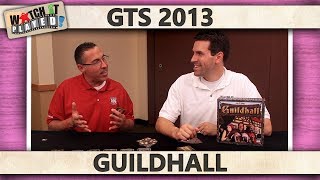
- Gets more fun with more players (2-4 player game)
- Interactive element makes players careful about their plays
- Strategic depth in managing cards and choosing actions
- Expansion adds new profession cards for more variability
Mechanics (from transcript analysis)
- action selection — On their turn, players have options to play a card, take an action, discard cards and draw, or turn in cards to score a chapter.
- Card Drafting — Players draw an initial hand of nine cards and can choose to discard and redraw if they don't like their hand.
- Hand Management — Players manage their hand of cards, deciding whether to play them, discard them, or hold them for future turns.
- Set Collection — Players aim to collect five cards of different colors within a profession to form a chapter.
- Take That — The assassin profession allows players to target and destroy cards that opponents have.
- Variable player powers — Each profession card has unique abilities that activate when played, and the potency of these abilities can increase with more cards of the same profession in the Guild Hall.
Video topics + discussion points
Quotes (from this video)
- I've brought my favorite game this is Guild Hall
- The more cards that I have in my Guild Hall as I play these cards in the same profession gives me a chance to do more and more things
- this game clearly has an interactive element as well you're not just doing your own thing
- literally every turn even after a player has turned and even myself I have to be careful about what I'm playing and what they are looking at what I'm playing
References (from this video)

Mechanics (from transcript analysis)
Video topics + discussion points
Quotes (from this video)
- it's been 3 years I think since I featured what you would call A A pure Miniatures game and it was really creating ly challenging and fulfilling to be able to do this
- if you've ever watch their show if you found value in their content then I recommend that you go over there and give them your financial support
- the thing is about this YouTube content is it's free to watch right but of course it's not really free to create it takes time it takes energy sometimes it takes money too right
- I just want you to know Rodney I see you got a gaming table how come you're not using on the Channel That's why
- it's the sort of thing that once you're Al you know you kind of only get one chance to do it right and so we want to do it right we want to make sure it's something that's fun and engaging and interactive for you to be a part of
- if there's any chance that you're going to move in the next few weeks or you have moved since you donated and gave us your address please contact me at watchitplayed live.com
- there's a lot of you and only one of me
- wow this description is going to be full of stuff hopefully you'll find it in there
- ghost you don't have to do a bunch of weird O's so ghost will be the code word
References (from this video)

- engine-building through cards in chapters
- multiple interesting card interactions enabling various paths to victory
- variety in victory point cards allowing chaining combos
- hand safety until cards are played, enabling planning
- chaos can occur, but it can be controlled
- iconography can be slow to learn due to many icons on cards
- analysis paralysis in multiplayer (especially with trader interactions), leading to slow rounds
- in some player counts, trailing players may slow the game down
- set collection and engine-building
- rule explanation with personal review
Mechanics (from transcript analysis)
- assassin / historian / weaver / traitor interactions — Assassin can kill cards in an opponent's guildhall; Historian can retrieve or reveal cards; Weaver can move cards from hand into chapters; Traitor can swap or take cards from opponents.
- card placement and constraints — When you play a card, it goes to your chapters at end of your turn; you cannot play a card into the action area that matches a card you already have in your chapters.
- dancer cards — Dancer cards let you draw cards equal to the number of dancers in your chapter and grant an additional action.
- End Game Bonuses — Game ends at the end of a turn when a player has 20 or more victory points.
- endgame — Game ends at the end of a turn when a player has 20 or more victory points.
- hand safety vs on-table disruption — Cards held in hand are safe from opponents' effects until played; playing cards exposes them to assassins/traitors.
- Set Collection — Create sets (chapters) by collecting colors; complete a set when you have one of each color for a guild, then turn in for victory points.
- set collection / chapters — Create sets (chapters) by collecting colors; complete a set when you have one of each color for a guild, then turn in for victory points.
- two actions per turn from three options — Choose to play a card from hand, discard cards to draw, or spend completed sets for victory points.
- weaver progression — Weaver levels (0/2/4) change how many cards you can move from hand into chapters.
Video topics + discussion points
Quotes (from this video)
- spoiler alert I love this game
- I really love this game
- the victory point system is just really really really really cool
- this is really cool and this is just a couple examples of the things you can do
- the rules well that could just be really powerful
References (from this video)

- cohesive shared experience
- friendly entry for fans of thematic adventures
- less competition, more collaboration might not suit all players
- cohesive group-driven exploration
- thematic journey through a fellowship-like adventure
- cooperative, thematic
Mechanics (from transcript analysis)
- cooperative mechanics — team-oriented decisions and shared outcomes
Video topics + discussion points
Quotes (from this video)
- it's our monthly roundup
- this is more viby
- the game is an experience
- we're going to go to Birmingham very soon
- it's the best artwork that I've seen
- the art in this made me a little bit emotional
References (from this video)

- Guild setting
Mechanics (from transcript analysis)
Video topics + discussion points
Quotes (from this video)
- It's sort of like war with actual decisions
- It'll take two minutes
- That was amazing. I wonder if that game is like that every time
- It turns out that it was
- So many card games following it have been inspired by that obviously
- The coolest combo you can make in Mystic Veil is like here. The coolest combo you can make in Mystic Lands is like here, right? And the average is like there
- What I made, right? Even if you didn't win, right?
- The most unique way that I have ever encountered an engine builder
- An unbelievably satisfying gameplay experience to destroy
- Betting is like a way to make people care about an outcome
- Poker is a terrible game if you're just playing it right? Uh but the second you're betting with money and you care, right?
- Why do we root for sports teams, right? Like our the day after go Dodgers
- The sitting back and then seeing what happens - yeah there is a really fun aspect to that
- Train making time. When all the technology moves to a certain thing, everybody is making trains, right?