/pic839090.jpg)









Hansa Teutonica Deep Dive
What the Community Thinks About Hansa Teutonica
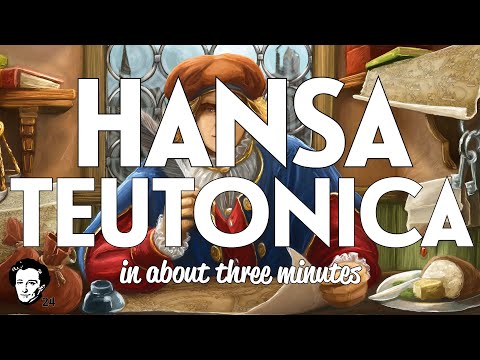
Every channel that covers Hansa Teutonica lands on the same word: tense. 3 Minute Board Games calls it "one of the most intensely competitive and in your face games" the reviewer has played, framing it as proof that the old complaint about Euro games being multiplayer solitaire does not hold up here. No Pun Included frames the game as the payoff for pushing past an ugly cover, describing the cube-displacement mechanism as maybe their favourite in all of board games. Board Gaming Ramblings takes a calmer angle during a countdown of five-player games, praising the game for still feeling fresh despite its age and for delivering crunch in a relatively short sitting.
The disagreement, such as it is, comes down to how much table experience each channel brings to the game. Board Gaming Ramblings openly admits the hosts feel they have played Hansa Teutonica too little relative to how much they enjoy it, and one host jokes about liking the idea of having played it more than actually sitting down to play it. No Pun Included, by contrast, treats the game as a known quantity worth defending against its own packaging, spending real time talking listeners past the box art before getting to the mechanics. None of the three sources voices real hesitation about recommending the game; the differences are in emphasis, not in verdict.
Core Mechanics That Define Hansa Teutonica
Building Trade Routes Between Towns
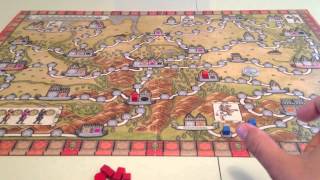
All three sources describe the same underlying structure: players place pieces along paths connecting towns on a map of Renaissance Germany, and completing a full line between two towns lets that player convert their presence into a permanent trading post. 3 Minute Board Games walks through this as network building and area control working together, noting that only one player can control each town on the board and that control is determined by whoever holds the rightmost trading post in a route, unless another player has more posts overall. No Pun Included describes the same loop in plainer terms, explaining that players are mostly either moving cubes from general stock into their personal supply or placing them from that supply onto the board, with each placed cube pushing a route closer to completion and, eventually, a trading post in an adjacent city.
Skill Upgrades and Player Boards
Both 3 Minute Board Games and Board Gaming Ramblings single out the player board of upgradeable skills as central to how the game plays out. 3 Minute Board Games explains that reaching certain towns unlocks tracks on a player's own board, and upgrading those tracks increases the number of actions available per turn, among other benefits, so that completing routes near the right towns becomes a second, quieter objective alongside scoring. Board Gaming Ramblings frames the same system as an early example of a trend the hosts see recurring in newer games, a player board that gets upgraded over the course of play, and calls it one of the things that feels distinctly Hansa Teutonica.
The Hansa Teutonica Experience
Constant, Personal Confrontation
No Pun Included spends the bulk of its segment on the displacement mechanic, where placing a cube on a spot already held by an opponent pushes their cube out, at a cost, while rewarding the displaced player with two free placements elsewhere. The channel describes this as flipping the whole game on its head, turning what looks like a calm route-building exercise into a running argument between players sitting at the same table. 3 Minute Board Games echoes the same feeling from the other direction, describing the core gameplay loop as one that rewards jamming pieces into the paths other players need, so that the eventual winner is usually whoever managed to get in everyone else's way most effectively.
An Old Design That Still Feels Sharp
Board Gaming Ramblings describes sitting down with Hansa Teutonica as feeling tense almost the entire time, because the board state keeps shifting and a plan that looked solid a turn ago can be blocked before it resolves. The same speaker calls the game an old classic that still feels fresh because of its smooth design, a comment made in the context of a five-player countdown where older, heavier Euro games are often the ones that show their age. 3 Minute Board Games makes a related point about adaptability, noting that sticking to a plan simply because it was the original plan tends to end badly, since the board rarely stays the way a player left it.
What Makes Hansa Teutonica Stand Out
A Confrontation Mechanic Built From Simple Pieces
No Pun Included's core argument for the game is that its most memorable system is also its simplest: placing a cube where an opponent's cube sits pushes that cube out, and doing so costs the pusher an extra cube while granting the displaced player two free placements on an adjacent route. The channel frames this as punishing the aggressor slightly while rewarding the victim, which keeps the interaction from feeling purely mean, and calls the resulting dynamic close to genius for how much tension it generates from one small rule.
An Old Box That Rewards Repeat Trips to the Table
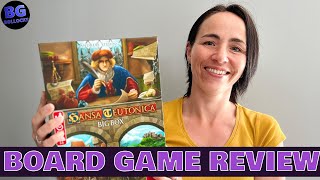
Board Gaming Ramblings praises the current big box edition for including an abundance of maps while still fitting in a normal-sized, rectangular box rather than an oversized one, and credits that variety with helping the game work at different player counts even though the hosts feel it shines most with four or five players. 3 Minute Board Games makes a similar point about longevity from a different angle, describing the core game as infinitely replayable even without the expansions the big box includes, which lets new players buy in without feeling like the base experience is incomplete.
Potential Drawbacks
No Mercy for Players Who Fall Behind
3 Minute Board Games is direct about the game's biggest downside: it is a zero luck design where skilled players can dominate, and it can be a pretty miserable experience for anyone who falls behind, since the game has no catch-up mechanics to pull them back into contention. That same channel also notes there is no solo mode, so the experience described throughout is strictly a three to five player one.
A Game That Asks for a Full Table and Some Patience
Board Gaming Ramblings suggests the game needs four or five players to really shine, which narrows the ideal group size even though the box supports fewer. The hosts also admit to feeling like they have played the game too little given how much they like it, a comment that points at a design dense enough that its full shape only comes into focus after several sessions rather than one.
If You Enjoy Hansa Teutonica
3 Minute Board Games points players toward Troyes for another nasty Euro game and toward Brass Birmingham for a more complex network builder in the same family of ideas. No Pun Included makes a different pair of comparisons while introducing the game to viewers coming from a more familiar title, calling Hansa Teutonica a next step from Ticket to Ride for players who want more rules and sharper conflict than that game offers, and noting that a Discord member's comparison to Go, specifically the way small skirmishes break out across the whole map, feels especially apt at lower player counts.
What Reviewers Are Saying
"Hansa Teutonica is one of the most intensely competitive and in your face games I've ever played. The whole gameplay loop rewards you for getting in the way of your opponents, and the person who wins is usually the one who's managed to jam their pieces into the path of everyone else playing the best."
— 3 Minute Board Games
"If you've never played Hansa Teutonica, you are in for a treat because this might be, no exaggerating, maybe my favourite mechanism in all of board games. And predictably it is, once again, genius because of how simple it is: you can push other people's cubes out. Simply place a cube of your own where their cube was sitting."
— No Pun Included
"Hansa Teutonica, I feel, it is like an old classic, but it still feels so fresh because of its smooth design. And this is a game that feels tense almost throughout the whole game, because you're always have the next step on your plan and be like I need to get this working."
— Board Gaming Ramblings