
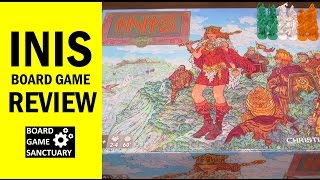



























Inis is a game deeply rooted in Celtic history and lore in which players win by being elected King of the Island (Inis). Players can try to achieve one of three different victory conditions:
Leadership: Be the leader — i.e., have more clan figures than any other player — of territories containing at least six opponents' clans.
Land: Have your clans present in at least six different territories.
Religion: Have your clans present in territories that collectively contain at least six sanctuaries.
Over the course of the game, players also earn deeds, typically chanted by bards or engraved by master crafters, that reduce by one the magic total of six for any condition. While one victory condition is enough to claim the title of King, a game of experienced players usually has a tight balance of power, emphasizing the leadership of the capital of the island.
At the start of each round, players draft a hand of four action cards (with 13 action cards for three players and 17 for four players) during the Assembly. Action cards not played at the end of one season are not held for the next. Players also have access to leader cards for the territories that allow it and where they were elected leader during the assembly. Each Assembly reallocates those cards. Finally, they collect "epic tales" cards that depict the deeds of the ancient Irish gods and heroes, like Cuchulainn, the Dagda, Lugh and many others. These will be kept and used to inspire the clans and achieve extraordinary feats...under the right circumstances. The cards provide a variety of actions: adding clans, moving clans, building/exploring, and special actions.
Careful drafting, hand management, bluffing (especially once players understand the importance of passing their turn), good timing, and a precise understanding of the balance of power are the keys to victory. After a discovery game you'll be ready for a full and epic game, where an undisputed player will be king by the Assembly for his merit and wisdom.
While Inis has "dudes" that are "on a map", it's a beginner's mistake to play this as a battle game because eliminating other clans reduces your chances of scoring a Leadership victory condition. Peace among different clans, with or without a clear territory leader, is the usual outcome of a clan's movement. Battles will occur, of course, as the Celtic clans can be unruly and a good player will listen to his clan's people (i.e., his hand of cards). That battle aspect is reflected in the clan's miniatures representing warriors. Woodsmen, shepherds and traders complete the set of twelve minis for each player; these occupations have no impact on the game, but give it flavor.
Mechanics (from transcript analysis)
Video topics + discussion points
Quotes (from this video)
References (from this video)
- Genuine masterpiece of game design when functioning well
- beautiful production quality when shipped correctly
- elegant and balanced mechanics (as described)
- serious fulfillment failures and mismanagement
- poor communication and support
- component quality and consistency failures
- legacy edition mismatch issues
- area control and political intrigue on a mystical island
- Celtic-inspired mythical island of Inis
- mythic, elegant, strategic with emphasis on balance and moments of table presence
Mechanics (from transcript analysis)
Video topics + discussion points
Quotes (from this video)
- Fuck you lazy and incompetent thieves. I know you're too lazy to actually read or respond.
References (from this video)
- Intense negotiation and alliance dynamics
- Extremely replayable due to map variance and flexible strategies
- Pretender tokens create pronounced psychological tension
- Teaching can be lengthy and complex
- Can feel cumbersome or analysis-paralysis prone for some groups
- Tension, alliance, and confrontation with a changing map
- Mythic island clans with territory and sanctuaries
- Episodic, negotiation-driven play with dynamic territory
- Rising Sun
Mechanics (from transcript analysis)
- blocking and position as the primary interaction — progress is primarily about contesting territory rather than direct eliminations
- card drafting — drafted action cards; players pass or play; hand size remains strategic driver across rounds
- card drafting and season-phase hand management — drafted action cards; players pass or play; hand size remains strategic driver across rounds
- Combat: Damage Based — clashes occur when clans occupy same territory but are not the main victory mechanism
- episodic combat as secondary — clashes occur when clans occupy same territory but are not the main victory mechanism
- randomized map with exploration — territory tiles are drawn and placed to form starting landscape; exploration can add new tiles mid-game
- three-victory-condition system (pretender token) — three separate paths to victory; players pursue one while others monitor progress; pretender token adds heightened tension
Video topics + discussion points
Quotes (from this video)
- They're cousins from the same family, not siblings.
- The moment someone gets a pretender token and starts working toward meeting more conditions, the entire table turns against them.
- If you want negotiation and table talk with the highest strategic ceiling, Rising Sun is the natural fit.
References (from this video)
- Kid-friendly design with approachable rules
- Quality components noted
- Short, family-friendly playtime
- Encourages strategic thinking without overwhelming new players
- Potentially limited to two players depending on edition
- Rules parsing can feel abstract for very young children
- Thematic focus on building simple networks and connecting ideas in a tangible, approachable format that introduces basic strategic thinking without overwhelming early gamers; the emphasis is on accessible systems where players see the impact of their choices through immediate, visible rewards.
- A home-based play area, typically a living room or family room, where a dedicated shelf holds a rotating assortment of children's games and light strategy titles. The area is accessible to young players, with large, colorful components and simple visual cues designed to invite touch, exploration, and quick setup between activities. The narrator uses this shelf as a conversation starting point about what to play next with kids, highlighting how the physical layout can influence play patterns and engagement.
- A casual, persuasive testimonial style that blends nostalgia with practical observations, aimed at other families or casual gamers who value family-friendly components and ease of use.
- Maple Valley
- Power Plants
Mechanics (from transcript analysis)
- network-building — Players construct a connected network by placing pieces to connect nodes and gain points, creating a tangible map of the evolving system.
- Network/route building — Players construct a connected network by placing pieces to connect nodes and gain points, creating a tangible map of the evolving system.
- tile placement — Tiles are placed to extend networks and shape the board, encouraging spatial planning and foresight in a compact play space.
- tile/graph placement — Tiles are placed to extend networks and shape the board, encouraging spatial planning and foresight in a compact play space.
Video topics + discussion points
Quotes (from this video)
- wow such a great game I love playing this game
- dedicated shelf for kids table board
- dedicated kids table board gaming Shelf
- this was maybe my first kids table board gaming game
- I got very amazing components in this game
- amazing game as well
References (from this video)
- High quality, visually striking ink bottle components with tactile appeal
- Striking table presence and elegant color-based aesthetics
- Strong variability via a rotating objectives board and changing tile styles
- Accessible core rules yet deep spatial puzzle with meaningful decisions
- Supports solo play and up to four players for varied play sessions
- Clear sense of progression and endgame tension as bottles are placed
- Penalty tiles can disrupt planned routes and require adaptation mid-turn
- Some players may find the color matching and placement optimization punishing if they lose momentum
- Complexity and variability may require a few plays to master optimal scoring patterns
- Ink flow and abstract area-building with color matching as core tension
- Colorful ink production and tile placement on a circular, modular board; individual players manage color-specific ink bottles and build patterns to win.
- abstract, puzzle-centric with tactile components
Mechanics (from transcript analysis)
- Area completion — As players complete contiguous zones of color on their personal boards, they claim rewards on an evolving objectives track.
- bottle tokens and color management — Each player manages a set of color specific ink bottles; placement and coverage decisions drive future moves and endgame scoring.
- penalty tiles and risk — Drawing or selecting tiles beyond certain reach can force penalties that cover up spots on the board, creating strategic tradeoffs.
- Rondel — A wheel-like mechanism determines the path around the central circle; advancing along it enables tile selection but caps options later to balance risk and reward.
- Rondelle movement — A wheel-like mechanism determines the path around the central circle; advancing along it enables tile selection but caps options later to balance risk and reward.
- tile flipping and rotation — Tiles can be rotated or flipped when placed to optimize coverage and maximize area control, adding a spatial reasoning layer.
- tile placement — Players select and place ink tiles to claim sections on their board, shaping the growing mosaic toward scoring opportunities.
Video topics + discussion points
Quotes (from this video)
- this is a tile laying puzzly game, which you know I love
- the look of these is just so great
- So this is a fun, thinky, puzzly game
- It looks really cool on the table
- I am loving it
- this is one of my most anticipated games of 2025
- that rondelle or that ratchet action or whatever it is
- you can place this anywhere you want, too
- you get to play this however you want
- colors don't have to match up if you don't want them to
References (from this video)
- Easy to learn and quick to play
- Supports 2-7 players (eighth with a house rule)
- High replayability due to many categories and card variety
- Appeals to both younger players and families
- No explicit cons mentioned in transcript
- Language, words, quick-thinking
- Casual home and party settings; family game nights
- informative, enthusiastic
Mechanics (from transcript analysis)
- category-based word generation — Each revealed card provides a category; players must supply a word starting with the card's letter that fits the category.
- Lightning bolt scoring — Each card has a number of lightning bolts indicating penalty points; lower totals are better at round end.
- Multiple answers per round — Participants propose up to three words per category, increasing chances to discard cards.
- real-time — Players race to supply valid words; speed influences who can discard and how points are tallied.
- Real-time, fast-paced play — Players race to supply valid words; speed influences who can discard and how points are tallied.
- Variable categories — Backside of cards shows different categories for high replayability and variability.
- Word building — Each revealed card provides a category; players must supply a word starting with the card's letter that fits the category.
- Written Answer — Participants propose up to three words per category, increasing chances to discard cards.
Video topics + discussion points
Quotes (from this video)
- this is a great game for two to seven players.
- a low score win scheme.
- you want to get rid of those first.
- I think this is a great one to pull out
- you can play it with younger kids.
- there is tons of variability.
- literally teaches in like a minute and a half and you are good to go.
- Slings is a great party game option.
References (from this video)
- high thematic immersion and historical framing in the rulebook
- rich potential for complex and satisfying combos when executed well
- surprisingly effective two-player variant with the map overlay and drafting mechanics
- strong production quality: visually appealing board, clear icons, and well-designed components
- turns can be lengthy and downtime heavy, especially with four players
- balance concerns: some special ability tracks may feel overpowered or less balanced than others
- significant setup and organization required to manage action chains and palace cards
- Civic strategy and grand project construction through interlocking actions and long-term planning
- Ancient Crete, with four Minoan clans competing for leadership and dominance
- Abstract civ game framed by historical context in the rulebook; emphasis on clever combos and strategic thinking over direct brute force
Mechanics (from transcript analysis)
- Area Control — Warriors (envoys) are placed on a map to influence territories, with movement and placement driving long-term position and bonuses.
- area control / map placement — Warriors (envoys) are placed on a map to influence territories, with movement and placement driving long-term position and bonuses.
- card drafting — Players gain and place cards to their palace boards, which provide permanent bonuses and unlock new action/dice interactions.
- card drafting / tableau building — Players gain and place cards to their palace boards, which provide permanent bonuses and unlock new action/dice interactions.
- dice drafting — At the start of each round players draft dice values into action slots. Lower numbers grant access to more powerful spots, while higher numbers may act sooner in the turn order.
- engine building — Players develop a personal engine by drafting dice-driven actions and triggering card effects that generate resources and recurring bonuses.
- progress and route systems — Two separate tracks (progress and trade routes) provide immediate and ongoing bonuses, shaping early and mid-game priorities.
- Resource management — A wide array of resources, buildings, and palace bonuses interact to create powerful, multi-step combos that reward planning and execution.
- resource management and combination strategy — A wide array of resources, buildings, and palace bonuses interact to create powerful, multi-step combos that reward planning and execution.
- Track advancement — Two separate tracks (progress and trade routes) provide immediate and ongoing bonuses, shaping early and mid-game priorities.
Video topics + discussion points
Quotes (from this video)
- Minos is an abstract civ building game that combines engine building dice drafting and a lot of combos
- set in ancient Crete where you take on the role of one of four illustrious Minoan Clans vying to become the ultimate leader or Minos
- lower numbers get to take the more powerful spots but higher numbers will act first
- there is a pretty good chunk of variability built into the game
- this is probably the biggest tricky point of Minos because of its propensity for combos turns in Minos can be long
- Minos does a bunch of things to adapt for different player counts
- throughout Minos is going to have its admirers but it isn't going to be for everyone
- Minos is worth a play but unless you've got a full day maybe just try it at two players first
References (from this video)
- art direction and component quality are highly praised; visuals and map tiles are described as striking and unique.
- large, substantial components (thick box, big cards) add to tactile enjoyment.
- maps and territory design look visually compelling, with varied terrain zones suggested by punch boards and tiles.
- rule book is concise (10 pages), which the reviewer took as a wash in favor of streamlined setup for a long-ago-released game.
- phase and card design (tarot-style cards) allow dense information while keeping the aesthetic engaging.
- rulebook is short and uses very small text in places, which the reviewer noted as a readability drawback.
- some players may find the font size on cards and pages too small; layout could improve readability.
- the box insert and organization can be fiddly; setup/teardown may be more involved than expected for a game of this type.
- the reviewer mentions the map size feeling smaller than anticipated and odds/strategies are not fully explored in this unboxing, leaving some ambiguity about expansion path and play balance.
- settlement, sacred rites, territorial expansion, and clan diplomacy/conflict.
- Celtic era; arriving on a new land to settle, build sanctuaries, citadels, and manage peaceful clans while exploring surrounding territories.
- mythic, grand, map-driven exploration with a focus on long-term territorial development.
Mechanics (from transcript analysis)
- Area Control — players vie for control of territories and clans, influencing scoring and end-game conditions.
- deck/hand management with season cards — season cards and action/advantage cards drive actions across phases, influencing timing and strategic options.
- hand management — season cards and action/advantage cards drive actions across phases, influencing timing and strategic options.
- phase-driven gameplay — the game progresses through structured phases (assembly, oracles, season preparation, season actions, clashes, end-of-season resolution).
- resource/temple zoning and construction — players build sanctuaries, citadels, and other structures that grant benefits and affect scoring.
- tile placement — place hex/map tiles to form or extend the board, creating territorial layouts with various terrain features.
- Variable Phase Order — the game progresses through structured phases (assembly, oracles, season preparation, season actions, clashes, end-of-season resolution).
Video topics + discussion points
Quotes (from this video)
- I do love the art in this game. Absolutely phenomenal.
- This is for two to four players. You're basically just like a Celtic chieftain.
- I really do love that. Okay. Oh, and a nice heavy thick box, too. I like that.
- These cards are big, tarot-type cards. Man, you can put so much stuff on them.
References (from this video)
- Elegant solitaire puzzle
- Tight, satisfying balance of planning and luck
- Some may prefer more thematic weight
- solitaire card sorting puzzle
- Office worker trying to finish the day
- Humorous slice-of-life depiction
Mechanics (from transcript analysis)
- candy tokens / abilities — spend candy tokens to activate card abilities
- card sorting / order management — arrange cards in order 1-48 across present/past/future
- Compound Scoring — complete all 48 cards to win; else lose
- multi-row layout — present/past/future rows with discard mechanics
- round-based scoring — complete all 48 cards to win; else lose
Video topics + discussion points
Quotes (from this video)
- new to me but proved to be a real gem
- could even fight for a solo board game of the year
References (from this video)
- Strong anticipation and excitement around a new title
- Prominent placement in the speaker's Spiel lineup
- Transcript provides limited specifics on components, rules, or price
- mythology and governance
- Mythic Crete, ancient Mediterranean
- Abstract with mythical framing
Mechanics (from transcript analysis)
- Area Control — Players vie for influence over strategic locations on a shared board.
- area_control — Players vie for influence over strategic locations on a shared board.
- Dice rolling — Player actions are shaped by outcomes of dice rolls, introducing randomness to planning.
- dice_driven_actions — Player actions are shaped by outcomes of dice rolls, introducing randomness to planning.
Video topics + discussion points
Quotes (from this video)
- oh I'm starting to get a spider sense
- I'm super excited about one of my most anticipated games for Spiel
- look at this taosi the new Danny Garcia game
- oh it's very heavy I am excited
- probably the last games coming before Spiel
References (from this video)
- early classic worker placement with variability
- interesting provost mechanic that affects planning
- older game with aging components or look
- may require a few plays to grok the asymmetry
- growth, resource management, governance
- medieval city development
- euro-style worker placement with variable board
- Caverna
- Kais 1303
Mechanics (from transcript analysis)
- asymmetric/variable boards — board progression changes the available options each game
- provost tile interaction — a provost token moves and blocks actions, adding player interaction
- worker placement — you place workers on a variable set of spots to gain buildings
Video topics + discussion points
Quotes (from this video)
- "This is a Rosenberg in which you are drafting tiles and building your own tableau of them."
- "Plus the uh the message that it it's trying to send is really nice too for environmentalism in Africa."
- "So that is my number 10, Click Tree."
- "My number two is Clans of Caledonia. This game is a kind of similar approach in the style of game as Terrammystica, Gaia Project, etc."
References (from this video)
- Engaging drafting and act-building within a compact two-player game
- Clear three-act structure that yields varied scoring opportunities
- Upstaging and layering mechanics add strategic depth and tactical choices
- Pattern-based scoring rewards planning and careful sequencing
- The theater theme provides strong flavor and immersion
- Two-player only reduces player variety for some groups
- Setup and learning curve may be non-trivial for new players
- Scoring patterns can be dense and possibly opaque without reference sheets
- Theatrical competition, drama, with flavor of corruption
- Ancient Athens during a grand theatrical festival
- Three-act progression built through drafting, layering, and upstaging
Mechanics (from transcript analysis)
- act construction — Selected cards are used to begin Act I, Act II, or Act III, shaping a three-act arc
- card crafting — Later cards can be tucked beneath existing act cards to flesh out or modify them
- card drafting — Players select cards from a stage lineup to seed or advance their acts
- card layering (tucking under) — Later cards can be tucked beneath existing act cards to flesh out or modify them
- Compound Scoring — Scores are driven by connecting pattern icons across acts to create scoring lines
- cross-act synergy — Icons and patterns can span across all three acts, increasing scoring opportunities
- pattern/icon-based scoring — Scores are driven by connecting pattern icons across acts to create scoring lines
- thematic flavor mechanics — Drama, spice, and corruption are introduced as flavor that can influence scoring indirectly
- upstaging — Replace an existing scene by placing an act card on top of it to alter the act’s trajectory
Video topics + discussion points
Quotes (from this video)
- It's very ingenious.
- All of Athens has turned out for the Dionia, a grand theatrical festival to honor the god Disus.
References (from this video)
- classic, influential worker-placement design
- notable for expanding options and activation choices
- older title; may feel dated to some
- building and resource development through worker placement
- historical worker-placement in a medieval setting
- classic Euro worker-placement flavor
- Agricola
- Laav
- Great Western Trail
Mechanics (from transcript analysis)
- activation/provost interaction — Provost movements interact to hinder/aid activations
- building expansion and castle construction — build and expand to activate new capabilities or score points
- worker placement — place workers into buildings to gain resources and actions
Video topics + discussion points
Quotes (from this video)
- I really like that aspect of keeping track of resources with dice
- I thought it was really clever how it was handled in this game
- this game is highly interactive it's hard to appreciate it based off of what you see here
- I would love to see this game get that support and can be more widely available soon
- I really enjoyed it I like the concept of it and I would want to return to it to see if it still holds up mechanically
- this game has a lot of hand management and deck management as well you go through pretty much your entire deck
References (from this video)
- Elegant fusion of drafting and area control in a compact package
- High ability to differentiate games across plays due to card interactions and timing
- Distinct, striking artwork and thematic flavor that stands out
- Tactical, reactive play that rewards situational awareness and adaptability
- Rule minutiae can slow early plays and create friction for new players
- Take-that style interactions can polarize groups and influence enjoyment
- Wind conditions and certain timing aspects can feel nebulous or fiddly
- Clan-based territorial control with a focus on strategy, timing, and subtle diplomacy
- Mythic Celtic-inspired islands map featuring four clan groups exploring territories
- mythic, abstract, tactical
- Giants
- Cichlides
- Kamat
Mechanics (from transcript analysis)
- Area Control — Players recruit clans onto territories, aiming to control six territories or assemble six sanctuaries for victory.
- Area control / Territory expansion — Players recruit clans onto territories, aiming to control six territories or assemble six sanctuaries for victory.
- card drafting — Start with a hand of cards, pick one to play, pass the rest on; drafted cards accumulate with each hand, enabling evolving strategy.
- Card-driven action economy — Green cards execute core actions (recruit, explore, build, clash); yellow cards grant extra actions; red cards introduce interaction dynamics with others.
- Clashes / combat resolution — Clashes occur when expanding into or contesting a territory; resolutions can be decisive or ambiguous, adding tension and timing considerations.
- Turn-based pacing with limited memory — A compact card pool (17 cards, 13 players in smaller games) emphasizes understanding card text and on-the-fly adaptation rather than memorization.
Video topics + discussion points
Quotes (from this video)
- It's a giant psychedelic jar of Marmite. You will either love it or hate it.
- Inish wants you to learn everything that is in the game. It does not play memory games with you.
- Inish is not a strategy game. In Cichlides and KT, you're formulating a path to victory. Whereas in Inish, you're mostly just reacting to what's happening. It is primarily a tactical game.
- We really, really like it.
- All these things will divide people. It is essentially a giant Marmite of design choices—either you embrace it or you reject it.
References (from this video)
- High strategic depth
- Large learning curve
- Medical clinic management
- Twilight Struggle
- Praga Caput Regni
Mechanics (from transcript analysis)
- high_strategy — Complex decision making and planning.
Video topics + discussion points
Quotes (from this video)
- theres no good or bad games objectively
- every game has its own unique profile
- the five attributes: theme mechanics components strategy and complexity
- the perfect board game formula
- identify the strengths of a game even if those strengths are outside of their own perfect board game formula
References (from this video)
- Unique negotiation-driven gameplay
- Asymmetric powers add variety and replayability
- Thematic and flavorful components
- Negotiation-centric play can be lengthy or tense
- Some players may struggle with table talk
- other negotiation/ASymmetric games
Mechanics (from transcript analysis)
- area/path progression — Players navigate paths to reach a final enclosure for scoring.
- asymmetric player powers — Different animal characters grant unique abilities affecting interaction and scoring.
- Asymmetric powers — Different animal characters grant unique abilities affecting interaction and scoring.
- negotiation — Players engage in alliance-building and deal-making to influence scoring opportunities.
Video topics + discussion points
Quotes (from this video)
- I love Wizards of the Grimoire if you guys haven't checked it out yet I definitely recommend trying it at least on BGA
- this is the first game from Eerie Idol games
- Barcelona is oh such a fantastic game
- I'm so so happy I now have it in the collection
- I am not the hugest fan of Cooperative games
- oh my goodness I love the way it looks
- you are going to be killing the guests in order to get money from them
References (from this video)
- Deep thematic integration of healthcare management
- Rich decision space with meaningful consequences for layout and resource allocation
- Core loop is clear and highly strategic
- Encourages forward-planning and long-term profitability
- High complexity and learning curve
- Potentially lengthy playtime and heavy downtime for new players
- Can be punishing if you fall behind in resource management
- Healthcare operations, resource allocation, scheduling, staff management, and profitability under constraint.
- Healthcare clinic management setting, focusing on daily operations and service delivery within a clinical environment.
- Operational realism with thematic flavor of medical administration; emphasizes process, logistics, and efficiency.
- dice Hospital
Mechanics (from transcript analysis)
- action selection — Three core actions can be chosen each round: build, hire, or schedule patients, forming the primary loop.
- Business phase sequence — A multi-step phase to calculate profits, which then informs scoring and progression.
- End-round scoring — Profit can be spent on victory points; unspent funds carry over to future rounds, encouraging planning.
- Facility layout — Placement and arrangement of clinic components affect efficiency and effectiveness.
- Queue/patient flow — Scheduling patients influences clinic throughput and revenue generation.
- Resource management — Players must manage money to cover expenses (construction, staff, parking) and plan for upcoming needs.
- Staffing and training — Hiring and training doctors and staff affects clinic effectiveness and future operations.
- Strategic planning — Longer-term decisions about savings, investments, and capital allocation shape outcomes.
- Victory point economy — Points accumulate over rounds to determine overall success and ranking.
Video topics + discussion points
Quotes (from this video)
- Clinic is a detail-oriented game that simulates the management of a health clinic
- for something simpler try dice Hospital
References (from this video)
Mechanics (from transcript analysis)
Video topics + discussion points
Quotes (from this video)
- It's just for fun.
- We don't like all the games and you probably don't like all the games that we like either.
- This is for me an E game as well because I don't remember.
References (from this video)
- clever, unique take on the area-control/drafting combo
- high variability with leaders and cards
- can be opaque to new players
- City-building and conquest with card drafting
- Dudes on a map style exploration
- Strategic, with a system of cards that drive the action
Mechanics (from transcript analysis)
- card drafting — Draft cards each round to determine actions and combos
- three win conditions — Be in six regions, be chief in regions, or collect deeds/other tokens
Video topics + discussion points
Quotes (from this video)
- the improvements or twists I guess that they make on the original Splendor formula are so much fun
- this game is going to be a keeper in the collection
- the overbuilding rules... room for creative strategic plays
- this mission was just tight and interesting
- Best in Class in terms of worker placement engine building
- three win conditions and deeds tokens make the game dynamic
References (from this video)
- Art and oversized cards with Celtic theme are visually striking
- Card drafting adds meaningful choice and tension
- Epic red cards add variety without breaking the balance
- Powerful swings keep games dynamic and exciting
- Aggressive play can overwhelm others and isn't for every group
- Pacing can be volatile; easy to lose track of win conditions
- Clans can be wiped off the board quickly if targeted by opponents
- political influence through clan management, territory control, and sacred sites
- Celtic myth-inspired island politics; a chieftain vying for regional influence
- mythic epic with album-like events and storytelling through cards
- Arcs
- Kit
Mechanics (from transcript analysis)
- alliances_and_tactical_movement — Card types allow movement and alliances that can influence board layout and combat.
- area_control — Control of regions by placing clans; majority in a region yields benefits and victory points.
- card_play_and_resource_management — Every action uses a card; managing hand and playing epic 'red' cards for swingy effects.
- combat_and_battle — Clans engage in battles with escalating outcomes; battles can swing the game and end by consensus or forceful advancement.
- drafting — Players draft cards each round to build actions and strategies, shaping the flow of play.
Video topics + discussion points
Quotes (from this video)
- it's an absolute work of art.
- The cards are oversized and the art is just amazing.
- I love card driven games, and this one adds drafting to that
- I love the one-off epic red cards and how they shake the game up dramatically
- The best thing about this game is how it manages to feel epic with such a low pace count.
- Inish needs more slan, but it's a gold medal game.
References (from this video)
- fluid area control feel with asymmetry
- shorter than many heavy euro/ameritrash hybrids
- rules can be dense for newcomers
- thematic flavor may feel abstract to some
- area control with movement and resource placement
- mythic island world
- abstract yet flavorful
- Root
- Cyclades
Mechanics (from transcript analysis)
- Area Control — move and place to control regions with limited space
- area control with key tokens — placing tokens to control routes and islands with special rules
- asymmetry — factions have distinct layouts and abilities
- factional asymmetry — each faction has unique abilities affecting control dynamics
Video topics + discussion points
Quotes (from this video)
- Diplomacy by email explicitly by email
- i don't want to sit at a table with you and play that game
- it's such a minimalistic game where the players themselves drive all of the fun and interaction of the game
- it's the first time in a game where i felt incentivized for certain strategies to die
- a box of cardboard chits that does everything that i want a game that is full of Twilight Imperium-esque plastic armies marching across the board
- there's room for betrayals, there's room for deal making
- the apex of like pure dudes on a map area control games
- my blood rage to me is where area control was starting to get played with
References (from this video)
- Didn't enjoy
- Historical conflict
- Celtic Ireland
- Thematic
Mechanics (from transcript analysis)
- card-driven conflict
Video topics + discussion points
Quotes (from this video)
- It wasn't just the hundred sort of best designed games this was the hundred games that I feel that I'm particularly sort of connected to
- The games that have a place in my heart really games that I've got a lot of nostalgia for
- It felt a bit like doing a roll and write game but without all of the sort of convenience
- I wish I still had castles of burgundy and notre dame
- The main thing that got in the way for me was all the iconography
- I do use board games as an escape from screens and technology
- I really like the production of cockroach poker
- I found it was a game where I could see the ending coming and then someone would just go and there we go we've got another 20 minutes now
- It feels like something other than a board game
- The decisions you make in the game are very very slight
- Right up my alley
- I do really like push your luck
- That's my favorite game
- Abyss is my second favorite game
- I love pekka pig
- I just think it's ugly
References (from this video)
- Interesting card-driven decisions
- Tight, tactical gameplay
- Can feel abstract or less thematic for some players
Mechanics (from transcript analysis)
- Area Control — A card-based system that drives actions and map control.
- card-driven area control — A card-based system that drives actions and map control.
Video topics + discussion points
Quotes (from this video)
- Dominant species is a truly awful game that I really really dislike
- this is a very very light worker placement game
- the seventh continent for us
References (from this video)
- Bright color patterns and satisfying visuals
- Engaging puzzle with adjustable difficulty via scoring conditions
- Pattern variance can be challenging for newcomers
Mechanics (from transcript analysis)
- Pattern Building — Score according to formed patterns, colors and shapes on the board
- pattern matching — Score according to formed patterns, colors and shapes on the board
- tile placement — Place tiles to create patterns and score based on configurations
Video topics + discussion points
Quotes (from this video)
- top 10 chilled board games now for me
- it's such a relaxing game in my opinion
- the production really does help it because it's a lovely lavish Deluxe feeling game
- think Wordle but the Twist on this game
- cooperative game ... very relaxing
References (from this video)
- easy to pick up despite depth
- intricate components and thematic artwork
- great tension and back-and-forth strategy
- mythology and strategic empire-building
- Mythology and fantasy world with Irish gods and heroes
- epic, back-and-forth tactical conflict framed by mythic influence
- Risk
Mechanics (from transcript analysis)
- area/land expansion and clash — Draft actions to discover lands, propagate clans, build structures, and clash with opponents.
- card drafting — Players draft action cards to guide their turns.
- epic cards with influence — Cards representing mythic influence that can turn tides of battles.
Video topics + discussion points
Quotes (from this video)
- it's freaking sick dad
- Between two castles is a perfect mashup of its predecessors between two cities and castles of mad king ludwig
- i love the working together with your neighbors aspect of between two cities
- these cards represent the influence of irish gods and heroes so it's only fitting that they could turn the tides
- ambush cards being able to tamper with your opponent's map from time to time really gives cartographers a much needed dose of player interaction
- nobody knows what anybody else's role is
References (from this video)
- Potential for deep strategy with repeated play
- Race to learn interactions rewards mastery
- Requires time to develop a robust meta-game
- There are better-feeling options for similar card-game combat
- hidden-ability card game with strategic depth
- battlefield contest with fixed deck of powers
- mind games and bluffing across zones
- Kier
- Valara
Mechanics (from transcript analysis)
- Area Control — Compete over zones with special restrictions.
- Betting and bluffing — Anticipate opponents' plays to outmaneuver them.
- Bluffing / mind reading — Anticipate opponents' plays to outmaneuver them.
- Fixed deck / hidden powers — A fixed set of power-cards, each with unique effects.
Video topics + discussion points
Quotes (from this video)
- this is a jeweling game
- self-contained box so that you're not paying paying to win this style game
- these type of games aren't generally for me
- the rules are quite fiddly
- extremely simple rule set
- one of the best styles of games like this that I've seen
- instantly fell in love with it
References (from this video)
- strong theme integration
- tight play rhythm
- high interaction
- steep learning curve for new players
- rules can be opaque at first
- island politics, diplomacy, and conflict
- fantasy island with Celtic-inspired themes
- mythic, epic
- Root
- Seven Wonders
Mechanics (from transcript analysis)
- area-control — players compete for influence over regions on the action map.
- hand-management — order cards and actions are managed and revealed to drive play.
Video topics + discussion points
Quotes (from this video)
- this is the going analog quiz show
- do you have a license for that so it's all about different licensed games
- name one katan based on a licensed property
- you know your history i was recently at the museum of play in rochester new york
- and that's the going analog quiz show everybody now you can stop watching and go play a game
References (from this video)
- Easy to learn but hard to master
- Replayability is high due to tale cards and tile variability
- Stunning production and absolutely gorgeous visuals
- Deliberate and strategic with meaningful choices
- Can require a long playtime, especially with more players
- Steep learning curve for newcomers to the system
- Downtime can be noticeable in multiplayer sessions
- chieftains vying for leadership, clan politics, religion, and territorial expansion
- From Ireland to a newly discovered land, inspired by Celtic history and legends
- mythic epic with a distinctly Celtic flavor
- Blood Rage
- Kemet
- Spirit Island
Mechanics (from transcript analysis)
- Area Control — Players contest presence in territories to gain leadership and victory conditions.
- card drafting — Draft action cards and illness cards that influence later rounds and strategic options.
- clan movement and conflict — Move clans across the board, clash with others, and build sanctuaries to secure territory.
- season-based actions — Two-phase rounds (assembly and season) determine which actions are available and how they resolve.
- tile/variable setup — Epic tale cards and tiles create high replayability and varied setups each game.
Video topics + discussion points
Quotes (from this video)
- it's easy to learn but hard to master
- replayability is one of its best attributes because of the epic tale cards and the many tiles
- the thing no one can dispute that it looks absolutely gorgeous
- if you want meaningful choices and a bit of conflict and you don't mind games that take several hours then you're gonna love it
- Rhino says a big yes to Inis you should definitely give it a go
References (from this video)
- bluffing elements
- character variety
- unclear if it will gel with all groups
- battlefield majority by assembling the strongest army
- secret role/hidden objective conflict
- bluffing, head-to-head interaction
Mechanics (from transcript analysis)
- hidden roles — compete for control via hidden information
- hidden roles/majorities — compete for control via hidden information
- Rock-Paper-Scissors — units counter and cancel each other in dynamic clashes
- rock-paper-scissors interactions — units counter and cancel each other in dynamic clashes
Video topics + discussion points
Quotes (from this video)
- I think this game is really cool
- this is a very simple kind of family weight puzzly game
- it's a very fantastic game
- the rules are absolutely horrendous
- I really love this game and I've played it a few times now and I think the balance is fine
- Luke from the Broken Meeple thinks this game is really imbalanced
- the row system where the positioning of your characters is important
- one of the best two-player games I've played in some time
References (from this video)
- tight, thoughtful design
- minimal luck; high strategic depth
- enduring appeal and time-tested reputation
- can be punishing for newer players
- some expansions needed to fully unlock potential
- medieval management and power dynamics
- Medieval European city development with a focus on growth and control
- serious, functional euro with a dry sense of humor
Mechanics (from transcript analysis)
- Resource management — Careful planning to avoid luck-based elements and optimize route through objectives.
- resource_allocation_and_strategy — Careful planning to avoid luck-based elements and optimize route through objectives.
- worker placement — Place workers to develop districts, collect resources, and gain control benefits.
- worker_placement — Place workers to develop districts, collect resources, and gain control benefits.
Video topics + discussion points
Quotes (from this video)
- Don't sit in the bath with your toaster
- If you're new here, consider subscribing to this channel
- pigs in blankets look like the wolf cogs
- this is a frantic time
References (from this video)
- Elegant drafting that drives confrontation
- Beautiful components and visual presentation
- Die-based movement can feel luck-driven
- Some players dislike the older, direct-die movement mechanic
- Area control and strategic tension
- Ancient Celtic island with strategic conquest
- Mythic, folk-tale flavor with a focus on positioning
Mechanics (from transcript analysis)
- Area Control — Compete for control thresholds across the map
- Asymmetric powers — Different factions/heroes provide unique abilities
- card drafting — Draft actions from a personal hand to execute turns
Video topics + discussion points
Quotes (from this video)
- my number ten game is one of my oldest one of my deepest loves talisman
- the board develops as you play—it's a novel instead of a book
- the mythos deck heavy in the hp lovecraft theme
- the drafting in this is the funnest part
- it's a beautiful game, it's lovely, gorgeous
- you really create your own clank based on your memories
References (from this video)
- intriguing premise for an abstract game
- heavily luck-dependent
- minimal decisions
- not crunchy or deeply strategic
- connect-the-dice formations for scoring groups
- central grid with dice-based placement
- abstract, luck-influenced
Mechanics (from transcript analysis)
- blockers — use blockers to shape interactions on the grid
- Dice rolling — roll dice and move to connect with each other for scoring
- Square Grid — use blockers to shape interactions on the grid
- tile flipping — flip/adjust dice or tiles to influence layout
Video topics + discussion points
Quotes (from this video)
- the best thing about this game is that it is pretty much a full worker placement game but in a tiny little box
- I found it quite forgettable
- there's just so many good Tile placement games and so many good area majority games that this one does not even stand close to most of them
- I generally do quite like the idea and concept of this but I did find it a bit too abstract for my personal taste
- the game was certainly lacking
- production is pretty damn awful
- color colorblind gamers
References (from this video)
- Creative initiative/turn order mechanic using victory points as bidding currency
- Well-designed for two-player play
- Best with three players
- Many shifting variables - kaleidoscope of options
- Analysis paralysis potential from too many options
- Bruno Cathala game-breaking powers (Gins) add unnecessary complexity
- Hard to get invested without feeling like work
- Bidding system underutilized (people rarely bid aggressively)
- Celtic Mythology
- Ancient Ireland
Mechanics (from transcript analysis)
- Area Control
- Asymmetric victory conditions
- bidding for turn order
- card drafting
Video topics + discussion points
Quotes (from this video)
- it delivers what it promises and it does have that true epic feel to it
- bless you you've got you've got a game that's tailor-made for you
- you can be set for life playing Magic with your group but yeah it's not for me
- this is a game where if you are playing with somebody who knows the game they are going to absolutely trounce you
- I think you'd cut 30% from this game and it wouldn't be a worse game for it
- taking myself out of the equation this is like 10 but with my own enjoyment into it it's definitely significantly lower
References (from this video)
- Deep, strategic decision space and tight engine
- High interaction and tension between players
- Flavorful theme with 3D modular components
- Expansions add variety and new strategic angles
- Edge-case rules can be confusing and generate debates
- Some rules are fiddly and easy to misapply during live play
- Teaching the game can be challenging due to complexity
- medical care, hospital management
- Modern-day hospital/clinic
- 3D modular hospital construction with floor-based room placement and patient flow
- Dark Alley (expansion)
- Trarion
- Tracarion
Mechanics (from transcript analysis)
- action_selection — Each round players select one of their three actions (build, hire, admit) with two of each action type available per player.
- adjacency_and_modules — Rooms must be adjacent to required hubs; certain rooms require specific placements to function.
- conveyors_and_access — Conveyor belts and service hubs move patients and resources efficiently.
- hidden victory points — Turn order is influenced by popularity/VP; VP can be spent to gain additional victory points.
- Modular board — The hospital is built on multiple floors with adjacency rules for rooms, hubs, and modules; 3D placement matters.
- modular_3d_board — The hospital is built on multiple floors with adjacency rules for rooms, hubs, and modules; 3D placement matters.
- patient_flow_and_treatment — Admit patients, assign doctors and nurses, treat them, earn income, and accrue VP.
- Resource management — Manage money, staff (doctors, nurses, orderlies), patients, and modules to earn income and victory points.
- resource_management — Manage money, staff (doctors, nurses, orderlies), patients, and modules to earn income and victory points.
- round_structure — Six rounds, each with an action phase, a business phase, and an admin phase.
- turn_order_and_victory_points — Turn order is influenced by popularity/VP; VP can be spent to gain additional victory points.
- Variable Phase Order — Six rounds, each with an action phase, a business phase, and an admin phase.
Video topics + discussion points
Quotes (from this video)
- This is one of the more cynical games in existence, I would argue.
- Edge-case rules that pissed me off.
- Conveyors are magical timefree zones.
- The base game is good by itself or is it peaked with expansions?
- I love this game.