/pic7032801.jpg)


















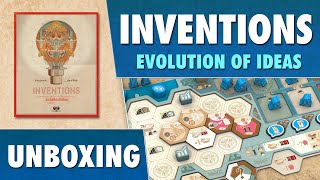
Inventions: Evolution of Ideas Deep Dive
What the Community Thinks About Inventions: Evolution of Ideas
Inventions: Evolution of Ideas arrived in 2024 to considerable critical acclaim. Reviewers from across the board gaming community found themselves impressed by Vital Lacerda's latest work, praising the game's mechanical depth, thematic execution, and ambitious scope. This is a game that demands respect from serious Euro enthusiasts. Most players agree that it ranks among the designer's finest solo experiences, with some calling it one of Lacerda's most accessible heavy designs in recent years. Solo players in particular have embraced Inventions as potentially their preferred way to experience this civilization-spanning saga.
Core Mechanics That Define Inventions: Evolution of Ideas
Worker Placement with Pillar Blocking
At its heart, Inventions is a worker placement game with a distinctive twist. Rather than blocking opponents from actions, you primarily block yourself. Each turn, players place one of their pillars, including an epoch pillar (used early in the game) and season pillars (used afterwards), onto one of ten action spaces arranged in five forums. You cannot place a pillar where you already have one, which forces careful planning across an entire era. If another player places their pillar on one of your pillars, you gain influence, creating interesting incentive structures that reward good pillar placement. The graphic design and iconography are exceptionally clear, making even complex turns readable once you understand the flow.
Action Chaining and Cascading Combos
The star mechanism of Inventions is its action chaining system. Each action can chain into other actions if you spend chain tokens, and the number of chain tokens available to you depends entirely on your influence level. Some actions like inventing or sharing an invention are dead ends that cannot be chained. Others like presenting an idea or Eureka automatically open paths to further actions. This creates the possibility of epic, multi-action turns where you take five or six actions in sequence. The chaining system is fundamental to how Inventions plays, encouraging long-term planning while remaining flexible enough to adapt when opponents move elsewhere on the board.
The Inventions: Evolution of Ideas Experience
Thematic Coherence Through Abstraction
The game zooms out to cover the entire scope of human history, with players acting as civilizations rather than individual characters. Ideas become inventions through a clear progression: you present an idea card to a region, someone invents it to unlock new possibilities, and then others can share that invention to spread knowledge globally. The milestones represent foundational knowledge like iron or sailing that unlock access to more advanced inventions. While some feel this scope makes the game less thematically intimate than earlier Lacerda designs, others argue the theme actually helps teach the systems by connecting mechanics to historical concepts. The beautiful board artwork features intricate florals and subtle color touches that reward closer inspection, though the palette leans toward beige and sage green.
Solo Play Excellence
For solo players especially, Inventions shines as Lacerda's finest design. The solo mode features two opponents, Kronos and Hephaestus, whose turns are straightforward to resolve without complicated decision trees. Kronos is almost laughably predictable, taking about ten seconds per turn, while Hephaestus provides more challenge through randomized action selection but remains easy to execute. The cognitive load is low because the AI doesn't require you to make strategic decisions on their behalf. Solo players consistently report that playing this game solo feels preferable to multiplayer, largely because they can take as much time as they need to plan elaborate action chains without worrying about analysis paralysis wearing on other players.
What Makes Inventions: Evolution of Ideas Stand Out
Exceptional Component Organization and Gameplay Flow
One design decision stands out as genuinely innovative: the game allows you to select and place progress tiles even after your turn has ended and play has moved to the next player. This keeps downtime minimal and maintains player engagement throughout. Tile selection happens asynchronously, with players choosing from displayed options while others play. The game includes beautiful double-layered player boards with dedicated spaces for every citizen type and progress tile placement. It also features tile holders that get passed around the table, making the physical interaction smooth and tactile. This attention to table presence and accessibility helps keep long turns from becoming oppressive.
Deep Strategic Options with Multiple Valid Approaches
Despite heavy rule overhead, once learned, Inventions offers surprising strategic flexibility. The blocked-by-yourself pillar system means there is almost always a path to your intended action if you think creatively about chaining. No two games feel identical because the pillar placement options available to you shift as the board fills. The game rewards both careful planning across an entire era and tactical adaptability when circumstances change. Players rave about the moment when the game clicks and they see how many journeys are possible from a single pillar placement, unlocking satisfying chains of actions that feel both powerful and earned.
Potential Drawbacks
Exceptional Complexity and Learning Overhead
Inventions is objectively heavy. New players consistently report feeling overwhelmed during their first play, even with good teachers. There are ten different action types, a full milestone system, knowledge tiles, specialists, scholars, and multiple types of progress tiles to understand. Rules interactions are not immediately obvious, and poor early-game decisions can feel punishing. Most players need three to five plays before the systems click and they stop feeling like they are reading a rulebook mid-game. First-time impressions should be taken with caution, as many negative reactions come from players still climbing the learning curve.
Analysis Paralysis in Multiplayer and Limited Interactivity
The chaining system, while brilliant for solo play, can become a liability in multiplayer because each turn requires analyzing multiple possible action pathways. In a four-player game with experienced players, turns can extend into long, thoughtful exercises. Additionally, despite having up to four players, there is surprisingly little direct conflict. Because you cannot block opponents from actions and going to a pillar someone else occupies only grants them two influence points, most games feel relatively peaceful. The lack of confrontation and the low interactive tension mean Inventions is quite different from games like Kanban or Gallerist, where each opponent move creates immediate pressure.
If You Enjoy Inventions: Evolution of Ideas
Inventions will appeal directly to fans of Lacerda's portfolio, especially those who loved Kanban and The Gallerist. If you embrace complex Euro games with engine-building elements, deep tableau construction, and meaningful long-term planning, you should find much to appreciate here. Fans of civilization-themed games will find this offers something different from typical 4X-style board games, focusing instead on mechanical innovation rather than territory control. Players who already enjoy cascading combo systems in other Lacerda designs will recognize the design philosophy. Solo gamers seeking truly premium solo experiences should absolutely investigate this title, as it consistently ranks among the finest Lacerda solo experiences available. Finally, if you have time and patience for games that reward multiple plays as understanding deepens, Inventions will continue to reveal new strategic possibilities.
What Reviewers Are Saying
"The chaining system is the heart of Inventions, and when you pull off an epic turn with six or seven actions in sequence, it feels amazing. You have to think of your turn as a journey of actions, and I really like how the pillar restrictions work."
— Totally Tabled
"I was definitely very overwhelmed, but the entire time we were playing this game over and over again we were just getting mindblown by the just like depth of strategy in this game and the different things that we were just like picking up on as we played."
— The Board Game Garden
"In my opinion this is Vital Lacerda's best game for solo play to date. Solo is my preferred way to play Inventions, and you have to keep in mind again I have not played it multiplayer. The reason I say that is due entirely to what is the star mechanism in Inventions which is the action chaining system."
— Totally Tabled