/pic7348675.png)



















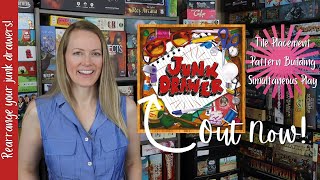












Junk Drawer Deep Dive
What the Community Thinks About Junk Drawer
Junk Drawer is widely recognized as a light, accessible polyomino placement game that excels as an introduction to board gaming. Reviewers consistently highlight its approachability, fast playtime, and thematic appeal. The game strikes a particular chord with casual gamers and families, though experienced players appreciate the clever puzzle design that lurks beneath its simple premise. Multiple channels emphasize how effectively the junk drawer theme connects to real-world experience, making the abstract puzzle feel tangible and relatable.
Core Mechanics That Define Junk Drawer
Polyomino Placement with Simultaneous Play
At its heart, Junk Drawer revolves around placing irregularly shaped polyomino tiles into four compartments of a personal drawer board. Each round, four items are revealed face-down and flipped one at a time. Players must place each item into a different drawer section during that round, creating genuine spatial puzzles. The simultaneous play mechanic means nobody sits idle waiting for others. Once you place a piece, the configuration of your drawer changes immediately, forcing you to adapt your strategy on the fly. This creates a fast, engaging rhythm where decisions feel consequential without requiring extended downtime between turns.
Dynamic Scoring Objectives
Each drawer section has its own scoring goal that players must satisfy by round's end. These goals range from simple coverage requirements to more complex conditions like surrounding spaces, creating specific color patterns, or avoiding interior placement. Reviewers emphasize that Junk Drawer offers three difficulty tiers: easy, medium, and hard objectives. This scaling allows groups to calibrate the challenge level. Players can start with relaxed goals to learn the spatial mechanics, then graduate to harder objectives that demand more foresight. The goals sit publicly throughout the game, eliminating hidden information and keeping everyone focused on the shared puzzle.
The Junk Drawer Experience
Satisfying and Tactile Puzzle Solving
Reviewers consistently describe the physical act of placing polyomino tiles as inherently satisfying. The chunky components feel good in hand, and fitting pieces into constrained spaces delivers immediate gratification. One reviewer notes that the experience evokes real-world organization, even triggering memories of their own messy drawers. The puzzle deepens as compartments fill; what felt like plenty of space early in the game transforms into a tighter constraint. Players report wanting to replay matches immediately after finishing, eager to attempt different strategies on fresh boards.
Gentle Tension and Accessibility
Despite the puzzle's complexity, Junk Drawer remains remarkably light in tone and presentation. The cartoon-style art and charming theme keep the game playful rather than punishing. Reviewers emphasize this is a game where failure feels educational rather than frustrating. Families and newcomers appreciate that a single player running out of placements ends the round for everyone, which can trigger table stress but adds cooperative tension. The game never devolves into complex calculations or opaque rules, making it equally welcoming to eight-year-olds and experienced gamers seeking a quick palate cleanser.
What Makes Junk Drawer Stand Out
Thematic Cohesion in an Abstract Game
The junk drawer theme perfectly mirrors the puzzle design. Rather than feeling tacked-on, the theme informs how players conceptualize their spatial decisions. Reviewers note that imagining a real junk drawer stuffed with buttons, batteries, and chopsticks makes the abstract shapes feel concrete. This alignment between mechanics and narrative creates a rare quality in polyomino games where the story and puzzle feel genuinely intertwined, rather than existing as separate layers.
Scalable Difficulty Through Objective Selection
While the core mechanic remains unchanged, the available scoring objectives create enormous replay variety. By selecting which difficulty tier to use for each compartment, groups can craft the exact experience they want. This flexibility transforms Junk Drawer from a static puzzle into an adaptive system that grows with a group's skill and preferences. Newcomers can enjoy it as a fun shape-matching game, while regular players can pursue the harder objectives that demand genuine spatial foresight and planning.
Potential Drawbacks
Limited Player Count and Scalability Issues
Junk Drawer maxes out at four players due to component availability. Several reviewers note frustration with this ceiling, particularly for groups of five or six. One reviewer suggests that adding more player boards would have been relatively inexpensive but would dramatically increase the game's utility. The simultaneous play mechanic means adding players would not extend playtime, making the limitation feel artificial rather than mechanical. Groups larger than four must split into multiple games or leave someone sitting out.
High Variance From Card Reveal Order
The hidden card reveals create genuine unpredictability, which can feel either exciting or punishing depending on luck and circumstances. Because players cannot see all four items for a round before placing, they must make decisions with incomplete information. Unlucky reveal sequences can force good players into impossible situations where every remaining drawer is blocked or unsuitable. While this creates tension, some reviewers note it occasionally overshadows strategy, particularly when one player suffers multiple rounds of poor draws while another catches favorable sequences.
If You Enjoy Junk Drawer
Players who love Junk Drawer typically appreciate polyomino puzzles and games with high spatial reasoning demands. Mind Up offers similar tile-placement satisfaction with a dice-rolling twist. Nacho Pile provides a push-your-luck dexterity experience with comparable lightness. For those seeking deeper tile-placement challenges, Cascadia and Acropolis offer more strategic depth while maintaining the satisfying physicality of piece placement. All four games share Junk Drawer's knack for scaling from casual introduction to meaningful strategic puzzle, making them natural extensions for groups who exhaust Junk Drawer's replay value.
What Reviewers Are Saying
"The game absolutely works even though this is an abstract game, the theme actually marries with the content like I just love that junk drawer next to your fridge that you pull out and like sometimes stuff gets stuck at the top and you can't get it out because you got too many soy sauce packets and ketchup packets."
— Tabletop Tolson
"It's lightning fast if not a little bit too fast, the decisions are a little bit obvious but it's good and it's fun, it's just so easy to learn and easy to get to the table."
— Chairman of the Board
"The fact that you do not get to see the four cards that are laid out ahead of time, you're not thinking like okay this one will go in the red area this will go in the blue, the fact that you have to make a decision the second you see a card, it's very crunchy for what it looks like."
— Before You Play