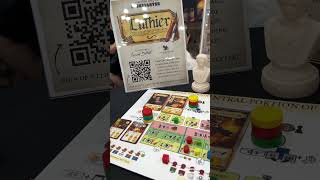
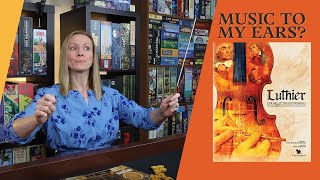
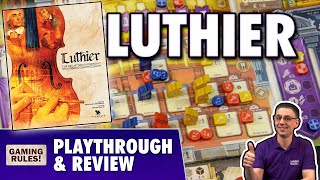
Luthier transports players to the height of classical music in Western Europe, when the art of the instrument was upheld equally by skilled craftspeople, noble patrons, virtuoso performers, and famous composers such as Bach, Mozart, and Beethoven.
Using a new, unique combination of hidden bidding and worker placement, players manage resources to craft various musical instruments in their workshop, while also courting actual historic patrons through an ever-changing personal tableau of actions and bonuses. Each player chooses how to balance improving skills across multiple tracks, unlocking specialized worker abilities and other bonuses. The choice to concentrate on varying gameplay strategies and goals, such as musical performances, instrument building and repairs, apprentice training and workshop expansion, and overall reputation as an instrument maker, provide multiple paths to victory.
Luthier finds true harmony through an authentic and original marriage of theme and mechanisms, resulting in a rich gameplay experience that equally speaks to both the strategic gamer and the classical music lover.
—description from the publisher
- Stunning art and components; artwork is a highlight
- Innovative timing-based worker placement
- Engaging orchestra/first chair mechanic with strong scoring tension
- Clear, accessible rulebook and setup
- Good replayability due to dynamic market and patron variety
- Some components hard to see due to art/printing quality
- Potential repetition toward the end of the game where several actions feel similar
- Artisan craftsmanship, patronage, prestige, and music performance
- A workshop crafting high-end musical instruments for wealthy patrons, featuring patron demands and orchestral performance.
- Eurogame-style worker placement with engine-building progression
Mechanics (from transcript analysis)
- Endgame scoring and scoring tracks — Scores come from chairs, completed instruments, endgame bonuses, and other resources; some values are divided (e.g., halved, tenth).
- Market and dynamic pricing — Market action changes resource costs; players buy/sell to optimize resources.
- Market Pricing/Manipulation — Market action changes resource costs; players buy/sell to optimize resources.
- Orchestra/First Chair bonuses — Orchestra positions grant bonuses; having more chairs yields endgame points; cannot bump a higher chair with a new instrument.
- Patron demands and frustration track — Fulfilling patron demands yields money and points; patrons have a patience track that can lose them if unmet.
- Planning phase with hidden tokens — Before actions, players place numbered tokens face down to plan actions; reveals influence order.
- Resource management — Rough and fine actions to convert resources into instruments on a workbench.
- Resource management and instrument crafting — Rough and fine actions to convert resources into instruments on a workbench.
- Worker placement with bidding and turn order — Players place actions with a bid number; highest number acts first; some spaces disappear as others take them.
Video topics + discussion points
Quotes (from this video)
- Art. It's fantastic. It's my favorite artist in a board game.
- The rule book's great. It teaches you really, really easily how to play in the setup.
- Eight and a half for me.
- The spark is back.
References (from this video)
- teaches quickly (in two minutes) but reveals depth over time
- unique spatial/asymmetric scoring
- portable and repeatable puzzle
- asymmetry can be challenging for newcomers
- mirror/deck mechanism with asymmetric scoring
- Space astronauts, abstract card game
- elegant, distilled
- Abstract strategy games
Mechanics (from transcript analysis)
- Compound Scoring — Scores based on width for the horizontal player and height for the vertical player.
- drift cards — Drift cards can be added to existing groups to alter scoring and options.
- Group scoring — Scores based on width for the horizontal player and height for the vertical player.
- mirror deck — Horizontal vs vertical play with rotated cards creating asymmetry.
Video topics + discussion points
Quotes (from this video)
- No patchwork, no Seven Wonders Duel, just genuinely underrated games that deserve a spot on your shelf.
- Buy this if you want something quick, portable, and full of meaningful decisions.
- That swing was massive.
- You can plan ahead because you know what your opponent might take and how it affects the board.
- The app is brilliant. It actually enhances the experience rather than feeling tacked on.
- The brilliance is in the timing and indirect interaction.
- Buy Tether if you want something that teaches in 2 minutes, but reveals depth of a repeated place.
- Buy Lacuna if you want something beautiful and tactile.
References (from this video)
- Beautiful Vincent Dutrait artwork
- Accessible weight for a Euro game; not overly heavy
- Engaging patron and instrument construction mechanics
- Excellent component quality in Deluxe Kickstarter editions
- Dynamic reputation and chair-based bonuses
- Complex setup due to many components
- Kickstarter/Deluxe pricing may be high
- Multiple mechanics can be dense for new players
- Music-themed resource management and patronage with instrument construction
- A music-themed patronage environment where players build instruments and satisfy patrons.
- procedural/Euro-style with strong theme
- Distilled
Mechanics (from transcript analysis)
- Area Control — First chair on the central board yields bonuses; owning an instrument can override first-chair status.
- Bidding-like action order via worker values — Action sequencing is driven by worker values rather than player order, creating strategic placement dynamics.
- end game bonuses — Endgame scoring includes patron bonuses, chair bonuses, and objective/bonus tiles.
- Endgame objectives and bonus tiles — Endgame scoring includes patron bonuses, chair bonuses, and objective/bonus tiles.
- First chair / area control — First chair on the central board yields bonuses; owning an instrument can override first-chair status.
- Market and inspiration tokens — Market cards influence costs; inspiration tokens modify actions and repair costs.
- Patron fulfillment — Complete patron requirements to gain points and reputation, with patrons sliding onto the player board for ongoing bonuses.
- Performances and repairs with dice — Performances require dice outcomes to determine payoff; repairs meet patron needs and yield rewards.
- reputation track — Move up the reputation track; higher spots affect action costs and endgame bonuses.
- Two-step instrument construction — Rough in an instrument using resources, then finish; completed instruments provide bonuses and sit on the player board.
- worker placement — Place workers on guild spaces to take actions; manage resources, upgrade workers, and build.
- Worker placement / guild actions — Place workers on guild spaces to take actions; manage resources, upgrade workers, and build.
Video topics + discussion points
Quotes (from this video)
- the game itself isn't actually that heavy of a Euro
- i love the mechanics that are in it
- i would highly recommend it for a nice Euro that is going to be nice and quick to set up and to play
References (from this video)
- Excellent teaching tools (The Rehearsal) and comprehensive player aid
- Beautiful original art by Vincent Dutrait; strong production visuals
- Clever baton-based teaching mechanism that remains functional and thematic
- Flavorful theme with adjustable starting conditions via family titles
- Clear two-player resolution board and straightforward scoring options
- Engaging ramp and varied actions that stay meaningful throughout the game
- Prototype art may include placeholders; final art may differ
- Some players may find the learning curve steeper due to multiple action layers
- Luthier craft and patron-driven scoring in a competitive workshop
- An orchestra workshop where instrument makers repair and build instruments for patrons
- Array
Mechanics (from transcript analysis)
Video topics + discussion points
Quotes (from this video)
- This was not a gimmick
- I really really liked it
- it's an incredible teaching tool
- an incredible design
- it's a freaking blast to play
References (from this video)
- Beautiful, thematic artwork and iconography
- Deep, multi-layered mechanics with meaningful choices
- Strong table presence and player interaction through hidden bidding and area control
- Thorough, well-laid-out rulebook
- High complexity and AP risk; tough to learn
- Very expensive due to components and production
- Roll-and-finish style of multiple tracks can be hard to manage during play
- Market card density can feel overwhelming
- patronage, prestige, and musical craftsmanship across periods (Baroque to Romantic)
- Baroque-era instrument making and performance world; workshops, patrons, markets, and orchestras
- historical-flavored with real instrument designers and patrons
Mechanics (from transcript analysis)
- Area Control — Central board area grants first chair if you are the first to the space; chairs provide end-game scoring bonuses.
- area control / first chair — Central board area grants first chair if you are the first to the space; chairs provide end-game scoring bonuses.
- Compound Scoring — End-of-round and end-of-game scoring based on patrons' requirements fulfilled by performances, repairs, or instrument types.
- endgame scoring architecture — Points come from chairs, instrument completion, patron bonuses, upgrades, and majority control.
- hidden bidding — Players bid secretly for turn order and market actions; resolution occurs highest bid.
- instrument craft pipeline — Roughing and finishing of instruments with resource costs to complete instrument cards; repairs may be required.
- Market and resource trading — Players can buy/sell resources and hire apprentices via a market deck with variable pricing.
- patron-driven scoring — End-of-round and end-of-game scoring based on patrons' requirements fulfilled by performances, repairs, or instrument types.
- worker placement — Heavy use of worker placement on tracks and spots to gain resources, upgrades, and authority to claim first chair based on majority.
Video topics + discussion points
Quotes (from this video)
- I am incredibly impressed with it.
- amazing beautiful artwork by Vincent Drait.
- The iconography is amazing in this game.
- this is a heavy style um worker placement with hidden bidding
- Oh, it's expensive.
- I really like this game.
References (from this video)
- Tight interaction and an engine-building core that rewards planning and adaptability
- Multiple viable routes and a layered puzzle that scales with player count
- Aesthetic and thematic coherence with luxurious presentation
- Starting family bonuses and patron progression add meaningful variability
- Solid solo mode that provides a credible opponent experience
- Longer play sessions at 3–4 players
- Steep learning curve and a not-insignificant initial setup to grok the efficiency puzzle
- Rule reminders can be forgotten (e.g., patron loss scoring) without reference aids

- Some randomness in the performance phase, though mitigated by planning
- Instrument makers (luers) building an orchestra through patron-driven production and performance
- A world of classical music, instrument making, and orchestral performance
- Informational with emphasis on process and efficiency; evolving engine
- Carnegie
Mechanics (from transcript analysis)
- End-game scoring via chairs and bonuses — Points come from chairs, personal/public goals, patron powers, special workers, and leftover resources.
- engine building — Three tracks grant special workers; investing in higher-value actions yields stronger bonuses and powers.
- Engine building via tracks and special workers — Three tracks grant special workers; investing in higher-value actions yields stronger bonuses and powers.
- Order influence and simultaneous resolution — Resolving a location affects all players; planning must adapt to where others place tokens and what resolves when.
- Resource management — Gaining resources and using a market each round to buy/sell; resources are used to build instruments and fulfill patron orders.
- resource management and market — Gaining resources and using a market each round to buy/sell; resources are used to build instruments and fulfill patron orders.
- set collection — Gaining patrons and completing patron orders; instruments are built and handed to patrons; tokens advance the orchestra.
- set collection and fulfillment — Gaining patrons and completing patron orders; instruments are built and handed to patrons; tokens advance the orchestra.
- worker placement — Players place workers on shared locations; actions resolve in the order of worker strength, creating planning and timing tension.
Video topics + discussion points
Quotes (from this video)
- This really is an efficiency puzzle.
- The complexity really comes from trying to do everything in the right order and most efficiently.
- There are so many levels to it as well.
- The interaction is high.
- I would be happy if only ever played it at two.
References (from this video)
Mechanics (from transcript analysis)
- theme-integrated action selection — Thematic actions map to mechanics; secondary actions always available.
Video topics + discussion points
Quotes (from this video)
- this is really interconnected worker placementish game.
- it's surprisingly smooth for how many moving parts there are.
- it's a game of inches where every space matters.
- there's way too many moving parts to explain here, but it is very very satisfying.
- you can definitely not just follow one thing and focus on one thing.
References (from this video)
- Stunning production, art, and components; the board, cards, and overall presentation are exceptional.
- The conductor's wand as the first-player token is a standout, large and visually impressive.
- Secret worker placement increases interaction and depth in a Euro game with strong thematic flavor.
- A rich blend of mechanics (crafting, repairing, performing) with meaningful decisions and variability.

- The game scale and arc evolve over six rounds, adding more workers and options for late-game action.
- Public/private goals create engaging strategic tension and replay value.
- Medium-heavy weight with long setup and potentially long play sessions; durations may exceed initial estimates.
- Analysis paralysis prone (AP) due to numerous crunchy decisions, especially at higher player counts.
- Plans can be sabotaged by other players, making the game punishing for those who like following a fixed plan.
- Mitigation options (top-card draws) are costly and not always worth it, potentially reducing efficiency.
- Board design could be improved with dual-layer mechanics to reduce numerator of bumps; deluxe edition lacks this feature.
- Best at 2 players; higher player counts increase complexity and reduce forgiveness for missteps.
- Music industry, instrument craftsmanship, patronage, and competitive orchestral success within a cultural marketplace.
- An orchestra-themed Euro-game set in a historically flavored environment where players manage instrument crafting, repairs, and performances to satisfy patrons across six rounds.
- Historically flavored with patrons and instrument types; emphasizes reputation, deadlines, and endgame prestige.
- Kanagawa
- Rise of Augustus
- Lockup
Mechanics (from transcript analysis)
- Area Control — A dynamic area-control mechanic where securing the first chair yields points and ongoing bonuses; later instruments can barge in to displace you.
- Area control (first chair mechanic) — A dynamic area-control mechanic where securing the first chair yields points and ongoing bonuses; later instruments can barge in to displace you.
- Dice-driven performance — Performances can involve dice to advance on performance tracks and improve scoring chances.
- Drafting of families (starting setup) — At game start, players draft one of two families that define starting resources and a unique starting ability.
- Dynamic market and apprentices — A fluctuating market affects buying/selling; apprentices bolster actions and can be advanced on tracks to gain bonuses.
- Instrument crafting and finishing — Craft instruments at a finishing bench, using resources to create instruments like harpsichord, cello, and clarinet.
- Narrative choice — Patron deadlines create tension and endgame scoring variation as unmet requirements penalize players.
- Narrative-driven tension — Patron deadlines create tension and endgame scoring variation as unmet requirements penalize players.
- Patron fulfillment system — Patrons require different instrument types or actions; satisfying them yields points and potential endgame goals, with penalties if unmet.
- Private and public goals — Players choose private goals and compete for public goals, which can be claimed now or waited for better versions.
- Resource management — Gather and spend resources (wood, horsehair, metal, etc.) to repair instruments, craft new ones, and satisfy patrons.
- Turn order influence (balcony area) — Players influence turn order, gain money or apprentices, and improve reputation, shaping strategic timing.
- worker placement — Players secretly assign workers to spaces; in resolution, the highest value acts first, with ties broken by order of placement.
- Worker placement (secret planning + resolution) — Players secretly assign workers to spaces; in resolution, the highest value acts first, with ties broken by order of placement.
Video topics + discussion points
Quotes (from this video)
- This might be as a whole the most one of the most if not the most gorgeous game I've ever seen.
- Secret worker placement. I love that.
- There are so many crunchy things to think about. Mechanism-wise, I think the game is medium crunchiness.
- The public and private goals... I've always liked that mechanism.
References (from this video)
- gorgeous production
- tightly integrated mechanisms
- high weight, heavy for some players
- Worker-placement with bidding and machinery
- Orchestral instrument building in a fantasy world
- Hefty thematic and production value
- Fractured Sky
- Aladdin's Dragons
Mechanics (from transcript analysis)
- worker placement — Three workers interact with a tableau; you bid to start with starting abilities and resources.
- worker placement / hidden bidding — Three workers interact with a tableau; you bid to start with starting abilities and resources.
Video topics + discussion points
Quotes (from this video)
- It's such a clean idea. It's so incredibly simple. But I love that you can teach this game in a minute.
- This is the game that kind of put Awaken Realms on a map.
- One surface in which you roll or flip and write. In every one of these games, everybody has their own sheet.
References (from this video)
- Interlocking trio of mechanics creates a cohesive, musical gameplay loop
- High interaction for a Euro game; avoids multiplayer solitaire tendencies
- Hidden auctions add constant tension and strategic depth
- Patron system provides meaningful, manipulable income and endgame choices
- Strong thematic integration with mechanics and scoring
- Longer playtime at two players, potentially approaching two hours
- AP and group dynamics can affect pacing and decision-making speed
- Moderate-to-high complexity and rules overhead may challenge casual players
- Music, performance, instrument construction, patronage, area control
- Orchestral performance and patron-driven outcomes within a Euro-style framework
- Puzzly Euro with interlocking systems and high interaction
- Galactic Cruise
Mechanics (from transcript analysis)
- Achievements and income engine — An achievement layer tied to instrument creation and patron rewards adds an additional path to scoring and resource generation, linking each core action to future benefits.
- Area Control — A central orchestra with chairs that grant points; majority control yields exponential point differences, and instrument spaces trump other actions, creating tension around placement and timing.
- Hidden auction — Each round, workers are placed face-down; the highest-valued bid determines who acts first in a given area or module, introducing micro-tensions and uncertainty about others' commitments and turn order.
- Instrument construction and finishing — Players gather resources to build instruments on a bench and move them to a finishing bench; instruments have priority in scoring and can trump other actions when placed first in a space.
- Orchestra area control — A central orchestra with chairs that grant points; majority control yields exponential point differences, and instrument spaces trump other actions, creating tension around placement and timing.
- Patron system — A cube-patience track provides gifts (income) and endgame scoring opportunities; managing patience and meeting patron demands drives income, prestige, and endgame swing.
Video topics + discussion points
Quotes (from this video)
- Luier is really a symphony of mechanics, three in particular, that work together to make this thing make beautiful music.
- a hidden auction that creates micro tensions on every single turn in every single round
- The three systems don't just coexist, they interlock
- I never get bored. I always feel a sense of urgency on every single turn
- This game oozes interaction really at every turn
- Luier is a highly dynamic hero with consistent moments of tension throughout the entire game
References (from this video)
- Hidden bidding adds a fun twist and depth
- Strong integration of theme and mechanics
- Engaging for two players with thematic cohesion
- Can be AP-prone in heavier play sessions
- Longer playtime (~1-1.5 hours at 2 players)
- pursuit of first chair in the orchestra
- Orchestra-themed workshop; performers crafting and performing
- personal, thematic to a classical musician’s world
Mechanics (from transcript analysis)
- Hidden bidding within worker placement — Workers with hidden strength values are placed to claim actions; stronger workers outrun weaker ones.
- Resource management — Gaining money and resources to craft instruments and fulfill patron requirements.
- Sequencing — Turn order and activation sequencing drive strategic planning and timing.
- worker placement — Locations for patrons, performances, repairs, and instrument crafting.
Video topics + discussion points
Quotes (from this video)
- Agent Avenue is a clever little game.
- Zenith is an incredibly tight game.
- Star Wars Battle of Hoth reminds me of being a kid again.
- I still love Scout and it's small enough where you can keep both.
- Hidden bidding feature really adds a fun twist to this one.
References (from this video)
- Intriguing mirror-deck mechanic that forces players to reinterpret numbers from the opponent's perspective
- Two-player spatial puzzle with distinct vertical/horizontal play directions
- Clear link between numerically ordered connections and variable scoring based on play area
- Astronaut theme adds accessible thematic flavor to an abstract puzzle
- Initial learning curve due to the inverted-number concept and the mirror deck may require extra explanation
- Spatial reasoning and connectivity in a mirrored numerical environment
- Space-based, astronaut tokens connected through a mirrored-number mechanic
- Expository overview delivered with promotional enthusiasm about the game's core twist
Mechanics (from transcript analysis)
- Connection and drift actions — On a turn, a player either connects an astronaut or assigns a drift, then draws a card.
- Mirror deck / inverted numbers — Players see numbers that are not the same as their opponent, creating a mirrored, relative-value puzzle.
- Scoring tied to the connected area — As players connect cards in numerical order, the size of the play area grows and determines scoring height.
- Vertical vs horizontal placement — One player places astronauts vertically while the other places them horizontally, shaping how connections form.
Video topics + discussion points
Quotes (from this video)
- This is a card game that will bring your favorite astronauts together.
- If you can wrap your head around this interesting number spatial puzzle, you'll be sure to see the universe.
- By connecting cards in numerical order, the size of the play area determines how high you're going to be scoring.
- I love it.
- On your turn, you either connect an astronaut or set an astronaut a drift.
References (from this video)
- Innovative combination of hidden bidding with worker placement
- Tension and anticipation due to strength-based priority
- Clear thematic flavor with customers, instruments, and performances
- Potentially complex for new players
- Requires careful tracking of strengths and order for optimal play
- Resource management, bidding pressure, area action choices
- Abstract Euro-style economic game with musical-themed actions
- Neutral, analytical
Mechanics (from transcript analysis)
- hidden bidding — Players secretly assign strength values to workers; higher strength can pre-empt others in actions.
- strength-based action priority — The order of actions is determined by the chosen strengths, enabling strategic beating of opponents.
- worker placement — Place workers to perform actions in various areas, with action resolution based on strength.
Video topics + discussion points
Quotes (from this video)
- Luier is a Euro game with a unique combination of hidden bidding and worker placement
- hidden bidding mechanic within the worker placement element
- if they place a worker that is of greater strength than yours, they get first dibs
- that same customer as you
References (from this video)
- Engaging worker-placement loop with a strong eurogame vibe
- Patron system creates meaningful long-term goals and rewards
- Solo mode with AI provides a solid single-player experience
- Orchestra/First Chair mechanic adds depth and strategic placement
- Prototype status includes placeholder art and ongoing rule tweaks
- Complexity may be daunting for new players
- Final production may adjust color schemes for clarity (cubes/colors)
- Music, patronage, and craftsmanship
- Artisan instrument makers in a European historical/classical era-inspired setting
- Eurogame with thematic patron-driven progression
Mechanics (from transcript analysis)
- Apprenticeship / specialty workers — Progression tracks and specialty workers grant ongoing bonuses and new abilities.
- Area Control — Placement of tokens in the orchestra area to gain first chair and associated bonuses.
- Area control / orchestra placement — Placement of tokens in the orchestra area to gain first chair and associated bonuses.
- Dice-based performance resolution — Performances are resolved with dice plus worker skill; higher skill can upgrade dice over time.
- Market and trade — Dynamic market to buy/sell goods; resources and inspiration tokens influence decisions.
- Patron-driven objectives — Patrons have main and secondary requests that grant rewards and permanent bonuses when fulfilled.
- Resource management — Manage animal goods, wood, and metals to complete instrument crafting and repairs.
- Solo/AI opponent with priority track — One-player mode uses an AI patron and a priority-tracker to drive actions and upgrades.
- Turn order and round progression — Rounds proceed through setup, planning, resolution, and cleanup with strategic turn order considerations.
- worker placement — Players assign workers to action spaces to gain resources, craft instruments, and fulfill patron requests.
Video topics + discussion points
Quotes (from this video)
- this is a sponsored video the publisher pavon games paid me to make this video to show you how luier plays
- everything I'm about to show you is a prototype and subject to change
- now I went ahead and I got almost everything set up for a solo game
- I think I'm going to take pomidor mostly because she's free but also because she's going to give us Gifts of money
- we're absolutely loaded up with metal
References (from this video)
- Beautiful vintage trait art
- Interesting worker placement with hidden information
- Engaging instrument theme
- Big heavy Euro with strategic depth
- Music theme is refreshing
- Building and repairing musical instruments as luthier craftspeople
- Time of refinement in European society
- Elegant period piece about high society musical culture
- Minos Donald LeB the Bronze
Mechanics (from transcript analysis)
- Building and crafting — Building, repairing, and selling musical instruments
- Delayed Action Activation — Choosing which action to activate reveals all workers and determines order
- Worker Bidding — Face-down worker strength determines activation order
- worker placement — Placing workers face-down at action spaces
Video topics + discussion points
Quotes (from this video)
- 2025 is halfway done. And this year, honestly, so far for board games has been super strong.
- This year has been really really strong.
- Race Chicago was a big surprise for us. We really liked it a lot.
- this just it doesn't feel like any other game I've played
- The Anarchy is an absolute banger.
- It's like the 2.0 level up from Hadrien's Wall.
- I love Molly House.
- it's really about coming together
- Luier is really really good. If you like big heavy euros that are pretty, it's a banger.
- this game is dope
- this is what I wanted Too Many Bones to be. It feels like too many bones leveled up.
- It's such a banger
- I just love the double-sided cards.
- Unstoppable is truly unstoppable.
- for my money, one of the best like two-player games I've played in a long time
- it's so good. It's so awesome.
References (from this video)
- tight action ordering creates meaningful player interaction for a heavy euro
- thematic integration around instrument crafting lands well with mechanics
- feels crunchy and satisfying for fans of engine-building euros
- anticipation and planning feel rewarding as you see outcomes evolve
- steep learning curve for new players to grasp bidding and card challenges
- heavy weight may not suit lighter gamers or casual sessions
- crafting, client satisfaction, and timing under pressure
- instrument crafting workshop and delivery chain
- heavy euro with indirect, multi-turn planning
Mechanics (from transcript analysis)
- action bidding — players bid for the order of actions, creating tension and strategic sequencing.
- Turn-based resolution — actions resolve one turn at a time in order of bid, creating a dynamic flow and meaningful player interaction.
- worker placement — actions are not taken in a simple worker-placing manner; cards determine available spots and costs, centralizing hand management.
- worker-placement-with-cards — actions are not taken in a simple worker-placing manner; cards determine available spots and costs, centralizing hand management.
Video topics + discussion points
Quotes (from this video)
- the map has all these different ways, and where they're located is very deduction-based
- this is a nice marriage of the two—cooperative play and deduction
- I love the pieces on this
- it's a good heavy euro where you have action bidding; you don't just place out a worker
- the interaction of the player spaces and the gears that you put out that allow you to basically pick from adjacent action spaces
- everything in this game is so logical and cohesive
References (from this video)
- thematic and well-produced art
- strong interaction around turn order and resource access
- thematic tie-in requires learning the background to fully enjoy
- luthier and instrument crafting and repair
- 1800s Baroque music scene
- thematic, historical
Mechanics (from transcript analysis)
- area/resource gathering — Visit different areas to gather items and satisfy customer needs.
- worker placement with bidding for turn order — Take actions in sequence by assigning valued workers; turn order is a resource.
Video topics + discussion points
Quotes (from this video)
- this is our top 10 board games of 2025
- it's a trick-taking style game where you predict exactly how many tricks you will win
- the Mindbugs can take control of that creature twice during the game
- it's a semi co-op element in Kidfire Council
- it's a cat-and-mouse hidden movement game
- it's an efficiency engine through and through that has a nice nature-based theme
- this is based off of the Pandemic system
- Speak Easy is by far the heaviest
References (from this video)
- Robust solo mode with balanced bot and dynamic interactions
- Strong resource management with meaningful tradeoffs
- Engaging worker initiative system adding tension and planning
- Chairs mechanic adds strategic contest and end-game payoff
- Replay variety via patron goals and endgame scoring
- Card draw luck can hinder consistent strategy and cause frustration
- Some swinginess in solo due to deck randomness
- Initial complexity may be challenging for new players
- Not drastically different playstyle across games
- art patronage, performance, instrument building
- Patronage-based instrument crafting in a concert/theater context
- evolving power through patron satisfaction
- Distilled
Mechanics (from transcript analysis)
- endgame-based scoring — multiple endgame goals and patron satisfaction yield points
- hand management — cards in offer influence patron and instrument types; deck draw luck affects availability
- hand management/offer card draw — cards in offer influence patron and instrument types; deck draw luck affects availability
- Resource management — managing goods, money, inspiration, apprentices to build/repair and perform
- solo mode mechanics — bot with action cards and movable tokens that balance over time
- worker placement — placing workers on actions with initiative values determining order and bonuses
Video topics + discussion points
Quotes (from this video)
- this is one of those Euros where you tend to do a little bit of everything
- the solo works is a full pro for my taste with some caveats
- it's a great spin on classic worker placement
- you are fighting over the first chair of the orchestra
- as I said earlier, the core idea of the game is you're trying to get these art patrons