/pic3716929.jpg)















































Merlin Deep Dive
What the Community Thinks About Merlin
Merlin occupies a fascinating place in Stefan Feld's design catalogue. Some enthusiasts regard it as a cerebral masterpiece that rehabilitates dice-driven mechanics; others view it as an ambitious experiment weighed down by its own complexity. The game has earned recognition in numerous top-50 lists, yet it doesn't receive the consistent acclaim of Feld's other major works. This divide reflects Merlin's greatest strength and occasional weakness: it is a game that demands player engagement without always making its rewards feel obvious.
Core Mechanics That Define Merlin
The Rondel and Dice Allocation
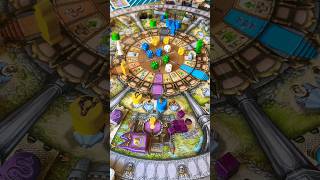
At Merlin's heart sits a circular track, or rondel, that would feel at home in many Feld designs. Players roll a pool of dice each round, then spend individual turns placing those dice into the center of the table to move their knight around this ring of action spaces. What elevates this beyond traditional roll-and-move is the delay between rolling and activation. Players know all available results before choosing which die to spend, and crucially, they can mitigate unlucky rolls through various mechanisms including flags that flip dice to adjacent values. This creates what reviewers describe as a "huge rondelle" where the "dice mechanism is utilized in a much more cerebral manner," stripping away the immediacy and frustration of classic dice-driven games.
The Mutual Merlin Piece
Every player controls a single shared token, Merlin himself, who moves around the same rondel as the knights. Any player can choose to move Merlin clockwise or counterclockwise on their turn, unlocking different action spaces than their personal knight would reach. This creates rich moments of interaction where moving Merlin either opens opportunities for yourself or blocks them for opponents. The mechanic rewards forward planning and generates emergent moments of tactical play within the larger strategic framework.
The Merlin Experience
Multiple Paths to Victory
Merlin refuses to funnel players toward a single strategy. The board offers builders and shield bearers to collect resources; ladies-in-waiting to establish influence in principalities; flag bearers to gain flexibility and special powers; and missions offering quick point bursts. The territories spread across the map invite area control plays, while the castle influence tracks present another distinct scoring avenue. This genuine abundance of approaches means that two games can follow entirely different strategic arcs, with different players excelling depending on their early choices and fortunate rolls.
The Tension of Push and Pull
Merlin creates distinctive tension through its modifier systems. The apples scattered on the board let players set a die to any face, but they're precious resources yielding victory points if unspent. Flags similarly give powerful flexibility but must be carefully rationed. Shield collection defends against raider threats but competes for space and attention. This creates a rhythm where players constantly balance immediate gains against future flexibility, and where seemingly simple decisions carry cascading consequences.
What Makes Merlin Stand Out
Dice Mechanics Reconsidered
Merlin arrived during a period when many hobby gamers had largely written off dice-driven games as relics of an earlier design era. Yet multiple reviewers note that Merlin demonstrates dice mechanisms remain viable when used thoughtfully. The separation of rolling from activation, the abundance of mitigation options, and the interactive rondel create a system where luck influences outcomes without overwhelming strategy. One designer specifically praised Merlin as a "pretty good" example of how "roll and move games don't have to be devoid of meaningful choices."
Stefan Feld's Design Philosophy in Practice
Merlin exemplifies Feld's approach to Euro design: abundant systems, multiple scoring paths, and player interaction through shared mechanisms. Unlike his more streamlined designs, Merlin embraces complexity in service of depth. The game trusts players to find their own pathways rather than channeling them toward dominant strategies. Reviewers recognize this design sensibility even when debating whether the execution fully justifies the complexity.
Potential Drawbacks
Randomness in Modern Design
Merlin's most common criticism centers on its reliance on dice rolls in an era when many serious gamers prefer more deterministic systems. While the mitigation mechanisms are robust, they cannot eliminate variance entirely. Some players find that even with flags and apples available, unlucky rolls during crucial turns feel frustrating. One reviewer noted the game "got a bit of mixed reception because it's got maybe a bit more luck in it to the average euro." This randomness element, intentional and well-managed as it is, remains a barrier for pure Euro enthusiasts.
Expansion Bloat and Setup Complexity
Merlin's greatest practical limitation may not stem from the base game but from its ecosystem. The game received multiple expansions adding modules and mechanical layers. A reviewer who owned the game reflected that achieving the "optimal experience with this game you had to pick and choose from a bunch of different expansions," making "setup time a real pain" and "a big obstacle to tear the game down." Rules referencing became difficult when "you'd have so many different pieces of the game from different expansions." For players hoping to simply open the box and play, this modular complexity presents a steeper entry barrier than many modern designs.
If You Enjoy Merlin
Players drawn to Merlin typically appreciate Stefan Feld's other rondel designs like Trajan or Strasbourg. The shared Merlin mechanic suggests exploration of games with mutual player pieces, such as Camelot Legends or works by designers who emphasize interaction through communal elements. If Merlin's dice mitigation appeals to you, Formula D and That's Life both showcase inventive approaches to making randomness serve gameplay. For the area control and influence play, The Lords of Waterdeep scratches similar itches in a lighter package. Players who embrace Merlin's complexity often find similar satisfaction in medium-to-heavy Euros with abundant systems, such as Concordia or Grand Austria Hotel.
What Reviewers Are Saying
"This clearly falls under the definition of roll and move, but it feels very different. The delay between rolling and activating the dice along with the myriad of ways in which you can mitigate against bad dice rolls removes the immediacy and excitement of the mechanism, turning into another lever to pull in a fairly complex thinking euro game."
— Adam in Wales, Board Game Design
"I love stephenfeld's games. It's basically a huge rondelle where you are rolling dice and you are choosing to use those dice in any order to move your player piece around the board to get different benefits. Additionally there's this mutual player piece of merlin which you can use to go clockwise or anti-clockwise around that rondelle which can really create some really cool synergies."
— Chairman of the Board, Decade Review
"I do so with quite a heavy heart because I am a big fan of the game itself. You are rolling a bunch of dice and you're allocating them to move these pieces around this rondelle, you're collecting items completing objectives, fighting off these threats. A real point salad style game as you'd expect with a Feld design."
— Chairman of the Board, Games I Got Rid Of