/pic8034813.png)






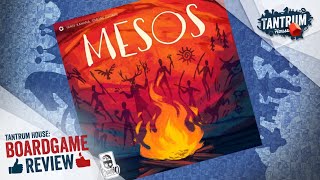









MESOS Deep Dive
What the Community Thinks About MESOS
MESOS has emerged as a standout title in the Mesolithic hunter-gatherer genre, capturing the attention of reviewers across multiple gaming communities. The game resonates with players who appreciate elegantly designed systems paired with thematic depth, though its performance varies significantly based on player count. From tight engine-building mechanics to rewarding tactical planning, MESOS demonstrates why designer Simone Luciani continues to shape modern board game design.
Core Mechanics That Define MESOS
Card Drafting with Turn Order Selection
At MESOS' heart lies an ingenious two-row market system where players place markers along a programming track to simultaneously select cards and determine turn order. Players can take zero, one, or multiple cards from the top and bottom rows, with each position offering different card quantities and bonuses. Reviewers consistently praised this mechanism for creating delicious tension: taking cards earlier grants fewer options, while claiming multiple cards forces you to go later in the round, often saddling you with food costs. This turns turn order into a resource itself, forcing difficult decisions about when to cash in for advancement versus preserving flexibility.
Set Collection and Resource Management
The game centers on collecting different character types: hunters, gatherers, builders, artists, inventors, and shamans, each with distinct scoring patterns and economic effects. Hunters generate food when added to your tribe, builders reduce building costs, and gatherers provide sustenance discounts. Building cards cost food to acquire but provide powerful ongoing abilities and victory points. This creates constant tension between acquiring people and building infrastructure, especially as feeding your growing tribe becomes increasingly demanding through the game's three eras.
The MESOS Experience
Breezy and Rewarding at Higher Player Counts
Multiple reviewers highlighted that MESOS shines brightest with three or more players. With expanded action spaces and more cards circulating through the market, the game creates dynamic decision points where players can meaningfully influence each other's options. The neutral middle position in three-player games provides relief from the tension of two-player confrontation, allowing for less adversarial tempo decisions. At higher counts, the variety of available actions and the unpredictability of what opponents grab makes each turn feel consequential.
Interactive and Dynamic Planning
The event system injects constant pressure and forward-planning opportunities. Knowing which events are coming allows savvy players to prepare: if a hunt event approaches, prioritize hunters; for a shamanic ritual, secure star-bearing shamans for majority scoring. Yet events arrive mysteriously through a deck, so perfect planning remains impossible. This combination of visible future challenges and hidden present realities creates the kind of tactical-within-strategic play that rewards both lookahead and adaptation.
What Makes MESOS Stand Out
Elegant Design Meeting Thematic Depth
Reviewers consistently noted MESOS as a designer's game that avoids unnecessary complexity. The ruleset remained teachable in under eight minutes according to multiple sources, yet the decision space expanded dramatically once players understood the fundamentals. The Paleolithic theme integrates naturally. You genuinely feel the survival pressure of feeding your tribe, and the progression from hunters and gatherers to builders and artists mirrors historical development without feeling pasted on.
Strong Replayability Through Variety
The combination of a substantial card deck and a randomized event sequence ensures each game feels distinct. With only a fraction of available cards entering play per game, you cannot lock into a predetermined strategy before the game begins. This forces tactical adaptation while allowing loose strategic direction. You might lean toward shamanic majority one game and builder infrastructure the next, depending on what appears available.
Potential Drawbacks
Two-Player Constraint Limiting Appeal
The consensus weakness emerged consistently across reviewers: MESOS underperforms significantly at two players. Multiple sources noted that the game becomes notably less tense with just two opponents. Without a neutral middle position, two-player games create swingier outcomes where one player's advantage in the action selection track proves harder to overcome. The drafting board contracts with fewer players, reducing both the visible future options and the chances for opponents to accidentally create opportunities for you.
Abstraction Underneath the Theme
A minority of reviewers observed that despite the thematic veneer, MESOS ultimately asks players to execute abstract economic optimization. Food represents pressure and action efficiency more than survival narrative, and while this abstraction never breaks immersion for most groups, players seeking deep thematic storytelling where every action feels grounded in the hunter-gatherer setting should calibrate expectations accordingly.
If You Enjoy MESOS
Fans of MESOS will find kindred spirits in games like King Domino (for the turn order-as-selection mechanism), Floriferous (for set collection through visible sequencing), and Cascadia (for nature-themed pattern building). The game occupies a middle ground between gateway-level accessibility and meaningful strategic depth, making it accessible to newer players while offering genuine puzzles for experienced gamers. Best suited for groups of three to five players who appreciate tempo decisions and forward planning within streamlined rules, MESOS rewards discussion and collaborative analysis without requiring extensive rulebook consultation.
What Reviewers Are Saying
"It reminds me of Floriferous, where the initiative plays a huge part in what you can take and where your standing is in the next round. This is like a hybrid between games like Floriferous, games like Palamedes, all boiled down into this one simple, clean, fun, and familiar card game that I thoroughly enjoy."
— Chairman of the Board
"You can see two turns ahead so you could do a lot of planning and there's a lot of if I do this then they'll do that sort of things. Most of the things that you draft are free so that really keeps the game going. The opportunity cost between this card and that card is what matters, not the actual cost."
— Getting Games
"For me to get another card drafting game I want it to be very special, and this one is different enough based on that drafting system which I think is fantastic."
— Board Game Dad