/pic751887.jpg)
"Long ago, after the Evil Samurai Warlord was banished the first time, an era of peace and tranquility descended upon the empire for more than 300 years. The dark castles he had built were abandoned and slowly fell into ruin and the villagers across the countryside no longer lived in fear. As the years went by, the secret of the powerful Kuji magic was hidden away in ancient shrines, and the people of the villages and towns went back to their daily lives.
Then one day, something changed. Terrible storms began to brew over the mountain on the distant horizon. Floods and earthquakes began to appear in the flatlands. At Ninja Mountain, The Ninja Master could see that something was terribly wrong in the world. Mysterious figures were seen hunting and caging animals for unknown reasons. The truth was that the Evil Samurai Warlord had returned, using the forbidden Kuji magic to transform innocent animals into mindless samurai warriors to use to recapture his dark castles and take over the world. But, by using the Kuji magic for evil purposes, the Evil Samurai Warlord was once again upsetting the balance of nature, bring the wrath of the gods down upon the earth in the form of ravaging storms. The larger his armies grew, the worse the storms became.
The Ninja Master knew none of this yet... though he knew that something must be done and made it his unbreakable oath. He sent his best ninja to discover the truth of the storms, but no word returned from the ninja. One by one, he sent another, but again and again... nothing. Until he was left with only two left, Hiro and Futo. The Ninja Master was hesitant to send his last two, but he knew the fate of the world would lay in their hands."
Source: Wikipedia, "Mini_Ninjas," available under the CC-BY-SA License.

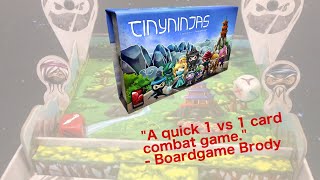
- Fast, brisk rounds with tight decision-making
- High-quality components: engraved dice, art, and durable cardboard
- Art and theme strongly reinforced by card illustrations and weapon imagery
- Flexible play options for solo or two-player sessions
- Limited to solo or two-player formats (not ideal for larger groups)
- Dice-driven outcomes introduce variability and luck
- Hidden hand mechanic may be opaque for new players until learned
- Ninja training, honor-bound duel, and sensei-guided modifiers affecting combat outcomes.
- A compact ninja dojo battlefield where players train ninjas and duel until one is defeated.
- Skirmish-level tactical duel with hidden information and probabilistic outcomes driven by dice.
Mechanics (from transcript analysis)
- Card-based attack and defense — Each ninja card provides an attack value and a defense value; the attacker selects a card to initiate an attack and the defender must respond with a matching colored defense card to mitigate damage.
- Dice-driven damage resolution — Damage is determined by rolling dice whose color and iconography correspond to the card values; certain icons indicate fixed results or specify which die to roll (Shuriken, Shriek, Kunai).
- Dojo/arena resource management — The discard pile is referred to as the arena; players train ninjas from the dojo by drawing from the dojo and utilize these cards in combat, with the potential to cycle or draw anew on future turns.
- Hand Management — Players draw up to five cards from the dojo and hold them face-down; hands are hidden from the opponent and cannot exceed five cards.
- Hand management and hidden information — Players draw up to five cards from the dojo and hold them face-down; hands are hidden from the opponent and cannot exceed five cards.
- Ninja card abilities — Ninja cards provide special abilities that can heal, grant extra cards, or enhance effects, enabling strategic plays at key moments.
- Resource Management — The discard pile is referred to as the arena; players train ninjas from the dojo by drawing from the dojo and utilize these cards in combat, with the potential to cycle or draw anew on future turns.
- Sensei markers and abilities — Four Sensei markers give each marker a unique ability; using an ability moves its marker back by one slot, allowing up to three uses per marker over the course of the game.
- Turn structure and role reversal — The attacker plays first, the defender may respond, and after exchanges the defender becomes the attacker with a new round of ninja training; play continues until one side is defeated.
Video topics + discussion points
Quotes (from this video)
- I enjoy the art on the cards as they did a great job as the art helps the game feel more thematic
- the game plays fast
- top-notch components
- the dice are custom engraved