/pic3066125.jpg)
/pic6505210.jpg)
/pic1519530.jpg)
/pic1726671.jpg)
In Mr. Jack, one of the two players represents Jack the Ripper, who will be one of the eight characters on the board. This player knows which character is Mr. Jack, and his goal is to flee from the district as soon as possible (or avoid being accused for eight turns). The other player represents an independent investigator (not represented on the board) who tries to guess the identity of Jack — but he can make only one accusation during the game!
During each turn, the players move the characters, using their special powers and placing them either in shadow or light. At the end of each turn, the witnesses declare whether Jack is visible — that is, in light or adjacent to another character — or not (alone in the shadows). This allows the investigator to know which characters are innocent. As the turns progress, the investigator tries to eliminate suspects while Jack tries to escape. Intuition, logic, and cold blood will be necessary for each of the two participants.
This page includes videos and mentions from the whole Mr. Jack family. Drill into a specific game below.
/pic3066125.jpg)

Rhino Says Yes #20 - Mr Jack

- Offers multiple different games with one small deck
- The 'Arcane Artifacts' mode was enjoyable with its wagering aspect
- Compact and good for limited space
- 'The Path Ahead' was too luck-based with no interesting decisions
- 'Sorcerer's Showdown' requires too much memory for the reviewer
- 'Arcane Artifacts' is not as streamlined as Kobe Yavya
- Struggles to identify the core audience
- Circus Flohcati
- Kobe Yavya
Mechanics (from transcript analysis)
- elemental system — A running thread through the game series is an elemental system where water > fire, fire > Earth, and Earth > water.
- Hand Management — In 'Arcane Artifacts', players can swap cards or commit to their current hand.
- Modular — More of a game system where you're using those cards to play several different games, with other modules that can be plugged in.
- Poker style — In 'Arcane Artifacts', it's a poker-style game where players try to have the strongest two-card hand by the end of the round, influenced by changing events.
- Push Your Luck — In 'The Path Ahead', players flip cards trying to guess if the next card is stronger or weaker than the current one.
- Set Collection — In 'Arcane Artifacts', the strongest hand is determined by specific elemental combinations.
- Trick-Taking — In 'Sorcerer's Showdown', it's a head-to-head trick-taking game where players must play a stronger card if possible. Winning a trick with the 'Avatar' card wins that trick and a previous trick.
Video topics + discussion points
Quotes (from this video)
- This is where I take a look at the last five new to me board games that I've played and I rank them and review them in order of preference.
- This one is probably the one of the best ones that I've played because it is so fast and you know you can teach this to you know your auntie who's not played a game since 19 1985 and they're still going to understand what to do here because everything is very clearly written on each card.
- For me this was a little bit too trick takery I'm not a big fan of trick taking games and to get the most from this one you need to kind of have a you know a Rainman style memory and I'm not like that so this one was also a Miss for me.
- This game is going to be directly compared to Magic the Gathering and rightly so you know I'd be lying if I said it wasn't very similar because it is.
- The only issue is I kind of struggle to see who the core audience is because if you like games like this you're probably going to be playing Magic.
- A lovely filler and very charming it looks nice on the table and I think this can fill that little kind of 20 minute Gap at the end of a game's day.
- This game is surely a game of efficiency.
- When I first played it I thought this is fine it's a little bit slow a little bit plotting but by the end of the game I was really enjoying it and you know I think this one has potential to climb for me and it maybe eventually reach a commendation.
References (from this video)

- tight, fast, and highly thematic deduction
- strong two-player head-to-head appeal
- easy to teach and quick to play
- asymmetric information can be limiting for some players
- theme may feel abstract to non-typical deduction fans
- hidden movement, deduction
- London, late 19th century
- theme-driven deduction with social deduction elements
- Memoir '44
Mechanics (from transcript analysis)
- Deduction — players infer the opponent's identity based on clues and movements
- Hidden Movement — players conceal their identities and movements to mislead the opponent
Video topics + discussion points
Quotes (from this video)
- This is definitive. It is not just our opinions, okay? This is now this is it.
- We will debate in a healthy manner to whittle down and come to our shared agreement of our top 10.
- Pillars of the Earth is out of print and yet I know all about it.
- Through the Ages: A Story of Civilization. Boom. Mutual pick. Instant classic.
- Niroshima Hex has had three different iterations of it.
- On the Underground was made and then reprinted again as On the Underground.
- Battle Lore is fully on my list. This absolutely, I think, should be a classic from 2006.
- This has to be on the list.
- Mass market darling Bananagrams.
References (from this video)
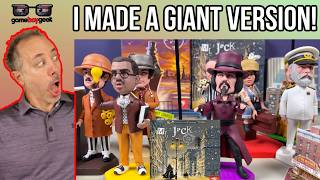
- Faithful homage to the original with a visually striking mega-build
- Thematic fidelity and dramatic table presence with custom figures and lights
- Custom elements (standing figures, hex bases, neon-like lights) elevate the game's feel
- The build is time-consuming and labor-intensive
- Some components are bulky or fragile and require careful handling
- Maintaining visibility of multiple pieces can be a bit fiddly
- crime, undercover investigation, and social deduction in a neon-noir setting
- New York City locations including Liberty Island, Manhattan, metro stations, and city landmarks
- personal project/vlog-style exploration with hands-on build process
- Mr. Jack (the original)
Mechanics (from transcript analysis)
- Area/space interaction on a hex grid — Characters and elements occupy two-hex starting areas and navigate a varied three-dimensional board.
- asymmetric roles — One side (Mr. Jack) tries to avoid detection while the other players cooperate to reveal him.
- Hexagon Grid — Characters and elements occupy two-hex starting areas and navigate a varied three-dimensional board.
- Hidden Movement — Players attempt to deduce the spy's (Mr. Jack's) location while others move around the board.
- Visibility and light influence — Lights on the board affect whether a character can be seen, impacting strategy and positioning.
Video topics + discussion points
Quotes (from this video)
- I'm going to make a giant version of Mr. Jack in New York and just go absolutely nuts with it.
- the labor of love that it was
- I love it
- it's the game I've probably played the most out of all of my games in my collection, more than 250 times
- these lights actually emit light
References (from this video)

- distinct two-player deduction experience
- tense and thinky, with interesting mechanics
- can be slow or overly thinky for some players
- crime/deduction stealth
- two-player asymmetric deduction; one plays Jack the Ripper escaping, the other plays the police trying to catch them
Mechanics (from transcript analysis)
- action selection duel — each turn each player uses a combination of actions drawn from a shared pool; the order and restriction of actions influences outcome
- asymmetric roles — one player is Jack, the other is the police; players take eight actions total with selective payoff
- Hidden information and deduction — Jack's location is concealed; the police deduce to catch him before time runs out
Video topics + discussion points
Quotes (from this video)
- this is a 4X Style game that plays in 60 to 90 minutes
- you never actually occupy any of the space between the planets you just use that space to figure out how far you have to actually travel in one shot to get from one spot to the other
- the judge they reveal one card into the middle of the table and unlike every other of these types of games that I've played the judge now actually has a decision to make they have to play a card from their hand as well
- it's a party style game where everybody has a hand of cards one person is the judge
References (from this video)

- two-player standout with strong tension
- tight playtime for quick sessions
- limited to two players
- asymmetric deduction and pursuit
- Victorian London
- short, tense duels with asymmetric powers
- Mr. Jack in New York
- Phantom of the Opera
Mechanics (from transcript analysis)
- asymmetric roles — distinct powers for each side create uneven play
- Hidden Movement — one side hides goals while the other searches the map
Video topics + discussion points
Quotes (from this video)
- Meadow I just think is a fantastic game. Gorgeous, gorgeous artwork here.
- one of the most like sort of distinct two-player games ever made.
- It's very fast; every round is tense and the reveals are sharp.
- I enjoy Marvel Champions. I love the versatility of this game.
References (from this video)

- Enjoyable for spooky season
- Good hidden movement mechanics
- Hidden movement, deduction
- Victorian London
- Mystery/Crime
Mechanics (from transcript analysis)
- Deduction — Detective trying to find the hidden accomplice
- Hidden Movement — One player is hidden, another tries to deduce their identity
Video topics + discussion points
Quotes (from this video)
- Foster the Meeple - a channel all about board games
- we have our team jeff team jamie patreons who are going to be voting on what the loser has to do
- i love res arcana res arcana is quickly becoming one of my favorite games
- adult where's waldo
- knocked our socks off
- i love it
- so much fun
- winter is coming
- board game city up in here
References (from this video)

- easy to grasp mechanics
- engaging two-player deduction
- gateway into asymmetric gameplay
- fits a cosy, accessible vibe for casual play
- mystery, deduction, hidden identity
- Victorian London; a chase to identify Jack the Ripper while he attempts to elude the detective.
- asymmetric, head-to-head deduction with hidden information
Mechanics (from transcript analysis)
- asymmetric roles — Jack as the hidden identity versus the detective who must deduce and capture him.
- Hidden Movement — Jack and other characters move with limited visibility to influence deductions.
- round-based actions with character powers — Each round allows two characters to activate and use their special abilities to shape the board and information.
- spatial visibility (shadow vs light tiles) — Tiles determine visibility and information available to the detective, guiding deductions.
Video topics + discussion points
Quotes (from this video)
- it's a very good example of an easy to grasp and engaging two-player game
- gateway game to get new people into asymmetric gameplay and into the Hobby
- one of the classic two-player games
- it's been played by lots of people
- it's a very good gateway for asymmetric gameplay and for introducing people to the hobby
References (from this video)

- Very cheap
- Lots of layers despite simplicity
- Easy to understand rules
- Deduction
- Hidden role
- Cat and mouse
Mechanics (from transcript analysis)
Video topics + discussion points
Quotes (from this video)
- When starting out in this hobby, losing is a huge pressure on the newbie. But what if you lose and win together? That's why horrified is a perfect cooperative game
- Monopoly is simple. You usually roll two dice and have a bad time. Well, in this game, you roll two dice and have a good time
- Engine builders are really cool because you always start with nothing and then build up from that point on and it makes you feel fantastic
- This is a game that drew me into this hobby and I'm happy I'm here
- And we went throughout this whole segment without saying that Monopoly sucks. Isn't that great?
References (from this video)
- strong theme
- tight player interaction
- requires player knowledge
- steep learning for new players
- hidden movement/deduction
- Deduction game in a Victorian setting
- thematic, light
- Guess Who
Mechanics (from transcript analysis)
- Deduction — players deduce and hide the identity of the 'Jack' using clues.
Video topics + discussion points
Quotes (from this video)
- Two-player only games tend to lend themselves to deduction games
- I could play deduction games like Mr Jack all day
- plenty of scope for new stuff
References (from this video)

- Elegant asymmetric deduction
- Strong tension and deduction dynamics
- Learning curve for new players
- Requires careful attention to rules and pieces
- Stratego
- Sheriff of Nottingham
Mechanics (from transcript analysis)
- asymmetric roles — One player is Jack the Ripper with hidden identity; others seek to deduce him.
- bluffing — Jack bluffs by disguising actions to mislead detectives without lying outright.
- Hidden Movement — Characters move around a board, with deduction based on positioning.
Video topics + discussion points
Quotes (from this video)
- lying is a subset of bluffing
- it's not outright lying but it features bluffing
- the only social deduction game that I can think of that doesn't feature outright lying it features bluffing
- hate drafting in another form
References (from this video)

- tight, elegant deduction in a small box
- great for two players
- two-player only
- pacing can be slow with learning curve
- deduction and pursuit in a two-player duel
- London 1880s, detective duel
- moody, noir-inspired deduction
- Sherlock Holmes: Consulting Detective (as thematic comparison)
Mechanics (from transcript analysis)
- action-selection — Players choose actions to reveal or deduce clues and move pieces.
- two-player deduction — Jack the Ripper vs. Sherlock Holmes with a grid of tiles and hidden information.
Video topics + discussion points
Quotes (from this video)
- this was definitely the hardest to rank these games
- none of these games I thought were bad this month
- this is an absolute delight
- ultra smooth ultra fun
- this is a thinky filler game with a great weight and repercussions
- you can teach this one in 30 seconds
- very elegant and easy to teach
- the elegance of the system is amazing
- I'm absolutely hit for me