/pic6121929.png)


















My Father's Work Deep Dive
What the Community Thinks About My Father's Work
My Father's Work represents something rare in the board gaming landscape: a worker placement game that married intricate mechanics with deeply personal narrative. The title secured the top spot on multiple year-end lists, earning recognition not for accessibility or flash, but for crafting an experience that felt simultaneously substantial and emotionally resonant. Reviewers found themselves captivated by a game that challenges players to balance mechanical optimization against a story about legacy, sacrifice, and the weight of inherited ambition.
Core Mechanics That Define My Father's Work
Worker Placement With Generational Scope
At its foundation, My Father's Work operates as a worker placement game, but one structured across three generations. Players deploy workers (themselves, spouses, servants, and caretakers) to different locations, each worker type suited for specific actions. The caretaker stays at the estate, while servants and spouses venture into town. The key strategic layer emerges from worker selection: choosing which person performs which task shapes not only immediate returns but also long-term consequences. Whether you lose a family member to an experiment gone wrong affects not just your current generation but the lineage you pass to your successors. This mechanic transforms worker placement from an abstract resource puzzle into something with thematic weight.
Knowledge Preservation Across Time
Where My Father's Work truly innovates is in how knowledge carries forward between generations. Most resources vanish when a generation ends, replaced with fresh workers and a reset estate. However, knowledge recorded in your family journal persists. This single element reframes strategic thinking entirely. Players must choose not just what experiments to complete this generation, but what insights deserve permanent record for future descendants. It creates a satisfying long-game narrative tension: Do you chase immediate victory points, or invest in foundational knowledge that serves a grand master work spanning decades?
The My Father's Work Experience
App-Driven Narrative as Living Scenario
The companion app transforms My Father's Work from a static scenario into a responsive story. It tracks decisions, remembers consequences, and asks clarifying questions between rounds. Did you conduct experiments? How many times did you visit town? Which family members died in your service? The app absorbs these answers and feeds them back into future generations through subtle rule adjustments, new story prompts, and branching consequences. One scenario contains nine different potential endings depending on how you navigate choices across three generations. This isn't window dressing; the narrative genuinely shapes gameplay. Some reviewers noted hiccups with app stability, but when functioning smoothly, it delivers an experience where story and mechanics reinforce each other rather than competing for attention.
Three Hours of Intimate Family Tragedy
Play time stretches to two or three hours, and unlike many longer games, My Father's Work sustains engagement throughout. The generational reset prevents the downtime doldrums of extended campaigns. Each new generation arrives with fresh optimism and new problems. A failed experiment that consumed your first generation's resources becomes a cautionary tale your children must navigate around. Reviewers consistently noted that despite the substantial playtime, sessions felt focused and thematic. The gameplay never felt like busywork in service of story, nor story like window dressing for mechanics.
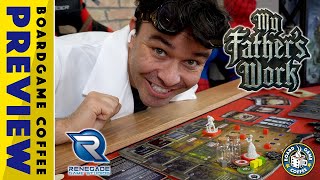
My Father's Work arrives with production value that matches its ambitions. Custom components, organizer trays, and art that leans into the gothic scientist aesthetic all contribute. The physical presentation grounds the theme firmly enough that players feel they're handling actual family research and estate notes rather than abstractly manipulating cubes.
What Makes My Father's Work Stand Out
Legacy Mechanics That Matter
Many games use legacy systems as novelty or as excuse for one-time narrative payoffs. My Father's Work integrates legacy directly into turn-to-turn decisions. Your current choices don't just affect this generation's score; they create the foundation your descendants inherit. Writing knowledge into your journal becomes a meaningful strategic choice with thematic resonance. It's not just that your father left you a journal; it's that you're now recording knowledge for your children to find, creating an intergenerational conversation across the game's three rounds.
Mechanical Simplicity Enabling Complex Decisions
Reviewers highlighted how the base rules remained straightforward despite the game's depth. At its core, you send workers to take actions. The complexity emerges from consequence management and generational planning, not from overwhelming option paralysis. This accessibility means new players can engage meaningfully while veterans find strategic crevices to explore. The game respects both audiences without catering exclusively to either.
Potential Drawbacks
App Dependency
The experience relies on a functioning app. While reviewers praised the app's writing and theming, some encountered technical glitches that disrupted immersion. The game doesn't collapse without the app, but it loses narrative cohesion. Players considering the game should verify app stability on their devices before committing to a full campaign.
Playtime Ceiling for Casual Groups
Three hours represents a significant commitment for casual gaming groups. While reviewers who played through found the experience worthwhile, the game demands table consensus that everyone wants to spend that time together. It's not a game for those seeking quick filler or for tables that prioritize rapid turnover.
If You Enjoy My Father's Work
My Father's Work appeals to players who value narrative-driven experiences without sacrificing mechanical depth. Similar explorations of legacy and consequence appear in games like Mansions of Madness, Arkham Horror, and other story-heavy euros that respect player agency. Those who appreciate worker placement with asymmetric choices will find familiar ground. The generational mechanics may also appeal to fans of transformation games and persistent campaigns where decisions ripple forward in time.
What Reviewers Are Saying
"This game has one of the best components that I've ever seen. It's an app driven narrative game with choices that change the board and what happens in the game every time you play. You will be trying to perform experiments and in between rounds you'll be moving on to the next generation. The mechanics are great, the story's fun, the changes every time we've played makes the game pretty amazing every time."
— Meeple Mountain
"My Father's Work is just a fantastic game that I will talk about with anyone really. One of the things that I really like about it is that it's a pretty long game that feels heavy, but actually the rule set is pretty simple. The mechanics and the characters and the drama and the narrative that surround it make it so good. The gameplay is really fun and super solid and not super difficult to pick up."
— Might I Suggest a Game
"This is a big game, a story-heavy game, but it is also a worker placement game. You're collecting resources, trying to achieve some objective. It's app assisted with a ton of story and flavor text. It uses that to do tons of world building. The game plays over generations. It's a good one for those nights when you really want to commit to a game with a couple of good friends that you want that head down strategy game."
— The Dice Tower