/pic4657706.jpg)




































No Thanks! Deep Dive
What the Community Thinks About No Thanks!
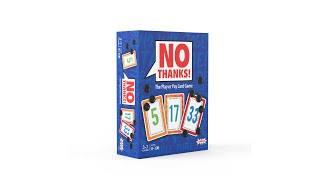
Few card games earn the kind of quiet reverence that No Thanks! has accumulated since Thorsten Gimmler designed it for Amigo Spiele in 2004. It shows up on lists year after year not because it overwhelms players with complexity, but because it delivers something far rarer: a clean, tense decision every single turn for every single player at the table.
Actualol's John Perkis put it plainly when asked about his favorite filler games: No Thanks!, For Sale, and High Society form what he called "the trinity of great filler games," adding that "they're kind of what every reviewer talks about." That ubiquity among reviewers is earned. The Secret Cabal's Jamie has owned a copy for years and says flatly that "everybody should own this game." Our Family Plays Games logged No Thanks! as their single most-played game of an entire year, hitting the table 15 times, and they still introduce it to new players as often as they can. Adam from Adam in Wales placed it at number 28 in his exhaustive all-killer-no-filler top 100, calling it "an absolute classic."
The consensus is rare in its uniformity: this is a game people keep, keep playing, and keep pressing into the hands of newcomers.
Core Mechanics That Define No Thanks!
The Pass-or-Take Decision
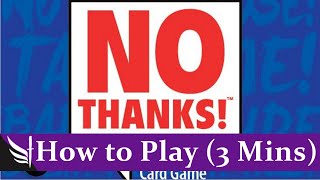
The entire game rests on a single repeated choice. A card is flipped from the deck. Each player, on their turn, must either take the card along with every token sitting on it, or place one of their own tokens onto the card and pass it to the next player. Cards carry point values ranging from 3 to 35, and the goal is to finish with the lowest score. Tokens cancel out points at a rate of one per token.
Actualol described the tension this creates: "you're trying to find the balance between taking cards that give you those tokens, which then give you options, and the cards will vary in number." Every token you spend passing a card is a token you no longer hold for a more dangerous card around the corner. Every card you accept may spare your token supply but costs you points. Neither choice is clean.
Board Game Dad highlighted what happens when the pressure builds: "eventually what's going to happen is someone's going to take the card, either because they want the card because it fills a set, or because they want the tokens on the card, or because they run out of tokens and they have no option left except to take the card." That forced-take moment is what the whole table waits for.
The Run Mechanic and Comeback Logic
The scoring rule that elevates No Thanks! above a simple token-management exercise is the consecutive-run exception. If you hold a sequence of adjacent cards, only the lowest card in that sequence counts toward your score. A run of 27, 28, 29, and 30 scores only 27 points, not 114.
The Secret Cabal's Jamie walked through why this transforms the game: "say you have that run of 27 through 30. If the 26 card comes out, that's not bad for you, that's actually great, because that'll actually score you one less point than you had before." Cards that would be devastating in isolation become desirable once you have adjacent numbers. And because nine cards are removed from the deck at random before play begins, you never know which cards will appear. A gap in your run might stay a gap forever.
Board Game Dad made the strategic implication explicit: "even if you take a card, let's say you take a card with 24 on it, well that's pretty bad, but if you take the 24 and you take 25 and you take 26, you could take a set and suddenly a card that was horrible isn't so bad anymore." This comeback mechanic is part of what keeps every player engaged until the final card.
The No Thanks! Experience
Constant Tension for Every Player
One of the structural advantages of No Thanks! is that nobody sits idle. When a card sits on the table accumulating tokens, every player around the table is in the same calculation: how much do I want those tokens versus how much do I want to avoid this card? The game has no downtime in the traditional sense because even when it is not your turn, the pot is growing and the calculus is shifting.
The Secret Cabal's Jamie captured the atmosphere at the table: "there's hooting and hollering and yelling at the table and pointing fingers and getting mad at each other, you know, playfully mad at each other." This is the social texture of the game. A high card with a mountain of tokens on it becomes a shared spectacle, with every player loudly claiming they will not be the one to blink first.
A Gateway Game That Respects Its Players
The rules of No Thanks! fit on a single page. Setup takes under two minutes. And yet, experienced players find genuine strategic depth in token conservation, run-building, and reading the table. Board Game Dad noted that while the rules are minimal, "what makes the game interesting is the strategy in how you play or save your chips, because you never know what the next card is going to be."
Actualol praised the version with illustrated cards showing unfortunate situations, noting that the art "appealed to me about this version of the game," though the game holds up regardless of edition. Adam in Wales agreed, saying "whichever version you get, even if you get one just with numeric design, it's still engaging enough that it's lifted above that sort of abstract presentation." The design is sturdy enough to survive minimal packaging.
What Makes No Thanks! Stand Out
Accessible to Everyone, Immediately
Board Game Dad placed No Thanks! in his list of games better than Monopoly specifically because it achieves the same accessible, anyone-can-play quality without the bloat. "Probably the simplest game on this list," he said, while also noting that the decision-making is richer than it first appears. The Board Game Garden's Jenna, who had not yet played it, already grasped why it works from description alone, comparing it to Scout and Fuji Flush as belonging to "that realm of just great card games."
The 3-to-7-player range is another practical advantage. Jenna specifically called out that "it can play up to seven people, which is awesome." Most sharp filler games max out at five. Getting seven people around a table with the same set of rules and the same tension is a meaningful achievement for a game that fits in a small box.
No Elimination, Always a Comeback Path
Board Game Dad drew a deliberate contrast with Monopoly's elimination spiral: "in no thanks it's funny but it's kind of painless when you run out of chips and you take a card. Fine. Not only do you take the card but you can make a comeback from that." Because of the run mechanic, a player who accumulates a cluster of high-numbered cards can suddenly find themselves in a strong position if the right adjacent card appears. Nobody is mathematically out of the running.
Our Family Plays Games described the moment when a big card lands with a pile of tokens on it: "sometimes you take it and some people have taken it and won. It depends on how many times it's going around, how many times they can hustle some extra tokens from everybody before they take it. Yeah, you got a large card and you got 20 tokens on there, it's not so bad."
Potential Drawbacks
Luck Is Real and Cannot Be Eliminated
Nine cards are removed from the deck at random before every game. This means a run you are carefully building might have a gap that never closes because the connecting card was removed before play began. You can see from your neighbors' expressions and token counts roughly what is happening, but you cannot know with certainty which cards remain in the deck. Players who dislike hidden information combined with variance may find this frustrating, particularly if they build a near-complete run only to discover the one card they needed was never in the game at all.
The push-your-luck element compounds this. Holding out for tokens on a card is sometimes the right play and sometimes catastrophic if the card comes around again before you expect it. There is no way to fully control outcomes.
The Experience Is Deliberately Thin
No Thanks! is not trying to be a strategy game. It plays in 20 minutes and offers one decision per turn. Players seeking mechanical depth, long-term planning, or multiple interlocking systems will not find them here. Adam in Wales was upfront about why light games get overlooked: "the light games don't get talked about as much as the big strategy games like Tigris and Euphrates." No Thanks! earns its place not through complexity but through purity, and that purity is a limitation as much as a feature for certain player groups. Gamers who want something to think about between turns, or who prefer games that develop in complexity over the course of an hour, will likely find the experience satisfying for a filler slot but unsatisfying as a main event.
If You Enjoy No Thanks!
Players who love the sharp, snappy tension of No Thanks! should look at For Sale, which John Perkis grouped with it as a filler classic and which shares the same lightweight auction energy with a touch more structure. High Society completes that trinity and adds a spending-pressure layer that feels natural after time with No Thanks!. Skull delivers a similarly social experience built on pure bluffing and reading the table. Love Letter offers another compact game where every card matters and the tension is immediate. For players who enjoyed the push-your-luck element specifically, Fuji Flush and Scout sit in adjacent territory: card games that are quick to learn, friendly to large groups, and rewarding to players who pay attention to what others are doing.
What Reviewers Are Saying
"For sale, no thanks, and high society, I would say, like the trinity of great filler games. But you've probably already heard of them and they're kind of what every reviewer talks about."
— Actualol
"There's hooting and hollering and yelling at the table and pointing fingers and getting mad at each other, you know playfully mad at each other. Such a simple game, everybody should have no thanks in their collection. It is absolutely 100 a fun fun casual card game."
— The Secret Cabal Gaming Podcast
"Everyone's in the game until the very end. No elimination makes it so much better. The game no thanks."
— Board Game Dad