
















































Paint the Roses Deep Dive
What the Community Thinks About Paint the Roses
Paint the Roses has earned admiration across the board game community as a uniquely challenging cooperative deduction game. Reviewers consistently highlight it as a game that demands careful logical reasoning, strategic communication, and nerves under pressure. The Alice in Wonderland theme resonates strongly with players, creating an immersive experience where gardeners race against time to complete the Queen of Hearts' garden. The game appeals to a specific type of player: those who love brain-burning puzzles, collaborative problem-solving, and the satisfaction of unraveling hidden information through careful observation.
Core Mechanics That Define Paint the Roses
Deduction Through Clue Token Placement
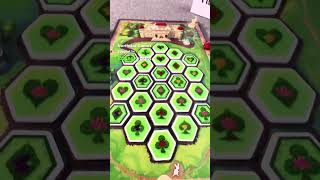
The heart of Paint the Roses is its elegant deduction system. Each player holds a secret card showing two characteristics: either two colors, two shapes, or a combination of both. When a tile is placed on the garden board, every player places clue tokens on that tile based on how many matches they see between the newly placed tile and adjacent tiles that match their hidden card. This creates a cascading puzzle where teams must deduce each player's card by analyzing the number of tokens placed. Reviewers praise this mechanism for its clarity and depth: placing tokens reveals information, but not placing tokens also reveals information by eliminating possibilities. The system scales elegantly from easy cards (pure color combinations) to hard cards (color-shape hybrids), allowing teams to set their own difficulty level.
Time Pressure Through the Queen's Speed
The Queen of Hearts functions as both antagonist and difficulty regulator. She begins moving one space per turn, but every time players cross a milestone on the score track, she gains a flower petal and increases her speed. Critically, incorrect guesses cause her to move double her current speed, creating high-stakes decision moments. This mechanic transforms the game from a purely cerebral puzzle into a race against escalating pressure. As teams progress and earn more points, they unlock access to more valuable cards but simultaneously accelerate their pursuer, forcing strategic choices about which cards to complete and when to make guesses.
The Paint the Roses Experience
Cerebral and Brain-Burning
Reviewers describe Paint the Roses as a game that "makes your brain feel so good," particularly emphasizing the satisfaction of the deduction process. Foster the Meeple and The Board Game Garden both place it on their top lists, citing the puzzle-solving experience as its core appeal. Watch It Played describes players "working together to decipher the very particular gardening tastes of the queen," highlighting the logical challenge. The game rewards careful note-taking, with provided notepads helping players track eliminated possibilities across multiple rounds. It is not a game for passive participation; every placement matters, and teams that miss details or fail to communicate clearly will face consequences.
Tense and Stressful in the Best Way
Reviewers consistently note the escalating tension as the Queen closes in. The Board Game Garden explicitly calls the experience "very stressful because you are getting chased by the Queen of Hearts," but frames this stress as intentional and enjoyable. Might I Suggest a Game describes it as "definitely a brain burner at times," emphasizing that the difficulty is part of the appeal. Teams who succeed describe winning as deeply satisfying precisely because the Queen's threat feels genuine. The rush of a last-minute correct guess or a successful completion of the garden before the Queen catches up creates memorable table moments that reviewers want to replicate.
What Makes Paint the Roses Stand Out
Perfect Scalability Across Skill Levels
Paint the Roses offers three card difficulty tiers, but beyond that, the game scales with player competence and experience. Teams can choose which difficulty deck to draw from each turn, with the constraint that only one player can hold an easy card at any time. This creates a flexible difficulty curve: new players can ease into the puzzle, while experienced teams face progressively harder cards. Before You Play notes that the expansion "Escape the Castle" introduces six modules with unique challenges, each scaling difficulty differently through character-based mechanics. The base game itself includes an expert variation where players begin with only edge tiles, forcing deeper deduction from turn one.
Alice in Wonderland Theming That Matters
The Queen of Hearts setting is not window dressing. Reviewers praise how the theme integrates with mechanics. The gardeners must keep their rules secret under threat of "losing their heads," forcing silent communication through tile placement alone. The whimsy of the setting creates emotional investment: players are not just solving puzzles, they are escaping an angry monarch. Watch It Played and Might I Suggest a Game both highlight how the theme of secretly communicating complex rules through physical placement creates narrative tension. The deluxe editions include upgraded components that enhance this immersion, with beautiful illustrations and enhanced tactile elements that reviewers specifically call out as adding to the experience.
Potential Drawbacks
High Difficulty Can Lead to Quick Defeats
While reviewers celebrate the challenge, multiple sources note that inexperienced teams can lose quickly. Meeple University notes that the Queen can catch you in about ten minutes if players are performing poorly, compared to 30-45 minutes for competitive games. This creates a pacing issue: teams learning the game may experience short, frustrating games before they develop the deduction skills necessary to stay ahead. The Board Game Garden mentions not winning in five solo attempts, getting close but ultimately defeated. Some players may find the early learning experience discouraging, particularly if they prefer games with more forgiving difficulty curves.
Lack of Solo Mode Limits Accessibility
The Board Game Garden specifically states there is "no solo mode" for Paint the Roses, expressing this as a limitation for solo-focused players. While the game is designed as inherently cooperative, the absence of solo rules means players cannot practice or play independently. This contrasts with other deduction games and limits the audience for players who prefer solo gaming or want to develop strategies without putting teammates in difficult positions.
If You Enjoy Paint the Roses
Teams drawn to Paint the Roses typically gravitate toward other cooperative deduction games and logic puzzle experiences. The expansion Escape the Castle builds directly on the base game with modular variants that add character abilities and new challenges. For players seeking similar cooperative tension without deduction mechanics, semi-cooperative games with escalating difficulty offer related experiences. Those wanting the deduction without the time pressure might explore print-and-play deduction games, while players drawn to the Alice in Wonderland theme can find several adaptations that explore the setting through different mechanical lenses. The game pairs well as part of a collection with other light-to-medium weight cooperative titles that value communication and logical reasoning over luck.
What Reviewers Are Saying
"It's a cooperative deduction game where you have these different tiles with patterns and you are either trying to get someone to guess two colors, two shapes, or a color and a shape by putting out little clue tokens on tiles. The Queen of Hearts is chasing you trying to chop off your head. She's a rascal that one, and it's so hard to win so when you win it feels so good."
— Foster the Meeple
"You are placing out these tiles into the garden and you are trying to guess the other players' cards. Each of their cards are going to be easy, medium, and hard cards and there's going to be a color and a shape. It's definitely the type of game that you get better at the more times that you play it and once you play it once it's easy to get hooked."
— The Board Game Garden
"This is a cooperative deduction logic puzzle game for two to five players. This one is definitely a brain burner at times but if you really love working together to solve these logic puzzles then this game is going to be perfect for you."
— Might I Suggest a Game