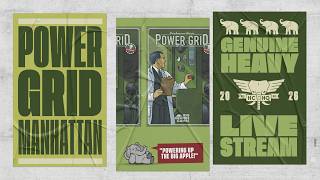
Power Grid is the updated release of the Friedemann Friese crayon game Funkenschlag. It removes the crayon aspect from network building in the original edition, while retaining the fluctuating commodities market like Crude: The Oil Game and an auction round intensity reminiscent of The Princes of Florence.
The objective of Power Grid is to supply the most cities with power when someone's network gains a predetermined size. In this new edition, players mark pre-existing routes between cities for connection, and then bid against each other to purchase the power plants that they use to power their cities.
However, as plants are purchased, newer, more efficient plants become available, so by merely purchasing, you're potentially allowing others access to superior equipment.
Additionally, players must acquire the raw materials (coal, oil, garbage, and uranium) needed to power said plants (except for the 'renewable' windfarm/ solar plants, which require no fuel), making it a constant struggle to upgrade your plants for maximum efficiency while still retaining enough wealth to quickly expand your network to get the cheapest routes.
☛ Power Grid FAQ - Please read this before posting a rules question! Many questions are asked over and over in the forums... If you have a question about a specific expansion, please check the rules forum or FAQ for that particular expansion.
- Engaging economic tension that scales with player count and session pacing.
- Clear but deep strategic options; rewards foresight and adaptation.
- Lodging room for house-rule experimentation can enhance pacing and player enjoyment.
- Steep learning curve for new players; setup and teardown can be lengthy.
- Thematic clarity can feel opaque to newcomers without guidance.
- Rules interactions are nuanced; misinterpretations can slow early plays.
- Resource management, market dynamics, and network expansion under price-pressure constraints.
- Industrial electricity market in a modern world where cities compete to secure power supply and infrastructure expansion.
- Economic, strategic, with social underpinnings as players negotiate sourcing, energy production, and city connectivity.
- Monopoly
Mechanics (from transcript analysis)
- Auction — Players bid for power plants and energy sources, balancing short-term cash needs with long-term plant efficiency and grid coverage.
- Auction / Bidding — Players bid for power plants and energy sources, balancing short-term cash needs with long-term plant efficiency and grid coverage.
- economic_engineering — The interplay of plant costs, fuel supply, and city demand creates a moving target that rewards strategic sequencing.
- network_expansion — Players lay track to connect cities to their grid, aiming to maximize reach while minimizing sunk costs and supply gaps.
- Network/route building — Players lay track to connect cities to their grid, aiming to maximize reach while minimizing sunk costs and supply gaps.
- Resource management — Money (electro) and energy sources are consumed to build and operate plants; careful budgeting shapes growth and end-game viability.
- resource_management — Money (electro) and energy sources are consumed to build and operate plants; careful budgeting shapes growth and end-game viability.
Video topics + discussion points
Quotes (from this video)
- The goal is the laughter. The goal is the fun. The goal is interaction around the table.
- A card laid is a card played.
- Jump in in real time as fast as possible and the gameplay continues in that direction.
- Dirty Spades is like ... this is how we're playing the game. It's silly. It's fun. Adds a little level of chaos to the thing.
- Bus rules. You could play it out and take a lot of time or it could just okay, now we know this what's going to happen.
- If the game state hasn't changed, go ahead and pay for it now.
References (from this video)
- Tightly designed auction/vector economy
- Engaging market tension
- Appeals to heavier gamers
- Iconic but heavy to teach
- Utility network expansion
- Power production economy with energy markets
- Strategic, market-driven
- Brass Birmingham
- Concordia
- Barrage
Mechanics (from transcript analysis)
- Auction / Bidding — Bid on power plants and manage resources
- auction/resource market — Bid on power plants and manage resources
- network-building — Connect cities via power lines to supply electricity
- Network/route building — Connect cities via power lines to supply electricity
Video topics + discussion points
Quotes (from this video)
- it's a wonderful starter game for nearly anyone.
- how have I not played dominion
- when I played Dominion I just felt like an absolute idiot
- the quintessential racing game out there
- it's an absolutely brilliant game
- the best network builder of all time
References (from this video)
- Deep strategic depth and multiple viable strategies
- Strong sense of progression and expansion possibilities
- Replayable with expansions
- Can be long and heavy to teach
- Expansions add complexity and price
- Aimed at heavier gamers
- Energy production, infrastructure expansion, and resource management
- Global energy distribution and electrical grid expansion
- Strategic economic engine-building with competitive market mechanics
Mechanics (from transcript analysis)
- Auction / Bidding — Open auctions for power plants that provide electricity.
- City / network expansion — Expand the grid to serve more cities and earn income.
- network building — Connect cities with power lines to supply energy.
- Network/route building — Connect cities with power lines to supply energy.
- Resource management — Buy fuels (coal, oil, garbage, uranium) to generate power.
Video topics + discussion points
Quotes (from this video)
- Power Grid. I'm never getting rid of my copy of Power Grid.
- I want to play Power Grid.
- Power Grid to be online somewhere to play.
- If you see me out in the wild... the answer is yes.
- Shadows Over Camelot is a great game. I would say yes.
- We should play Shadows Over Camelot.
- I love King Arthur and Camelot.
- Dixit is one of the games that got me into board games.
- Dixit comes with a lot of these abstract kind of esoterically beautiful artwork cards.
- It was the first game to have these beautiful abstract artwork cards on it.
- I really like the game Detective Club.
- Mysterium, Obscurio, Detective Club were inspired by Dixit.
References (from this video)
- Three-phase arc with rising complexity
- Tension driven by auctions and market shifts
- Heavy number crunching and math at endgame
- Complexity can overwhelm casual gamers
- evolving power market and expansion strategy
- Electrical power market with a city-building bent
- economic progression with shifting phases
Mechanics (from transcript analysis)
- Area Control — Cities and power plants drive strategic positioning
- area_control — Cities and power plants drive strategic positioning
- Market Pricing/Manipulation — Dynamic power plant market shifts resources and pricing
- market_fluctuation — Dynamic power plant market shifts resources and pricing
- phased_gamePlay — Game moves through distinct eras with changing rules
- Variable Phase Order — Game moves through distinct eras with changing rules
Video topics + discussion points
Quotes (from this video)
- The arc is this strange cadence to it.
- And so it has this sort of the arc of the game is in these interesting spurts of attention and ignorance that players throw each to each other's ways.
- The arc has such strong story beats to it, especially with the new stuff.
- Desperation. We're all going to lose.
- It's a nailbiter like it gets right to the edge.
References (from this video)
- Donut map variant (Bremen) introduces fresh plant-value dynamics and strategic tension.
- Removal of nukes on the Bremen map simplifies some rules and pacing.
- Auction plus resource/connection management creates rich player interaction.
- Some rule wording and board notation led to questions and confusion during play.
- The round can feel lengthy on this map, especially for new players.
- Strategic depth can be challenging for newcomers to grasp quickly.
- Energy production, market manipulation, infrastructure expansion
- Donut-shaped Bremen map and broader global power-grid operations
- Economic strategy with auction-driven plant acquisition and network building
- Glory to Rome
- Age of Steam
- Option Paralysis
Mechanics (from transcript analysis)
- Auction — Players bid on power plants; the bid influences end-of-round benefits and turn order.
- Auction / Bidding — Players bid on power plants; the bid influences end-of-round benefits and turn order.
- Endgame trigger and scoring — In a four-player game, end condition triggers at 13 cities; scoring revolves around plant count and connectivity.
- Market-driven turn order — After each auction, the lowest-numbered plant is used to determine turn order for the next phase.
- Network/City placement — Players connect districts to their network; subsequent placements must connect to existing network via houses.
- Network/route building — Players connect districts to their network; subsequent placements must connect to existing network via houses.
- Resource management — Purchase coal, oil, and garbage; manage scarcity and pricing dynamics.
- Resource market management — Purchase coal, oil, and garbage; manage scarcity and pricing dynamics.
Video topics + discussion points
Quotes (from this video)
- No nukes here in Bremen first off.
- Power Grid
- This is Power Grid.
- Donut World
- Power plant at the end of this and only once.
References (from this video)
- Fascinating, economic, and highly interactive
- Strong catch-up mechanics and strategic depth
- Can be exhausting on the first few plays
- Steep learning curve for new players
- La Granja
- Age of Steam
Mechanics (from transcript analysis)
- Auction / Bidding — Bid for power plants to power your cities and manage resources.
- economic engine building — Balance costs of plants, resources, and expansion across cities.
- engine building — Balance costs of plants, resources, and expansion across cities.
Video topics + discussion points
Quotes (from this video)
- The Bloody Inn. This is on this was a play on a couple of plays on Board Game Arena, and I think the theme and mechanisms aren't as deep and complex and the theme isn't as enticing to me per se.
- Age of Steam is definitely a top-tier experience that I really want to play again.
- Power Grid is a fascinating game where you balance money, plants, and city growth.
References (from this video)
- tight euro-style economics
- different strategies per map
- can be long for some groups
- network building and auction economics
- electrical grid development across regions
- economic, infrastructural
- Greed Incorporated
- For Sale
Mechanics (from transcript analysis)
- auction / market mechanics — buy power plants and bid for resources
Video topics + discussion points
Quotes (from this video)
- I don't know very much about wargames I haven't played many war games
- these games are for adults
- these are the vast majority these are available easily
- abstract strategy games don't really look like that anymore
- these are not children's items they're for adults to have a serious time together
References (from this video)
- engaging auction dynamics
- clear tension around endgame scoring
- math-heavy
- often needs a specific player count for balance
- electricity production and distribution
- industrial electricity networks across cities
- economic simulation with resource auctions
Mechanics (from transcript analysis)
- auction/bidding — players bid for power plants to expand their grid
- network building — players connect cities to power plants to supply demand
Video topics + discussion points
Quotes (from this video)
- my number 10 is tachu
- it's fun I mean plant and I mean so you obviously I would say do you like that kind of having to siphon through
- the real MVP comment Micah down below
- Kay's number one game of all time tune in next year geez
References (from this video)
Mechanics (from transcript analysis)
- auction/bidding — players bid for power plants and buy resources to power cities
- route/connection building — construct networks to connect cities and supply electricity
Video topics + discussion points
Quotes (from this video)
- it's just a big mess
- this is the new norm
- it's a ripple effect across the whole thing
- quality over quantity is going to be a big thing moving forward
- expedite fees and premium rates
References (from this video)
- Classic Euro with strong engine
- Flexible with expansions
- May be long for some groups
- resource management, bidding and network expansion
- Global power market
- economic strategy
Mechanics (from transcript analysis)
- Auction — bidding for power plants
- resource_management — managing resources to generate power
Video topics + discussion points
Quotes (from this video)
- hi i'm adam porter and this is my board game vlog
- this video is partly inspired by actual video john perkis recently did
- the kalax shelves the ikea kalax every youtuber has kalax shelves don't they
- i'm afraid we're going to have to go broad strokes here
- since i've been at home through lockdown working from home a lot of the time this has become my office as well
- monopoly monopoly gamer i just think monopoly game is so fun
- i've backed the complete collection which will come in a massive coffins type box
References (from this video)
- Great economic game
- Lot of fun
- Game that got host into board gaming
- Fairly old now
- Other games do similar things better
- Power plant operation and management
- Industrial power generation
- Economic simulation
Mechanics (from transcript analysis)
- Auction mechanics — Bid on power plants
- Economy driven — Economy efficiency focused gameplay
Video topics + discussion points
Quotes (from this video)
- Agricola is one of those games that you just got to have in your collection if you like euro style games
- Porta is one of my favorite underrated games
- Broom service I absolutely love food service one of the coolest mechanics in board games 100 percent recommend this game it is a hoot
- Barron Park is my favorite polyomino Tetris in a board game game
- Orleans is a top 5 game for me period just one of my favorite games to play ever
- Power grid this was the game that got me into board gaming y'all
- Seven wonders this is a modern-day classic
- Betrayal at house on the hill every game is different
- King of Tokyo one of those games that you have to have in your collection
- If you like board games one or percent recommend this game
References (from this video)
- High depth and a broad decision space that rewards long-term planning
- Significant player interaction through auctions, housing decisions, and resource market dynamics
- Scarcity of power plants and resources creates meaningful trade-offs and tension
- Rich map variety and expansive content through expansions and alternate maps
- Clear, escalating momentum and a strong sense of progression throughout the game
- Steep learning curve for new players
- Early mistakes can be punishing and can slow down recovery for lagging players
- The base game's treatment of industrial impact is somewhat thin; pollution themes are not deeply explored
- electricity generation, distribution networks, and market dynamics
- 1950s electricity market expansion and competition among firms
- economic strategy with auctions, resource management, and network building
- Concordia
Mechanics (from transcript analysis)
- Auction — Players bid for power plants; the bidding order and plant availability influence strategy each round.
- Auction / Bidding — Players bid for power plants; the bidding order and plant availability influence strategy each round.
- city placement — Houses are placed in cities to expand the player's network; placement costs escalate with each additional house.
- market dynamics — Prices and availability of power plants and fuels swing based on supply and demand, influencing decisions.
- Market Pricing/Manipulation — Prices and availability of power plants and fuels swing based on supply and demand, influencing decisions.
- network/building — Players construct a network to connect cities and supply power where they have houses.
- Network/route building — Players construct a network to connect cities and supply power where they have houses.
- phase-based turn structure — The game progresses through defined phases and steps, culminating when a player reaches the house-placement threshold or the deck triggers the end.
- Resource management — Fuel resources (garbage, coal, oil, and uranium) must be bought and allocated to power plants to produce electricity.
- Variable Phase Order — The game progresses through defined phases and steps, culminating when a player reaches the house-placement threshold or the deck triggers the end.
Video topics + discussion points
Quotes (from this video)
- Power Grid is the Millennium Falcon of board games
- the game has a lot of depth and a huge decision space
- the level of interaction between players in terms of auctions, house placements and resource buying are quite high for a euro game
- the best thing about this game is dealing with scarcity
- In a 5 player game you can only ever have 3 power plants
- it's a skill heavy game where early mistakes can be punished
- Power Grid shares a lot in common with the popular Concordia
References (from this video)
- auctions drag on forever
- analysis paralysis
- drawn-out bidding
- too much AP
- punishing heavy Euro
Mechanics (from transcript analysis)
Video topics + discussion points
Quotes (from this video)
- Remember it's only a game
- I am very much one of these people that if you go after my family or friends there will be hell to pay
- Five out of ten is average, it's a game that I would still play if you put it on the table
- I do really like closed drafting in games
- I love the way that you plan for this sort of stuff
- Power Grid is the worst contender for this, auctions in this just refuse to freaking end
- I want to see it more - the typewriter mechanic
- Area control is just kind of meh
- It's just so many of these games are just like oh we need to make a quick buck
References (from this video)
- Excellent auction mechanics
- Network building elements
- Many strategic options
- No trains in theme
- No emergent alliances
- Power generation
- Network infrastructure
- Economic competition
Mechanics (from transcript analysis)
Video topics + discussion points
Quotes (from this video)
- most of what i look for in a train game is about emergent alliances
- the more people you get in there the more entangled it gets and that's what's really exciting for me about train games
- definitions are useful when they highlight affinities and they cease to be useful when they're used to exclude
- i will call it a train game because it will piss off how to train gamers
- this is the game that invented everything i rip off in my games
- it feels very much like a train game that would have been designed like in 2010
- the rules are really very simple they're just they just take a long time to play
- soft spot for games that are designed just for me as a solo player
- i really enjoy automated opponents and seeing what they're capable of
References (from this video)
- classic thinky euro that rewards careful planning and math
- dense strategic depth with clear systemic rules
- resource and logistics optimization with political power over energy
- electrical power market and infrastructure across a developing world
- simulation-like economic puzzle
Mechanics (from transcript analysis)
- auction/bidding — players bid for power plants and fuel to maximize efficiency and coverage.
- network/graph building — players connect cities to form a resin-like network supplying power.
Video topics + discussion points
Quotes (from this video)
- two Ninjas they're saying Mission failed
- Mission failed he found us
- it's a math exercise
- this is called Indiana Bones and the Doom Temple
- Santa Claus oh my God she's so small there's a hobbit house somewhere there
- Essen is the capital of board games
- Arc which was the hype in 2024 ... they are fuel cartel
- this is an homage to Kim Stanley Robinson
References (from this video)
- Works well with 6 players
- Substantial economic depth
- Engaging gameplay for economics enthusiasts
- Power production and distribution
- Economic simulation
- Strategic economic
- Poseidon
- Speculation
- Stockpile
Mechanics (from transcript analysis)
- Auction — Players bid on power plants and resources
- economic — Managing resources and production networks
Video topics + discussion points
Quotes (from this video)
- a series of videos where I take a bunch of different possible scenarios some of them provided by you the viewers and I shuffle them up into a deck of cards I reveal a scenario and roll a dice to see how many players I've got
- I got in lots of trouble last time for using the word dice as a singular so we'll be sticking with die as long as I remember today
- everything economic uh that I really really love seems to cap out at five players
- I can't imagine how long it would take so I think that would probably ruin ruin game
- frankly I played that with uh two players once and we gave up after about seven hours
- there's some good ones but most games before 1995 would ruin game night if you tried to play them today
- you're not allowed to speak to each other and you're playing against the time so it's very frantic
- the only way you're able to communicate is by tapping this wooden token to say look I need you to do something
- I think Mysterium would fall apart if they didn't speak the language and that's odd isn't it because it does isn't a game that has any text in it
- I think a terrible idea there's not that much interaction and the game gets longer with each player that you add
- I don't understand the people who put down a big you know they stick down Scythe in front of kids or boast about the fact their four-year-old can play sides
- there's no reason to be playing um Snakes and Ladders or or Candyland I would say not that Candyland is a big thing in the UK
References (from this video)
- clear, segmented phases make complex economic play approachable
- highly deterministic and satisfying when calculations pay off
- scales well and remains an absolute classic
- longer play sessions require larger groups
- can feel dry for players seeking lighter games
- economic engineering and utility expansion
- industrial power networks and city connections
- deterministic/analytic
- Citrus
Mechanics (from transcript analysis)
- auction and resource management — auction for power plants; fuel types drive production capacity
- Grid building — place buildings, connect cities to maximize coverage
- grid-building with city connectivity — place buildings, connect cities to maximize coverage
- Market Pricing/Manipulation — fuel prices rise as demand increases and supply is limited
- supply and demand pricing — fuel prices rise as demand increases and supply is limited
Video topics + discussion points
Quotes (from this video)
- this is a really interesting game
- one of the best examples of that mechanism being used correctly
- infinite replayability
- timeless, evergreen status
- flows wonderfully and rewards careful planning
References (from this video)
- Sophisticated self-balancing auction system
- Creates interesting strategic choice between leading and lagging
- Incentivizes varied playing strategies
- Building power networks
- Infrastructure building and resource management
- Economic strategy
Mechanics (from transcript analysis)
- Auction System with Turn Order Reversal — Going first in auction has significant advantage, but players with fewer houses get first choice of both power facility cards and resources at cheaper prices
- Leading-Behind Pricing Inversion — Lagging players get cheaper items and purchase priority, making it a viable strategy to lag slightly to get early advantages before catching up
Video topics + discussion points
Quotes (from this video)
- Balance, perfect balance, I think is kind of boring in games.
- I like games that have a card that might feel better than a different card either circumstantially or always.
- As long as you have a fair shot at getting that card over just a random draw, that's the key.
- Self-balancing mechanisms make sure that games remain balanced while you play.
- Games that use the players to selfbalance it, especially if there's a lot of direct interaction in the game.
- If you pull one lever up, something else is going to go down.
- There's a way that the game kind of gives you an interesting choice and a little way of catching up if you are falling behind.
References (from this video)
- relatively accessible to teach once learned
- high strategic depth with auction dynamics
- clear progression from plant acquisition to city coverage
- energy distribution, industrial economics
- North American electricity market with cities competing for power plants and grids
- economic simulation with competitive bidding and network expansion
Mechanics (from transcript analysis)
- auction/bidding — Players bid to acquire power plants to generate electricity.
- economic engine/area control — Profit and city connections determine end-game scoring and revenue flow.
- network expansion — Players lay and upgrade transmission lines to connect cities.
- Resource management — Cities require resources (coal, oil, garbage) to power plants; resource market fluctuates.
Video topics + discussion points
Quotes (from this video)
- What's up, y'all? It's been a while.
- I've been gone for a while. I've been gone for I don't know, about a month or so.
- I don't work with a script. You all know that. Everything I do is live.
- I'm under an extreme amount of stress.
- I walked into the studio that day and I just I was like, I can't do this.
- I'm not happy and I'm not feeling happy, so I don't want to fake it.
- Staying here is not going to lower and make things better.
- The sword of Damocles is hanging over.
- Power Grid tonight.
- Two games that I am going to stream very soon are Raising Chicago and The Game Makers.
- I beg your grace and I beg your understanding.
- It's a stream of consciousness as it usually is.
- The internet's the internet. I have no idea what's going on in social media.
- I will figure it out. Always do.
- I am terrified of streaming tonight around my friends.
- The 45 days to move out and demolition's going to start.
- Boston housing is prohibitively expensive.
- Magic is real. I am the world's biggest 12-year-old when it comes to magic.
References (from this video)
- Elegant economic mechanics
- Works great with 5-6 players
- Scales well to different player counts
- Interesting auction system
- Classic design
- Strong emotional connection value
- Takes 2+ hours to play
- Complex for newer players
- Economic power generation and distribution
- Multiple maps available
- Realistic economic simulation
Mechanics (from transcript analysis)
- Auction mechanism — Bidding on power plants and resources
- Economic gameplay — Managing finances and investments
- network building — Building power station networks across map
- Resource management — Gathering coal, oil and other resources
- Supply and demand — Resource prices fluctuate based on availability
Video topics + discussion points
Quotes (from this video)
- hi i'm adam porter and this is my board gaming vlog and we're looking at my top 100 board games
- i found in a german board game shop i've never heard of it so i was very excited
- there's these nice little stories narratives that come through and they're not in your face nothing's written
- it does feel like you're running a little sort of tavern business in oldie worldy uh sort of germany
- this is just a mind-bending game
- really power grid is way out in front as the best freedom and freeze game
- as far as economic games go it's one of the best ones out there as well
- luna really stuck with me
- it's just really satisfying board game
- it's just fun to sit around the table and all know you're allowed to lie to each other
- really satisfying if you like puzzles
- it's one of the classic gateway games
References (from this video)
- very satisfying game
- watching energy network expand
- clever market mechanics
- never turns down a play
- probably forever game
- building power network
- germany power grid
- economic_strategy
Mechanics (from transcript analysis)
- Area Control — area control game
- drafting — drafting game
- market — market mechanics determined by players
Video topics + discussion points
Quotes (from this video)
- this is my list the video says the top 100 board games of all time but it really is just my top 100 board games of all time
- three minute board games is an independent channel we dont take money from publishers and we do not do any form of paid content
- Mosaic has the ambitious goal of being a civilization game that can be played in two to three hours and it very much succeeds at this goal
- a game that does not need to be played with a traitor because the inherent selfish goals in this game created enough internal conflict
- I love space racing games and space corp is the game that is most racy as far as space racers go
- the term I use instead of gateway game is foundation game
- Sentinels could easily be a forever game the kind of game you just play over and over and over and over again endlessly
- Modern Art is a simple and brilliant and beautiful game and easily the best pure auction game Ive ever played
- Black Orchestra models some very clever things about how conspiracy is run
- when I asked the question hey what game should I play with my non-gamer friend who's interested in gaming but hasn't done much gaming I almost always answer Sentient Golem Edition
- Arkham Horror is the game that really made board gaming my number one hobby
- there are a few things more fun and rewarding in board gaming than organizing a fight in the arena
- Twilight Struggle is one of the best head-to-head games out there
- Santorini is the definition of an elegant design
- Arkham Horror the card game absolutely should be for you it's a hundred percent for me and it is my number one game of 2023
References (from this video)
Mechanics (from transcript analysis)
Video topics + discussion points
Quotes (from this video)
- customers don't purchase products they purchase a better version of themselves
- the outward presentation of our product sets expectations in the user
- it's central to the design
- it's an observation i can relate to
References (from this video)
- deep strategic choice
- scales to larger numbers
- can be challenging and lengthy for new players
- economic resource management and infrastructure
- industrial city power networks
- system-driven with market dynamics
Mechanics (from transcript analysis)
- Auction / Bidding — bidding for power plants and managing fuel markets
- auction and market — bidding for power plants and managing fuel markets
- network optimization — build a grid to supply cities efficiently
- Network/route building — build a grid to supply cities efficiently
Video topics + discussion points
Quotes (from this video)
- cartographers that's got a solo mode doesn't it
- I'd like to play the Teenage Mutant Ninja Turtles Shadows of the Past I've got that game it works brilliantly for five players
- Twilight Struggle there we go
- Fantasy Realms nice little portable card game simple to teach lots of nice strategy
- this dragon's gold now
- that game is the meanest game I think I've got
- Power Grid plays with six and it's quite good with bigger numbers but I'm rubbish at it
- Pitch Out flicking game really good totally overlooked
- self-serving because it is my own design but would play a nice three-player game of Doodle Rush
- rock paper wizard that's what I'd go for
- I've changed a lot over the years didn't enjoy killer bunnies
- Ticket to Ride is very predictable isn't it
- Identic that's what I'd go for duplic or identic it's the same game
- the most complex games that I have are Dominant Species and Poseidon
- Poseidon that's a heavy economic game an introductory 18xx game
- I could easily imagine a bunch of six to eight year olds asking to play Monopoly that would ruin my day
References (from this video)
- classic euro with deep strategic play
- strong community and expansion content
- can be heavy and punishing if mismanaged
- electric power / infrastructure
- The Power Grid expansions
Mechanics (from transcript analysis)
- economic engine — balance building, buying power, and expanding networks with money.
- network / route building — connect power plants to cities via a network while managing resources.
Video topics + discussion points
Quotes (from this video)
- you are a pepper farmer
- this is eclipse this is a four second dawn for the galaxy 4e game that i have actually played
- i'm teaching alex this
- i'm so excited that i now know how to play this game
- it's a tile laying game where you're laying out a map
References (from this video)
- deep strategic choices
- replayability through map variations
- can feel dry with older components
- math-heavy for newcomers
- resource management and economical expansion
- industrial power distribution in a developing market
- economic strategy with modular maps
- Power Grid expansions
Mechanics (from transcript analysis)
- auctioning and resource management — players bid for power plants and buy resources to power cities
Video topics + discussion points
Quotes (from this video)
- probably the greatest party game of all time
- it's a betting racing game
- this is basically one huge massive rondell of a game
- I hate painted miniatures
References (from this video)
- Familiar yet deep stock-like market for resources
- Engaging progression and planning
- 18xx
Mechanics (from transcript analysis)
- resource market / power network building — dynamic resource costs mirror supply and demand; players power stations via strategic resource management
Video topics + discussion points
Quotes (from this video)
- i absolutely love cockroach poker
- the big moments and the big swings are quite satisfying
- i find these games hilarious
- i really like the game huh or hein
- watching the value of things change
- the moment when that tower collapses it's exciting
References (from this video)
- Tight, interlocking economic engine
- Downtime is minimized due to simultaneous phases
- Clear, objective win conditions based on powered cities
- Steep early-game learning curve
- Can drag for players who fall behind in market access
- Energy supply, infrastructure expansion, and market dynamics
- Global electricity production and city energy demand
- Economic simulation with competitive bidding and market fluctuation
Mechanics (from transcript analysis)
- Auction — Players bid on power plants to gain the rights to generate electricity
- Auction / Bidding — Players bid on power plants to gain the rights to generate electricity
- network_expansion — Players lay out and upgrade city connections to power more cities
- Network/route building — Players lay out and upgrade city connections to power more cities
- Resource management — Fuel markets (coal, oil, garbage, uranium, etc.) fluctuate and must be managed
- resource_management — Fuel markets (coal, oil, garbage, uranium, etc.) fluctuate and must be managed
- turn_order_pressure — Better performers move later in turn order, tightening the market pressure
Video topics + discussion points
Quotes (from this video)
- The joy of Power Grid comes from the economic planning and watching what the other players are doing.
- The better you're doing, the later in turn order you go.
- One of the key gameplay mechanisms for me is I always have to be anticipating the future actions and making my board ready to take full advantage of it.
- The game does an excellent job of blending dice drafting, tile placement, and engine building into a satisfying strategic puzzle.
- This game is a feast for Odin.
- The engine building and kind of a deck builder. The theme is pretty shaky for this one.
- What sets this game apart is the time aspect.
- The joy of this one is seeing what cards you have to work with and coming up with a long-term strategy, but being agile enough that if you get cards that may be a better engine or scoring, you can pivot midame, maybe even pivot several times during the game to figure out what's best for you.
- The dice drafting is not just about luck. It is a layer decision-making puzzle.
References (from this video)
- Elegant engine-building with clear economic loop
- Widely regarded as a cornerstone of the catalog
- Can be long and heavy for new players
- city power production and resource management
- networked power economy
- dry, iconic
Mechanics (from transcript analysis)
- Auction — Players bid for power plants with varying efficiency and resource costs.
- network/engine-building — Connect cities via a growing power network across rounds.
- resource/stock management — Purchase resources from a central market to power plants and cities.
Video topics + discussion points
Quotes (from this video)
- Bandu is fantastic and hasn't really been surpassed as a simple dexterity stacking game
- extremely accessible extremely fun for all different ages
- this is essentially the European version but it goes down a very different route in terms of its graphics and puzzles
- Libertalia I find hugely enjoyable, it's got a fantastic theme and there's so much going on that you barely notice the frustration of that car play and not being able to judge what other people are going to do
- San Juan holds up to this day
- in Yin one player is black and the other white
- it's a master piece
- Power Grid fantastic game
- Tigris and Euphrates is a masterpiece
References (from this video)
- timeless design with strong market-driven cash flow
- careful management of power plants and resources creates tense decisions
- can be long and heavy for new players
- learning curve around bidding and power plant timing
- cash flow, power plant management, energy economy
- industrial society, energy market
- economic simulation with competitive market dynamics
Mechanics (from transcript analysis)
- Dynamic markets — resource and plant costs shift with supply and demand; auctions influence power supply
- economic engine — players acquire resources and build power plants to supply cities for points
- Turn order impacts — player order affects access to valuable actions and long-term strategy
Video topics + discussion points
Quotes (from this video)
- there is this more injected element of player interaction
- it's a genius twist
- the market is completely driven by the players
- money is such a tight resource in this game
- the rules overhead is very low
- a timeless design
- you can bet your funds on other people being right
- loads of things to weigh up, a complete package of the game
References (from this video)
- clean, elegant core loop
- highly influential design
- can be long with analysis paralysis
- economic/industrial infrastructure
- electrical grid expansion and city power networks
- systems-focused strategy
- Freedom and Free
- Fisher Flippenfadelan
Mechanics (from transcript analysis)
- auction/bidding — players bid for power plants and fuel to generate electricity
- set collection/resource management — managing resources to optimize grid expansion
Video topics + discussion points
Quotes (from this video)
- The Spiellers Yares Award is the most prestigious award in board gaming in the world.
- Bucket King 3D uses plastic cups that stack on top of each other to give it a real three-dimensional view.
- It's a lot of fun.
- This is not a great game, but it is a funny one.
- Splendor is everywhere. The artwork is so boring. It’s a lovely game, don’t get me wrong.
- Rise of Augustus demonstrates that bingo is the one thing that makes it so accessible.
- This is an accessible, simple game. It's got a beautiful look to it.
- Concept would have been a worthy winner.
- Arcadia looks amazing when you play it and lay it out on the table.
References (from this video)
- Deep strategic planning and economic pressure
- Interesting map-driven engine
- Can feel heavy and long for newcomers
- Electricity markets and infrastructure
- Industrial power network expansion
- Economic simulation with techno-organic growth
- Agricola (economic depth), Race for the Galaxy (resource management under constraints)
Mechanics (from transcript analysis)
- Auction / Bidding — Bid for power plants to expand your network
- auction/bidding — Bid for power plants to expand your network
- Resource management — Buy resources and lay out power plants to connect cities
- Resource management and network building — Buy resources and lay out power plants to connect cities
Video topics + discussion points
Quotes (from this video)
- you can't stop
- the more people are into it, the better it is
- it's a Dice Tower essential
- a masquerade of classic and modern designs
References (from this video)
- tight, strategic bidding and scarcity-driven decisions
- deep, repeatable engine with many map variants
- excellent representation of power market dynamics
- complexity can be intimidating for newcomers
- ruthlessly efficient engine can punish mistakes
- economic strategy and resource scarcity with auctions
- 1950s electricity market growth with cities needing power
- tight economic system with strategic bidding and expansion
- Concordia
- Energy Empire
Mechanics (from transcript analysis)
- Auction / Bidding — auction power plants and manage capacity to power cities
- auction/bidding — auction power plants and manage capacity to power cities
- network building — connect cities to power plants to maximize coverage
- Network/route building — connect cities to power plants to maximize coverage
- Resource management — gas, coal, oil, and uranium as fuels to power plants
Video topics + discussion points
Quotes (from this video)
- This is the definitive Game of Thrones game if you want to capture the feeling of the epic battles for the throne.
- The best thing about this game is winning as House Lannister.
- The dice's combat is great and I personally do not like playing with the optional tides of battle cards.
- The art as always with Red Raven Games is stunning.
- Chinatown is deeply rooted in stereotypes of Chinese businesses and families; if you find that offensive, this game won't be for you.
- Circadian's First Light is a busy game with a heck of a lot going on.
References (from this video)
- tight economy, strategic planning
- strong thematic coherence
- rules can be dense for new players
- energy production, resource management
- industrial power network expansion
- technical / infrastructural
Mechanics (from transcript analysis)
- Auction / Bidding — bid for power plants and fuel sources
- network building — laying out connections between cities to supply power
Video topics + discussion points
Quotes (from this video)
- I'm all for getting rid of board game boxes when needed.
- The more this has happened, the more I think I should do it to all my games.
- I feel like an assassin. The first one's hard, but then it gets easier.
- Keyside is it's the heaviest installment in this series. I think it's a masterpiece.
- Ticket to Ride is one of my all-time favorites.
References (from this video)
- tight resource management
- great market-driven decisions
- math-heavy for some players
- table time can be long
- electricity production and network expansion
- industrial power market
- economic simulation
- Agricola
- Terraforming Mars
- Through the Ages
Mechanics (from transcript analysis)
- auction/bidding — Bid for power plants and fuel to supply cities.
- network optimization — Build a grid to connect cities efficiently for revenue.
Video topics + discussion points
Quotes (from this video)
- gloomhaven well everybody knows that right
- pandemic season one is a cooperative game
- it's the crew
- code names
- magic maze
- the correct answer is sheriff of Nottingham
- subscribe like and comment on this video
- time stories isn't it but time stories isn't as well so one point for you
- you don't know board games
- Terraforming Mars
References (from this video)
- deep strategy, satisfying planning
- beautiful components
- climactic tension around auctions
- auction pressure can be punishing; take-that elements
- building power grids and supplying cities
- Industrial revolution, global power networks
- strategic, macro-management
Mechanics (from transcript analysis)
- auction (bidding) — auction for power plants or rights to run plants

- engine building — develop network to produce and distribute electricity
- Resource management — manage money and resources to expand grid
Video topics + discussion points
Quotes (from this video)
- it's a race game it makes it super interactive
- it's really quite mean
- this game is mean but it's only mean at two players
- it's so highly interactive
- this is easily one of my favorite auction games ever
References (from this video)
- Tense economic decisions
- Clear, thematic scoring
- Some players find auction math dense
- Resource acquisition and bidding
- Electricity market and power plant operation across regions
- Economic strategy with tense auctions
- Funems of Energy (fictional)
Mechanics (from transcript analysis)
- Auction / Bidding — Players bid for power plants and fuel resources to supply cities.
- economic resource management — Fuel and resources are bought to power grids and expand networks.
- Resource management — Fuel needs drive production expansion and profitability.
Video topics + discussion points
Quotes (from this video)
- The hobby has become all about quantity.
- More stuff is always better.
- Bag building is a worse version of deck building.
- House ruling should only happen if a question scenario is not addressed in the rule book or BoardGameGeek.
- Ties in games are fine, especially if they're rare.
- Kickstarter exclusives will kill a game in the long term more than it helps the game in the short term.
- The great thing about board games is we can create new types of auctions that don't work in real life.
- Phase 10 is not as bad as some people make it out to be.
- I would rather air on the side of smaller boxes than bigger ones.
References (from this video)
- Rich tactical decision making with repeated plays improving familiarity
- For Sale
- Modern Art
Mechanics (from transcript analysis)
- Auction — Value of power plants and power stations fluctuates with bidding and market dynamics.
Video topics + discussion points
Quotes (from this video)
- This list is all about hopefully it'll give you some ideas of games that you might want to pick up yourself.
- Auctions are challenging; the more you play, the more you start to feel how much those power stations are worth.
- Not everybody is going to have totally accurate general knowledge and it welcomes players in to just have a go.
- I split you choose is a mechanism that could be used more broadly; it creates delicious tension and stress at the table.
References (from this video)
Mechanics (from transcript analysis)
Video topics + discussion points
Quotes (from this video)
- There's no real order.
- There are ties on the dates.
- The 12 oldest and the 12 newest.
- There's just brownie points.
- I haven't played Age of Innovation.
References (from this video)
- clever balancing to prevent runaway leaders
- strong economic/power-grid pacing
- can be complex to track turn order across phases
- Power Grid (self)
Mechanics (from transcript analysis)
- turn order with dynamic priority — player order changes based on current scoring and actions; going first can be valuable when behind, creating a balancing risk-reward dynamic
Video topics + discussion points
Quotes (from this video)
- it's really satisfying because everybody's involved in every turn of the game
- i really like games where i get income throughout the game
- a puzzle is laid out by laying out a series of cards and then we race to fit those different dice into that different orientation shown on the puzzle
References (from this video)
- strong strategic depth
- keeps multiple players engaged through turn-order tug-of-war
- steep learning curve for newcomers
- complex interaction can be intimidating
- turn order and resource scarcity
- electricity market and resource management
- economic strategy with power market dynamics
- Dominion
- Kingsburg
Mechanics (from transcript analysis)
- resource auction and expansion — players bid for power plants and buy resources to power their network
- turn order as a strategic asset — players re-order themselves by bidding to gain turn advantages that may influence future rounds
Video topics + discussion points
Quotes (from this video)
- it's brilliantly incorporated into this.
- the final sprint is at the end of the game and the wind can change everything.
- these are old games like Monopoly and Risk.
- hidden information is always wonderful … so games like Ticket to Ride stay involving while you don't know who the leader is.
- Power Grid has that brilliant turn order mechanism whereby the player who's furthest back gets the advantageous positions in turn order.