/pic8368500.jpg)
PRINCIPES (Latin: Princes)
Year 1202, the Kingdom of Poland has been divided for 64 years. The last, respected Senior-Prince, Mesco the Old, dies in peace, but with his death the fragile order collapses.
13th century Poland is broken into 4 Principalities, led by 4 branches of the Piast dynasty. The players' task is to take control of their part of the Kingdom and lead to the coronation of one of their Princes. To do this, players will develop and expand their lands, wage wars and form alliances with neighboring factions. Only the most persistent and clever will succeed!
Players will compete with each other for a maximum of 6 Rounds, which are divided into 3 Periods. Each Round begins with the revealing of the History Card (through them, the Teutonic Knights and the Mongols can appear on the board, among others). The core mechanism of the game consist of secretly programming 3 of 6 available Actions, which are: Progress, Taxes, Assembly, Movement, Building and Politics. The goal of the participants is to climb up the 3 Tracks (the Track of Power, Support of the People and the Clergy) to the highest position - then they can crown their prince, and thus immediately end the game with their glorious victory!
The game is being created thanks to a scholarship from the Minister of Culture and National Heritage of Poland and tells the story of a key, extremely interesting period of confusion, chaos and growth in Polish history - it is called the time of great disruption, after which (with the help of players) the rebirth will come.
-description from designer
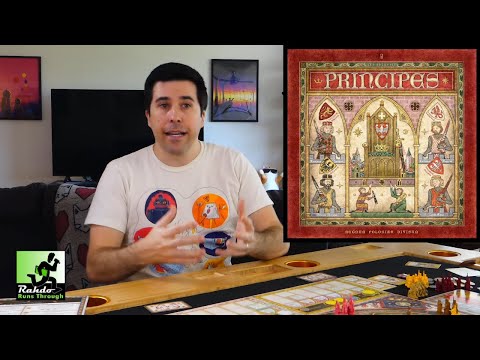

- Interesting and accessible action selection system
- Strategic depth
- Fast-paced gameplay once actions are programmed
- Engaging historical theme and political landscape
- Tense and unpredictable gameplay
- Publisher actively working on improving accessibility (e.g., colorblindness)
- Replayability due to different princes, events, and player interactions
- Action selection can be slow and lead to analysis paralysis for some players
- Color contrast on the prototype could be improved (though publisher is aware)
- Princes trying to unite a divided kingdom under their rule
- 13th century Poland
Mechanics (from transcript analysis)
- action selection — Players choose three actions from six available action discs each round. Actions are revealed and taken one at a time.
- Area Control — Players vie for control of territories on the board, which grants benefits like 'might' and influences track advancement.
- Combat — Battles are resolved by rolling dice, with modifiers from unit types and potentially cards, affecting units and potentially territory control.
- event cards — Historical event cards are revealed each round, introducing effects that impact gameplay for that round.
- Neighbor Interaction — Players can influence or attack neighboring principalities, and neighbor cards can disrupt plans.
- Programming — Players program their actions at the start of the round, which can lead to simultaneous thinking and faster turns once actions are revealed.
- Set Collection — Collecting specific progress tiles is mentioned as a way to augment actions and gain advantages.
- Track Advancement — Players advance on tracks representing the people, church, and military might to achieve victory conditions.
Video topics + discussion points
Quotes (from this video)
- I really, really like what they've done here, making this a very accessible war game.
- You're never safe in this game. You can always be attacked by your neighbors.
- It's this kind of slow movement, but then it ramps up and then slows down and then it ramps up.
- I think this is an accessible war game with a lot of deep strategy that I think people can get really into.
- It's got a really cool setting.
References (from this video)
- Rich multi-layered strategy combining area control, political intrigue, and military combat.
- Multiple victory conditions including coronation, elimination, or late-game political maneuvering.
- Diverse action economy (progress tails, cards, and builds) creates deep tactical choices.
- Princess and neighbor mechanics add dynamic diplomacy and risk management across rounds.
- High complexity with a steep learning curve and lengthy setup.
- Numerous components (cards, tails, tracks) may be overwhelming for new players.
- Rule interactions can produce analysis paralysis in low-player-count games.
- Medieval political power, conquest, diplomacy, and religious authority in a stylized Polish setting.
- A closed-circle map of a divided Polish kingdom with four districts plus a central neutral core; players vie for control and influence through political action, military activity, and religious legitimacy.
- Historical-fantasy with documentary-like structure (princes, princesses, nobles) and narrative-driven round events via history cards.
Mechanics (from transcript analysis)
- Action Drafting — Each round, players secretly select three action tokens and place them on dedicated spaces; after everyone has planned, tokens are revealed left-to-right, and actions are executed in order.
- Action token drafting and reveal — Each round, players secretly select three action tokens and place them on dedicated spaces; after everyone has planned, tokens are revealed left-to-right, and actions are executed in order.
- area/territory control — Players place and move units on a map divided into four districts plus edge-neighborhood areas and neutral central lands, gaining control through military actions and by eliminating opponents' princes.
- Buildings and cities as resource/power levers — Build actions upgrade strongholds to cities or place buildings such as abbeys or castles; upgrades provide defense benefits and impact tax and church tracks, with limits on space per land.
- Card-driven event and action economy — A mix of history cards, court cards, neighbor cards, and prince cards shapes the event flow, diplomacy, military actions, and resource acquisition; cards can be played for immediate effects, ongoing benefits, or traded for gold.
- Combat resolution using symbol-based dice — Battles are resolved by counting sword symbols on attacking units and shield symbols on defending units, with shields canceling swords; knights (horses) carry two sword symbols and have higher life; subsequent steps may include battle cards and post-battle promotions.
- Combat: Dice — Battles are resolved by counting sword symbols on attacking units and shield symbols on defending units, with shields canceling swords; knights (horses) carry two sword symbols and have higher life; subsequent steps may include battle cards and post-battle promotions.
- Engine Building — Build actions upgrade strongholds to cities or place buildings such as abbeys or castles; upgrades provide defense benefits and impact tax and church tracks, with limits on space per land.
- Neighbor actions and diplomacy — Neighbor cards allow players to move or coordinate attacks with neighboring factions; diplomacy can block or enable multi-front battles and strategic repositioning.
- Princess missions and token economy — Each period assigns a princess mini token to a player who can activate special actions or deliver missions; sending the princess to a neighbor or to a capital affects future rounds by granting cards or forcing discards.
- Progress tails and market/upgrades — A market of progress tails (technology and culture upgrades) is used to upgrade actions across districts; tails come in colors and types, some providing ongoing action upgrades while others grant passive benefits such as hand-size increases.
- Rule-based variations and endgame variants — Two variants exist: a passive variant where non-playing districts are defensing, and an active variant where non-playing districts can be used for free actions but may trigger additional battles; optional variant allowing continued play after last prince is eliminated.
- Time track and coronation victory condition — A global time track advances each round; players try to reach the crown across three tracks (power, public support, church support); coronation by prince if all tracks reach the end, or other victory conditions trigger if players are eliminated.
Video topics + discussion points
Quotes (from this video)
- The coronation can only be carried out during a convention and this is organized as a political action.
- The Principus board game starts with the player in church of Polonia Minor.
- During setup, note that preparation of the deck of his story card looks a little different from other cards.
- In this board game, there are various effects like urbanization or invasion by enemy factions.
- The princess acts as special agent who at the beginning of each period after the order of the players is determined are sent on a mission.
- You can summon two types of units, knights on horses and foot soldiers.