/pic8361340.jpg)

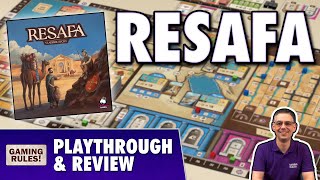
The game Resafa takes place during the 3rd century AD in the area of today's Middle East. Resafa now lies in ruins in modern-day Syria, but at this time it was a fortified desert outpost that flourished as a stop along important caravan routes.
In the game, players represent merchants who travel on business trips and buy and sell goods in the various cities in the region. Resafa had no local sources of water, so it depended heavily on large cisterns to collect the spring and winter rainwater to make the area habitable. Players build water tanks and canals to distribute that water where it is needed. In the cities, they build workshops to help their businesses grow, which will allow them to collect resources and camels. They also construct gardens between the businesses, generating more resources and also victory points.
The game is played over six rounds. In each round, a player takes only three actions, playing action cards in this tight and exciting game.
—description from the publisher
This page includes videos and mentions from the whole Resafa family. Drill into a specific game below.
/pic8361340.jpg)


- Amazing game
- A thing of beauty
- Innovative
- Went very smoothly once the mechanics were understood
- Intense at the start to get your head around the mechanics
- Time looping
- Azul
- In Asia
Mechanics (from transcript analysis)
- Card drafting/matching — Players play matching sets of cards to place a piece and then get more cards back that have to not match what they've just played, creating a cycle of colors.
- Grid Building — Building shapes of tiles on a grid.
- Set Collection — Playing matching sets of cards.
- Tile Placement — Players place pieces on a grid.
- time loop — Features a time looping mechanic.
Video topics + discussion points
Quotes (from this video)
- what a day it's been
- we went from light scatter to the heaviest game we played all day
- it's a thing of beauty
- it's quite Innovative quite Innovative everything you hoped for
- We played it and then I immediately buy.
- it really really good immediately accessible immediately really really fun
- oh my God we like it's now my mission to sit down and play that before this weekend it looks freaking incredible
References (from this video)
- Coolest player board
- High variability due to modules
- Modular design allows customization of gameplay
- Interesting core puzzle of pattern building
- Offers a campaign mode
- Good prototype production
- Can feel too luck-based for some
- Might feel too chaotic with four players
- Certain patterns can be very hard to complete
- Some players might find the luck factor off-putting
- going back in time to fix something to stop the world from existing
- time travel
- Yatsi
Mechanics (from transcript analysis)
- action selection — Players choose actions by moving their adult figure on the board and placing cards.
- Card Drafting — Players play cards from their hand onto spaces, and there are also cards on display that can be taken.
- Dice Rolling — One module uses dice rolling, likened to 'a Yatsi Yatsi kind of thing'.
- Modular — The game has four main modules and smaller ones that can be added, allowing players to customize the strategic, luck-based, or complex aspects of the game.
- Pattern Building — The core system involves placing cards to match symbols and colors on a player board to score points.
- Set Collection — One module involves collecting X and Y chromosomes for set collection or streaks.
- Variable player powers — Different character cards have different abilities that can be placed in the player board.
Video topics + discussion points
Quotes (from this video)
- victory points will save the world
- it's one of the coolest player boards I've ever seen
- this might be the coolest card holder in a like like integrated into a game I have seen
- the variability is pretty high
- the core system of this game is this puzzle here because this is all about pattern building
- if you know us we usually don't like luck in games and the more heavy the game is the Le less we like luck if you're like us you might feel like this is going to be a too much luck based game because there are some layers of luck there is also mitigation in many ways
References (from this video)

- Amazing
- Great game
- Unique artifacts
- Interesting combos
- Solid
- Can feel like there's nothing you can do once someone gets too far ahead
- Could use more pictures in the rulebook/marketing
Mechanics (from transcript analysis)
- Making broken combos — Basically about making broken combos
- Multi-Use Cards — The bottom half of the card can be used, tucking under the tableau for a permanent ability.
- Tableau Building — You basically are you're making these artifacts and you're putting them in Tableau that you're just their they're sort of like a program
Video topics + discussion points
Quotes (from this video)
- nice I played the expansion of after the Empire with a guy who it's his favorite game ever so that was that was a lot of fun
- The implementation of the 'revealing thing' for the keys is frustrating and annoying.
- The way to feed the key in is face up, but it should be face down.
- everybody's just a jackass I mean you're basically just giving away all the food that we set aside for you
- BGCon competes with the vendors because it's a good convention in my opinion
- The older I get the more my calendar fills with funerals
- You know that guy was making crystal meth by the way this is sort of like on the politics Spectrum
- he survived the shooter was sentenced to 36 years in prison the man appeared seemingly out of nowhere and stood in front of our van and pulled out a gun aiming it right at us I yelled duck as The Gunshot rang out the guy shot he didn't even like oh that's c a lunatic
- it's a buying crowd nobody plays games it's just a buying crowd
References (from this video)

- Really cool player board
- Interesting gameplay mechanics
- High replayability suggested by the complexity
- Passing laws part can be confusing
Mechanics (from transcript analysis)
- Engine Building — The game is described as an engine building game.
- Law Making/Voting — A significant part of the game involves creating or passing laws.
- Pattern Building — Players create patterns with cards on their player board and the main board.
Video topics + discussion points
Quotes (from this video)
- Baghdad crafting the cosmos from Office dog is my next game on my most anticipated games list
- you are an Interstellar architect competing to build the Galaxy one star at a time
- manipulate the laws of the universe to your advantage shifting gravity or the flow of time to activate useful Power Cards and even spawn Advanced life that can earn you extra victory points at the end of the game
- use your resources wisely as you craft your Cosmic creation
- the last one on my list is propolis from Flatout games
- I'm really excited about this because of what it says the game's all about worker placement engine building area control and Tableau building woo it's getting me excited
- my one concern is it says it plays in 15 to 30 minutes with all those different gameplay mechanics I'm concerned is the game going to play too fast for my taste
- they usually put out really really good games I mean they put out Cascadia they put out Calico Point salad um love love those games
- this game you are taking on the role of competing medieval be colonies and taking turns to deploy your worker bees to collect pollen fortify their positions and construct your hives to appease your queen and become the most glorious in the land
- theme's kind of cute um but the gameplay could be amazing um I hope it's amazing as my number one on my most anticipated list here
References (from this video)

- Unique and ambitious design with a 3D pop-up board.
- Interesting theme of time travel and saving humanity.
- Engaging engine-building mechanics.
- Described as ambitious, implying potential complexity.
- Saving humanity from a dystopian future
- Time travel
- Time travel with elements of self-interaction across different ages.
Mechanics (from transcript analysis)
- Engine Building — Players gather resources to build up their capabilities.
- Pattern Building — Players aim to complete specific chain patterns on the board.
- Resource gathering — Players collect resources throughout the game.
- Time travel — The game involves moving through and interacting with different points in time.
Video topics + discussion points
Quotes (from this video)
- Truly, I I do believe I'm in a fever dream and I will wake up because it it's so cool.
- I've just wanted to create something that had all the good pieces and none of the bad.
- This is what really stood out to me, Becca, is this part right here, the dice uh, manipulation.
- I love this stop motion rules explainer.
- Stop motion is so undervalued these days in these days of horrible AI.
- Basically, she had a bunch of components laying around and decided I'm going to make a game in the next like hour or so and just threw it together and this became a game.
- It's an ambitious design uh from um excuse me, from uh Totem Game Studios.
- Everybody loves cute critters doing war.
- Game of Thrones but animals.
- Today I learned you could type in naughty words in hardback.
- Fat with a ph is a word. Pretty hot and sexy.
- Penny Dreadful is the AI here.
- Even though I tricked Becca into playing a cooperative game, you got to see how hardback is played, just like paperback, but with those genre cards.
References (from this video)
- The game can be played in approximately 90 minutes once familiar with the rules.
- Features four different modules that offer varied gameplay.
- Modular design allows for different play experiences.
- Core mechanism of completing missions is central to gameplay.
- Strategic use of adrenaline crystals for temporary boosts.
- Interesting objective system that encourages player interaction and competition.
- New players might find the initial turns overwhelming due to the number of options and rules.
- The game might feel 'clumpy' at times with card draws.
- Potential for players to misplay or misunderstand rules without direct guidance.
- Time travel nanotechnology is used to alter future events, but time travelers from different futures appear, each selfishly trying to save their own world, leading to conflict between parallel worlds.
- The not-so-distant future, after the world as we know it no longer exists due to destruction.
- The backstory describes a cataclysmic event and the subsequent development of experimental time travel nanotechnology, which creates chaos due to conflicting time travelers.
Mechanics (from transcript analysis)
- action selection — On their turn, a player chooses one of four fields (focus, perception, intelligence, memory) to activate, with the restriction of not choosing the same field as the previous turn.
- Card Play — Players play cards from their hand onto a 'space-time grid' or their player board to complete missions or gain abilities.
- End-game scoring — Points are awarded at the end of the game for completed missions, objectives, specific cards on the player board, buried cards, and adrenaline crystals.
- Hand Management — Players manage a hand of cards and a 'card holder' with limited space for missions.
- Resource Management — Players manage 'adrenaline crystals' (used for boosting actions and worth points) and 'time tokens' (required to complete missions).
- Set Collection — Players try to collect chromosome cards to form sets for scoring, such as sequences of numbers or sets of the same number.
- Variable player powers — Each player has a character with a special ability.
- Worker Placement — Players use miniatures (child and adult) to occupy spaces on the board to perform actions.
Video topics + discussion points
Quotes (from this video)
- What could possibly go wrong? Nanochips can easily connect to the human brain, allowing people to travel through time and alter future events. While this could have brought hope, it instead brought chaos.
- Players are trying to complete missions, which are cards that they've got. Don't know if you can see this cuz they're all off camera, but each player has one of these card holders, which when it sits on the table, the cards actually go in them.
- The adults also cannot go to a space where there is another adult cuz they don't get on, and they'll just end up fighting each other, I guess.
- So, whenever you complete a mission, you do not automatically get to play a new one. The way that you get new missions in this game is all dependent on which dystopia you're playing.
- The adrenaline crystals will only last until the end of your turn. So, you are literally having to make a decision about whether you want to lose those points, spend the adrenaline in order to temporarily boost the action.
- The only time you lose points for missions is when your holder is full and you take an extra card and that's when you're forced to discard one of them and it's worth negative points.
- And as soon as we're down to three cards here, game ends immediately.
- I was thinking you might because these if these two are about to do amazing stuff. But, I can do some You might be So, I move my red up there. So, you're choosing the B plan.
- The only mandatory action in the game. Everything else you do is optional, but taking a new mission is mandatory.
- The adrenaline crystals disappear at the end of your turn. So, you are literally having to make a decision about whether you want to lose those points, spend the adrenaline in order to temporarily boost the action.
- The problem is I don't want them to come out of the board.
- The adrenalines disappear at the end of your turn. So, you are literally having to make a decision about whether you want to lose those points, spend the adrenaline in order to temporarily boost the action.
References (from this video)
- Modular game with different elements and challenges.
- Blue fragments are described as helpful.
- The game can be 'painful' in a way that suggests depth and engagement.
- The track progression offers points at the end of the game.
- Deep burying cards adds strategic depth.
- The end game scoring offers multiple avenues for points (crystals, objectives, tracks, buried events).
- Completing some missions can be costly in terms of time tokens or other resources.
- Miscalculations can lead to suboptimal plays.
- Traveling through time and affecting the passages of time across three ages.
- Pandemia
Mechanics (from transcript analysis)
- action selection — Players take turns placing action discs to perform actions, with the round ending when a certain number of mission cards are in play.
- Area Movement — Player figures move around the board to different spots.
- Card Play — Players play cards to spots on the board to power up actions, accomplish objectives, or gain resources.
- Dice Rolling — Dice are rolled to advance on tracks, with options to re-roll dice based on collected resources.
- Hand Management — Players manage a hand of cards, with a hand limit of three cards mentioned.
- Push Your Luck — Players decide whether to reroll dice, potentially improving their outcome but also risking a worse result.
- Set Collection — Players aim to achieve specific configurations of events on the board to accomplish mission cards.
- Worker Placement — Players place their 'child' and 'adult' figures on the board to take actions.
Video topics + discussion points
Quotes (from this video)
- And in this game we are traveling through time.
- The vast majority of points we're going to get are going to come from accomplishing these mission cards.
- I'm already panicking.
- This is expensive.
- It is expensive. I think blue fragments early on are so helpful.
- You have to do everything. Yes. Everything in this game. It's really painful.
- I think I might have to wait. Do you have voids? I might have to wait.
- The fact that you get a second roll every time is pretty strong.
- We're going to go for B. I guess. We're going to go for B.
- I'm going to go up the B track. Oh, I meant to pay a crystal before I do that. I'm going to move B track and once again lock that.
- I got a circle thingy. Check. Circle thingy. I will head over here. Circle thingy circle thing for me. I'm so bad at that.
- I want to do that. I want to do that. But can I afford to if I do that? I can do that and that, but that doesn't help me.
- It's a more complicated way of saying no, but no.
- We're going to go for B. I guess.
- The question is if we're going to I'm not going to be able to get any more blue tokens in theory.
- My turn? Your turn. I'm going to go over here and I'm going to take one time as well as one card.
- My turn. My turn. I'm going to go here. I'm going to take two times. I will get a card.
- You can't share spot with your own.
- And then I'm going to play this card which is going to be along with three void fragments to get the wild sand.
- I think I'm going to spend two here and three here. What are you doing? You're ramping up those shots.
- You get 10, so you're going to go up your green. So 1 2 3 4 5 6 7 8 9 10. Game end is triggered.
- I have fragment crystals that reach or pass the plan B action on the time action. Oh, nice.
- It's a waste of a movement. I would rather do that one instead of that yellow.
- What if I like maybe don't want to play? Then you cannot play a card.
- I'm going to discard this card. I don't care which one I'm discarding. Here.
References (from this video)

- Enjoyed the gameplay
- More modules provide variety
- Runs a little longer than expected
- The arc of gameplay progression could be smoother
- The game could have ended a quarter earlier
- time travel
- Thematically going back in time to kind of change events, so you're trying to constantly restructure based on your objectives.
Mechanics (from transcript analysis)
- Card manipulation — Players manipulate a board of cards to achieve objectives.
- Modular Board — The game features a modular system.
- Time travel — The game is a time travel game where players go back in time to change events.
Video topics + discussion points
Quotes (from this video)
- Rebuilding Seattle is excellent. I love it. It's probably a 4.5 for me. I think it's amazing.
- Rebuilding Chicago over here, I am excited to play. It looks mostly the same, with some small differences.
- CMON, you make it so hard to defend you. You make it so hard to like you. You make it so hard.
- The Line Must Go Up or The Line Goes Up. It's a 2-hour video documentary on the nature of of of more NFTs, but it touches upon the general idea of cryptocurrencies across the board.
References (from this video)

- Interesting visual design.
- Upgrading player abilities is appealing.
- Variety of scenarios offers replayability.
- The 'ocean rise' theme is particularly intriguing.
- Potential for a 'plug and play' system.
- The time travel theme was not strongly felt from the description.
- Columns of cards felt abstracted.
- Time Travel
- Anachrony
- Age of Rome
- Pandemic
Mechanics (from transcript analysis)
- Card Columns — The game features columns of cards representing different time periods.
- Player Progression — Upgrading player abilities is a noted mechanic.
- scenarios — The game includes different scenarios, with one recommended to start with.
- Time travel — The theme involves time travel.
Video topics + discussion points
Quotes (from this video)
- this is a lot more game going on than River Valley Glassworks.
- It definitely felt more complex.
- instead of Venn diagram, it's flowcharts.
- tremendously well-done set of streamlining for a lot of Zombicide things that have come out before.
- the mechanism of the water where the pirates when they go I'm sorry the zombies when they go into the water how you can't target them cuz they sink to the bottom and they're like crawling towards you.
- That theme is very, very popular. I mean, like it is incredibly strong that IP.
- My fear, I'll tell you this honestly, I don't know. ... Because they might explode.
- homeschooling extraordinaire kind of thing, you know, teach music, use it as a toy, use it as a learning instrument.
- There's one update in this project and it's to plug a different thing they're running. ... A tarot deck from Vivid. That's the only update.
- advertised by a lady wearing what looks like a giant diaper.
- They will 100% I mean, again, we know this for a fact. They will not let you put a piece of luggage with a battery on the plane.
- It's just a really fun game for me, so it is my pick of the week, Things on Strings.
- This one right here is great. It's done a lot of things. I think first of all, they got rid of the noise, which I think is great.
- this is the Zombicide that will replace all the others for me. Like I really, really enjoyed it.
References (from this video)
- Enjoyed it more than expected.
- Liked the action selection with choices.
- Liked the card upgrades that allow for different plays.
- Enjoyed the dynamic market and tile flipping.
- Liked the network building and water flow mechanics.
- Tight gameplay where not all tracks can be maxed out.
- The complexity, while high, is manageable once understood.
- Felt like there was just enough to do without feeling overwhelming.
- The action selection system and card play were appreciated.
- The game offers good player interaction through actions and potential blocking.
- High overhead for teaching the game.
- The theme feels like a jumble of things; actions aren't strongly tied to the theme.
- The rulebook could benefit from more thematic explanation beyond single sentences.
- Canal building and trading in a historical setting.
- Underwater Cities
- Praga Caput Regni
- League of Six
Mechanics (from transcript analysis)
- Action Card Play — Players play action cards each turn to perform actions, with each card offering two actions, one top and one bottom.
- Market manipulation — The trading tiles flip over, creating a dynamic market for buying and selling goods.
- Resource conversion — Resources can be converted into other resources or used for various actions.
- Set Collection — Collecting sets of cards or resources is a component of the game's scoring.
- Tile Placement — Players place garden and canal tiles on the board, connecting them to activate bonuses and score points.
- Track Advancement — Players move markers along colored tracks to gain benefits or cards.
Video topics + discussion points
Quotes (from this video)
- It is all about trading and all about water courses.
- This felt like okay and there was a huge amount of points at the end. Once you get the water flowing and maybe it's designed that you have a big rush at the end.
- The action selection system for a start, I like the way that you've got every action twice because it kind of forces you to do other things.
- My only hesitation of the game is that there might be a little bit too much in terms of each area works in a different way.
- My entire plan was because that card was there. So, I thought, right, I'm going to grab that card and I'm going to build loads of them.
References (from this video)
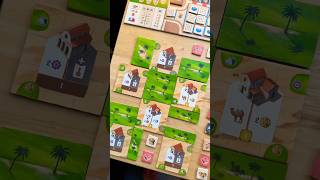
- Garden construction mechanism
- Canal construction puzzle
- Establishing businesses as merchants
- 3rd century AD in the area of today's Middle East
Mechanics (from transcript analysis)
- action selection — Players choose one of two actions from six different cards.
- Area Control — Building trading bases in trading center locations.
- Card Drafting — New cards are drawn after actions in some rounds, but not in even rounds, requiring careful planning.
- Resource Management — Managing goods, resources, camels, and water.
- Set Collection — Special cards on color tracks increase in scoring power and effect as they are progressively unlocked.
- Tile Placement — Garden tiles are placed in a checkerboard fashion.
Video topics + discussion points
Quotes (from this video)
- I really love the garden construction mechanism where you place your tiles in a checkerboard fashion and connect them together with little garden strips.
- The canal construction puzzle is also mighty fine, and I love it.
References (from this video)
- High theme engagement
- Strong player interaction
- Clever card design with multiple uses
- Interesting engine building through permanent crystals
- Tight action selection mechanism preventing repetition
- Modular expansions add replayability
- Asymmetrical player characters
- Mechanics are well-woven together
- Game end can feel abrupt and unfair due to turn order
- Lack of equal turns for all players when the game ends
- Can feel frustrating if consistently one or two steps away from completing objectives
- saving their world by traveling through parallel dimensions
- navigating the past, present, and future as a time traveler
Mechanics (from transcript analysis)
- action selection — Players place a marker on one of four action spaces, and cannot choose the same space twice in a row.
- Area Movement — Player figures (adult and child) move around different board spaces representing time periods.
- Card Drafting — Players can draw face-down cards or choose from face-up cards available.
- Dice Rolling — Used in some actions to determine outcomes or progress on tracks.
- Engine Building — Players upgrade areas of expertise or gain permanent bonuses to improve their turns.
- Hand Management — Players manage a hand of cards, deciding which to play for actions or to fulfill objectives.
- Modular Board — Different 'plans' or modules can be added to the core game, changing gameplay.
- Resource Management — Managing 'time', 'adrenaline crystals', and 'void tokens'.
- Set Collection — Players aim to collect sets of cards with specific colors and patterns to complete mission cards.
- Variable player powers — Each character has unique abilities that affect gameplay.
- Worker Placement — Action markers are placed on action spaces.
Video topics + discussion points
Quotes (from this video)
- The problem I have is that the game has an ending out of turn order.
- I feel really raw. I feel like I'm kind of robbed of my turn, especially if I'm not getting my turn.
- And so, for me, that just kind of rubs me the wrong way.
References (from this video)

- mind-bending mechanics
- clear path to score via tableau patterns
- modular scenarios increase replayability
- complex at first glance
- risky rule-heavy setup for new players
- time travel and world-changing events
- Time-manipulation tableau with past/present/future
- scenario-driven, multi-timeline
Mechanics (from transcript analysis)
- card management — cards provide multiple effects; players choose how to use them
- Events — events modify the timeline to impact scoring
- Multi-Use Cards — cards provide multiple effects; players choose how to use them
- scenario-based board variation — each scenario changes the goals and board setup
- Tableau Building — players build and manipulate a tableau to activate events
- tableau-building — players build and manipulate a tableau to activate events
- timed events across past/present/future — events modify the timeline to impact scoring
- Variable Set-Up: Board — each scenario changes the goals and board setup
Video topics + discussion points
Quotes (from this video)
- mind-bending
- it's visually stunning and ambitious
- the scale of this game is huge
- Indiana Jones head
References (from this video)
Mechanics (from transcript analysis)
Video topics + discussion points
Quotes (from this video)
- This is a trick digging game. It's called Bidcoin.
- There is a very limited amount of money in the trough and the first piggy to snuffle it all up basically just gets it.
- This is a game that doesn’t feel like it’s trying to be something it’s not.
- The world is a loosey goosey experience.
References (from this video)
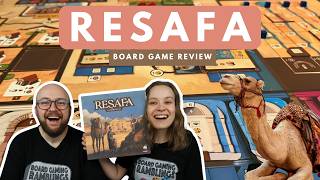
- Tight, card-driven engine with strong interlocking systems that reward planning and adaptation
- Clear and well-structured rulebook; components feel Euro-like and approachable
- The six-card system with color actions creates meaningful choices and minimizes downtime
- Balanced path options: produce, build, garden, canal, and color actions offer varied strategies
- Good to excellent two- to four-player dynamic; four players increase tension on competition for scarce resources
- Canal action is less accessible in two-player games; dynamics favor more players for maximum interaction
- Some variability is limited; most games feel similar in core puzzle unless cards shift significantly
- Endgame scoring cards can be heavy and may swing strongly if a player stacks certain bonuses
- Not the tightest or most thematic V. Sui title among his catalog; weight sits in the mid-to-heavy range
- Trade, resource management, and infrastructural growth in a desert setting
- Desert trade routes with a focus on caravan travel, canal building, and oasis development
- Engine-building euro with thematic flavor kept minimal; emphasis on systems rather than story
- Cura
Mechanics (from transcript analysis)
- Camel resource tracks — Camels act as a capacity tracker for resources; players allocate resources to camels and manage transport to maximize scoring potential.
- Card balance and hand size — Each player holds only three cards at a time, reducing decision time and forcing deliberate prioritization of actions.
- Card-driven action system (up/down actions on six shared player cards) — Players play one of six cards each turn to trigger a specific action and a color action; color actions advance tracks, grant scoring cards, or provide other abilities, with a mix of immediate and long-term benefits.
- Color action tracks — Three color tracks determine access to bonuses, cards, and abilities; progression on tracks unlocks new options and scoring potential.
- End-game scoring layers — Final scoring incorporates multiple components: Scarab tiles, garden/workshop/Canal interactions, card-based bonuses, and remaining resources.
- Garden connections and canal building — Gardens connect to provide ongoing bonuses; canals cost bricks and coins and yield points both during play and in end-game scoring, with water mechanics affecting scoring around rounds.
- Hand Management — Each player holds only three cards at a time, reducing decision time and forcing deliberate prioritization of actions.
- Open draft of bonus cards — At the start of each round three bonus cards are laid out for players to choose from, providing temporary boosts or engine-building opportunities.
- Production action — Produce by selecting two of your workshops; the selected cards yield resources, conversions, or other benefits based on the workshop text.
- Sack card mechanic — A small bonus card option that can be taken when no other immediate need is pressing; acts as a flexible, lesser-granting option.
- Tableau Building — Players build workshops and gardens on a personal tableau; workshops enable production and resource generation, gardens provide end-game scoring opportunities and bonuses linked to connected gardens.
- Tableau construction (workshops and gardens) — Players build workshops and gardens on a personal tableau; workshops enable production and resource generation, gardens provide end-game scoring opportunities and bonuses linked to connected gardens.
- Track Advancement — Three color tracks determine access to bonuses, cards, and abilities; progression on tracks unlocks new options and scoring potential.
- Trading/Market action — Move around the board to build trading posts and buy/sell resources, creating a flowing economy and end-game scoring opportunities tied to market activity.
- Variable card availability and semi-uncertainty — Not all level-3 cards are present in every game; players may reveal or look through top cards to gauge options, adding a memory/variance element.
Video topics + discussion points
Quotes (from this video)
- it's not a thematic game but we don't care about themes so it's it's fine
- the color actions feel powerful
- this is a medium heavy game
- the core puzzle is what's going to make you come back to the game to try to optimize that
- I give this an eight
References (from this video)
- Strong thematic integration across time travel, pandemic, and politics
- Innovative mix of pattern-building with card-driven timeline changes
- Striking, brain-inspired components and cute lab aesthetics
- Ambitious design that pushes the boundaries of genre
- Promising player interaction with meaningful choices each turn
- Clear enthusiasm from creators and early supporters
- Potentially steep learning curve for new players
- Multiple timelines and scenarios could impact game balance and pacing
- Kickstarter risk: production scaling and fulfilment timelines
- Component complexity may affect setup time and accessibility
- Time travel, saving the future, personal ambition
- Dystopian future with time travel and a pandemic
- Modular, scenario-driven timelines; layered brain metaphor
- AG of R
- Game Boy
Mechanics (from transcript analysis)
- card-driven timeline manipulation — Event cards inserted into timelines to alter future outcomes.
- Events — Event cards inserted into timelines to alter future outcomes.
- Modular Board — Flip and reconfigure boards to represent different timelines and crises.
- Pattern Building — Players create patterns from cards to trigger actions and chain effects.
- personal boards with brain metaphor — Unique pieces representing conscious and subconscious processes on each player board.
- Player Board | Main Board — Unique pieces representing conscious and subconscious processes on each player board.
- political influence and governance — Players influence Senators and vote on laws to steer outcomes.
- scenario-based modular boards — Flip and reconfigure boards to represent different timelines and crises.
Video topics + discussion points
Quotes (from this video)
- it's a time travel theme game
- Time Travelers traveling back from a dystopian future
- it's fabulous
- the combinations of like pattern building and card combos
- it's something unique
- Innovative stuff
- we like to bring something new to the table
- phenomenally ambitious
- a totally unique concept
References (from this video)

- Visually appealing prototype and look
- Proactive engagement with the publisher for revamp
- Kickstarter did not complete initially; process delayed
- Restart (pre-reprint version)
Mechanics (from transcript analysis)
Video topics + discussion points
Quotes (from this video)
- I'm a huge fan of Viking themed games.
- the sweet spot is probably three or four players
- the Kickstarter did not complete
- I like the company
- the draw was the designer. Emerson Matsuchi is a great designer
- you can play it cooperatively with up to four people
- as soon as I do, I'll pick it up
References (from this video)

Mechanics (from transcript analysis)
Video topics + discussion points
Quotes (from this video)
- Django and Bruge are the two games Rasafa reminded me of; it captures that card-driven action feel and multi-part engine without being a direct clone.
- In this game you focus on one major thing and the other one is additional, a familiar pattern in strategy design, but Rasafa does it with a fresh twist.
- I really enjoy the card play here; the dual-sided cards give you meaningful choice and a sense of building an engine rather than executing a single action.
- The canal interactions and water scoring create a thematic and mechanistic hook that stands out from many Euro-style games.
- It's point salad with layers: canals, trading, gardens, and card-driven upgrades all contribute to a dense endgame feel.
- The back-and-forth of trading on different sides and higher-level planning is genuinely thematic and satisfying.
References (from this video)
- Rich, multi-layered action selection built around a clever dual-sided card mechanic that creates meaningful trade-offs each turn
- Strong thematic integration of canal-based water management, trade routes, and city-building that feels coherent and flavorful
- Engaging engine-building through workshops, gardens, and canal networks with clear progression and payoff
- Significant endgame depth via objective cards and bonuses that reward planning and specialization
- Two-player scaling can feel relatively independent, which reduces interaction compared to higher-player-count games; snatching for cards and canal spots can vary by player order
- Rule complexity and component management may impose a learning curve and slow the first game
- The pacing is deliberate rather than flashy; players who crave rapid chain combos may find the tempo more restrained
- Trade, exchange, and city-building through resource flows, canal networks, and merchant strategy
- The trading city of Rafa in the 3rd century, a bustling nexus for caravan traders and maritime commerce
- Eurogame-forward narrative: minimal storytelling, maximal mechanic fidelity; theme expressed through verbs like trade, upgrade, canalize, and profit
- Django
- Bruge
Mechanics (from transcript analysis)
- Canal placement and scoring — Canals are placed on a modular map to connect water routes. Water triggers scoring at the end of each round, and players can steer the water flow to optimize their own routes while potentially bypassing others. The canal system adds a spatial puzzle element and a competitive edge: while everyone can place canals, controlling the water yields the best dividends, creating a subtle tug-of-war around the riverine network.
- Card-driven action selection (dual-sided cards) — Each turn you draw into a hand of three cards from a six-card deck; every active card has two sides, and you choose one side to activate, granting both a color action and a main action. The sides offer complementary or divergent effects, forcing players to balance immediate gains with longer-term engine growth. This design emphasizes choice under constraint and creates a high-variance, high-reward decision space that rewards pattern recognition across rounds.
- Color tracks and upgrades — Color actions move a marker along distinct tracks. Advancing on a track unlocks upgrades to your action cards, allowing more powerful or flexible plays later. The color tracks function as a pacing mechanism: you invest early to tilt your engine, then reap the rewards as upgrades cascade across rounds. The choice of which color to advance interacts with which main actions you plan to execute, creating a web of strategic timing.
- Endgame scoring objectives and bonus cards — Endgame scoring is driven by a rotating set of objectives and bonus cards drawn every few steps. Some bonuses are immediate, some are ongoing, and others are situational. This mechanic ensures that late-game decisions, timing, and micro-optimizations can swing the final tallies, rewarding players who balance engine-building with timely objective completion.
- Gardens and checkerboard placement — Gardens come in 2/3 and 1/3 sizes and must be placed on a checkerboard pattern. Completing gardens yields recurring benefits and end-of-game bonuses. The 2/3 vs 1/3 sizing introduces tactical choices about how aggressively you invest into garden infrastructure and which half of the board you occupy. The triggering interactions from completed gardens compound points and recurring rewards, creating satisfying long-tail scoring loops.
- Resource trading and caravan management — The game centers on four non-coin resources (stone, marble, amphora, spice) and a camel-based caravan system. Players move their camels along color-coded tracks to access locations for buying or selling resources. The cash-and-cargo economy requires balancing inventory, transport costs, and timing, with the possibility of delivering high-value goods for substantial point rewards. The caravan mechanic ties movement, market access, and endgame scoring together.
- Trading posts and merchants — Trading posts provide merchants that populate your board and contribute to endgame scoring and objective fulfillment. They add another layer of scoring tension: you may chase merchant-based bonuses rather than pure resource or canal points, creating optional paths to victory.
- Workshop production and upgrading — Players build workshops (initially level 1, later level 2) and activate two of them per turn to produce resources or trigger benefits. Workshops are placed on a checkerboard board with orientation flexibility, enabling a progressive and spatially distributed engine. Upgrading to higher levels increases production capacity and unlocks additional activation options, encouraging deliberate build-order planning.
Video topics + discussion points
Quotes (from this video)
- Django and Bruge are the two games Rasafa reminded me of; it captures that card-driven action feel and multi-part engine without being a direct clone.
- In this game you focus on one major thing and the other one is additional, a familiar pattern in strategy design, but Rasafa does it with a fresh twist.
- I really enjoy the card play here; the dual-sided cards give you meaningful choice and a sense of building an engine rather than executing a single action.
- The canal interactions and water scoring create a thematic and mechanistic hook that stands out from many Euro-style games.
- It's point salad with layers: canals, trading, gardens, and card-driven upgrades all contribute to a dense endgame feel.
- The back-and-forth of trading on different sides and higher-level planning is genuinely thematic and satisfying.