Reviving Kathmandu is a bidding and set collection game for 1-6 players. In the game, players are builders who travel to Nepal. They’ll compete to earn the title of Most Respected Architect in Kathmandu.
Bid on construction materials (cards). Then collect those cards and use them to build the most prestigious Buddhas, Shrines, Stupas and Pagodas (“Monuments”). You’ll score points for your monuments, for achieving special objectives, and for paying special attention to color. The architect who achieves the most points will win the game.
HOW TO PLAY
The game is played over 8 rounds. Each round has 3 phases: Bid, Collect, and Build. Players work through these 3 phases, in this order. Each phase is explained in greater detail in the rulebook. But, generally, players will:
- BID: Starting with the first player and continuing clockwise, each player must place 1 coin of their choice face-down onto one of the bid spots on the playmat. Each bid spot targets 2 cards within the same row or column.
- COLLECT: Players flip their coins and determine who won each card. Determine the winner for each card using this order:
1. The only bidder
2. Highest bidder
3.If tied, the player whose coin is closest to the card
4. If still tied, the player whose coin is on the long edge of the card
Then each player collects 2 cards total to their hands — taking from the Market and/or the red deck.
- BUILD: Players use as many cards as they want from their hands to build Monuments. To add to a Monument, slide an appropriate card under the previous one, revealing the section that continues the Monument. Once a Monument has all its required sections, it is “complete.” Buddhas are considered complete immediately after they are built. When you complete a Monument, immediately score points for completing it
The game has 8 rounds. After every 4 rounds, each player will only have 1 coin left. When this happens, players either convert their last coin to points or buy 1 discarded card.
MISSIONS: Players may complete various objectives for bonus points. Each Mission contains 4 objectives—to complete a Buddha, a Shrine, a Stupa, and/or a Pagoda with sections matching the color(s) shown on the Mission.
GAME END:
- Discard all cards left in your hands and discard piles.
- Score points for the topmost card of any incomplete Monuments.
- Score color bonuses (if any) for your completed Monument.
WINNING: The player with the most points becomes the most well-respected architect, and therefore wins the game!
Reviving Kathmandu is the second game in the Lemery Games Globetrotter Game Series, after Chili Mafia.
—description from the publisher

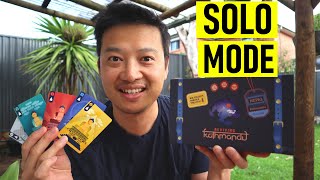
- Solo mode is challenging and fulfilling.
- Solo mode fits the theme of the game.
- Solo mode is easy to run and understand.
- Solo mode emulates the multiplayer experience.
- The cultural message is powerful and strong.
- Good for travel/holidays due to interactivity.
- Auctioning feels dynamic and engaging in solo.
- Solo mode is still in draft form (as of video recording).
- Rebuilding the city of Kathmandu after the 2015 earthquakes
- Kathmandu
Mechanics (from transcript analysis)
- auction/bidding — Players use bidding coins to acquire cards, and the solo mode features a randomized auction influenced by debris placement.
- Resource Management — Managing bidding coins and monument colors is crucial for completing objectives.
- Set Collection — The game is described as a set collection game where players aim to acquire specific card types and colors.
- solo mode — The video focuses on the solo mode, which involves controlling two player boards with specific objectives related to building monuments of different types and colors.
- Variable Player Powers (Implied) — Players control the purple player and manage other player coins, suggesting an asymmetrical or unique player role in the solo mode.
Video topics + discussion points
Quotes (from this video)
- The solo mode is actually quite a cool challenging experience.
- The layered depth of the solo puzzle is quite specific and so the decisions that you're going to make are going to be super important.
- I think the solo mode in Reviving Kathmandu is simple enough to grasp that you'll still get the same gratifying feeling as if you were playing the game at a multiplayer level.
- This game is probably also one that I would definitely take away on holidays uh just because it's so interactive the bidding is so loud yes it's so easy to get into and not to mention that the cultural message is so powerful and strong.
References (from this video)

- Strong cultural message and connection to the story of rebuilding Kathmandu.
- Simple yet elegant mechanics with depth and layered nuance.
- Satisfying bidding mechanism that accounts for different situations, so players are never truly punished for not winning an auction.
- Cool spatial puzzle of predicting opponents' bids and intentions.
- Well-suited for five to six player counts with medium strategy.
- Beautiful presentation.
- Refreshing design compared to games with overly complex rulebooks.
- No solo mode available.
- Certain cards (e.g., Buddha cards) were less popular, potentially creating blocking mechanisms and focusing bidding on other cards.
- Rebuilding Kathmandu after the 2015 earthquakes.
- Kathmandu
Mechanics (from transcript analysis)
- Area Control (implied) — Placing coins on the board around card columns creates competition and requires players to consider spatial puzzles and opponents' potential goals.
- bidding — Players place numbered coins (1-5) face down to bid for sets of cards needed to build structures. Bidding is in secret, and ties are broken by proximity to the card or edge length.
- Card Drafting — Players collect cards to build structures, with compensation cards drawn from a red deck if they miss out on bidding.
- secret bidding — Bidding occurs in secret, adding an element of deduction and prediction about other players' actions and needs.
- Set Collection — Players collect sets of Buddhas, shrines, stupas, and pagodas. Building structures is mainly comprised of the same color, but mixed colors can satisfy personal mission cards.
- Worker placement (implied) — Placing player coins on circular spaces on the main board acts like a 'hidden donation' to claim cards, with coins being used once per half of the game.
Video topics + discussion points
Quotes (from this video)
- When it comes to playing board games, I always appreciate a game design that has a strong cultural message.
- The game centers around using these player coins numbered from one to five, which players will use to make a bid for pairs of cards that players will need to use to build those buildings.
- So, if you don't win an auction, you're never really ever punished in the game, which is really good.
- Wow, what a beautiful board game. It's a game that I really had a strong connection with. It had me reflecting on my own cultural heritage and values, and the strong global message of interconnectedness really shines through in this game.