/pic5813147.jpg)
American West, Folio 1
Players represent a leader and crew of Mountain Men around 1825, with various skills and equipment. The crews venture into the Rocky Mountains, exploring new hexes and drawing their discoveries in crayon. A player needs to manage their crew in trapping, hunting, dangers, movement, exploration, encounters, and more. While the beaver pelt is prized, further money can be made in exploration, discoveries, and finding routes to the Great Salt Lake and mapping the Colorado River.
Rocky Mountain Man is played either solitaire or against another player. If 2 players, both will play in a kind of simultaneous solitaire fashion.
The game is played in turns, a turn comprising several phases. After a turn is conducted another begins, continuing until either the time limit is complete, the goal is achieved, or the Trading Post is built (if playing a campaign), or if all crews have been killed.
In a two-player game, each player goes as fast or as patiently as they prefer. Each player may be in a completely different part of a phase than another. One player may complete several more turns than another, depending on their speed.
The game can be played in timed sessions, by achievement of goals, or as a campaign.
Victory is based on the kind of play. In s two-player game Victory Points determine the win. In solitaire, achieving a goal will provide victory.
Rocky Mountain Man is based on the Source of the Nile (1978) game system. While there are many of the same game rules, some have been adjusted and others added. For players familiar with Source of the Nile, it is good to know the general pattern of that game, but do not assume a rule will be exactly the same.
-description from designer

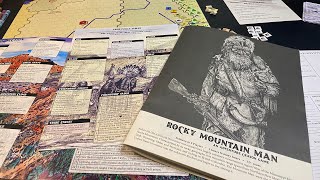
- Strong historical dedication and depiction of the frontier era
- Thoughtful treatment of Indigenous peoples through tribes' policy and history sections
- Campaign mode with seasonal arc and Rendezvous/trade mechanics
- Two-player solitaire mode with simultaneous play and timer for each season
- Multi-use cards and dynamic charts add depth
- DIY components (cut-out cards) and assembly required; not polished out of the box
- Board and chits can wear when moving; markers needed; not included; reliance on manual tools (transparency sheets)
- frontier exploration, trapping, trade with Indigenous peoples
- Rocky Mountains, Colorado/Utah region in the early 19th century American West
- Historical/educational with a campaign-driven exploration
- Lost Valley
Mechanics (from transcript analysis)
- Card multi-use and charts — Cards have multiple uses; referenced charts for hunting, crossing rivers, combat, etc.
- Danger and encounter cards — Drawing danger cards when moving into unexplored hexes; various hazards depending on terrain
- Discovery and victory points — Discoveries yield victory points when returning to town
- Encounters with Indigenous tribes — Approach, trade, or combat with tribes; friendship/war paths and policy decisions
- Hexagon Grid — Explore hex map; time-limited seasons; lost and exploration bonuses
- Hidden Victory Points — Discoveries yield victory points when returning to town
- Leadership and crew management — Leaders have skills; hiree; roles like soldiers, hunters, doctors, guides
- Map exploration and hex-grid — Explore hex map; time-limited seasons; lost and exploration bonuses
- Movement and terrain costs — Moving through explored vs unexplored hexes with varying movement points and danger checks
- Movement Points — Moving through explored vs unexplored hexes with varying movement points and danger checks
- Multi-Use Cards — Cards have multiple uses; referenced charts for hunting, crossing rivers, combat, etc.
- Resource Management — Rations, pelts, rifles, horses/mounts, to manage supply and movement
- Seasonal play and weather — Campaign unfolds over seasons; seasons have different effects; winter is harsh
- Trade Rendezvous and Outpost building — Annual Rendezvous to trade, hire, and prepare for an Outpost building to win
- Transportation and travel options — Canoes, river routes; movement by horse; weight tracking (optional in advanced rules)
Video topics + discussion points
Quotes (from this video)
- one of the cool things about this game one of the things I really enjoy is it its dedication to history
- I am playing in a Solo Manner and I am playing in the campaign mode
- this is just a portfolio game
- does remind me a lot of one of my favorite games um what is it Lost Valley