/pic8828234.jpg)

































Rumble Nation Deep Dive
What the Community Thinks About Rumble Nation
Reviewers keep landing on the same word for Rumble Nation: quick. Chairman of the Board calls it a game that offers "that next level of gameplay in the same amount of time" a heavier title would need, and All You Can Board describes setting it up expecting a bigger production only to find it plays "closer to being a filler game" with real decisions packed into a short runtime. Board Game Garden and its April wrap-up companion video both single out the watercolor castle on the box before ever getting to the rules, and the BoardGameGeek panel frames it as a light, easy-to-teach area control game that people keep enjoying once they can actually find a copy.
The disagreements are narrower but real. Chairman of the Board is unimpressed by the included dice, calling them "rather boring small cheap little dice" and recommending an upgrade for tactility, while All You Can Board singles out the dice as a highlight, saying they were "really impressed by the dice" and that "the dice are great." There is a similar split on how the second half of the game should feel. Stonemaier Games loves the overall design but flags that once the dice and cards are spent, "you don't actually do anything" while the battles resolve, whereas Chairman of the Board treats that same hands-off resolution as the game's biggest strength, arguing it removes the drawn-out, uncomfortable tension of typical area majority games.
Core Mechanics That Define Rumble Nation
Dice-Driven Area Control
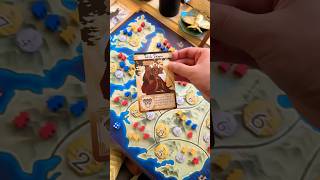
On a turn, players roll three dice and split them into a pair and a single die. The pair is added together to pick one of the numbered regions on the map, and the remaining die sets how many soldiers go in: a one or two places one soldier, a three or four places two, and a five or six places three, as both Board Game Garden and Drive Thru Games walk through in their explanations. Chairman of the Board adds that players get one re-roll if they are not happy with the split, which lets them redistribute before committing. Once every player has placed all of their soldiers, the regions resolve in order from the lowest number to the highest, and each region is worth victory points equal to its own number, so the later regions matter the most.
Tactic Cards and Cascading Reinforcements
Alongside the dice, a shared row of tactic cards sits on the table, one more than the number of players. Each card can only be used once per game, by whoever gets to it first, and Chairman of the Board points to that scarcity as a real strategic question: whether to grab a card immediately or hold out and hope it is still there later. All You Can Board highlights the same one-time-use design as one of the game's better touches, since a card someone else covets can simply become unavailable. Drive Thru Games explains the payoff for winning a region: the winner drops reinforcement units into every adjacent region that has not been resolved yet, which can chain from one battle into the next and change outcomes down the line. Game Night Picks - Pair Of Dice Paradise describes that spillover as having "a little tiny smidge of a pandemic flavor" to it.
The Rumble Nation Experience
A Fast, Filler-Sized War
The box lists thirty minutes, and reviewers generally treat that as accurate once the rules are known, though All You Can Board notes a first play with a mix of new and returning players ran closer to thirty five or forty minutes. Once people know it, All You Can Board expects it "could get this down to like twenty minutes" as a reliable go-to filler, a step down from the denser card-based fillers already on their shelf. Chairman of the Board frames the appeal the same way: a thirty minute game that does not force players to sacrifice depth or strategy to hit that runtime.
Approachable Conflict Without the Sting
Drive Thru Games recounts a group member who typically dislikes area control, and specifically dislikes "some guy moving in like one piece and taking everything away," warming to Rumble Nation because the dice mean players do not always have a choice about where to go, which takes the edge off the backstabbing feeling. Chairman of the Board makes a related point, arguing the game could win over players who are put off by long, tense area majority games, since the building phase and the resolution phase are cleanly separated rather than dragged out. All You Can Board adds that the simple, symbol-heavy rules make it approachable even for people who have not played anything like it since Risk.
What Makes Rumble Nation Stand Out
A Watercolor Castle on the Box
Board Game Garden first noticed the game in Japan purely from its cover, before knowing what it was, calling the foiled Japanese lettering, the watercolor sky, and the castle art "absolutely beautiful." In a separate video from the same channel, the reaction is the same: a game picked out for a favorite-covers list specifically for its "gorgeous painting-like cover" and watercolor look, alongside the note that it went on to be genuinely enjoyed at the table once played at Canada Plays.
A Cascading Twist on Area Majority
Chairman of the Board singles out the reinforcement cascade as the mechanical hook that sets the game apart, calling it "fascinating" and something not seen used before in another area control title, since winning one region can set off a chain reaction into the regions next to it. Drive Thru Games walks through the same chain in more detail, noting that winning one battle can push reinforcements into a second region, which can then push into a third, turning a single roll into a wider swing across the board.
Potential Drawbacks
A Passive Back Half
Stonemaier Games loves the game overall but is candid about its biggest reservation: once every player has finished placing soldiers, there is nothing left to decide. "There's no actions that you take in the second half of the game when the rumble actually happens," and the game effectively ends, in that reviewer's view, once the decisions stop and the battles simply play out.
Bare-Bones Dice and Availability Hurdles
Chairman of the Board's other reservation is the included dice, describing them as small and cheap for a game where dice rolling is central, and suggesting an upgrade set improves the tactility. Availability has been its own obstacle: the BoardGameGeek panel calls it hard to import and not readily available, describing tracking down an original copy and later a Kickstarter deluxe edition, and Drive Thru Games recounts playing an all-Japanese edition where the card text and rules had to be printed from an English PDF before a full English edition existed.
If You Enjoy Rumble Nation
The BoardGameGeek panel draws a direct line to Waddle, a lighter-themed area control game about penguins circling a watering hole that one panelist called "very similar to Rumble Nation," swapping soldiers and dice for penguins and movement but keeping the same fight-for-majority structure. All You Can Board reaches for Caesar's Empire more than once, describing the same surprise that a game which looks like it will be a bigger, heavier experience turns out to be "really snappy" in actual play. Drive Thru Games groups it with El Grande, Blood Rage, and Rising Sun as area control comparisons, adding that the reinforcement cascade in particular "feels a lot like Rising Sun."
What Reviewers Are Saying
"The only reason I felt a little weird picking up for this list is that you don't actually do anything. There's no actions that you take in the second half of the game when the rumble actually happens."
— Stonemaier Games
"I like the way the game looks. It's nice and clean, it's certainly not overdone, and it's nice and crisp, and you can clearly see what all the different regions are. I love how vibrant all the different colors of the color cubes are, you can clearly see who's who, even if you're color blind, very easy to differentiate."
— Chairman of the Board
"I've been really impressed by this, in the sense that when you set it up it feels like it's going to be more involved than it is, almost like in an Ethnos style. It feels like there's going to be more going on, but even more so, this is closer to being a filler game than it is to being an actual main event game."
— All You Can Board