






San Francisco Deep Dive
What the Community Thinks About San Francisco
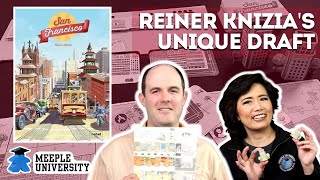
San Francisco is a two to four player city-planning game by Reiner Knizia, published by Rebel Studio, that reviewers played for roughly 45 to 60 minutes. Players act as rival urban planners who draft cards into three columns, build districts of five types, connect cable car networks, and raise skyscrapers. Reviewers agree on that pitch, and most of them agree the game is less about flashy spectacle than about careful, low-scoring planning. Meeple University is the most detailed voice, and Karen describes being drawn to games where points are hard to earn. The disagreement comes over pacing. The same review that praises the scoring warns that the game can end early and without much built, and that the draft rules take time to absorb. Meeple University with Taryn and Stella described it as a city and root-building game with contract mechanics, while Watch It Played reported the Rebel Studio announcement and a second-quarter release window.
Core Mechanics That Define San Francisco
Contract-Based Card Drafting
On a turn, a player either adds a card to one of the three columns or takes every card in a column and builds them into their city, with each colour placed from left to right. Taking a column also earns a contract, and from then on a player cannot take a column that holds fewer cards than their contracts. Once everyone holds at least one contract, everyone discards one, which keeps the number of contracts low. Meeple University explains that the rule exists because without it the first player could always place a card out while the opponent always took it. Reviewers call the result a push-your-luck draft. Taking a card gives the opponent a larger choice, so every pick carries a risk. The reviewers admit the rule is less intuitive than most, but they consider it necessary for the draft to work.
Compound Scoring
Points arrive in several layers. Each row of the city pays out to the player with the most workers, the second most, and the fewest, and finishing a row first earns a hexagon bonus. Cable car tokens go to the players with the most, second most, and fewest connected cable car cards. Skyscrapers score when seven workers sit orthogonally adjacent to a foundation card, and some cards lower that requirement to six. Meeple University notes that many of the points come from these plain majorities rather than from the skyscrapers, which are the more visible part of the design. The result is a game where the final total is small, with a winning score near ten points, and where one well-placed worker can change the standings.
The San Francisco Experience
City Building
Play feels like sketching a city one district at a time. Each card placed in a column becomes part of a network that must reach back to a depot, and players keep an eye on whether a cable car line will connect to a foundation before an opponent claims it. Reviewers praise the three-dimensional skyscrapers, with Meeple University calling them very cute, and the game's theme comes through in the cable cars and districts rather than in a stream of thematic events. The setting also resonates with players who know the city. The Getting Games host, who lives across the bay and spent a decade working in San Francisco, approaches the game mainly through its location.
Rewarding Mastery
The rules are simple to state and harder to play well. Meeple University calls the game deceptively simple but not intuitive, and says it takes a full game to get through. The planning deepens with the decisions about when to take a column and when to leave a card for an opponent, along with keeping track of the contract count. The reviewers' view is that the depth comes from those choices rather than from extra components.
What Makes San Francisco Stand Out
A Low-Point Scoring Structure
Reviewers repeatedly praise the scoring. Meeple University describes San Francisco as a very low-points game, and contrasts it with point salad designs in which players scramble for every small reward. Because the majorities, cable car tokens, and skyscraper bonuses are all hard to win, each decision carries weight. A reviewer who likes hard-to-earn points finds this a welcome change from games that spread small rewards across the whole board.
Timing-Driven Draft Decisions
All You Can Board's Dylan links the game to Reiner Knizia's usual design habit, in which a simple mechanic becomes exciting because of when players act. Dylan compares it with Lost Cities, where a card played or drawn at the wrong moment can ruin a hand, and argues that the instruction to choose the right moment to take on new projects points toward a similar kind of tension. The contract system is where this shows up most clearly, because each pick is also a decision about what the opponent will be able to take next.
Potential Drawbacks
Abrupt Endings
The most common criticism is that the game can end too quickly. In Meeple University's first play, the game finished when the foundation cards ran out after about a third of the deck, and the table had barely built anything. Karen notes that the game can end very abruptly and very quickly, which is different from the predictable endgames Karen usually expects. One group considered a house rule to extend play, but the reviewers were unsure whether it would work once the endgame trigger was in place. Reviewers suggest that four player games are steadier because more of the deck gets through before the trigger.
A Niche Learning Curve
The second criticism concerns how the game will land with a wider audience. Meeple University describes San Francisco as a game that is simple to teach and get to the table, but not intuitive, and says the draft rules and card management take a game to absorb. The reviewers do not expect it to become a classic, though they expect it to find an audience among players who like unusual drafting and planning. Players who dislike the conflict in the contract system may find the game frustrating rather than refreshing.
If You Enjoy San Francisco
- Canopy: Players who like extending networks by taking cards from a supply will recognise the same kind of planning. All You Can Board's Dylan compares the cable car building in San Francisco with the way Canopy lets players start new trees or extend existing ones.
- Rainforest: Meeple University links the two games because both require players to build networks and place pieces so that they connect. In Rainforest, the left-to-right construction rule forces players to think ahead in a similar way.
- Lost Cities: Players who enjoy the timing and push-your-luck tension of San Francisco's draft will find a similar satisfaction in Lost Cities, the game All You Can Board uses as its main comparison.
- Carcassonne: Players who enjoy building a shared landscape over time will find familiar ground in the way San Francisco grows a city one tile at a time.
- Meadows: Meeple University notes that San Francisco is a very different game from Meadows, which comes from the same publisher. Fans of Rebel Studio's earlier release may enjoy seeing how the studio approaches a city theme.
- Ticket to Ride: Players who want network building with a lighter set of decisions will find the same central pleasure of connecting places, with fewer rules to absorb.
What Reviewers Are Saying
"I do like the points of difference. I'm always instinctively drawn into games where you don't have that big point seller where all the points are hard to get, and so this was interesting from that standpoint."
— Meeple University
"The reason that one sentence attracts me is that one of Reiner Knizia's staples of his design is that usually there's this simple mechanic that the timing of when you do things is where it all of a sudden becomes this grueling amazing experience."
— All You Can Board
"I live across the bay from San Francisco, but my previous job had me working in San Francisco multiple times a week for a decade, so I have a lot of experience being in San Francisco even though I've technically never actually lived there."
— Getting Games