/pic306339.jpg)
Originally published in issue #51 (July 1981) of Dragon Magazine.
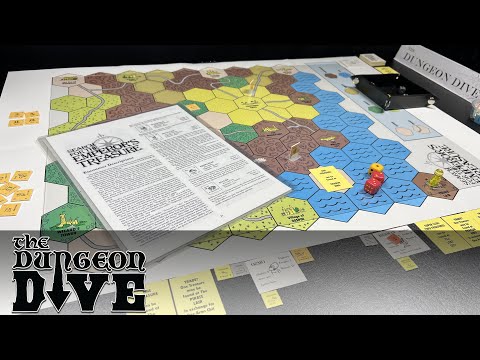
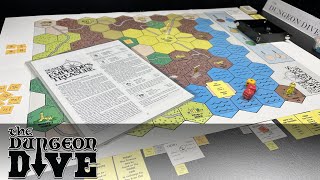
A tongue-in-cheek version of "classic" Dungeons & Dragons (some even say Mertwig's Maze is a similar treatment of Advanced D&D). As such, players become a warrior, elf, cleric, or magician, then wander around the board collecting treasure and resolving encounters. The Emperor's six magic artifacts are both high-powered magic items and a countdown clock, as when enough have been found, the game ends. (Exactly how many depends on number of players.)
Treasure, encounters and equipment are all randomized with chits in three cups. Characters obtain them by fighting monsters or lucky die rolls on result charts associated with various board locations (e.g., castles, villages, The Wizard's Tower, The Pirate Lair, etc.). Not all encounters are monsters -- some are travelers who will bestow treasure upon completion of quests, others are annoyances, and there's even Imperial Guard patrols looking to confiscate the Emperor's Treasure.
Terrain types are a key strategy feature, as a player whose current location's terrain doesn't match the encounter drawn can bestow it on someone else who does. So a character in rugged forest or mountains can get stuck fighting several monsters in succession during other players' turns.
A surprising amount of flavor is included for a magazine game. There's an assortment of magic spells, ranged and close combat, magical weapons & armor, damsels in distress, evil wizards, a volcanic demon, even a wandering elephant.
A significantly revised version was published as part of The Best of Dragon Magazine Games.
- Minimal in artistic minimalism, component minimalism, and mechanical minimalism.
- So simple.
- Fun.
- Tom Wham's doodles add a lot of charm.
- Mechanically very simple.
- Combat is a simple d6 dice pool system.
- Has a whole bunch of different armor, weapons, and items.
- Spells are simple with effects listed on an information page.
- Super simple.
- Turns are very fast.
- Minimalistic art.
- Minimal components.
- Minimal mechanisms.
- Awesome game.
- So much fun.
- Nothing gets in the way of the adventure.
- All encounters are simple.
- No solo rules, but can be played by controlling multiple characters.
- The art is very minimal.
- Competitive treasure hunting.
- A world where players explore for treasure.
- Minimal flavor text and art prompts players to create their own story.
- Runebound
- Talisman
Mechanics (from transcript analysis)
- Dice Rolling — Uses a simple d6 dice pool system for combat, where fives and sixes count as successes.
- Encounter resolution — Players draw encounter chits with names and doodles, then look up the encounter details on pages to determine stats and how to deal with it.
- exploration — Players move around a board to find treasure.
- Set Collection — Players collect treasure tokens, with the goal of finding six Imperial treasures.
- Terrain-Based Encounters — Certain encounters are specific to certain terrain types.
Video topics + discussion points
Quotes (from this video)
- And so sometimes a game that just has a little bit of stuff or employs a certain kind of minimalism can be a breath of fresh air.
- And so it's kind of a minimalist in its component quality and quantity.
- This game is so minimal in what it provides and in its mechanisms. You know, I if you took just one thing away, it would kind of stop even being a game.
- The game doesn't construct things for you. It leaves a lot up to the players to determine how things look, how things feel.
- So, Darkest Night takes the complete opposite uh direction there. And you only get one action on each of your turns. So, it uses a kind of minimalist action economy.
- Well, Dragons Down takes the opposite approach.
- And so by employing that kind of narrative minimalism, I think Dragons Down is a much better game for that.
- And it is so minimal in every way that we've already discussed in artistic minimalism, in component minimalism, and in mechanical minimalism.
- But this game has everything I look for in an adventure game.
- And all three of those things combined to make this an awesome game. I love it. It is so much fun.
- There is nothing to get in the way of the adventure that I want to feel.
- But these kinds of games that I'm talking about really prove that that's not true.
- And you know, it's just I I wish I could embrace that more often.
- But maybe we just need a bare minimum of art, of components, and of mechanisms because sometimes a really small, very simple game is exactly the game that I want to play.
References (from this video)
- Charming, accessible, and distilled form of an adventure game
- Simple core mechanics that capture the feel of a mini-D&D-style quest without a full campaign
- Beautiful and practical map design (especially the Best of Dragon reprint) that facilitates varied setups
- Engaging encounter system with memorable creature designs and flavorful descriptions
- Spells, companions, and treasure dynamics add depth without overwhelming complexity
- Flexible house-rule options (e.g., global treasure) that speed up play and introduce competitive tension
- Original maps can be ornate and perhaps more aesthetic than the hex-map compromise used in the Best of Dragon edition; purists may prefer the original board design
- Rule depth is light by design; players seeking heavy crunch may find it shallow or feel okay with a shorter play session rather than a full campaign
- Replay variety relies on encounter text and card art; some players may want more diverse encounters or modular components to maintain long-term novelty
- Treasure hunting and light dungeon-adventure play; a distilled D&D-flavored exploration that can simulate a one-night 'campaign' experience without a full campaign commitment.
- A fantasy land under Emperor Baldwin, explored on a fixed or modular hex map with named sites like Midland Castle, the village of Moog, the Lost City, and the Imperial capital; players quest to locate Imperial Treasures and gain victory points.
- Encounter-driven exploration with simple quest hooks, side-quests via encounter cards, and evolving character capabilities through treasure, experience, and spells.
- Mert Wig's Maze
- Kings and Things
- File 13
- Dungeons & Dragons
Mechanics (from transcript analysis)
- Clues and treasure gathering — Treasure clues point to map locations; collecting Imperial Treasures and other magical items progresses toward end-game triggers (e.g., end when six Imperial Treasures are found).
- Combat resolution with dice and equipment effects — Combat uses D6 dice; ability scores determine dice pools; magic items (e.g., a mace) modify hit thresholds (e.g., four, five, or six becoming hits). Shields absorb wounds; enemies also have ability scores and wound counts.
- Companions and ally recruitment — Characters can recruit companions (e.g., local heroes or summoned aid) who contribute to combat or exploration, each with their own abilities, wounds, and treasure interactions.
- Deduction — Treasure clues point to map locations; collecting Imperial Treasures and other magical items progresses toward end-game triggers (e.g., end when six Imperial Treasures are found).
- Encounter chits — Tiny encounter cards present enemies, allies, and events. Each chit has an escape value, a ability score, wounds, and a potential treasure or side-quest reward.
- End Game Bonuses — Discovery of the sixth Imperial Treasure ends the game; players tally treasures and experience to determine the winner; optional rules introduce a shared Global Treasure to accelerate pacing.
- End-game condition and pacing — Discovery of the sixth Imperial Treasure ends the game; players tally treasures and experience to determine the winner; optional rules introduce a shared Global Treasure to accelerate pacing.
- Experience points and upgrades — Defeating encounters yields XP based on wounds; reaching 25 XP upgrades a hero's abilities, adding depth to combat and exploration choices.
- Hex-map exploration — Players move on a hex-based map to reach clues and named locations; the map design encourages exploration and varied setup between games.
- Spells and meditation — Characters with magical abilities can meditate to gain more spells, at the cost of movement; spells like Speak to Animal and Friendship enable recruitment of allies or negotiation outcomes.
- Trading — Treasure items and Imperial Treasures can be traded or exchanged at certain locations; some rules variants allow trading for arms, armor, or other Treasure types to boost a party's strength.
- Treasure management and trading — Treasure items and Imperial Treasures can be traded or exchanged at certain locations; some rules variants allow trading for arms, armor, or other Treasure types to boost a party's strength.
- Variant rules and optional content — Optional rules and errata exist (e.g., from Jay McCracken) to adjust the treasure gathering, map setup, and encounter balance; these add replayability and help tailor sessions.
Video topics + discussion points
Quotes (from this video)
- This game is absolutely Charming it's super simple
- it's a distilled adventure game
- This is a distilled adventure game, and the main excitement comes from encounter chits
- I recommend using the experience points variant whenever you defeat an encounter
- I really appreciate how much this game does with its simple mechanisms