/pic1809442.jpg)
/pic7692151.jpg)
/pic1809442.jpg)

















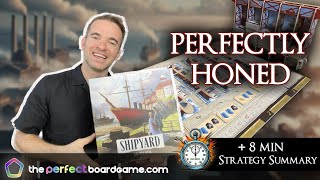







Shipyard Deep Dive
What the Community Thinks About Shipyard
Shipyard has earned consistent appreciation from board game reviewers as a mechanically elegant design that delivers on a deceptively simple premise: build ships and send them through canals for points. The 2023 second edition reprint signals renewed interest in this 2009 classic by Vladimir Suchy, drawing praise for how cleanly its systems work together. Reviewers recognize it as a gateway into more complex Euro games, marked by straightforward rules paired with meaningful strategic depth that emerges through careful planning and timing.
Core Mechanics That Define Shipyard
Action Selection via Rondelle Movement
The game's backbone is its action selection mechanism powered by a rotating rondelle system. Players advance around tracks to access different actions: recruiting crew, manufacturing equipment, building ships, exchanging commodities, and constructing canal routes. The clever twist is that taking an action rotates a wheel that doubles as a turn counter, creating natural pressure as the game progresses. When you claim an action tile, it moves to the start of the track, and coins flow to you based on how many opponent markers sit to your right. This creates a secondary economy where choosing less-popular actions can generate unexpected income. The interplay between action availability and cash generation forces constant attention to opponent positioning, transforming what could be a solitary puzzle into a genuinely interactive experience.
Tableau Building Through Ship Construction
Ships form the heart of individual engines. Players assemble vessels from components: bows, sterns, middle sections, alongside equipment and crew that occupy mounting points. Each completed ship travels through the player's personal canal, accumulating points based on vessel speed, crew composition, equipment synergies, and how well it matches hidden scoring objectives. The beauty lies in how pieces reward coherence. Building a ship loaded with cranes scores points for those same cranes when they encounter government officials during the canal crossing. A captain generates bonus crew capacity. Equipment interacts with technology tiles that multiply effectiveness across turns. This interconnected web of synergies transforms construction from checklist completion into genuine optimization puzzles where forward planning separates strong players from strategic masters.
The Shipyard Experience
Breezy Yet Demanding Gameplay
Shipyard plays faster than its depth might suggest. Rules are accessible within a teaching, and turns move quickly since action selection is straightforward. Yet beneath this approachable surface sits substantive planning. Players constantly evaluate whether to pursue blocked actions by paying coins, spend resources on ship building now or invest in equipment for long-term gains, and navigate the tension between filling immediate needs and executing longer-term synergies. This creates the satisfying dynamic of a game that flows quickly in execution but demands sharp decision-making. The pacing never drags because even blocked turns yield coins and forward progress toward scoring ships.
Satisfying Engine-Building Progression
Shipyard delivers the core pleasure of engine building: watching disparate pieces click into harmony. Early turns feel constrained as players slowly gather resources and components. Mid-game accelerates as technology tiles and crew bonuses compound, making subsequent actions more efficient. The arc culminates in late-game turns where careful planning pays dividends: ships complete with all their intended equipment, canal routes align with ship capabilities, and scoring multipliers activate. This progression from scarcity to abundance creates palpable satisfaction, especially when a last-turn supership emerges from accumulated investments and sends massive points cascading in during the canal crossing. The game respects player ingenuity; skilled players noticeably outpace those flying blind.
What Makes Shipyard Stand Out
Functional Component Design as Artistry
Rather than relying on painted miniatures or elaborate artwork, Shipyard's design elegance resides in functional components that serve dual roles. The rotating wheel simultaneously advances the action track and acts as the turn counter. Players physically pick up action tiles and place them, creating kinesthetic engagement with the game state. The tray itself resembles a shipping container. This design philosophy transforms setup and play into thematic immersion; interacting with components feels like operating an actual shipyard. Production clarity prioritizes usability over spectacle, yet this restraint itself becomes artistic. The game teaches itself through its component architecture.
Clean Mechanical Elegance
Shipyard stands apart among Suchy designs for its mechanical coherence. Every element justifies its presence. The secret objectives create scoring asymmetry and tension without unnecessary rules baggage. The coin economy flows logically from action selection consequences. The canal route system interacts meaningfully with ship building without feeling bolted on. Reviewers emphasize how smoothly the game plays once learned, contrasting it with other Suchy games that sometimes feel mechanically denser than necessary. This clarity makes Shipyard exceptionally teachable and encourages repeated plays, as players quickly internalize the ruleset and can focus entirely on strategy.
Potential Drawbacks
Thematically Dry Presentation
The game's greatest weakness is also its most honest: building ships is not inherently exciting as a theme. The cover art and overall presentation will not turn heads on a shelf. Reviewers must actively sell players on the mechanics rather than riding theme enthusiasm. Those seeking narrative immersion or thematic resonance will find little here. The game is pure mechanism wrapped in functional aesthetics, which delivers elegant euro gameplay but sacrifices the immediate appeal that games with vivid themes or intellectual narratives command. This becomes relevant when introducing the game to casual players; evangelists must lead with mechanical depth rather than thematic promise.
Hidden Information and Score Variance
Secret objectives create a potential imbalance. If one player's objectives happen to align well with actions naturally flowing through the rondelle, while another's objectives conflict with opponent strategies, score gaps emerge that feel unrelated to player skill. The randomness of which ship tiles and canal tiles appear in the market can also create downstream advantages for players whose engines happen to synergize with available options. While skilled players can mitigate these swings through flexible planning, games where lucky draws overwhelm strategic maneuvering leave some players frustrated. Making objectives public would increase transparency about why opponents pursue specific actions, though this would fundamentally alter the game's dynamics.
If You Enjoy Shipyard
Players who connect with Shipyard typically gravitate toward tightly designed euro games with elegant action selection. Russian Railroads delivers similar mechanical focus on a single refined system. Concordia shares Shipyard's clean design philosophy and rewarding planning. Praga Caput Regni and Woodcraft offer rondelle variants with Suchy's fingerprints. Weather Machine combines action selection with tableau building and demanding forward planning. Hansa Teutonica and Power Grid provide pure mechanical puzzles. For lighter entry points, Acropolis delivers tableau satisfaction with faster play, while Ticket to Ride shares the careful resource management philosophy without euro complexity.
What Reviewers Are Saying
"I built up quite a nice little engine in terms of the technology tiles which meant that every time I bought anything essentially I'd get an extra one of these sails and one of my in-game objectives was to have sets of sails so all of my different kind of moving parts in the game did synergize with each other which helped me quite a lot and on my last turn in the game I managed to build this kind of super ship really had tons of sails and they absolutely blitzed it around these tiles and got me tons of points to get me the win there."
— Chairman of the Board
"What really makes this game stand out is that it does one thing very very well and that one thing is action selection so you're paying attention to your opponents watching and keeping track of the game state and seeing when the opportunity is just right so you can seize it when it comes your way, that's really where the interaction falls in for this game."
— Board Game Dad
"It has this clean compared to Praga Caput Regni, Praga is kind of messy, teaching the rules is not fun, it's a great game I love it but it's messy and it doesn't make sense, this one was like oh wow I get it. The mechanics get a little messy in some of his games but in Shipyard everything is there and makes sense."
— Board Game Dad