/pic8478387.png)






















SILOS Deep Dive
What the Community Thinks About SILOS
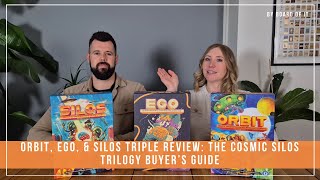
SILOS lands as one of three games in Bitewing Games' Cosmic Silos trilogy, a set of releases designed by Reiner Knizia, and reviewers largely treat it as the standout of the group. Banter and Boards frames it as a game of clever positioning and sneaky tactics and closes its review saying the channel really enjoyed it. Board Of It goes further, naming SILOS its favorite of the three and giving it a standing ovation on first play. Board Game Animal, whose host has played close to two hundred Knizia designs, calls the production across the trilogy stellar and singles out SILOS as a re-implementation of the older game Municipium with a lot more character. Going Analog covered the game as an early preview ahead of its Kickstarter launch, with Bitewing Games co-founders Nick Murray and Kyle Spackman joining the episode to discuss the redesign.
The praise is not unanimous in degree. Board Game Buzzz calls SILOS the title it was most excited about among the three but lands on a more measured seven out of ten, and Board Game Animal settles on the same score after starting at six, noting the game does not pull it back to the table the way other Knizia designs do even though every individual session has been enjoyable. Board Of It and Banter and Boards also split on player count: Board Of It insists the area control holds up at two players just as well as at four, while Banter and Boards is clear that SILOS is not a true two-player experience and works best with three or four at the table.
Core Mechanics That Define SILOS
Area Majority Around a Roaming UFO
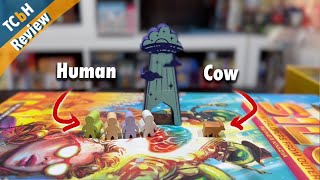
Reviewers describe a shared loop built around a UFO that moves between seven town locations as cards are played. Banter and Boards explains that a turn is quick: move alien pieces, play a card, then resolve whatever the card triggers, whether that is an abduction event, a mind control event, or a special powers event. Going Analog breaks the scoring into three tiers tied to who holds the most presence at a location: majority control nets a cow when the UFO arrives, filling a location with revealed humans triggers a mind control event that rewards the top two players there, and holding a location when its unique power activates gives the controlling player that power's benefit. Board Game Animal frames the whole thing as area majority where players are abducting humans, or cows, which count as any human type toward a set.
Card Tracking and Personal Power Cards
Because the deck drives which event fires next, Banter and Boards points to card tracking as the mechanic that keeps the luck in check: once a card is played it stays visible on the board, so players can see what has already come out and estimate what is still likely to appear. On top of the shared deck, each player holds a small set of one-time personal cards that can shift influence or trigger an event on demand instead of waiting on a draw. Banter and Boards also flags the leader figure, a piece worth one and a half influence rather than one, which the channel says creates a real decision about where to place it at setup because ties at a location are common.
The SILOS Experience
Two Players Versus a Full Table
Banter and Boards has played SILOS at two and three players and reports that the two-player game leans on a fake third player, a phantom set of pieces placed at each location that always wins ties but is not controlled by anyone. The channel calls the result serviceable and says it keeps some tension in the game, but is upfront that it is not a true two-player experience and feels a bit artificial. Board Of It takes the opposite position, saying the game works well no matter the player count because the tension comes from racing to activate powers rather than from pure area domination, so even two players are fully engaged.
Fast Turns, Constant Positioning
Board Of It describes very little downtime because almost every card flip matters to the whole table, not just the player who drew it, with the moving UFO and shifting powers keeping everyone watching the board between turns. Banter and Boards backs this up from the other side of the table, describing SILOS as fast to play with players constantly jockeying for position and looking for chances to outmaneuver opponents rather than settling into long turns.
What Makes SILOS Stand Out
Retro Alien Theme Over an Old Design
Board Game Animal calls out the upgraded components and gorgeous production across the trilogy as more than cosmetic, saying it actually elevates the quality of gameplay rather than just looking pretty on the table. Board Of It credits the light touch humor and deliberately old school, eighties-inspired look for flipping its expectations once actual play began, and says the theme carries all the way through the game rather than fading once the rules take over. Going Analog adds that the redesign takes what was originally a drier, more muted theme in Municipium and layers in the alien abduction concept and new art to make it feel colorful and lively.
Modular Locations and Expansion Variety
Board Of It highlights that the seven locations each carry a unique power, and the box includes alternate power sets that can replace the printed ones for a different map every time. The included Crop Circles content adds two further modules on top of that: one that grants a permanent influence bonus at a location once triggered, and one that hands out personal skill tiles the first time a player wins a given location's power. Board Game Animal notes the same expandability, describing extra modules and replay variety as part of what elevates the game beyond a single fixed layout.
Potential Drawbacks
A Denser Teach Than the Rules Suggest
Banter and Boards is careful to separate rules complexity from teaching difficulty here: the basic turn structure is simple, but for players to actually play well everyone needs a real understanding of what each location does and what each event means, which makes the teach itself more involved than in lighter Knizia games. The channel says this can feel intimidating for a table of players who do not typically play hobby board games, and that the first game is rarely tight, with things clicking into place by the second play.
A Reactive Loop That Can Feel Flat
Board Game Buzzz's biggest reservation is that the area control can feel more reactive than proactive, saying the gameplay was fun but that it personally preferred having more say over the board rather than constantly responding to what the UFO and other players were doing. Board Game Animal echoes a version of the same hesitation from a different angle, saying the core loop is genuinely enjoyable in the moment but that SILOS lacks the pull to get back to the table that the channel's other favorite Knizia designs have, landing it below other area control games when it comes to an unprompted recommendation.
If You Enjoy SILOS
Board Game Animal and Going Analog both point straight to Municipium as the game SILOS reimplements, with Going Analog describing the original as a phenomenal design under a beige, forgettable Roman theme that the new alien invasion setting was built to fix. Going Analog also compares the feel of play directly to El Grande, saying SILOS flips that classic on its head by turning slow card auctions into a faster, more dynamic scramble to reposition around the board. Board Of It, which ranks SILOS as its favorite of the Cosmic Silos trilogy, contrasts it with trilogy-mate Ego, preferring the zaniness and in-your-face humor of SILOS over Ego's more serious, tactical gambling style.
What Reviewers Are Saying
"I really enjoyed Silos. It's really fast to play. You're constantly jocking for position, and you have clever opportunities to outmaneuver your opponents."
— Banter and Boards
"I think it's really good at spinning plates. It's kind of a lot of shifting focus, which is really fun because the UFO is going to move around every time."
— Board Of It
"In and of itself, I think I would give Silos a 6 out of 10. However, thinking about the fact that every single time I play it, I have such a good time in the moment, and I enjoy what's happening around the table, and I really enjoy the theme. I think a lot of that has to do with the production and theming that was put into the game itself."
— Justin, Board Game Animal