/pic945314.jpg)
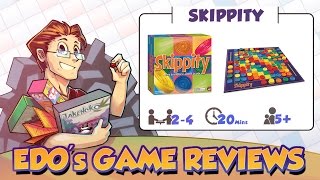
If Susan McKinley Ross' Qwirkle can be described as a simplified Scrabble – with colors and shapes replacing letters – then her 2010 release from MindWare – Skippity – might be dubbed "checkers for the Timothy Leary set".
On a blazingly colored 10x10 game board, players randomly lay out one hundred tokens in five colors, then remove the tokens from the four central squares. On a turn, a player takes a single token and jumps orthogonally over an adjacent token to an empty space, capturing the token jumped. Multiple jumps are possible, with the player capturing each token jumped.
The game ends when no more jumps are possible. Players then compare their stacks of tokens, with each set of five differently-colored tokens counting as a set. The player with the most sets wins, with the tiebreaker being the number of tokens captured but not in sets.

Edo's Skippity Review
- Easy to explain
- Family-friendly and accessible to young players
- Bright, colorful board and components
- Interesting scoring mechanism based on the lowest color
- Setup time can be longer than actual play time
- color stacking with a scoring rule based on the lowest color
- Family-friendly abstract strategy on a colorfully designed board
- explanatory, reviewer-led with contextual comparisons to classic games
- Checkers
Mechanics (from transcript analysis)
- balancing forward progress with trailing color — The lowest color in a stack limits scoring, encouraging forward planning while watching trailing colors.
- Catch-Up — The lowest color in a stack limits scoring, encouraging forward planning while watching trailing colors.
- Color stacking — Players stack colors, and scoring is determined by the lowest color value among the colors present.
- color-coded components — Pieces are color-coded and used on a color-rich checkered board.
Video topics + discussion points
Quotes (from this video)
- I've also played it
- play it in 15 minutes
- scales down to my my four-year-old
- it's easy to explain fun this one