/pic8160197.jpg)






































Skyrise Deep Dive
What the Community Thinks About Skyrise
Skyrise has earned a reputation as one of the most elegantly designed bidding games in recent memory. Brains on Games called it "the best bidding game that I've ever played," while BoardGameCo elevated it to a five-out-of-five rating after repeated plays, noting that "every play has just been better and better." The Board Game Garden placed it at number four on their top heavier games of 2024, describing it as a game that won them over through exceptional player interaction. All You Can Board framed Skyrise as "the better experience" compared to similar auction games, one that "leaves me happier when the gaming is done."
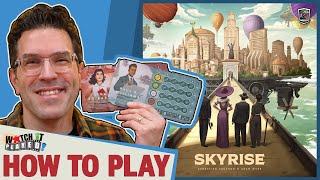
What strikes reviewers most consistently is how much strategic depth hides behind deceptively simple rules. Allies or Enemies summed it up: it is "rules light but strategy kind of a more medium weight game." Skyrise is a reimplementation of the 2008 game Metropolis, updated by designers Adam Wise, Gavin Brown, and Sebastian Poon for Roxley Games. Published in 2024, it plays two to four players in about ninety minutes.
Core Mechanics That Define Skyrise
The Bidding Chain
The auction in Skyrise works differently from standard bidding games. Each successive bid must be placed in a neighborhood adjacent to the previous bid, meaning that when you outbid an opponent, you are not claiming the space they wanted. You are claiming a new neighboring space for yourself. BoardGameCo captured the elegance of this: "When you overbid, you're not bidding on the thing that the person is bidding on. You're bidding on the next thing." Every player at the table simultaneously tries to steer the chain toward favorable locations while boxing opponents into corners where no further bids can legally be placed.
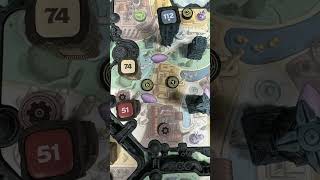
Because all remaining bids are displayed face-up in ascending numerical order on each player board, everyone can see exactly what each opponent is capable of spending. Board Game Coffee noted that this transparency makes you "feel like you're playing the person more so than the numbers." The decision of when to deploy a high-value building is a game within a game. Managing building values across two eras, the first using your initial set of buildings and the second unlocking a fresh set plus a powerful wonder piece, creates sustained tension from start to finish.
Tokens, Tracks, and the Scoring Engine
Winning an auction does more than place a building. The winner claims a neighborhood disc that slides onto one of four color-coded tracks on their player board. These tracks determine how many points each building in that color scores at game end. The relationship is deliberately non-linear: filling a track to its fifth slot earns six points per building, but pushing to the sixth slot drops the value back down to four. Allies or Enemies highlighted this as a key wrinkle, noting that an opponent can "almost trick somebody into taking an extra one of those tokens" to tank their scoring.
Additional scoring layers come from patron discs, which grant secret information about hidden end-game point values, and wonder pieces chosen from cards dealt early in the game. The wonder automatically wins any auction it enters in era two and triggers a unique bonus effect. The Board Game Garden described the wonder selection as one of the game's most exciting choices, noting that the card you choose also sets your turn order for the second era, turning even that selection into a strategic trade-off.
The Skyrise Experience
Cerebral and Tactile
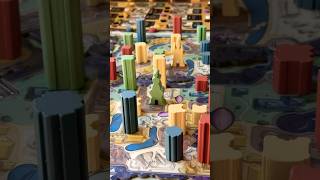
Skyrise creates a distinctive mood at the table. The board depicts a sweeping sky, and floating island tiles arrange around a central hub to create the visual impression of buildings rising among the clouds. Board Game Coffee could not stop commenting on the aesthetics: "I can't deny how good this game looks on the table." The retail edition features chunky wooden buildings with clearly printed bid values. The deluxe edition adds sculpted plastic buildings and elevated island risers. Allies or Enemies praised the wooden version and concluded that the retail is "plenty" without needing to upgrade.
Reviewers describe the play experience as cerebral but not exhausting. Brains on Games highlighted its gift for full engagement: "every single player is involved in every turn." Because each bid directly affects the next, no one waits passively. The spatial puzzle unfolds in real time for everyone at the table, making Skyrise feel more interactive than many games of comparable weight.
Player Count Considerations
Reviewers broadly agree that Skyrise shines at three or four players, where the full board and a richer web of bidding competition come into play. Allies or Enemies were direct: "I do think that this is a better four player game." At higher counts, island control scoring becomes more contested and the strategic interplay of tracking what others can bid creates richer dilemmas. The two-player experience, while functional, feels more like a focused chess match. All You Can Board called it "a pretty poor two-player experience," though Allies or Enemies noted it still carries its own tactical dimension.
What Makes Skyrise Stand Out
Information Transparency as Design
One of Skyrise's most praised choices is its radical transparency. Every player's available bids are displayed openly on their player board. There are no hidden hand sizes, no secret stockpiles. You know precisely what each opponent can spend, and they know what you can spend. BoardGameCo celebrated this as one of only a handful of games to achieve that feeling. The game also assigns each player color a unique set of building values, meaning no two players share the same numbers. Allies or Enemies noted this feeds directly into the strategy: "do I think they're going to increase the level of the building" based on what remains on each player board.
Replayability Through Interlocking Systems
Skyrise does not rely on a sprawling card library for replay value. The variability lives in its interlocking systems: randomly arranged island tiles that change adjacency relationships each session, two shared Panorama objective cards drawn from a deck, a secret personal objective per player, and wonder cards offering different powers and initiative values. All You Can Board emphasized the wonders in particular: "You'll come back to each game with new powers to discover and try out for yourself." Because the island tiles connect differently each play, the spatial puzzle of the bidding chain shifts meaningfully between sessions.
Potential Drawbacks
Analysis Paralysis Risk
All You Can Board noted that Skyrise "can lead to a lot of analysis paralysis because of the sheer number of spaces you can extend your bids to." With a large board and many legal adjacent placements available, the decision tree can expand quickly. Groups that include deliberate strategic thinkers may find pacing uneven. Allies or Enemies also flagged a minor clarity issue: illustrated board features that factor into Panorama card scoring can get obscured by placed buildings, requiring players to take a careful bird's-eye view at scoring time. Adjacency cases near blimps and bridges occasionally need a second look.
Limits of Secret Objectives
Allies or Enemies raised a concern about the personal objective cards. Every secret objective follows the same structure: score points for having four or more structures in a particular neighborhood color. While this keeps all players on equal strategic footing, it removes variety from that layer of the game. "I really would not mind having a few more of those," the reviewer noted. For groups who play frequently, the uniform objective structure may feel familiar before the other variables do. The two-player experience, as noted by multiple reviewers, also falls short of the three- and four-player game, with uncontested building placement possible late in the game.
If You Enjoy Skyrise
Reviewers point toward several related games worth exploring. Modern Art is a natural companion for fans of auction mechanics with strong player interaction. The Estates shares bidding DNA with Skyrise but leans into more confrontational territory. Tower Up is described by Allies or Enemies as "the much lighter version" of the auction-meets-placement formula. Bus is mentioned by All You Can Board as another bidding-adjacent game that earns its place in a similar competitive conversation. Keyflower and Metropolis, the original game Skyrise reimplements, offer historical comparison points. Tapestry appeals to those drawn to the city-building theme and layered production ambitions. Watergate is referenced as another game demonstrating how clever design can make competitive push-and-pull feel genuinely surprising.
What Reviewers Are Saying
"Skyrise by Roxley Games might be the best bidding game that I've ever played. It's beautiful first of all, you're placing these little buildings on this map, it's area control, it's bidding, the buildings are numbered so you place them upside down so that other people can see if they can outbid you or not. This is quick, it's strategic with hard choices and every single player is involved in every turn. What a great game."
— Brains On Games
"I like the estates, I really do and I respect it for what it's doing and for the mechanics and the design of the game itself and it might even be the better game of the two, but Skyrise is the better experience. It leaves me happier when the gaming is done. It leaves me feeling more sure of the fact that everyone that was there had an enjoyable time, even if the game isn't one that they personally want to come back to."
— All You Can Board
"People often ask me what is a list of my five out of fives. This is a five out of five for me. I originally gave it a four to five. It has progressively grown from a four to a 4.5 and it's now currently a five. Every play has just been better and better."
— BoardGameCo