/pic6588069.png)






























So Clover! Deep Dive
What the Community Thinks About So Clover!
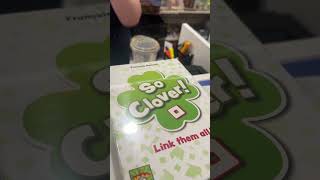
So Clover! has earned an unusually warm reputation among board game reviewers, not just as a party game but as a social experience that keeps finding new audiences. From seasoned hobbyists to casual players who rarely touch a game box, the response is consistent: this is a game people want to play again before the first session has even ended.
Alex from Might I Suggest a Game places So Clover! at number eight on his all-time personal favorites list, calling it "definitively my favorite party game of all time." That kind of enthusiasm is common among reviewers who cover a wide range of game weights. Getting Games describes it as a game he "absolutely loves" while using it as a benchmark to compare other word association designs against. The Brothers Murph include it on two separate lists: one for games you can play forever without needing expansions, and another for games that make you feel genuinely clever.
Rolls in the Family gave it an 8 out of 10 and 8.5 out of 10, respectively, noting those scores represent near-ceiling ratings for the party game category. Chairman of the Board describes it as a solid party game with a unique gimmick and calls it a hit with groups played so far. Liz from Might I Suggest a Game named it her top table hogger of the entire year, reporting that it works "with all ages and all sorts of different friend groups." The picture that emerges across all these voices is a game with unusual crossover appeal and staying power.
Core Mechanics That Define So Clover!
The Clue-Writing Phase: Bridging Impossible Word Pairs
Each player begins the game with a four-leaf clover-shaped board into which four square cards are placed randomly. Each card carries words on all four sides, and where two cards meet on the board, two words sit adjacent. The player's job is to write a single clue that points to both words simultaneously. As Chairman of the Board explains, if the words are "balcony" and "green," a clue like "plant" or "nature" must bridge both concepts. Simple in concept, but the word combinations are deliberately strange and often resist obvious solutions.
The Brothers Murph offer an illustrative example from play: "casino and mountain were the two words. Not really are those two things related at all. So what you are going to do is write a clue that hopefully points to both of those words." The solution they landed on was "smoky," pointing to both the Smoky Mountains and the historically smoke-filled casino floors. This kind of lateral thinking is at the heart of what makes the clue-writing phase so engaging. When the right word arrives, it feels like a minor revelation. As Rolls in the Family put it: "that feeling when you come up with that clue, and maybe people won't even get it, but you know that is such a good connection between those two words that just seem like you couldn't have thought of any way to connect them, and you find the word that does, and it's so satisfying."
The Guessing Phase: Collaborative Puzzle Reconstruction
Once clues are written, all four cards are removed, a random fifth card is added as a red herring, and the group works together to reassemble the original arrangement based on the clues. This is where the social energy of the game ignites. Rolls in the Family describe it as "filled with lively conversation as everyone tries to justify why a certain card might make sense in a specific spot." The clover's owner sits silently, unable to participate, watching the table debate their logic.
The Brothers Murph note that So Clover! seems like an impossible task at first glance: "There's no way you can reassemble the clover, seems like there's too many options, you have 20 words, how are you going to possibly do it?" But clever clues do the work of narrowing the possibilities, and when everything locks into place, the moment carries real satisfaction. The fifth random card adds just enough chaos without making the puzzle feel unfair. Rolls in the Family observe that "the difficulty of that puzzle seems to find a great balance between being too easy and discouragingly difficult."
The So Clover! Experience
Laughter as a Core Feature, Not a Side Effect
Reviewers do not merely mention that So Clover! is funny. They describe it as a game that structurally generates laughter through its mechanics. Rolls in the Family say flatly: "There's no other word association game that has us laughing as much as this game does." The Brothers Murph describe it as a "fantastic casual party game hangout activity" and say they can never get tired of reassembling the clovers. Alex from Might I Suggest a Game says that "every time I play it, it ends in hysterical laughter one way or another."
Part of the comedic engine is the experience of sitting silently while your own clover is discussed. Rolls in the Family capture this perfectly: "The person whose clover is being discussed, you're like you're trying not to give away any visual cues of like 'you're way off,' but you're just dying laughing over there." They go on to note that watching the table reason through your thinking, arriving at wrong but perfectly logical conclusions, is often the funniest part of the game. The social dynamic turns every puzzle into a comedy of reasoning.
Inside Jokes and Lasting Memories
A consistent theme across reviewers is that So Clover! does not just entertain for 30 minutes. It generates stories and references that persist well beyond the table. Alex from Might I Suggest a Game says the game "encapsulates everything I want a party game to be: it's super fun, it is hilarious, it has the potential to get a little rowdy, and after a good round you'll have things to talk about for weeks." He describes the inside joke potential as a mark of a great party game, and names So Clover! as the game he always recommends when friends ask to borrow games for a cabin trip or weekend away.
Liz from Might I Suggest a Game echoes this: "I feel like a good mark of a good party game is whether or not you have inside jokes after it's all said and done, and So Clover is the quintessential inside jokemaker." The Brothers Murph describe it as "the end of the night game," something they pull out when people have been hanging out casually and want one more thing to do together. This quality of fitting naturally into social settings rather than demanding full attention is part of why it works across groups with varying levels of game experience.
What Makes So Clover! Stand Out
Cooperative Stakes That Keep the Room Together
Many party games split players into teams, which creates friction and hierarchy. So Clover! is fully cooperative, and reviewers identify this as a key reason it plays well across all kinds of groups. Alex from Might I Suggest a Game notes: "In So Clover, the stakes are low, and if you give a ridiculous clue for one of them, it's gonna end in laughs instead of anger, and to me that's the sign of a great game." Rolls in the Family are explicit about how the cooperative structure shapes their choices: "I'm almost to the point of do I play a party game that doesn't have a cooperative element? Because it's just so much more fun. There's been so many times where I've got a group that I'm kind of unsure about and I look at my party games on the shelf and it's like hard to reach for other ones over these cooperative ones."
The scoring system reflects this low-pressure spirit. Points are earned for correct placements, with a bonus for getting the whole clover right on the first try. But reviewers note they often stop caring about the score at all. The Brothers Murph say: "We don't really even hardly keep score. We just want to get perfection each time." The game invites players to compete against themselves, chasing improvement over previous sessions rather than battling each other.
Infinite Replayability Through Language Itself
So Clover! ships with enough cards to create virtually endless variety. The Brothers Murph note there are roughly 200 cards in the box, each with four words, and even a small subset would produce unique puzzles every session. But the deeper source of replayability is the nature of language. Rolls in the Family put it well: "The beauty of word association games is that the English language supplies an endless number of interesting combinations that will always make each puzzle unique." Because the word pairings are random and the clues come from players rather than a scripted set, no two games feel the same even if the same cards appear.
Rolls in the Family describe this as giving the game an "evergreen" quality: "I just don't see myself tiring of that exercise." Liz from Might I Suggest a Game says it "feels like it never gets old" and adds that she finds herself recommending it or wanting to play it whenever friends come over, even people new to her social circle. Chairman of the Board similarly points to "pretty much infinite replayability" from the card orientations alone. When you factor in how differently the same cards play depending on who wrote the clues, every game carries a layer of personality that keeps it fresh.
Potential Drawbacks
Analysis Paralysis During the Writing Phase
The primary criticism reviewers raise is that some players, when faced with word pairs that simply do not connect, can freeze. Chairman of the Board names this directly as "probably the only negative about this game," explaining that some players finish their clues quickly while one person struggles significantly longer, leaving the rest of the group waiting. The writing phase is done in silence and individually, so there is no collaborative support at that moment.
Rolls in the Family acknowledge the game can feel "front loaded with the most thinky piece," noting that the initial clue-writing can be surprisingly demanding for a box that presents itself as light and casual. Their advice: "Just put something that is at least strong for one of the words" and push through. They also observe that "you can almost see the mental 'oh wow, this is actually really hard' front-loaded with the most thinky piece, which is the sit there by yourself without any collaboration." The experience shifts dramatically once the group phase begins, but newer players may not know that yet when staring at two seemingly unrelated words.
The Scoring System and Player Count Ceiling
A secondary concern is that the scoring mechanic, which asks players to compare their total against a tier list in the rulebook, can feel anticlimactic. Rolls in the Family say they often end up just comparing against their own previous scores and find the tier system unsatisfying as a conclusion to an otherwise energetic experience. They also note that the six-player ceiling can be limiting for larger gatherings: "Only goes to six players, which in the party game category can be a little bit of a limiter."
Getting Games adds that new players sometimes freeze during the clue-writing phase in a way that slightly easier games avoid: "I've definitely had people lock up the first time they play So Clover. There's just so many things, I'm going to do it wrong." This is less a design flaw and more a function of how the game presents itself. The playful clover theme and light component style suggest a game easier than the initial word-association task actually is. That gap can create a moment of unexpected stress before the fun takes over. Chairman of the Board also flags that the player whose clover is being guessed is not actively involved during that phase, which can feel like a lull if the puzzle takes a long time.
If You Enjoy So Clover!
Reviewers who love So Clover! frequently draw comparisons to other word games, with Just One cited most often as the closest relative. Chairman of the Board calls So Clover! slightly more complex and "gamey" than Just One but rates both equally, seeing them as complementary rather than competing. Rolls in the Family note that So Clover! solves the downtime problem they felt with Codenames, where one side waits while the other deliberates. So Clover! keeps everyone engaged throughout by giving every player a clover to build and a voice in solving others.
Getting Games describes it as hitting "a similar-ish part of the brain" to other word association games, while noting that its structure of building a personal puzzle and then presenting it to the group is distinct enough to stand on its own. Masterword was mentioned by Rolls in the Family as a game acquired alongside So Clover! that "played once, got rid of it immediately, fell flat," making the contrast stark. If cooperative word games that reward creative thinking and generate natural conversation are what you are looking for, So Clover! sits at the top of that category for many reviewers who have explored it deeply.
What Reviewers Are Saying
"So Clover is an amazing hidden word party game for three to six players that every time I play it ends in hysterical laughter one way or another. It really is just a blast and I think it encapsulates everything I want a party game to be. After a good round you'll have things to talk about for weeks."
— Might I Suggest A Game
"There's no other word association game that has us laughing as much as this game does. Sometimes that's my favorite part, is hearing people try to think about what you were thinking and discuss things. It's hilarious, it's interesting, and when they get it on the first try, everyone just gets excited."
— Rolls in the Family
"I always remember the first time I saw people playing this because it blew my mind. I was like there's no way you can reassemble the clover, seems like there's too many options. But you can do it if the clues are good. I always think it's like a bit of a magic trick."
— The Brothers Murph