/pic4176743.jpg)

/pic4176743.jpg)




Sorcerer Deep Dive
What the Community Thinks About Sorcerer
Among competitive card gamers and fans of gothic tabletop experiences, Sorcerer has earned a devoted following. Published by White Wizard Games, it draws praise from The Cardboard Herald, AzureDeath Solo Board Gaming, Board Game Coffee, and Hungry Gamer as a head-to-head dueling game that refuses to soften its competitive edges. The community recognizes it as a title that respects player intelligence and rewards mastery, while acknowledging that it asks for commitment from anyone entering its dark Victorian world.
Core Mechanics That Define Sorcerer
The Three-Deck Assembly System
Sorcerer's most distinctive feature is its mashup deck-building approach. Rather than constructing a single unified deck, players choose three mini-decks representing a Character, a Lineage, and a Domain. These shuffle together into a deck unique to each player's chosen combination. The base box offers several options per category, generating hundreds of possible sorcerer identities, and that number expands dramatically with expansions. Reviewers note that the system, inspired by late-1990s and early-2000s collectible card games, rewards understanding theme alongside mechanical synergy. The mashup replaces deck-building overhead with immediate, thematic roleplay: players declare who they are, a Vampire Demonologist of the Forgotten Temple or a Spider-controlling Monastic Mage, and grab three card piles.
Energy, Omen Tokens, and Dice Mitigation
Combat in Sorcerer flows through two tightly coupled resource systems. Energy fuels spells during the action phase, while Omen tokens provide critical mitigation during the battle phase. Unlike games where dice rolls feel punishing, Sorcerer's Omen economy lets players force rerolls on individual dice, both their own and an opponent's. This creates meaningful tension: push your luck for high rolls, or spend precious tokens to lock in outcomes. The scarcity matters, since Omen tokens accrue gradually through card play and abilities rather than arriving in unlimited supply. Combat itself branches into two damage types, regular hits and critical strikes, where only critical results can be assigned directly to enemy creatures while regular damage flows to the defending player to allocate. Because the defender chooses where regular damage lands, the design avoids the frustration of losing to a single unlucky roll.
The Sorcerer Experience
Escalating Engagement and Minimal Downtime
Sorcerer's alternating-action structure, where players take one action at a time during the action phase and then trade attacks during combat, eliminates the multi-turn waits that plague many card games. Reviewers emphasize that you are never simply sitting and waiting for an opponent to finish an entire turn. During battle, one player attacks and the opponent immediately responds, creating a rhythmic back-and-forth that mirrors tactical positioning games like Warhammer. This keeps everyone invested throughout the match, especially in two-player duels where agency feels direct and consequential.
Learning Curve and Theme Absorption
The game's complexity creates an initial barrier that dissolves quickly upon play. Newcomers often struggle on the first turn, overwhelmed by the interplay of energy costs, omen tokens, and ability triggers. After the first round, though, comprehension tends to click, because the rules, while numerous, appear entirely on the cards without reliance on hidden keywords or rulebook lookups. Reviewers praise this clarity. The thematic payoff arrives as players realize their chosen combination shapes both mechanical identity and narrative flavor: a Demonologist plays differently from a Warrior because the card abilities reinforce the archetype, not because of arbitrary restrictions. This fusion of theme and mechanics creates a roleplay experience inside a competitive framework.
What Makes Sorcerer Stand Out
Gothic Aesthetic and Evocative Artwork
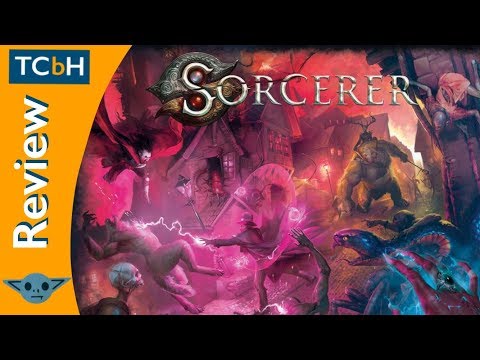
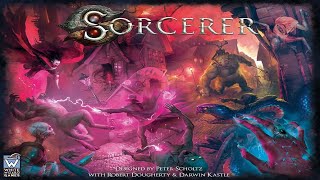
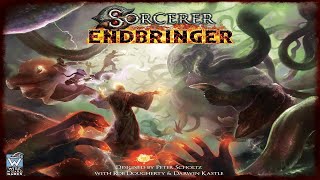
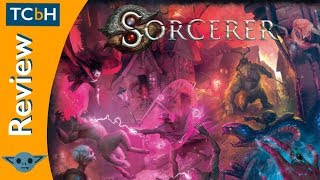
The visual identity of Sorcerer stands apart in a crowded deck-building landscape. The game's artwork, developed by its European art team, presents a dark Victorian aesthetic rich with literary inspiration. Characters materialize as fully realized personas: vampires, demonologists, monks, and creatures drawn from occult tradition. The card illustrations drip with atmosphere, and minions and spells carry real weight and presence. The Cardboard Herald called the artwork phenomenally good and observed that it evokes a great theme, feeling far more unique than a couple of wizards trading blows. Every card reinforces the gothic mood, making each turn feel like advancing through a dark narrative rather than executing dry mechanics.
Deck Variety Without Deck Construction Burden
Most card games solve the variety problem by demanding extensive deck construction outside the game. Sorcerer sidesteps this by creating instant variety through its mashup system. A player's first game can play completely differently from their second simply by choosing a new combination of Character, Lineage, and Domain. This grants the psychological reward of collecting and combining without the engineering burden that discourages casual players. Future expansions promise new mini-decks that introduce fresh archetypes and combinations without bloating a single unified deck. As reviewers observe, you pick a character, declare the role you want to play, and the game becomes playable without hours of optimization.
Potential Drawbacks
Combat Pacing and Learning Expectations
While the alternating-turns system keeps players engaged, combat itself can sprawl longer than newcomers anticipate. The battle phase resolves location by location, with each location generating multiple attack opportunities before moving on. Combined with dice rolling, omen decisions, and ability triggers, a single round of combat can consume 20 to 30 minutes in experienced hands and longer while players learn the interactions. Reviewers caution that going in expecting quick combat resolution can leave you feeling bogged down by the pace. Managing expectations before the first play proves essential, since the game rewards mastery but demands patience during the learning phase.
Competitive Focus and Player Count Scaling
Sorcerer unapologetically prioritizes head-to-head dueling. Its most satisfying experience emerges at two players, where direct rivalry and tactical positioning feel most intense. Scaling to three or four dilutes that focus, as multiple opponents introduce indirect damage assignment and fewer individual turns per round. Reviewers reinforce that the game is at its best with two players. It is decidedly not for groups seeking cooperative experiences, casual social play, or games where every action affects every opponent equally. This specificity is a strength for the intended audience but a real limitation for groups wanting a versatile gaming tool.
If You Enjoy Sorcerer
Players drawn to Sorcerer gravitate toward titles that blend collectible card game depth with tabletop tactical positioning. Magic: The Gathering offers similar deck-construction puzzle-solving and resource management, though with greater upfront building commitment. Warhammer: Age of Sigmar shares the area-control and positional depth that drives Sorcerer's combat, with miniature-assembly overhead and higher complexity. Smash Up captures the mashup-deck joy without the competitive intensity. For gothic atmosphere with card play, Arkham Horror: The Card Game delivers mythos theming and cooperative construction, though it emphasizes narrative campaigns over direct competition. Ultimately, Sorcerer occupies a unique space: competitive, thematically rich, and unwilling to compromise on darkness or player agency.
What Reviewers Are Saying
"The game felt balanced and had enough variety to stay fresh for a while, but it is a game that can expect to benefit from future expansions in the best possible way, by adding variety without adding complexity."
— The Cardboard Herald
"I really love the card play here, and it has all of those things that you would expect from something that is trying to hit the same notes as Magic."
— AzureDeath Solo Board Gaming
"The artwork is phenomenally good and it evokes a great theme. It feels way more unique than just a couple of wizards fighting it out."
— The Cardboard Herald