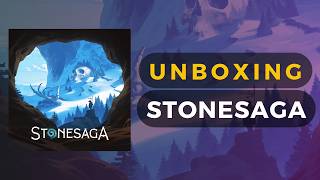
The "Stone Age" times were hard indeed. In their roles as hunters, collectors, farmers, and tool makers, our ancestors worked with their legs and backs straining against wooden plows in the stony earth. Of course, progress did not stop with the wooden plow. People always searched for better tools and more productive plants to make their work more effective.
In Stone Age, the players live in this time, just as our ancestors did. They collect wood, break stone and wash their gold from the river. They trade freely, expand their village and so achieve new levels of civilization. With a balance of luck and planning, the players compete for food in this pre-historic time.
Players use up to ten tribe members each in three phases. In the first phase, players take turns placing their tribe members in regions of the board that they think will benefit them, including the hunt, the trading center, or the quarry. In the second phase, each player activates each of their staffed areas in whatever sequence they choose, in turn order. In the third phase, players must have enough food available to feed their populations, or they face losing resources or points.
What is Worker placement
Stonesaga | Seeds of the Wind | Playthrough
- Tense resource management and push-your-luck decisions on tracks.
- The agriculture track adds a strategic planning layer.
- Dice variance can be catastrophic, causing chaos rather than tension.
- The feeding mechanic can feel like busy work rather than meaningful decisions.
- Once players identify safe patterns, randomness diminishes replay value.
- Resource gathering and strategic risk management
- Prehistoric village management with worker placement
- Tension built through resource allocation and risk
- Catan
- Dominion
- Ticket to Ride
Mechanics (from transcript analysis)
- dice variance — Resource outcomes depend on dice results, introducing luck.
- Feeding/Resource Management — Pay food to maintain workers; mismanaging leads to penalties.
- Resource management — Pay food to maintain workers; mismanaging leads to penalties.
- worker placement — Assign workers to tracks to gather resources and take actions.
Video topics + discussion points
Quotes (from this video)
- BGG's rating system struggles with distinguishing between this is an excellent party game and this offers repeated strategic depth.
- Accessibility isn't the same as complexity. Beautiful components aren't the same as mechanical richness.
- Memorable first plays aren't the same as longevity. These games are genuinely excellent gateways.
- If you're brand new to modern board gaming, many of these are fantastic entry points. They teach mechanics painlessly and generate fun.
References (from this video)
- Strong sense of growth through civilization development across a long campaign
- Emergent, branching narrative with exploration elements
- Varied survival actions (fishing, foraging, digging) that are quick and thematic

- Persistent outposts and inventions provide long-term strategic hooks
- Randomness can create high-threshold dice checks with limited mitigation late in scenarios
- Crafting sometimes yields no useful result, wasting actions
- Limited item variety and early cap on equipped items reduces crafting motivation
- Character progression is slow and not tightly tied to who you are playing, reducing personal attachment
- Some repetition in missions and rule-checks can slow play for some groups
- survival, exploration, and civilization growth
- fantasy prehistoric civilization-building world
- emergent, branching narrative with campaign progression
Mechanics (from transcript analysis)

- Campaign — persistent improvements across scenarios; upgrading outposts unlocks inventions that persist through the campaign and affect gameplay.
- Campaign progression and branching narrative — the campaign is structured into epochs and sessions; narrative is shaped by journey cards, night cards, and the choices made by players.
- card crafting — combine two resources of matching symbol types to attempt an item; many attempts yield no result, while some yield upgrades or new tools; items can become redundant as you progress.
- Character progression and traits — traits can be earned and tokens can level up characters, but tokens are reusable across characters and traditional leveling in-story is limited; many characters die and are remembered as legends.
- crafting system — combine two resources of matching symbol types to attempt an item; many attempts yield no result, while some yield upgrades or new tools; items can become redundant as you progress.
- Dice Checks — roll a six-sided die (often with a character stat) and add it to a target number; some checks require multiple dice; gear can mitigate or modify results.
- Dice rolling — roll a six-sided die (often with a character stat) and add it to a target number; some checks require multiple dice; gear can mitigate or modify results.
- Exploration and narrative cards — exploration decks and event/night cards generate emergent storytelling and exploratory content during movement and rest.
- mini-games — distinct sub-games for foraging, fishing, and underground digging; involve dice, cards, and a selection of spots; provide food and water to sustain the settlement.
- Outposts and inventions — persistent improvements across scenarios; upgrading outposts unlocks inventions that persist through the campaign and affect gameplay.
- Resource gathering mini-games — distinct sub-games for foraging, fishing, and underground digging; involve dice, cards, and a selection of spots; provide food and water to sustain the settlement.
Video topics + discussion points
Quotes (from this video)
- In Stone Saga, one to four players control leaders of a civilization in sort of a fantasy prehistoric setting, moving around and exploring the land around them, gathering resources to survive the elements, crafting items, and building up their civilization with those resources to complete goals, move their civilization forward and see what awaits in the narrative campaign.
- the dice checks and the dice luck in the game... on the positive side, gear you've built can give you mitigation for these.
- the sense of upgrading and leveling up in the game... your characters don't level up much at all.
- the overall campaign structure and narrative and sense of exploration. And this is a full pro for my taste.
- it's got a lot of things to appeal to a lot of people.
- there is the potential for some repetition for missions that do kind of the same stuff, doing the same things to get resources.
- it's got a few pain points, but overall it is a very ambitious and generally successful experience.
References (from this video)
- Accessible worker-placement game
- Good for family and casual/game groups
- Solid replayability and multiple paths to scoring
- Can feel lengthy with larger player counts
- Theme is fairly abstract
- worker placement, resource gathering, village building
- prehistoric era
- Euro-style, abstract
- Viticulture
- Lords of Waterdeep
Mechanics (from transcript analysis)
- card drafting — Score cards and huts via cards and card-driven scoring
- Card drafting/activation — Score cards and huts via cards and card-driven scoring
- Resource management — Manage resources to build huts and progress toward victory
- worker placement — Place workers to gather resources and take actions
Video topics + discussion points
Quotes (from this video)
- that's number 50, that's Stone Age
- Just One is really a party game to me
- it's app assisted... and the stories evolve
- Monk ala... activate all these other spots on the board
- it's almost like watching a TV show
- the app lets you hint and push through
- Steam has two sets of rules - advanced and normal
- Unlock is probably for me my favorites of this sort of escape room puzzle solving thing
- Airlines Europe is almost like a train game but it's an airline game
- Eldritch Horror... big map and globe-trotting encounters
References (from this video)
- Array
- Array
- Classic worker placement with resource trading and development
- Array
- Bronze Age society building and resource gathering
- Array
- Array
- Array
- positive
Mechanics (from transcript analysis)
Video topics + discussion points
Quotes (from this video)
- Everything is programmed in
- On Board Game Arena everything's programmed in you know exactly where you can go, how many resources you would get, where your dice are at, which tracks will move up
- this video is not sponsored by Board Game Arena in any way shape or form
References (from this video)
- Classic worker-placement feel
- Clear, approachable rules
- resource management and civilization growth
- prehistoric tribe development
- tactical, resource-focused
- Ethnos
- Carcassonne
Mechanics (from transcript analysis)
- dice resolution — dice results determine resource yield
- Dice rolling — dice results determine resource yield
- Resource management — gather resources to build and develop
- worker placement — place workers to take actions
Video topics + discussion points
Quotes (from this video)
- Mechanics first, theme second.
- The fastest way to lose new players is with a dull 3-hour game.
- This is a perfect entry-level co-op game.
- Open drafting lets you see what everyone is taking as they take it.
References (from this video)
- Deep crafting system with tangible progression
- Varied actions: fishing, foraging, mining, forging
- Two-player cooperative campaign with evolving characters
- Accessible setup with well-structured components
- Complex and lengthy setup
- Rule density may hinder first-time play
- Longevity concerns for long repeated campaigns
- cooperative survival, exploration, resource management, and crafting
- A glacier-veiled valley called the Veil, explored by two players constructing a civilization through campaigns.
- legacy/campaign-driven with character progression and evolving lore
- Mythwind
Mechanics (from transcript analysis)
- Campaign — Campaign goals reset across days; outcomes influence future campaigns; possibility of endless mode.
- Campaign and legacy progression — Campaign goals reset across days; outcomes influence future campaigns; possibility of endless mode.
- card crafting — Refining and combining resources across tools to produce items; uses a codeex and recipes.
- Combat: Damage Based — Tests of dexterity/might determine if you flee, fight, or suffer injuries.
- Crafting and processing system — Refining and combining resources across tools to produce items; uses a codeex and recipes.
- Day/Night phase with energy management — Actions occur during day; night phase involves threats, recovery, and token degradation.
- Encounter and combat with predators — Tests of dexterity/might determine if you flee, fight, or suffer injuries.
- Events — Decks drive events, with mishaps and luck outcomes affecting resources and lore.
- Mantles and character sheets — Mantle boards determine abilities; stats are rolled and assigned.
- Resource collection and depletion tokens — Deplete resources via actions; depletion increases costs for subsequent actions.
- Resource management — Deplete resources via actions; depletion increases costs for subsequent actions.
- Rogue-like events via journey, knight, and omen cards — Decks drive events, with mishaps and luck outcomes affecting resources and lore.
- Tile-based map setup and exploration — Starting hexes chosen; tiles provide resources and actions; terrain influences options.
- Two-character per session play — Players control two characters; can advance to legend and create new ones.
Video topics + discussion points
Quotes (from this video)
- It's one of the coolest and most unique crafting systems I've seen
- This game is awesome so far
- From a campaign perspective, certainly has two full plays in it
- The endless mode adds replayability
References (from this video)
- Solid classic design with strong flow
- Good pacing and accessible for new players
- Tight decision-making for experienced players
- Older mechanic set may feel dated to some
- Replay value can be less for players seeking innovation
- Resource management and simple-to-learn worker placement
- Prehistoric Stone Age
- Classic Euro flavor with crunchy decisions
- Agricola
- Caverna
Mechanics (from transcript analysis)
- hand management — Manage a hand of development cards and tools for future rounds.
- Resource management — Gather wood, bricks, food, and other goods to drive actions.
- worker placement — Assign tribe members to collect resources and build structures.
Video topics + discussion points
Quotes (from this video)
- In space, no one can hear you scream about how you didn't draw the card you need again.
- The real monsters are the other players.
- The answer here, of course, is terraforming Mars.
- This one's food chain magnet.
- Cartographers.
- The biscuit tin never has biscuits in it, does it? It's always got bubbling sewing stuff.
References (from this video)
- classic worker placement experience
- highly replayable
Mechanics (from transcript analysis)
- worker placement — Players assign workers to gather resources and develop their tribe
Video topics + discussion points
Quotes (from this video)
- Life finds a way.
- AI can't do that.
- Talk is cheap because supply always exceeds demand.
References (from this video)
- Rich campaign progression with meaningful long-term goals and legends.
- Deep crafting and resource-management loop with tactile, hands-on processing.
- Integrated tools/app aids (Codex app) to streamline rule lookup and planning.
- Lively, thoughtful tutorial-style playthrough that highlights core systems.
- Flexible, two-player cooperative experience with meaningful decision points.
- Rule complexity and numerous interacting systems can be overwhelming for new players.
- Inventory and processing chains require careful tracking and can slow early gameplay.
- Luck-driven encounters (predators, unpredictable terrain) can slow momentum.
- Survival, exploration, community-building, and campaign-style progression.
- A frozen northern valley where a small settlement establishes outposts to endure the winter and uncover hidden lore.
- Campaign-driven with evolving legends, mantle powers, and inter-session persistence.
- Seventh Continent
- Seven Citadel
Mechanics (from transcript analysis)
- Arduous journeys and obstacles — Movement may require spending energy when hexes present obstacles; danger and tests affect outcomes.
- Campaign progression and legacy — Characters gain long-term status (becoming legends) and carry over effects across sessions.
- card crafting — Processing raw materials with tools (sunstones, grinding, cracking) to craft usable items and weapons.
- Crafting and tool processing — Processing raw materials with tools (sunstones, grinding, cracking) to craft usable items and weapons.
- Day and night phases with resource management — Five energy per character per day; night requires food, water, shelter; activity/lore/unrest tracks push the campaign forward.
- Events — Night events can cause illnesses; omens and moon events influence actions and rewards.
- Movement points — Movement may require spending energy when hexes present obstacles; danger and tests affect outcomes.
- Outposts and village building — Establish outposts with terrain overlays, then progress toward building a village with multiple structures.
- Resource gathering and depletion — Foraging, fishing, mining, and resources replenish/decline over time; depletion affects future actions.
- Resource management — Five energy per character per day; night requires food, water, shelter; activity/lore/unrest tracks push the campaign forward.
- Weather and peril events — Night events can cause illnesses; omens and moon events influence actions and rewards.
Video topics + discussion points
Quotes (from this video)
- Stone Saga is a very cool survival campaign game.
- The Codex is a big book used for a lot of stuff.
- I will say they have a great app that I've actually been using for my plays that like automates, well, not automates, but it's just a a quicker way to look up stuff.
- It's a game where you keep on going and going with your campaign.
- That's really part of the campaign model.
- a full campaign is what would it be 12 to 18 sessions I believe.
References (from this video)
Mechanics (from transcript analysis)
Video topics + discussion points
Quotes (from this video)
- It's just for fun.
- We don't like all the games and you probably don't like all the games that we like either.
- This is for me an E game as well because I don't remember.
References (from this video)
- Breezy, approachable Euro with satisfying planning
- Solid pacing and straightforward resource management
- Luck from dice can undermine plans
- Requires careful risk tolerance and focus
- Resource gathering and building using worker placement
- Prehistoric era with early humans
- Casual, family-friendly weight with light narrative frame
Mechanics (from transcript analysis)
- dice-based resource generation — Roll dice per worker and convert results into resources.
- Push Your Luck — Decide how many workers to send out, balancing risk and reward.
- pushing luck — Decide how many workers to send out, balancing risk and reward.
- worker placement — Place workers at various locations to collect resources.
Video topics + discussion points
Quotes (from this video)
- the real meat of the game is that first phase which is a real-time tile laying game
- Saving Grace with Galaxy Trucker is the game gets better the worse you are at it
- the D10 from Hell the single most evil die in board game history
- it's a Scrabble killer
- Friday is just a really clever small deck building game that's solo only
- I will always overindulge in piracy
References (from this video)
- Accessible introduction to worker-placement
- Iconic early Euro design
- Some players find it lighter or less theme-heavy than newer titles
- basic resource gathering and development
- prehistory / hunter-gatherer era
- light thematic veil on classic Euro design
- Agricola
- La Havre
Mechanics (from transcript analysis)
- Dice rolling — chance elements integrated in some actions
- dice/rolls for certain actions — chance elements integrated in some actions
- end game bonuses — points often tied to a collection set or bonus objectives
- set collection / end-game bonuses — points often tied to a collection set or bonus objectives
- worker placement — draft workers to take actions and collect resources
Video topics + discussion points
Quotes (from this video)
- these are games from you know 1990 something all the way up to I think the most recent one is 2013
- I really want to try Agricola because Francis and I have played Caverna we absolutely love Caverna
- the fisherman theme that's why we tried News Fjord as well because we loved that theme
- Onirim ... a solo game where you shuffle through your dreams and open doors
- Robinson Crusoe ... you are trying to survive on an island cooperatively
- Hanamikoji is absolutely beautiful and I would love to try it
- CV is one that I would love to try the art is absolutely adorable
References (from this video)
- Unique dice-to-resource mechanic
- Accessible yet deep with planning
- Luck element can dominate at times; requires planning
- stone-age resource management
- prehistoric era
- light, approachable
Mechanics (from transcript analysis)
- dice-based worker placement with production synergy — Number of workers translates to dice rolled; goods produced based on outcomes and totals.
- division of dice results into resources — Different goods are obtained by divisor rules from dice totals (e.g., two yields wood).
Video topics + discussion points
Quotes (from this video)
- I really love the way that this works
- I really enjoy this solo as well
- the dice Caravan mechanism is really cool
- the dice mechanism for this one is you have three dice in three different little spots
- the dice in this game are absolutely beautiful
- you are creating a character … you are trying to complete all of your different attributes
- I really enjoy the dice puzzle mechanism that they have in role player
- the end scoring phase you're going to lose some points and also you're going to have less for the next round
References (from this video)
- classic, well-regarded Euro with solid design
- strong interaction of resource management and timing
- perceived as heavy or aggressive in some playgroups
- not ideal for a desert-island survival vibe due to heavy planning
- resource management and civilization-building
- prehistoric tribes in a Stone Age environment
- abstract realism with crunchy decisions
- Gloomhaven
Mechanics (from transcript analysis)
- Resource management — optimizing resource flow to advance development
- worker placement — send workers to locations to gather resources and build
Video topics + discussion points
Quotes (from this video)
- 10 out of 10 ideal Desert Island game
- the Cup's double is great rainwater collection devices
- you can't always get along with family
- it's solo only game
- the theme of the game is being the last survivor in a horror movie
- it's a great Euro game with a lot of moving parts
References (from this video)
- classic, recognizable engine
- strong table presence and theme
- easy to teach but deep enough for strategy
- dice luck can influence early momentum
- older components compared to newer titles
- resource gathering and clan development
- prehistoric tribe
- classic worker-placement with dice-driven resources
- Lords of Water Deep
- Nevada City
Mechanics (from transcript analysis)
- dice/resource management — dice determine resource outputs and bonuses
- worker placement — send tribe workers to gather resources
Video topics + discussion points
Quotes (from this video)
- Breaking news… our fan plays games will be at Cardboard Caucus in Des Moines October 22nd to the 24th.
- There is light at the end of that tunnel.
- We love Cascadia and we want to thank Efka and Ellen for the shout-out.
References (from this video)
- classic euro with crisp decisions
- the eight-tribe sweet spot is memorable
- older design; may feel dated to some
- survival, resource gathering, and population growth
- Prehistoric village and tribe management
- classic euro
- Arboretum
- Harvest
Mechanics (from transcript analysis)
- food and population management — feed your tribe; optimize tribe size for efficiency
- worker placement — place family members to gather resources and advance technology
Video topics + discussion points
Quotes (from this video)
- Rebel Princess is fantastic.
- The premise is it's kind of like a slight social deduction setting.
- it's a tableau building game
- the end-game via last tile is clever
- the cutest little game
- Dune Imperium is my number one
- hidden roles add tension and intrigue
- the eight rounds
- tiles and shared space create intense competition
References (from this video)
- thematic and approachable for new players
- end-game scoring cards add meaningful late-game tension
- for a 2-4 player game, is relatively fast and accessible
- dice luck can influence early efficiency and pacing
- depending on the session, can feel less tense than some other games
- accuracy of end-game scoring can hinge on hidden cards
- developing civilization through resource gathering and production
- Prehistoric tribe building a village
- player-driven progression with end-game scoring cards
- Kingsburg
Mechanics (from transcript analysis)
- Compound Scoring — cards can provide ongoing or end-game scoring opportunities
- cumulative card-based scoring — cards can provide ongoing or end-game scoring opportunities
- dice-as-workers — dice represent workers; the higher the die, the more resources produced
- Dice-based resource management — gather wood, stone, brick, and more to develop huts, tools, and cards
- end game bonuses — cards grant end-game bonuses that can swing final points
- end-game scoring cards — cards grant end-game bonuses that can swing final points
- Feeding mechanic — players must feed their people; penalties apply for failure
- Resource management — gather wood, stone, brick, and more to develop huts, tools, and cards
Video topics + discussion points
Quotes (from this video)
- the end scoring can be as much or more than the scoring during the game
- it's pretty anticlimactic
- there's a tension that is constantly there
- the higher you roll, the more Goods you get
- Stone Age you're the head of a clan
References (from this video)
- great introductory worker-placement
- family-friendly
- quick to teach compared to heavier euros
- player interaction is relatively light
- some scaling issues
- workforce allocation and resource gathering
- prehistoric village development
- lightweight, accessible
- Catan
- Lords of Waterdeep
Mechanics (from transcript analysis)
- Resource management — Turn resources into tools, food, and points
- set collection / build-up — Acquire cards and structures as you build up your economy
- worker placement — Send workers to gather resources and advance your village
Video topics + discussion points
Quotes (from this video)
- Sleeping Gods is a story game where there are tons of choices you just get stranded with your ship and a logbook.
- Arc Nova is on the heavy side, super heavy side where you build a zoo.
- You always can draw as many cards you want from your deck until you either burn or you stop.
- it's the party hit for this year for sure.
- Wavelength is the party hit for this year as well.
- The Crew Deep Sea Edition is the most played game this year because it's much easier to play.
References (from this video)
- beautiful on the table
- strong gateway into worker placement
- cup and tactile components can be off-putting (punishment cup anecdote)
- early civilization and survival
- prehistoric era
- resource-driven
Mechanics (from transcript analysis)
- Resource management — use gathered resources to build and optimize production.
- worker placement — dispatch workers to collect resources and develop your tribe.
Video topics + discussion points
Quotes (from this video)
- D's not a rules follower
- on each person's turn you know one person draws calls out a resource and then everyone has to place that resource
- it's a gateway game and it looks beautiful on the table
- the alien player is giving the human team a word and saying this is the score for this word
- Lost Cities is tense and cutthroat in a very clean, simple way
- this is basically Dominion but with words in Paperback
References (from this video)
- solid resource collection loop
- accessible for families
- some randomness from resource draws
- hand/resource optimization and settlement growth
- Prehistoric resource management
- strategic, primal
- Lords of Waterdeep
Mechanics (from transcript analysis)
- set collection — Gather resources as a group to fulfill needs and score points.
Video topics + discussion points
Quotes (from this video)
- "top 23 board game terms that we mentioned quite a bit"
- "we want to ramp up quicker"
- "we're going to pick out the top 20 is where we started but then we said well it's 2023 so we're going to give you the top 23 board game terms"
References (from this video)
- Classic Euro feel with accessible rules
- Engaging tension from resource dice and card interactions
- Supports enjoyable social play with friends
- Dice luck can be punishing; some players feel outcomes depend on rolls
- Endgame can feel grindy if resources stall
- hunter-gatherer to early farming growth
- Stone Age village; prehistoric resource management
- euro-style management with heavy luck elements
- Carcassonne
Mechanics (from transcript analysis)
- dice_rolling — Roll dice to convert gathered resources into outputs; luck heavily influences results.
- resource_management — Use resources to feed workers and advance on huts/tech cards.
- set_collection — Stock huts and tools for scoring opportunities across rounds.
- worker_placement — Assign workers to spaces to gather resources and advance actions.
Video topics + discussion points
Quotes (from this video)
- This is the grandparent of all tile-laying games.
- You draw a tile and then you must place that single tile.
- It's very simple. It's very laid-back, but there's just enough strategy to it that it's quite enjoyable.
- I actually really enjoyed it.
- There are no ways to mitigate the dice.
- This is the heart and soul of the game. It's this resource gathering mechanic.
- I actually really liked it.
- The tempo of the game is really nice.
- Your entire economy is built off of these workers that you have.
- There are three different colors of workers and you have to keep them hidden.
- This is the heaviest of the four games that we played.
References (from this video)
- clear thematic feel and approachable mechanics
- engages planning and resource planning
- math heavy for new players
- can have downtime between actions
- resource gathering and development
- prehistoric era, tribes
- abstracted civilization progression
- Suburbia
- Carcassonne
Mechanics (from transcript analysis)
- Resource management — manage wood, stone, food, and other resources to optimize actions
- worker placement — send workers to scouts, gather resources, and build tools
Video topics + discussion points
Quotes (from this video)
- board games do a lot they're an asset to your lifestyle
- I love engine building
- Stone Age has a lot of math
- Carcassonne every time there's nothing to do with this
References (from this video)
- Popular worker placement game post-2005
- prehistory
- survival
- Tribune
- Pillars of the Earth
Mechanics (from transcript analysis)
Video topics + discussion points
Quotes (from this video)
References (from this video)
- A strong introduction to worker placement
- Accessible and well-regarded example of the mechanic
- Asks players to balance over-commitment vs. action needs
- Better availability may vary by region
- Resource management and worker placement
- Ancient nomadic civilization/resource gathering
- Hands-on, approachable worker-placement with a thematic veneer
- Dominant Species Marine
- Other worker-placement titles
Mechanics (from transcript analysis)
- worker placement — Assign workers to locations to gain resources and advance on goals; commonly cited as a great starting point for the mechanic.
Video topics + discussion points
Quotes (from this video)
- I’m cautiously excited if that makes sense.
- Stone Age is a great recommendation because it really helps explore worker placement without an overload of rules.
- Cheez-its are the number one around here.
- Rivet Heads is being published by New Mill Games, which is a publisher with a small team.
- Tiny Epic Galaxies is my favorite Tiny Epic game after trying most of them.
- I ended up stopping formal reviews because they were taking the joy out of the hobby for me.
- Dominant Species Marine tweaks the worker placement, making it a bit lighter on overhead but still chaotic.
References (from this video)
- Deep resource management with multiple viable strategies
- Live rule clarifications during play
- Varied scoring and card sets for replayability
- Expansion support and multi-sided boards for different player counts
- Rule translation/clarity issues in some editions
- High complexity that can be confusing
- Board space restrictions with larger player counts
- tribal development, resource gathering, tool creation
- Prehistoric Stone Age settlements, agrarian development and early civilization
- explanatory lets-play with live rule clarifications
- Lords of Waterdeep
- The Village
Mechanics (from transcript analysis)
- card_based_building_and_scoring — Civilization cards provide costs and end-game points.
- dice_based_hunts — Hunt outcomes are determined by dice; the number of dice depends on available workers and tools.
- end_game_trigger — Game ends when civ slots are exhausted or a building stack is empty.
- feeding_mechanic — Population must be fed each round; shortage incurs penalties.
- resource_management — Players collect and spend resources (wood, stone, clay, gold, food) to build and score.
- set_collection_scoring — End-game scoring favors diverse card sets with different backgrounds.
- tapping_mechanic — Used tools are rotated 90 degrees to indicate they have been used in the round.
- tool_upgrades — Tools can be upgraded to higher levels and later used to enhance actions; used tools are rotated to show usage.
- worker_placement — Players place workers on action spaces to perform tasks and acquire resources.
Video topics + discussion points
Quotes (from this video)
- so the goal of the players is to master all of these challenges there are many ways to do so
- each tool can be used only once per round to roll a dial with hunt during resource procurement
- the game ends in two ways
- set of cards with green backgrounds
References (from this video)
- tightly designed, accessible
- good balance of luck and strategy
- dice randomness
- survival and resource gathering
- prehistoric village
- puzzle-like, optimization
- Agricola
- Puerto Rico
- Ages of Empires III
Mechanics (from transcript analysis)
- Dice-based outcomes — dice rolls introduce variability to resource generation.
- worker placement — assign workers to action spaces to collect resources.
Video topics + discussion points
Quotes (from this video)
- it's agonizing as to which choosing which one to pick first
- there's a bit of a gambling element
- Pillars of the Earth I realize that's one of my favorites as well
References (from this video)
- delivers tense planning and efficiency
- solid weight for its class
- can feel repetitive over long play sessions
- resource gathering and worker placement
- prehistoric tribe management
- paleolithic micro-management
Mechanics (from transcript analysis)
- set collection / resource management — collect resources to develop tools and structures
- worker placement — send workers to gather resources and advance on action cards
Video topics + discussion points
Quotes (from this video)
- "this is a very welcoming and very friendly community"
- "no bs and no tolerance when it comes to toxicity"
- "you should actually say to you welcome back because you were on season one episode two"
- "we really want to create and what we strive to do is create a welcoming inclusive space for everybody"
- "it's a very welcoming awesome group"
References (from this video)
- strong foundational Euro game
- clever resource economy
- math-heavy for some players
- resource management, societal development
- prehistoric tribe building
- classic Euro
- Age of Dirt
Mechanics (from transcript analysis)
- worker placement — gather resources to develop your tribe
Video topics + discussion points
Quotes (from this video)
- Sushi Roll is a dice game about eating sushi with such a perfect name that you can't help but feel the makers of 2014's sushi dice should all retire in shame
- I love gambling on trying to collect the best set because if you do it feels like pulling off a full house in poker
- it's not going to appeal to gamers who want strategic depth but if you want a light-hearted social game with big moments age of dirt is one-of-a-kind
- Deep Blue is the year's big family game
- this is the best storytelling board game I've ever played and it's not even close
References (from this video)
- Clear core mechanics for beginners
- Good gateway into eurogames
- Rules can be confusing at first
- Resource management and survival
- Prehistoric village
- Abstract
- Carcassonne
- Dominion
Mechanics (from transcript analysis)
- Resource Production — Convert collected resources into goods and victory points.
- worker placement — Assign workers to gather resources and perform actions.
Video topics + discussion points
Quotes (from this video)
- You gotta touch it
- The journey is long and we're going to but it's rewarding
- Gateway into something else
- We put in the work to learn these games
- Rules-first approach, how-to-play videos, reviews, and playthroughs
- Calico is a gorgeous, tactile gateway game
References (from this video)
- Quick-to-learn core mechanics with deep strategic planning
- Nice card art and dreamy, hazy visuals
- Helpful player aid cards; clear scoring cues
- Two deck pairings provide variety and replayability
- Appealing narrative framing and era progression
- Balance concerns: future-era cards can dominate play
- Rulebook clarity could be improved for bottom/top interactions
- Occasional misprint (Vortex Stone Age card) affecting trust in physical components
- Some players found the modern/future era more accessible than the stone/dinosaur-era pairing
- Resource gathering and worker-driven development of a community, with evolving technologies; a timeline approach from rough stone tools to early civilizations.
- A prehistoric settlement-building scenario spanning the Stone Age as early humans gather resources, develop tools, and seek to expand their tribes.
- Abstract/historical timeline with a dreamlike, stylized presentation of eras
- Renaissance vs Industrial Revolution box set
Mechanics (from transcript analysis)
- Card interactions and effects (mimic/destroy) — Special effects can mimic other cards, move cards around, or destroy cards, adding depth and variance to each run.
- Era-based progression and passing rule — The game advances through six eras; when both players pass in an era, the era ends and scoring occurs; this creates a tense rhythm of risk and timing.
- Hand management and drafting — Each era begins with drawing six cards; players choose which cards to play and which to save, creating a personal rhythm and pressure to optimize the top six scoring cards.
- Time-shifted influence (today/yesterday/tomorrow) — Certain cards affect cards in adjacent eras, creating forward and backward influence across the six eras.
- Top-six scoring with era-specific triggers — At end of each era, the six highest-scoring cards are identified; some cards have end-of-era or immediate scoring effects that influence strategy.
- Two-box deck variants (medieval/modern vs stone/future tech) — The box provides two decks; you can mix or choose deck pairings, enabling different play experiences and balancing considerations.
- Worker-placement-like actions via action cards — Card play resolves actions on the table that generate resources or trigger effects on other cards, simulating worker placement decisions through card play.
Video topics + discussion points
Quotes (from this video)
- it's really simple give each player a deck of cards
- it's a fun card game lots of strategy and planning
- we enjoyed the game played many rounds and we'll play it again for sure
- we did get a misprint though we got a Vortex Stone Age card with the back of a future Tech card
- we're giving it a 7.5 on 10
- keep an eye for the other box set as well which will have the Renaissance versus the Industrial Revolution
- the artwork is nice and a little hazy as if you were dreaming
- the rule book needs some work when it comes to explaining the bottom and top cards
References (from this video)
- accessible for the genre
- tight pacing and decisions
- randomness can affect balance
- some players seek more thematic depth
- early civilization development and resource gathering
- prehistoric era
- economic/engine-building
- Agricola
Mechanics (from transcript analysis)
- developments — build cards to improve capabilities
- Resource management — manage food and goods to advance
- worker placement — send workers to gather resources
Video topics + discussion points
Quotes (from this video)
- "it's a Tetris-like game where you have cats in different shapes and you're just trying to fill out your ship"
- "you're saving them on that ship by filling it out and you score points for that"
- "it's a really beautiful game"
- "Chronicles of Crime is a deduction game where you're solving a crime by scanning with the app different clues and and people and then they talk to you"
- "Code names is a team game where there's a captain on each team and he's giving out clues to his teammates and they're trying to guess the words"
- "Agricola Tolkien damn it"
- "exactly one point for you"
References (from this video)
- Solid classic euro feel
- Engaging resource economy
- Can be dense for new players
- Scaling can be challenging with larger groups
- resource management, development
- Prehistoric village
- evolution of a tribe through basic needs
- Catan
- Agricola
Mechanics (from transcript analysis)
- Resource management — Turn resources into greater capabilities and tools.
- worker placement — Assign workers to gather resources and advance the settlement.
Video topics + discussion points
Quotes (from this video)
- there's going to be 13 questions
- if nobody can figure it out we can ask for a hint and then we can get half a point
- it's magic maze
- stone age
- it's your game in what game humans are bad and spirit island
- there are raccoons there
- root
- it's sushi go
References (from this video)
- Accessible and fast-paced for a strategy game
- Solid foundational worker placement experience
- Some players feel it’s light compared to heavier titles
- Luck around resource generation can impact outcomes
- early civilization and resource management
- Stone Age village life
- primitive family life with wooden huts
- Agricola
- Le Havre
Mechanics (from transcript analysis)
- Resource management — Balance food, wood, and resources to grow your tribe.
- worker placement — Send tribe members to gather resources and develop your village.
Video topics + discussion points
Quotes (from this video)
- I love worker placement games.
- The spice must flow.
- This stream is about the top 20 worker placement games and we love them all.
References (from this video)
- Rich toolset with many strategic options
- Classic gateway to euro mechanics like worker placement
- Engaging progression with meaningful choices
- Complexity can be dense for absolute beginners
- The pace can drag mid-game with heavier planning
- resource gathering and development
- prehistoric village management
- functional and strategic
- Catan
Mechanics (from transcript analysis)
- Resource management and building — Use resources to construct buildings and advance your civilization.
- worker placement — Assign workers to locations to harvest resources and perform actions.
Video topics + discussion points
Quotes (from this video)
- euro games if you want to know exactly what a euro game is and why they're important
- king domino is a super light family euro
- starting with your castle you're gonna build a kingdom one tile at a time
- it's easy to explain to granddad
- it's the best possible entry point to this style of gaming better than katan
- Ticket to Ride tops a lot of lists not just for family euro games but games to introduce people to board gaming in general
- there's no player elimination it's super difficult to tell who's winning till the very end and it sold millions for a reason
- for new gamers it's absolutely worth your time
References (from this video)
- Core mechanic is approachable and solid
- Timeless in the hobby
- Older UI may feel dated
- Some players find the luck element with cards impactful
- resource management and worker placement
- prehistoric village development
- classic Euro
- Suburbia
- Five Tribes
Mechanics (from transcript analysis)
- Resource management — utilize wood, stone, brick, and gold to score
- worker placement — send workers to gather resources and build
Video topics + discussion points
Quotes (from this video)
- "Brass Pittsburgh is a standalone take on Martin Wallace's system set in America's Gilded Age."
- "Bruce Lee returns with a new mini and two new Battlefields."
- "float like a butterfly, sting like a bee."
- "Dark Quarter is heavy. It’s a noir-ish detective game with occult overlays."
- "Deep Regrets. We love this game."
- "The best part of worker placement is the satisfaction of putting out your worker and getting something in return."
References (from this video)
- simple, approachable entry point for worker placement
- shorter playtime for a heavy-weight genre
- less depth than heavier titles in the list
- some may prefer more thematic variance
- settlement-building and resource gathering
- prehistoric era
- light thematic layer with straightforward eurofeel
- Stone Mill
- A Feast for Odin
Mechanics (from transcript analysis)
- Resource management — convert gathered resources into huts and points
- worker placement — place workers across a variety of sites to gather resources
Video topics + discussion points
Quotes (from this video)
- i haven't gone back and looked at all the video i watched about five seconds of it and then i was sick in my mouth because it was that bad
- if your top 10 worker placement game ain't on this list that's because a [__] or b probably ain't played it
- bollocks
- there is literally no luck in this game